Beyond Goleman: What Emotional Intelligence Actually Looks Like in the Brain
Daniel Goleman’s 1995 framing of emotional intelligence popularized the concept so effectively that most people now treat EI as a single, unitary skill: something you either have or you don’t. In my practice, I encounter the consequences of that oversimplification constantly: high-performing individuals who score well on self-report EI assessments yet remain blindsided by their own emotional patterns in high-stakes moments. The gap between what the popular framework promises and what neuroscience actually reveals is substantial.
The more rigorous model (developed by John Mayer, Peter Salovey, and David Caruso) defines emotional intelligence as a four-branch ability hierarchy: perceiving emotions, using emotions to facilitate thought, understanding emotional dynamics, and managing emotions strategically. What makes this model neuroscientifically significant is that each branch maps to distinct neural circuits with different developmental trajectories, different anatomical substrates, and different vulnerabilities to disruption. Emotional intelligence is not one thing. It is four separable neural competencies that interact, and treating them as interchangeable is the foundational error that undermines most EI development programs.
This distinction matters enormously for anyone who has plateaued in their emotional sophistication despite years of self-awareness work. Understanding which specific branch, which specific neural circuit, is the bottleneck changes everything about what restructuring looks like.
The Interoceptive Foundation: Why Emotional Intelligence Starts in the Body
Before the brain can perceive, use, understand, or manage emotions, it must first detect them. This detection process, called interoception, is the foundational capacity that every other dimension of emotional intelligence depends on, and it is the dimension that most EI frameworks either ignore entirely or collapse into the vague category of “self-awareness.”
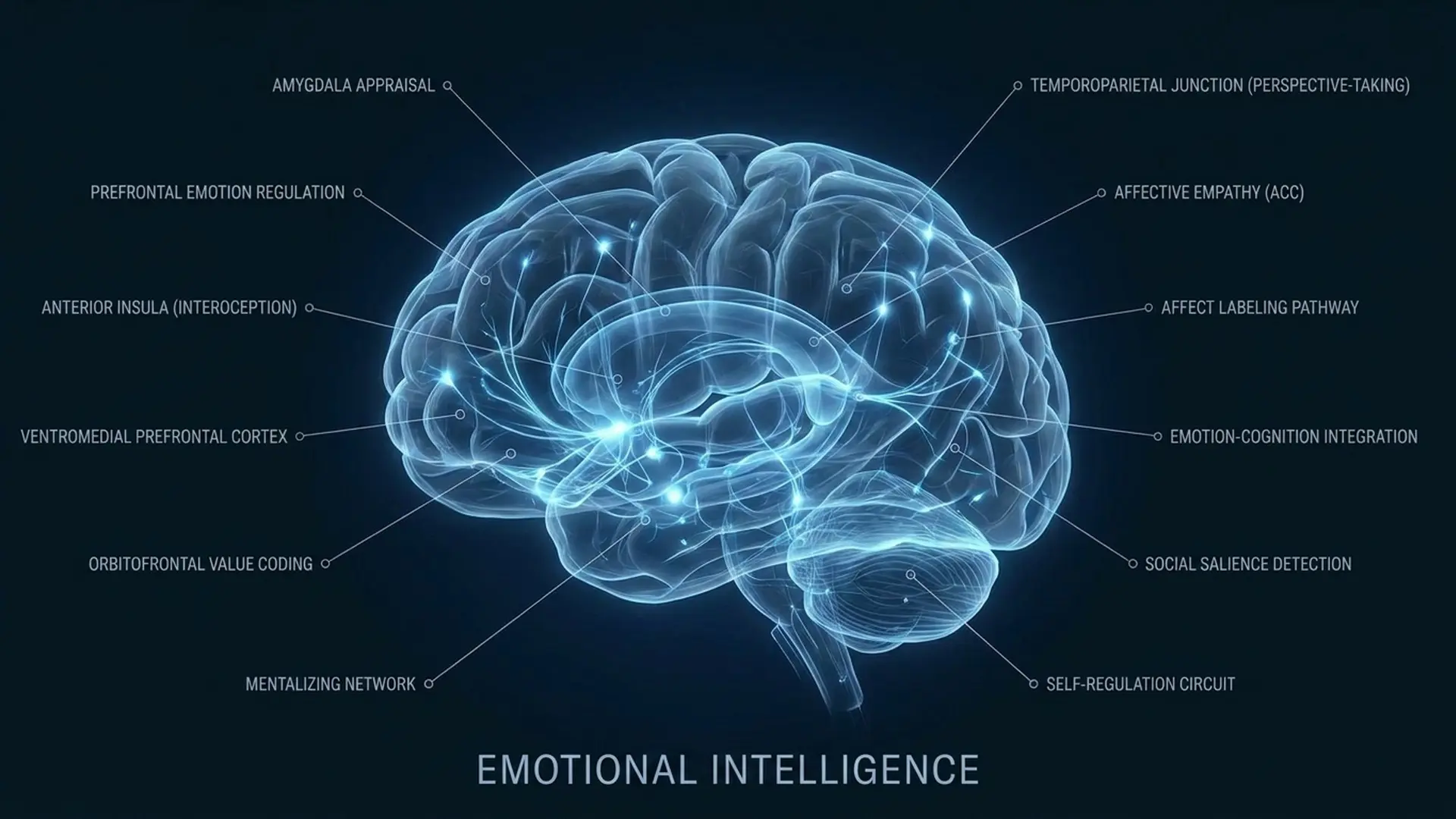
Interoception is the brain’s capacity to sense and interpret signals from the body’s interior: heart rate, gut tension, respiratory rhythm, muscle contraction, temperature shifts. The primary neural structure responsible for integrating these signals is the anterior insula: a cortical region that functions as the brain’s internal surveillance system. The anterior insula receives visceral afferent signals from the body via the vagus nerve and the spinothalamic tract, constructs a moment-by-moment representation of the body’s physiological state, and makes that representation available to conscious awareness.
Research from A.D. (Bud) Craig at the Barrow Neurological Institute demonstrated that the anterior insula does not merely register body states: it generates the subjective feeling of those states. The felt sense of an emotion (the gut drop of dread, the chest expansion of confidence, the throat constriction of suppressed anger) is an interoceptive construction. Individuals with higher interoceptive accuracy (the measurable ability to detect their own heartbeat, for example) consistently demonstrate superior emotional perception, better decision-making under uncertainty, and more nuanced social cognition.
What I consistently observe is that individuals who describe themselves as emotionally intelligent but who struggle under pressure often have a specific interoceptive deficit: they can identify emotions retrospectively but cannot detect them in real time as they are building. The signal is there: the autonomic nervous system is producing it, but the anterior insula’s processing of that signal is either delayed or attenuated. The foundation of deeper self-awareness and interoceptive processing is what makes the difference between understanding your emotions after the fact and catching them as they form.
Emotion Perception: The Fusiform-Amygdala Reading Circuit
The first branch of the Mayer-Salovey-Caruso model, perceiving emotions in oneself and others, depends on a neural circuit that operates with remarkable speed and often without conscious awareness. Two structures anchor this circuit: the fusiform face area and the amygdala.
The fusiform face area, located in the fusiform gyrus of the temporal lobe, is specialized for processing facial configurations. It detects micro-expressions, fleeting facial movements lasting 40 to 200 milliseconds, that reveal emotional states the person displaying them may not even recognize in themselves. This structure processes faces holistically rather than feature-by-feature, which is why emotional perception from faces feels instantaneous and intuitive rather than analytical.
The amygdala operates in parallel, evaluating the emotional significance of perceived expressions before the visual cortex has completed detailed processing. Research from Ralph Adolphs at Caltech established the amygdala’s role in reading fear from faces. This rapid appraisal circuit is what allows emotionally perceptive individuals to “read a room” before they can articulate what they are sensing. The amygdala is not reading faces. It is reading threat-and-safety signatures embedded in facial muscle configurations, vocal prosody, and postural cues simultaneously.
The critical finding for emotional intelligence is that this perceptual circuit is not fixed. Perceptual sensitivity to emotional cues varies substantially across individuals, and those variations correlate with measurable differences in fusiform-amygdala functional connectivity. Individuals who grew up in environments requiring constant monitoring of caregiver emotional states often develop hyperacute perception, excellent at detecting emotion but prone to interpreting ambiguous signals as negative. Individuals who grew up in emotionally flat environments may show reduced perceptual acuity. Neither extreme represents optimal emotional intelligence. Optimal function requires calibrated perception: accurate detection without systematic bias.
Emotion Understanding: The Medial Prefrontal Architecture of Meaning
Detecting an emotion is not the same as understanding it. A person can accurately perceive that their colleague is angry without understanding why, what the anger signals about the situation’s trajectory, or how that anger will evolve over the next thirty seconds. This deeper comprehension, the third branch of the Mayer-Salovey-Caruso hierarchy, depends on a different neural architecture entirely.
Emotion understanding is primarily mediated by the medial prefrontal cortex (mPFC) and the temporal pole: structures that together form the brain’s system for constructing models of other minds. The mPFC generates predictions about others’ internal states based on contextual information, past experience, and real-time behavioral cues. The temporal pole contributes semantic knowledge about emotional concepts: the learned understanding that shame typically follows public failure, that grief comes in waves rather than linear stages, that expressed anger often masks underlying fear.
This is the dimension of emotional intelligence that separates genuine insight from pattern matching. Research from Rebecca Saxe’s laboratory at MIT on theory of mind demonstrated that the mPFC does not simply mirror others’ emotions. It constructs predictive models: simulations of what the other person is likely feeling, what they will feel next, and what response would most effectively address their actual state rather than their displayed state. This predictive modeling is what allows emotionally sophisticated individuals to respond to what someone needs rather than merely reacting to what they show.
In 26 years of working with high-performing individuals, I have found that this branch is the most commonly underdeveloped in people who are otherwise cognitively brilliant. They perceive emotions accurately. They regulate their own emotions effectively. But they lack the mPFC-temporal pole architecture for understanding emotional dynamics, which is why they are frequently surprised by others’ reactions, misjudge the emotional temperature of negotiations, or fail to anticipate how a decision will land emotionally with their team.
The Regulation Circuit: dlPFC-Amygdala Connectivity Is the Bottleneck
Emotion regulation, the fourth and most studied branch, is fundamentally a question of connectivity between the dorsolateral prefrontal cortex (dlPFC) and the amygdala. The strength, speed, and flexibility of this connection determines whether an individual can modulate emotional responses in real time or is subject to emotional reactions that override strategic thinking.
The dlPFC exerts top-down regulatory influence on the amygdala indirectly: its output reaches the amygdala by way of the ventromedial prefrontal cortex (vmPFC) and the anterior cingulate cortex rather than through any direct tract. One mode of that influence provides rapid suppression of amygdala-driven emotional responses, useful when an immediate emotional reaction would be counterproductive. The other, slower mode provides more nuanced modulation: not suppressing the emotion, but recontextualizing it. This slower mode is the neural substrate of what researchers call cognitive reappraisal: the ability to change the meaning of a situation and thereby change the emotional response to it.
Kevin Ochsner’s work at Columbia University demonstrated that cognitive reappraisal produces measurable changes in amygdala activation within seconds. People who reappraise habitually show lower amygdala reactivity to negative material, alongside greater prefrontal engagement. The circuit strengthens with use. This is neuroplasticity operating in the regulation domain: the more effectively and consistently the prefrontal cortex modulates the amygdala, the more robust the connection becomes, and the more effortless regulation feels.
What the research does not adequately capture, and what I see repeatedly in practice, is that dlPFC-amygdala connectivity degrades under specific conditions: sleep deprivation, chronic stress, cognitive overload, and sustained threat exposure. An individual who demonstrates excellent emotional regulation at baseline can show dramatically impaired regulation when these conditions are present. This is not a character failure. It is a circuit operating beyond its capacity. The prefrontal cortex is metabolically expensive to run, and under resource depletion, the amygdala’s direct influence on behavior increases because the regulatory circuit cannot maintain its modulatory function.
Why Emotional Intelligence Tests Measure Performance, Not Capacity
A significant misunderstanding in how emotional intelligence is assessed involves the confusion between current performance and neural capacity. Standard EI assessments, including the MSCEIT (Mayer-Salovey-Caruso Emotional Intelligence Test), measure how an individual performs on emotion-related tasks at a single point in time, under controlled conditions, with adequate cognitive resources available. They do not measure the underlying neural architecture that determines performance across varying conditions.
This distinction has profound implications. An individual can score highly on an EI assessment administered in a calm, resourced state and yet demonstrate poor emotional intelligence under the conditions where it actually matters: during conflict, under time pressure, in situations involving genuine personal stakes. The test measured their ceiling. Their real-world performance reflects their floor: the level of emotional functioning their neural circuitry can sustain when prefrontal resources are depleted and the amygdala’s influence is elevated.
What matters for functional emotional intelligence is not peak capacity but sustained capacity under load. This depends on the robustness of the underlying neural connections, particularly the dlPFC-amygdala pathway and the anterior insula’s interoceptive processing speed, not on knowledge about emotions or the ability to perform well on a multiple-choice assessment about emotional scenarios. A person’s EI score tells you what they can do when conditions are optimal. Their behavior during their worst moments tells you what their neural architecture actually supports.
Emotional Intelligence Versus Empathy: Different Circuits, Different Functions
The conflation of emotional intelligence with empathy is one of the most persistent errors in popular psychology, and untangling the two is essential for understanding what genuine emotional intelligence requires at the neural level.
Empathy activates the brain’s mirror neuron system, primarily in the inferior frontal gyrus and the anterior insula, producing a simulation of another person’s emotional state within the observer’s own neural circuitry. When you wince watching someone stub their toe, that is the mirror system generating a shared representation of their pain. This capacity is automatic, often involuntary, and does not require any cognitive sophistication. It is a perceptual resonance, not a skill.
Emotional intelligence is something categorically different. It involves the controlled, strategic deployment of emotional information for adaptive purposes. Where empathy is automatic resonance, emotional intelligence is deliberate architecture: the capacity to detect emotional data (perception), integrate it into thinking (facilitation), model its dynamics (understanding), and modulate both one’s own and others’ emotional trajectories (management). Empathy provides the raw signal. Emotional intelligence determines what you do with it.
In practice, I frequently encounter individuals who are extraordinarily empathic yet have low functional emotional intelligence: they feel everything others feel but cannot use that information strategically, cannot regulate the resulting emotional load, and become overwhelmed or reactive precisely because their perceptual system is producing signal their regulatory and comprehension systems cannot process. Equally, I work with individuals whose empathic resonance is modest but whose emotional intelligence is exceptional: they detect emotional cues through analytical observation rather than visceral resonance, and they deploy that information with precision. The circuitry of emotional intelligence mastery at the neural level involves networks that extend well beyond what empathy alone engages.
Building Neural Emotional Intelligence Architecture
Dr. Sydney Ceruto’s approach to emotional intelligence operates from a principle that most EI development programs miss entirely: emotional intelligence is not a knowledge problem. It is a neural architecture problem. Reading about emotional intelligence, taking assessments, attending workshops: these activities increase knowledge. They do not restructure the circuits that determine real-time emotional functioning under pressure.
Building genuine emotional intelligence requires strengthening four specific neural systems: the anterior insula for interoceptive accuracy, the fusiform-amygdala circuit for calibrated emotion perception, the mPFC-temporal pole system for emotion understanding and prediction, and the dlPFC-amygdala pathway for flexible regulation. Each system has different restructuring requirements. Each responds to different conditions. A program that trains all four identically (or worse, trains only regulation while ignoring interoception, perception, and understanding) produces incomplete and fragile results.
Real-Time Neuroplasticity(TM) targets these circuits during the moments when they are active and therefore maximally plastic. The neuroscience of experience-dependent plasticity confirms that neural circuits restructure most efficiently when they are engaged under conditions that combine activation, prediction error, and emotional salience. Working on emotional intelligence in a calm, reflective setting trains calm-setting performance. Working on it during the live moments when it actually matters (during difficult conversations, high-stakes decisions, interpersonal ruptures) trains the circuits under the conditions where they must perform.
What I have observed across 26 years is that individuals who arrive with extensive self-knowledge about their emotional patterns but no change in those patterns are not lacking insight. They are lacking the neural infrastructure to convert insight into real-time capability. The difference between understanding your emotional patterns and having the neural architecture to operate differently in the moment those patterns activate is the difference between emotional intelligence as a concept and emotional intelligence as a lived neurological capacity.
The relationship between emotional intelligence and attachment styles and relational patterns further demonstrates that EI is not a standalone trait but an integrated neural system shaped by relational history and modifiable through targeted intervention.
If your emotional intelligence performs well in calm moments but deteriorates under the conditions that matter most (conflict, pressure, intimacy, leadership) the issue is not effort or knowledge. It is neural architecture. Schedule a strategy call with Dr. Ceruto to assess which circuits are limiting your real-time emotional functioning and what restructuring those circuits requires.