Transient Hypofrontality
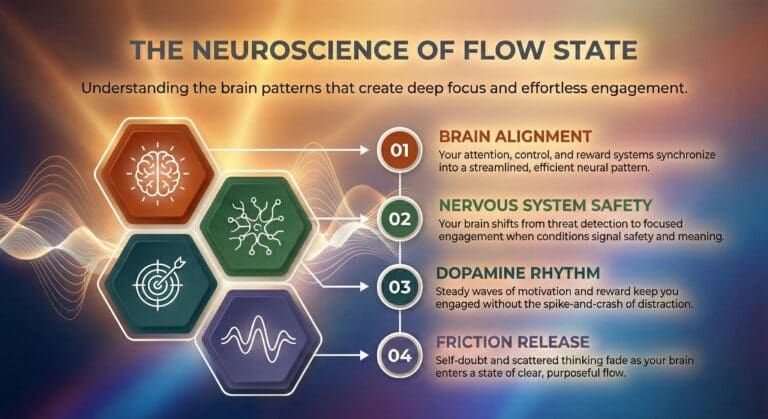
Flow is often described as a state of “super-consciousness,” but neurobiologically, it is actually a state of down-regulation. The primary mechanism is Transient Hypofrontality: the temporary deactivation of the Prefrontal Cortex (PFC). The PFC is responsible for complex planning, temporal processing, and the “inner critic.” When it shuts down, you lose the sense of self and time. This allows the brain’s implicit, automatic systems (like the Basal Ganglia) to execute high-skill tasks at maximum speed without the interference of conscious over-thinking.
The Neurochemical Cocktail
Flow is the only state in which the brain releases a potent cascade of five performance-enhancing neurochemicals simultaneously.
-
Norepinephrine & Dopamine: Tighten focus and enhance pattern recognition.
-
Anandamide: Promotes lateral thinking and novel connections.
-
Endorphins & Serotonin: Suppress pain and produce a feeling of well-being. This cocktail dramatically accelerates learning; some research suggests skill acquisition rates can spike 400-500% during flow states due to this chemical potentiation.
The Cycle of Performance
Flow is not a switch; it is a four-stage cycle. Most people fail to enter flow because they abort during the first stage.
-
Struggle: This phase is characterized by Beta brain waves and cortisol. It feels like agitation. This is not a sign of failure; it is the loading of data.
-
Release: To trigger flow, you must briefly step away from the problem (nitric oxide release) to allow the brain to switch gears.
-
Flow: The state itself, characterized by Theta/Gamma waves.
-
Recovery: The drop-off. You must actively recover serotonin levels, or you risk “burnout” before the next cycle.