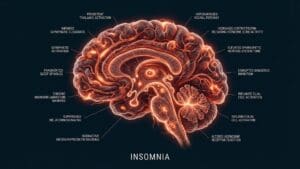
A failure of the “off switch.” We provide protocols to calm the hyper-aroused brain, regulate body temperature, and re-establish healthy sleep architecture.
Executive Neuro-Brief
The Evolutionary Design
Your ancestors lived in a dangerous world. A sleeping human was an easy target for predators. Your brain developed a hyper-arousal system to keep you safe. When it sensed a threat, it flooded your body with cortisol. This kept you awake and alert. It was a survival mechanism. It ensured you could react instantly to a snapping twig or a shadow. Nature built this to keep you alive during short periods of high risk.
The Modern Analogy
Insomnia is like having a brain that refuses to turn off the lights in the house at night, wandering from room to room when everything needs rest. The master switch is jammed. You want to sleep, but the lights blaze in the kitchen and the living room. Your mind paces the hallways. It checks the locks over and over. It looks for problems that do not exist. The house burns through electricity while the grid is supposed to be offline. This leaves the structure weak and the battery empty for the next day.
The Upgrade Protocol
You need to fix the wiring. You cannot force the darkness. You must install a dimmer switch. Create a routine that signals safety to the control center. Lower the temperature and remove blue light. Walk through the mental house and gently flip the switches down one by one. Convince the guard dog that the perimeter is secure. Once the brain stops pacing the halls, the lights will fade. The house will finally go quiet.
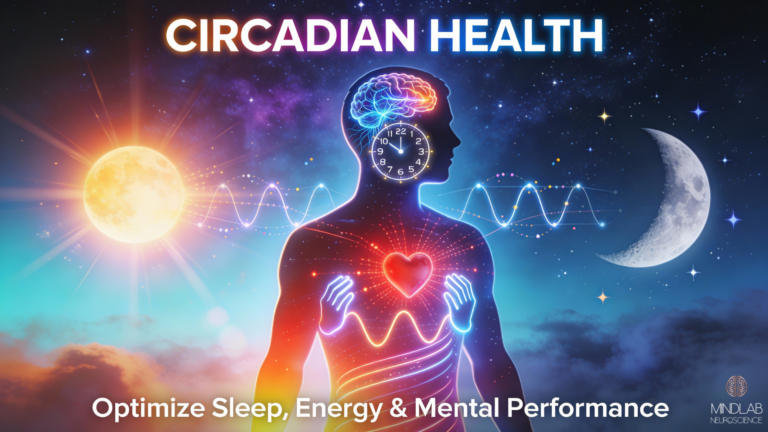
Why do energy levels crash and sleep patterns falter? The answer often lies in your circadian health. Discover the science behind your body’s internal clock and learn actionable strategies to synchronize...
Insomnia is often a state of Hyperarousal. The brain’s “wake drive” (controlled by cortisol and orexin) fails to power down, overpowering the “sleep drive” (adenosine and melatonin). It is not that you cannot sleep; it is that your brain believes it is not safe to sleep.
The Psychophysiological Loop
Insomnia feeds on itself. One bad night creates “sleep anxiety” about the next night.
Conditioned Arousal: The bed becomes a trigger for wakefulness and frustration rather than rest. The brain learns: “Bed = Thinking/Worrying.”
Thermal Regulation: Sleep requires a drop in core body temperature. Chronic stress keeps blood in the core, preventing the temperature drop necessary for sleep onset.
Sleep Architecture Repair
Restoring sleep requires behavioral consistency.
Stimulus Control: If you can’t sleep after 20 minutes, get out of bed. Break the association between bed and being awake.
Morning Light: Viewing sunlight within 30 minutes of waking anchors your circadian rhythm, building the “sleep pressure” you need for the following night.
The Intelligence Brief
Neuroscience-backed analysis on how your brain drives what you feel, what you choose, and what you can’t seem to change — direct from Dr. Ceruto.