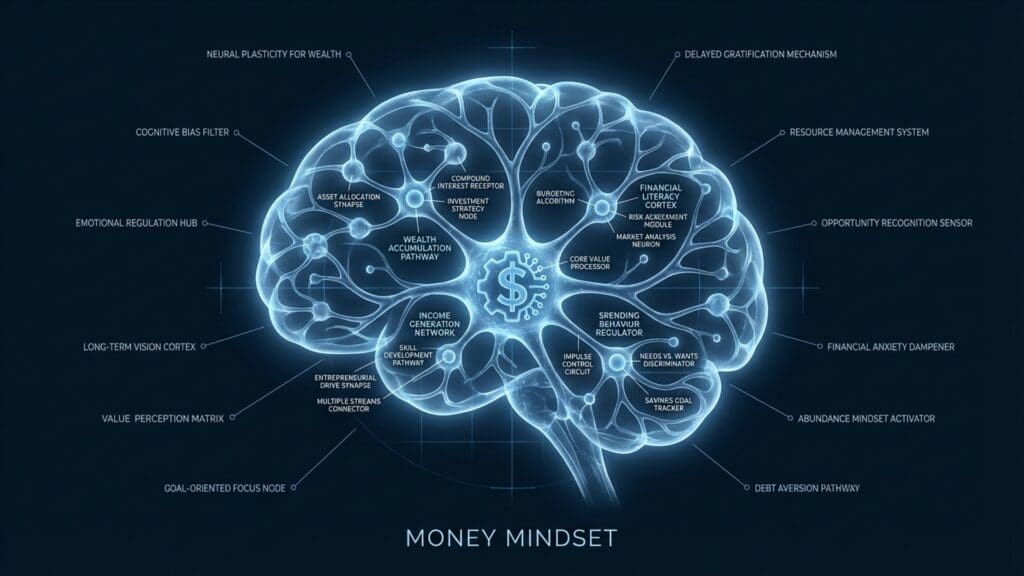
The subconscious scripts driving your finances. Identify and rewrite the limiting beliefs that cap your earning potential and financial growth.
Executive Neuro-Brief
The Evolutionary Design
Your brain is wired to survive. It constantly scans the environment for resources like food and shelter. Today, money represents those resources. Nature built a system to detect scarcity. When supplies ran low, your ancestors felt fear. This fear forced them to hoard and protect what they had. The brain treats a lack of money like a physical threat to your life.
The Modern Analogy
Money mindset is like the lens of a camera—if it’s smudged with fear or scarcity, it distorts everything you see about earning and spending. A dirty lens ruins a beautiful picture. You look at the world and see only problems. The opportunities are right there, but the smudge blocks the light. Your brain filters out the positive options. You focus on the dirt instead of the subject. The view becomes dark and blurry.
The Upgrade Protocol
You must wipe the lens clean. You do this by challenging your old automatic thoughts. Remove the grime of fear. When the glass is clear, the light gets in. You can finally focus on the opportunities in front of you. The picture becomes sharp. You stop looking at the distortion and start seeing the potential for growth. A clear lens captures the true value of the moment.
Financial decisions aren’t just about numbers—they’re about understanding the hidden forces in your brain that shape every choice you make. Discover how neuroscience helps you overcome biases, master emotional...
Discover the neuroscience behind true wealth and learn how to cultivate abundance in all areas of life. This insightful exploration goes beyond financial riches to reveal the multifaceted nature of a truly...
Money is rarely just about math; it is about emotion. “Money Mindset” refers to the subconscious beliefs and neural pathways that dictate how you earn, save, and spend. These scripts are often formed in childhood and operate in the background, influencing financial behavior before the logical brain even gets involved.
Scarcity vs. Abundance Neural Loops
Your financial reality is often a reflection of your Reticular Activating System (RAS).
Scarcity Mode: If your brain is primed for scarcity (fear), the amygdala remains hyper-active. You essentially develop “tunnel vision,” focusing only on immediate threats and bills, blinding you to long-term opportunities or investments.
Abundance Mode: This is not magic; it is cognitive openness. A relaxed nervous system allows the Prefrontal Cortex to engage in abstract planning and risk assessment, which are required for wealth accumulation.
Rewiring Financial Trauma
Many people suffer from financial trauma—a chronic stress response triggered by checking a bank account or discussing money.
The “Upper Limit” Breach: When you earn more than your subconscious believes you deserve, the brain may self-sabotage (unexpected spending) to return to a familiar baseline.
Desensitization: To fix this, you must normalize wealth. Exposure to financial literacy and successful peers rewires the brain to view money as a tool (neutral) rather than a threat (negative).
The Intelligence Brief
Neuroscience-backed analysis on how your brain drives what you feel, what you choose, and what you can’t seem to change — direct from Dr. Ceruto.