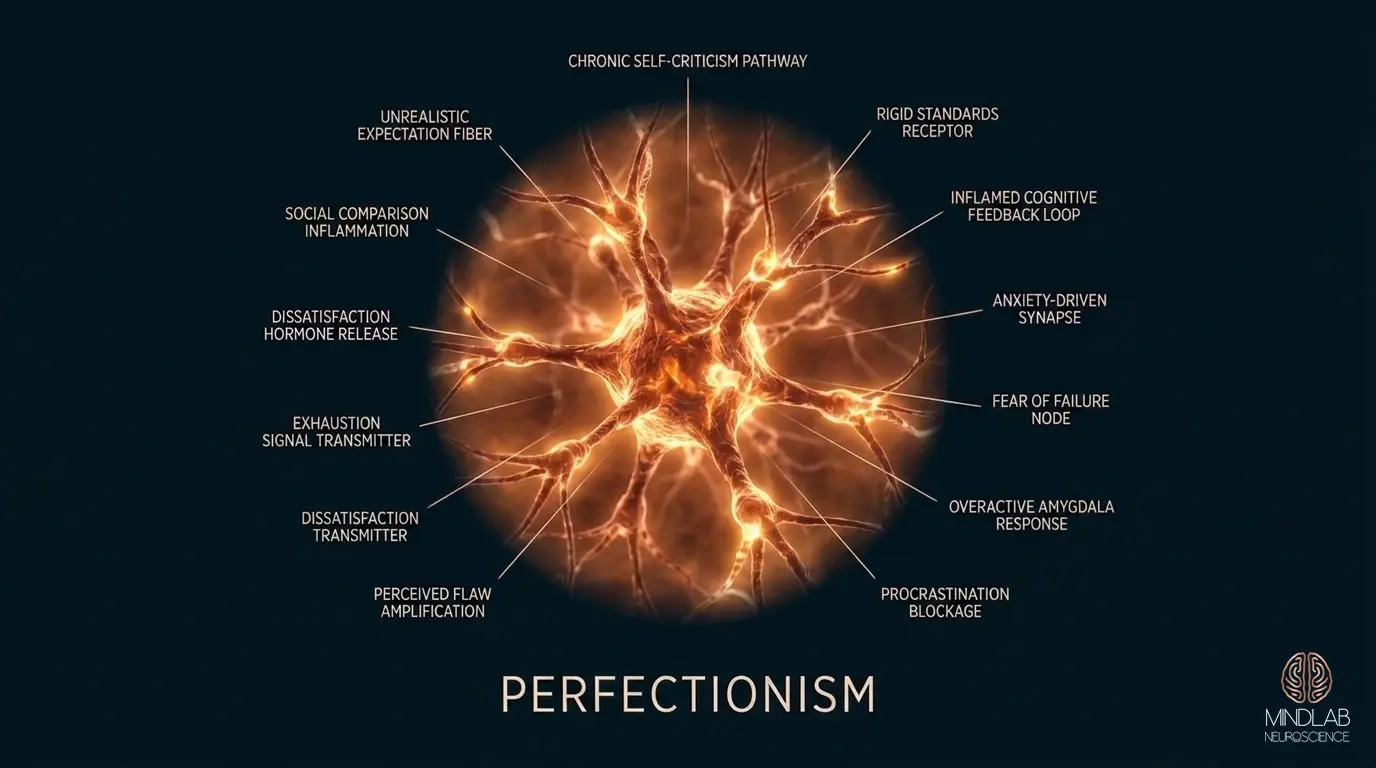
Few neural patterns are as quietly destructive as perfectionism. On the surface it looks like high standards and relentless ambition, yet underneath it operates as a prediction-error sensitivity loop that hijacks the brain’s own quality-control circuitry. In 26 years of working with individuals who function at the highest levels of business, medicine, and creative performance, I have watched perfectionism erode the very outcomes it promises to protect. What neuroscience now reveals, and what I observe in real time in this work, is that perfectionism is not a personality trait. It is a measurable miscalibration in the circuits responsible for detecting mistakes, assigning value to outcomes, and regulating the stress response that follows both.
The Error-Detection Engine: How the Anterior Cingulate Cortex Drives Perfectionism
Every brain contains an error-monitoring system anchored in the anterior cingulate cortex, commonly abbreviated as the ACC. This region sits at the medial surface of the frontal lobes and functions like an internal auditor: it compares what you expected to happen against what actually happened, then flags any discrepancy. In a well-calibrated brain, the ACC fires proportionally: small errors produce small signals, and large errors produce appropriately larger ones. In the perfectionist brain, this proportionality breaks down.
What I consistently observe in individuals trapped in perfectionism is ACC hyperactivation even when the mismatch between expectation and outcome is trivial. A minor grammatical slip in a presentation draft triggers the same magnitude of neural alarm as a consequential strategic error. The brain, in effect, has lost its ability to rank-order mistakes. Every deviation from an internal ideal registers as equally catastrophic, producing a constant stream of error-related negativity (ERN) waveforms that keep the nervous system locked in vigilance.
This hyperactive error detection does not make people more accurate. It makes them slower, more hesitant, and increasingly prone to the kind of overthinking and rumination patterns that consume working-memory bandwidth without improving the quality of decisions.
The Prefrontal Monitoring Trap: When Executive Control Works Against You
The ACC does not operate alone. It works in tight coordination with the dorsolateral prefrontal cortex (dlPFC), the region most associated with executive function, strategic planning, and top-down cognitive control. In healthy performance, the dlPFC receives an error signal from the ACC, evaluates its significance, and either initiates a correction or dismisses the signal as irrelevant. This is the neural basis of adaptive striving: the ability to notice a mistake, learn from it, and move forward.
In perfectionism, the dlPFC becomes an accomplice rather than a moderator. Instead of filtering ACC signals, it amplifies them. The prefrontal cortex begins devoting excessive monitoring resources to output quality, continuously scanning work product, social interactions, and even internal thoughts for flaws. This excessive prefrontal monitoring creates the subjective experience perfectionists describe so precisely: the relentless feeling that something is not quite right, that one more revision is needed, that releasing anything in its current state would be reckless.
What makes this pattern so insidious is that the dlPFC engagement gives perfectionism the appearance of conscientiousness. The individual feels as though they are being thorough, responsible, and detail-oriented. At the circuit level, however, they are burning through cognitive resources at an unsustainable rate, leaving less capacity available for creative problem-solving, strategic pivots, and the kind of cognitive flexibility and thought patterns that distinguish exceptional performers from merely competent ones.
The Cortisol Paradox: How Perfectionism Degrades the Performance It Seeks
Here lies the central paradox of perfectionism, and the one I spend the most time helping high-performers understand: the very neural strategy designed to ensure flawless output systematically degrades the brain’s capacity to produce it.
Chronic ACC hyperactivation and excessive dlPFC monitoring generate sustained cortisol release through activation of the hypothalamic-pituitary-adrenal axis (HPA axis). Cortisol, at moderate and time-limited levels, sharpens focus and supports memory consolidation. But when the error-detection system never turns off, cortisol levels remain elevated for hours, days, and eventually months. Prolonged glucocorticoid exposure produces a cascade of downstream effects that directly undermine the performance perfectionism was meant to protect.
First, elevated cortisol amplifies the excessive catecholamine signaling that impairs prefrontal synaptic plasticity, reducing the dlPFC’s ability to update strategies and shift between tasks. Second, it promotes dendritic atrophy in the hippocampus, weakening the memory consolidation processes that allow new learning to integrate with existing expertise. Third, and most critically for perfectionists in high-stakes roles, chronic cortisol exposure amplifies amygdala reactivity, making the emotional response to perceived failure progressively more intense over time.
The result is a neurochemical trap: the harder the perfectionist works to eliminate errors, the more their brain chemistry undermines the very cognitive architecture required for precision and innovation. In my practice, this is the inflection point where accomplished professionals begin to describe feeling as though they have “lost their edge”: a subjective experience that directly maps to measurable changes in prefrontal connectivity and stress-hormone regulation.
What compounds this problem is that perfectionists rarely attribute their declining performance to the perfectionism itself. The internal narrative typically shifts toward self-blame, concluding that they need to work harder, prepare more thoroughly, or raise their standards even further. Each intensification of the perfectionist strategy produces another incremental increase in stress load, accelerating the very prefrontal degradation the individual is desperately trying to compensate for. By the time most high-performers recognize the pattern, the neurochemical cycle has been running for years.
Adaptive Striving Versus Maladaptive Perfectionism: A Circuit-Level Distinction
Not all high standards are neurologically equivalent. Neuroscience draws a clear line between adaptive striving and maladaptive perfectionism, and the distinction is visible at the circuit level. Adaptive strivers show robust ACC activity paired with efficient dlPFC gating: the error signal fires, the prefrontal cortex evaluates it, and the system either corrects or moves on. The default mode network (DMN) remains accessible during rest periods, allowing for the kind of spontaneous insight and self-reflective processing that fuels creative breakthroughs.
Maladaptive perfectionists show a markedly different pattern. The ACC-dlPFC loop operates in a closed feedback cycle with minimal dampening. The DMN is suppressed even during nominal rest, because the monitoring system never fully disengages. Functional connectivity analyses reveal weakened communication between the prefrontal cortex and the ventral striatum, the region responsible for registering reward and satisfaction. This means that even when perfectionists achieve an excellent outcome, the neural reward signal is attenuated: the brain does not register the accomplishment as genuinely satisfying, which immediately triggers another cycle of effortful striving.
This disconnection between achievement and reward is one of the reasons perfectionism so frequently co-occurs with imposter syndrome. When the striatal reward circuit fails to validate accomplishments, the brain interprets success as accidental rather than earned, reinforcing the belief that even greater vigilance is required to maintain one’s position.
How High-Performers Get Trapped: The Reinforcement Architecture of Perfectionism
Understanding why intelligent, self-aware individuals remain stuck in perfectionist loops requires examining the reinforcement learning dynamics that sustain them. The brain’s dopaminergic projection system, particularly the mesocortical pathway running from the ventral tegmental area to the prefrontal cortex, assigns motivational value to behaviors based on their predicted outcomes. When a perfectionist revises a document for the fifth time and the final version is well received, the dopamine system encodes the entire sequence of excessive revision as the causal factor in the positive outcome.
This creates a powerful superstitious reinforcement pattern: the brain learns that agonizing over details leads to success, even though the marginal improvement from revision three to revision five may have been negligible. Over months and years, this reinforcement architecture becomes deeply entrenched. The perfectionist cannot distinguish between the effort that genuinely improved the work and the effort that merely served the error-detection compulsion, because the dopamine signal treats the entire behavioral chain as a unit.
In individuals who occupy leadership and executive performance roles, this reinforcement pattern carries additional weight. Early career success, often achieved through genuine talent compounded by intense effort, creates a narrative in which perfectionism is credited as the engine of achievement. By the time the neurochemical costs become apparent, the behavioral pattern has been reinforced by thousands of positive outcome pairings and is extraordinarily resistant to change through insight alone.
Neural Recalibration: Resetting the Error-Detection Threshold
Because perfectionism is rooted in measurable circuit-level dysfunction rather than a character flaw or a simple habit, addressing it requires intervention at the level of neural architecture. This is the foundation of my Real-Time Neuroplasticity™ (RTN™) methodology: a protocol-driven approach that works in real time to identify the specific calibration errors in each individual’s ACC-dlPFC-striatal circuitry and then systematically recalibrate them.
The process begins with comprehensive brain mapping to establish a precise baseline: where is the ACC hyperactivation most pronounced? How efficiently is the dlPFC gating error signals? What is the functional connectivity strength between the prefrontal cortex and the ventral striatum? These are not abstract questions: they produce quantifiable metrics that guide every subsequent step of the recalibration process.
From there, the work focuses on three neural targets simultaneously. First, reducing ERN amplitude in the ACC to restore proportional error signaling: teaching the brain, at the circuit level, to distinguish between consequential mistakes and trivial deviations. Second, strengthening dlPFC gating efficiency so that the prefrontal cortex resumes its role as a filter rather than an amplifier. Third, restoring striatal reward sensitivity so that genuine accomplishments register as satisfying, breaking the cycle in which no outcome ever feels adequate.
What makes this approach distinct from conventional strategies is its specificity. Rather than applying generalized stress-reduction techniques and hoping the perfectionism resolves indirectly, neural recalibration addresses the exact circuits maintaining the pattern. In my practice, individuals typically begin to notice measurable shifts in their error-detection reactivity within the first several weeks, not because they have learned to tolerate imperfection intellectually, but because the underlying neural firing patterns have been restructured.
The Downstream Architecture: What Changes When Perfectionism Releases
When the ACC-dlPFC loop recalibrates, the downstream effects extend far beyond reduced anxiety about mistakes. Individuals consistently report improvements across multiple performance domains that they had not initially connected to their perfectionism. Decision-making speed increases as the prefrontal cortex stops subjecting every choice to exhaustive error-checking. Creative output improves as the DMN regains access during rest periods, allowing for the incubation processing that produces novel solutions. Interpersonal dynamics shift as the perfectionistic monitoring that individuals had been applying to colleagues and direct reports relaxes, creating space for the trust and delegation that effective leadership requires.
Perhaps most significantly, sleep architecture often improves substantially. The hyperactive ACC-dlPFC monitoring system that drives perfectionism during waking hours does not simply shut off at night. It persists into the sleep-onset period, generating the racing, evaluative thoughts that perfectionists characterize as an inability to “turn off” their brains. As the error-detection threshold resets to appropriate levels, the transition from waking to sleep becomes more efficient, and the slow-wave sleep stages critical for memory consolidation and neural repair begin to normalize.
The individuals I work with frequently describe this phase as feeling like they have recovered a version of themselves they had forgotten existed: a version that could produce excellent work without the punishing internal surveillance that had become their default operating mode.
Moving From Insight to Neural Change
If the patterns described here resonate with your experience (if you recognize the relentless error monitoring, the inability to feel satisfied with objectively strong outcomes, the progressive erosion of creative confidence beneath a surface of apparent high performance) it is worth understanding that insight alone rarely resolves perfectionism. The circuits maintaining this pattern were built through years of reinforcement, and they require targeted, neurologically informed intervention to restructure.
The first step is always a comprehensive assessment: mapping the specific neural signatures that sustain your particular version of perfectionism and identifying the precise recalibration targets that will produce the most meaningful change. If you are ready to understand what is happening in your brain and begin the process of resetting it, I invite you to schedule a strategy call with Dr. Ceruto to discuss how a personalized neural recalibration protocol would apply to your situation.