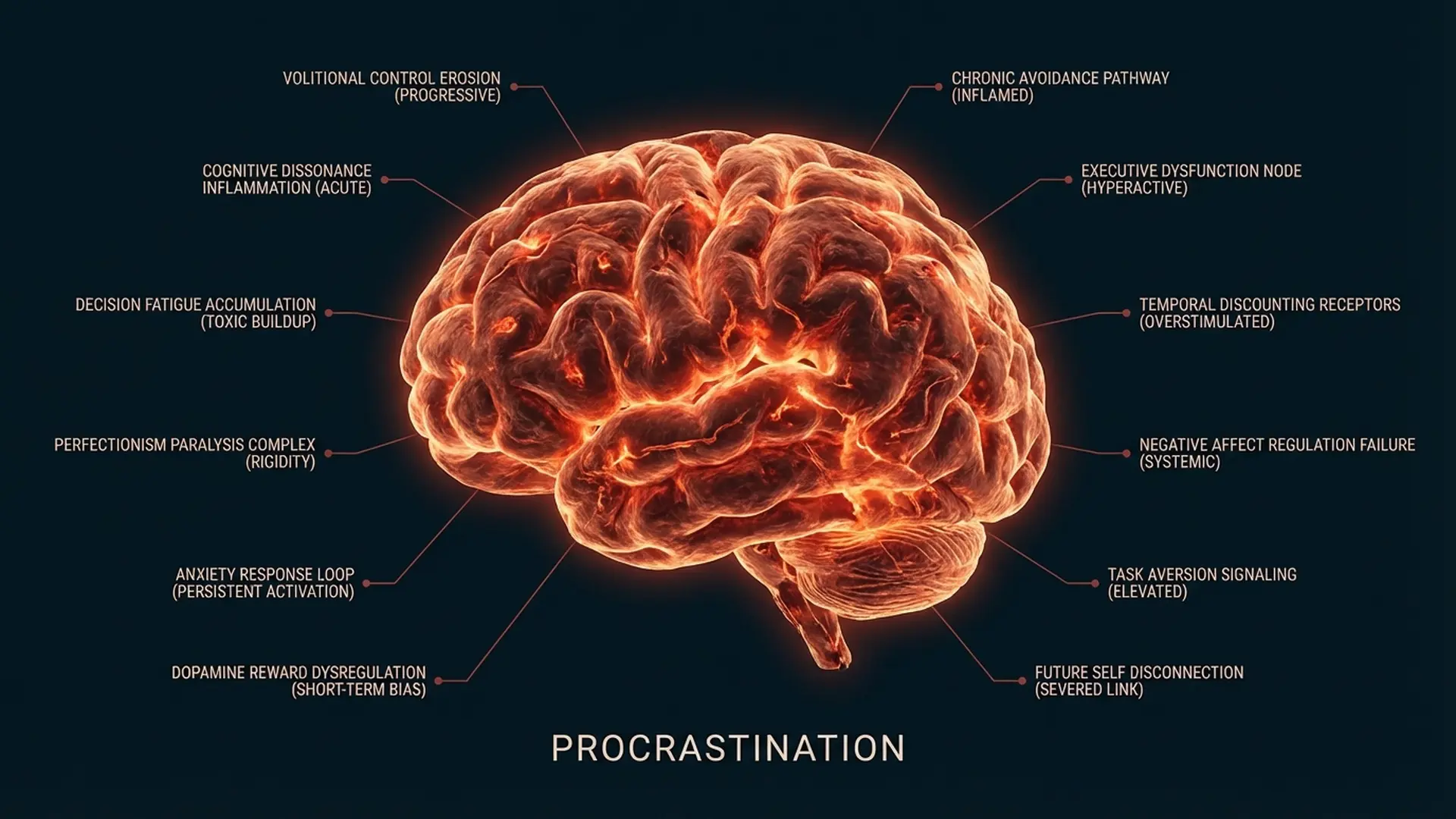
The Neuroscience of Procrastination: Why Your Brain Isn’t Broken
Procrastination is one of the most misunderstood phenomena in behavioral neuroscience. For decades, it was filed under moral failure: a character flaw belonging to the undisciplined and the lazy. That framing is not just inaccurate; it actively prevents people from making any meaningful change. When you believe procrastination is a willpower problem, you apply willpower solutions. You set more alarms, make stricter schedules, shame yourself harder. None of it works, because you are applying pressure to the wrong system.
What neuroscience has revealed over the past two decades is that procrastination is a neural computation problem. Your brain is not refusing to work. It is working exactly as designed, running a continuous cost-benefit analysis and concluding, moment by moment, that beginning the task in front of you is not worth the effort required. That calculation is happening below the threshold of conscious awareness, and it is being driven by systems that evolved long before the concept of a deadline existed.
Understanding this distinction is where productive change becomes possible. The goal is not to override your brain through sheer force. The goal is to change the inputs of the computation so the output changes on its own.
The Brain’s Effort-Cost vs. Reward Prediction Engine
Every voluntary action you take is preceded by a rapid neural assessment of effort cost against predicted reward. This is not metaphorical: it is a literal computational process occurring in overlapping circuits spanning the anterior cingulate cortex, the ventral striatum, and the prefrontal cortex: the same working memory and mental clarity architecture that governs all executive function. Neuroimaging studies consistently show that these regions activate in sequence before a person either initiates or avoids a difficult task.
When the predicted reward exceeds the computed effort cost, the system generates motivational drive and action follows. When effort cost is computed as too high relative to the expected payoff, the system suppresses initiation. This is where procrastination lives, not in a failure of willpower, but in an unfavorable ratio inside a neural ledger you cannot directly read.
The critical insight is that this computation can be influenced. The effort-cost side of the equation is not fixed. It is built from past experience, current physiological state, emotional valence associated with the task, and the perceived clarity of the path forward. Each of these variables is malleable. What makes procrastination so persistent is that most people never address any of them: they simply pile pressure onto the reward side by adding external consequences, which only raises the emotional stakes without touching the underlying computation.
Why the Effort-Cost Calculation Runs Hot
Tasks associated with procrastination tend to share a specific neural signature. They are perceived as effortful, ambiguous, or emotionally charged, and often all three simultaneously. Ambiguity alone dramatically inflates the effort-cost computation because the brain cannot generate a reliable prediction of what completing the task will actually require. Uncertainty is metabolically expensive for a prediction-based system. When the brain cannot model the task clearly, it assigns a high effort-cost by default as a conservative estimate.
This is why people frequently procrastinate on large, complex projects while easily completing smaller, clearly defined ones. It is not that the complex project is more important or more feared. It is that the brain genuinely cannot compute its cost with confidence, and so it defaults to avoidance until more information is available, which it never seeks, because avoidance perpetuates the cycle.
The Amygdala-Prefrontal Conflict at the Root of Procrastination
Procrastination is also, at its core, a conflict between two competing neural systems operating on different timescales and with fundamentally different priorities. The prefrontal cortex (the seat of planning, future orientation, and goal-directed behavior) is capable of representing abstract future outcomes and adjusting present behavior in service of them. The amygdala operates on an entirely different logic: it processes immediate emotional salience, threat signals, and past associations with pain or failure.
When a task carries any emotional charge (anxiety about performance, memories of past failure, fear of judgment, uncertainty about the outcome) the amygdala flags it as a threat-relevant stimulus. This triggers an avoidance impulse that competes directly with the prefrontal system’s directive to begin. The amygdala does not care about your quarterly goals. It cares whether the thing in front of you feels safe to approach right now.
In individuals with high cognitive capacity and high achievement drive, this conflict is often amplified rather than reduced. High performers frequently have stronger prefrontal representations of future consequences, which means they also have more material for the amygdala to work with. The clearer your vision of what’s at stake if you fail, the stronger the threat signal. This is one reason why intelligent, ambitious people are not immune to procrastination. In many cases, their neural architecture makes them more susceptible to it on high-stakes work.
The Feedback Loop That Keeps Procrastination Running
When avoidance succeeds, when you delay the task and the immediate anxiety subsides, the amygdala records a reinforcement signal. Avoidance worked. The discomfort resolved. This is not a conscious process, but it is a real one, and it strengthens the avoidance circuit with each iteration. Over time, procrastination stops being a response to any specific task and becomes a trained neural default: the pathway the brain takes whenever it detects a certain class of effortful or emotionally loaded work.
This is why procrastination tends to get worse over time without deliberate intervention, and why behavioral tricks that produce short-term action often fail to produce durable change. The underlying circuit has been trained. Addressing it requires working at the level of the circuit, not the behavior.
Temporal Discounting: Why Your Future Self Doesn’t Feel Real
One of the most consistent findings in behavioral neuroscience is that the brain systematically devalues future rewards relative to immediate ones: a phenomenon called temporal discounting. The further away a reward is in time, the less motivational weight it carries in the present moment. This is not irrationality. It is a feature of a system that evolved in an environment where delayed rewards were genuinely uncertain and immediate ones were not.
Procrastination exploits this architecture directly. The reward for completing a difficult project (the grade, the promotion, the finished manuscript) exists in the future. The relief of not beginning it exists right now. From the brain’s computational perspective, immediate relief consistently outweighs future reward unless specific conditions are met that allow the future to feel more present and more real.
Neuroimaging studies have shown that when people think about their future selves, the brain activates patterns more similar to thinking about a stranger than thinking about their current self. The future person who will benefit from your present effort is, neurologically speaking, not fully you. This is not a metaphor. It is a measurable difference in self-referential processing, and it goes a long way toward explaining why even highly motivated people struggle to act in the interest of their future selves consistently.
Collapsing the Temporal Gap
The practical implication of temporal discounting is that reducing procrastination requires making future consequences feel more immediate and more self-relevant, not just more intellectually understood. You can know with complete certainty that a deadline is real and still fail to generate the motivational drive to act on it, because knowing and feeling are processed by different systems. The prefrontal cortex handles the knowing. The limbic system handles the feeling that drives action.
Interventions that work on procrastination tend to do so by either collapsing the perceived time horizon, making the future feel present, or by increasing the reward signal associated with the immediate act of beginning, rather than the distal act of completing. These are not the same thing, and conflating them is one of the most common errors in self-management approaches to procrastination.
The Dopamine Prediction Error and Why Some Tasks Never Generate Momentum
The role of dopamine and motivational drive in procrastination is more specific than most people realize. The popular conception of dopamine as a reward chemical is incomplete. Dopamine neurons fire most strongly not in response to receiving a reward, but in response to a prediction that a reward is coming. This anticipatory dopamine signal is what generates motivational drive: the pull toward a task before any reward has been received.
For procrastination-prone tasks, this signal is typically weak or absent. If the brain has no confident prediction of a rewarding outcome, or if past experience has associated the task with frustration and difficulty rather than satisfaction, the anticipatory dopamine signal does not fire with sufficient strength to drive initiation. The task never generates its own momentum because momentum requires anticipatory dopamine, and anticipatory dopamine requires a credible reward prediction.
This explains a pattern that confuses many high-performing individuals: they procrastinate specifically on tasks that are most important to them, while easily completing work that is objectively less valuable. The high-stakes task carries uncertainty, past associations with difficulty, and elevated emotional charge. The lower-stakes task has a clear path, a predictable outcome, and no threatening consequences for imperfect performance. The dopamine signal for the easy task fires reliably. For the important task, it is suppressed.
When High Performers Hit the Cognitive Bandwidth Wall
High-performing individuals carry a specific additional burden in the neuroscience of procrastination: cognitive bandwidth allocation. The prefrontal cortex has finite processing capacity: a constraint explored across the science of attention, focus, and cognitive resource management. When it is already engaged managing complex responsibilities, long-horizon planning, interpersonal dynamics, or ongoing high-stakes decisions, its capacity to initiate new effortful tasks is genuinely reduced, not as an excuse, but as a neurobiological reality.
Procrastination that emerges at the intersection of peak performance and peak cognitive load is frequently misread as avoidance of the task itself. In many cases, it is more accurately understood as the brain’s resource management system protecting existing cognitive investments by refusing to initiate something new that would compete for limited prefrontal resources. The task isn’t the problem. The allocation problem is the problem.
This distinction matters enormously in practice. Pushing harder into a bandwidth-depleted prefrontal system produces diminishing returns and accelerating avoidance. Addressing the allocation problem (through structure, sequencing, and deliberate cognitive recovery) produces more durable access to initiation capacity.
Rewiring the Effort-Cost Computation: Dr. Ceruto’s Approach
The question that matters is not why procrastination occurs: the neuroscience answers that clearly. The question is what can be done about it at the level of the neural systems that drive it. Dr. Ceruto’s approach works directly on the effort-cost computation by targeting the specific variables that inflate perceived effort cost and suppress anticipatory dopamine.
The first principle is precision over volume. Rather than generating motivation to complete an entire project, the work focuses on generating a clear, specific neural representation of the very next action: one small enough that the brain can compute its effort cost with confidence. Ambiguity, as established above, is a major driver of inflated effort-cost. Collapsing the task to its next concrete step removes the ambiguity signal and makes initiation computationally cheap.
The second principle is working directly with the amygdala’s threat signal rather than suppressing or overriding it. When a task carries emotional charge, attempting to push through via executive override tends to fail because the amygdala’s signal does not diminish under pressure: it often intensifies. The approach involves changing the emotional valence associated with the task by intervening at the level of the association itself, not at the level of behavior.
The third principle addresses the dopamine prediction error by creating reliable, credible reward signals in the near term. This is not about external rewards or incentive structures. It is about restructuring the task environment so that the brain can generate confident predictions about what beginning will feel like and what completing a small unit of work will produce. Predictability restores anticipatory dopamine. Anticipatory dopamine drives initiation. Initiation breaks the procrastination cycle.
The Role of Neural Recalibration in Sustained Change
Short-term behavioral changes in procrastination are achievable through environmental structuring and technique application. What they rarely produce is lasting change, because they do not address the trained neural circuits that generate procrastination as a default response. Lasting change requires what Dr. Ceruto describes as recalibration: a systematic process of updating the brain’s predictions about effort, reward, and self-efficacy associated with a specific class of work.
Recalibration works because the brain’s effort-cost computation is built on prediction, and predictions are updated through experience. When the experience of beginning and completing a task is repeatedly different from what the avoidance circuit predicted (less aversive, more rewarding, more within reach) the circuit updates. The update is not immediate, but it is cumulative, and with the right structure, it is self-reinforcing. Each successful initiation makes the next one computationally cheaper.
Procrastination is not a fixed trait. It is a trained neural pattern operating on outdated predictions. The work of changing it is the work of generating new data for the prediction system, and that work is entirely possible when it is approached with the right understanding of the mechanisms involved.
If procrastination has become a persistent barrier to your most important work, the patterns described here are exactly what a strategy call is designed to address. You can schedule a strategy call to explore what is driving the effort-cost computation in your specific case and what it would take to recalibrate it.