Key Takeaways
- Codependency is not loving too much: a nervous system pattern confusing self-erasure with connection.
- The brain encodes caretaking as the reward circuit: identity becomes contingent on being needed.
- Hyperactive mirror neurons + blurred self-other boundaries drive anticipation of partner’s needs.
- Intermittent reinforcement (dopamine) keeps people in harmful relationships.
- Recovery rebuilds the self-other boundary and shifts the reward circuit from external to internal validation.
The Codependent Tango: Are You Locked in an Unhealthy Dance?
Codependent relationships trap one partner in a self-erasing cycle of excessive caretaking, where personal identity erodes to sustain another person’s emotional needs. Research estimates codependency affects roughly 40 million Americans, with neuroimaging studies showing hyperactivated threat-detection circuits in codependent individuals. These patterns typically develop over years before partners recognize the dysfunction, a pattern examined across the neuroscience of relationship dynamics.
Codependency is a complex dance of two people locked in an unhealthy, imbalanced dynamic. One partner, the “giver” or “caretaker,” compulsively sacrifices their own needs, desires, and sense of self to cater to the other, the “taker.” The giver’s self-worth becomes tied to how much they’re needed, while the taker grows increasingly reliant on the giver to meet their every need, often avoiding personal responsibility.
In this toxic tango, boundaries blur, identities merge, and true intimacy is replaced by a suffocating enmeshment. The codependent couple becomes so intertwined that they lose sight of where one ends and the other begins, both parties displaying codependent traits.
But what causes someone to become codependent? How does this dysfunctional pattern take root in our brains and behavior? And most importantly, is there a way to break free from the chains of codependency and reclaim a healthy, fulfilling relationship – with both our partner and ourselves?
Buckle up as we dive into the neuroscience of codependency to answer these questions and chart a path toward recovery and transformation. Get ready to have your mind blown (and your relationship reborn)!
| Pattern | Neural Circuit | Protects Against | Hidden Cost |
|---|---|---|---|
| Anticipating partner’s needs | Hyperactive mirror neuron + threat monitoring | Partner’s displeasure | Loss of access to own needs |
| Unable to say no | Amygdala threat response to boundaries | Rejection or abandonment | Resentment accumulation |
| Responsible for partner’s emotions | Blurred self-other (medial PFC) | Chaos in attachment system | Emotional exhaustion |
| Staying despite harm | Intermittent reinforcement (dopamine) | The unknown | Normalized harm; self-abandonment |
| Identity from being needed | Reward circuit calibrated to caretaking | Worthlessness if not useful | Collapse when no longer needed |
What is Codependency?
Codependency involves an imbalanced relationship dynamic where one person, the “giver” or “caretaker”, compulsively sacrifices their own needs to care for the other, the “taker. The giver derives their sense of purpose and self-worth from being needed. Meanwhile, the taker learns to rely on the giver to meet all their needs and avoids taking responsibility for themselves.
Signs You May Be in a Codependent Relationship
- Constantly prioritizing your partner’s needs above your own
- Feeling responsible for your partner’s happiness and well-being
- Losing your sense of self and identity in the relationship
- Enabling your partner’s unhealthy behaviors
Characteristics of Co-Dependent Relationships
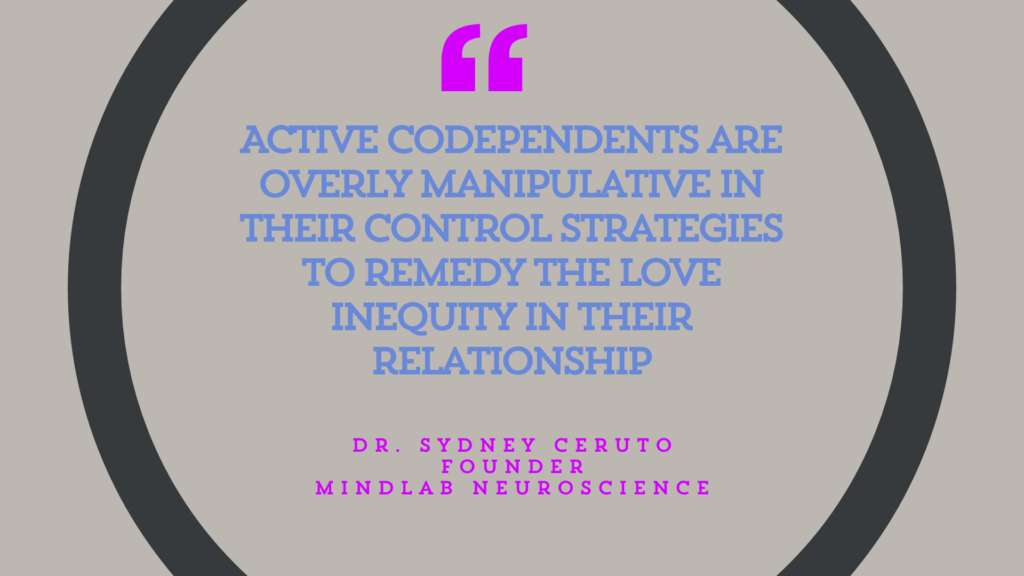
Codependent relationships activate measurable patterns of emotional dysregulation and self-abandonment in both partners. Researchers identify core behavioral signals including excessive caretaking, poor boundary maintenance, fear of abandonment, and suppressed personal identity. Studies estimate that codependency affects approximately 40 million adults in the United States, often rooted in early attachment disruptions and family-of-origin dysfunction.
- Difficulty making decisions without the other person’s input or approval
- Constantly seeking validation and approval from one’s partner
- Feeling responsible for the other person’s emotions and well-being
- Sacrificing personal interests, hobbies, and friendships to cater to the partner’s needs
- Enabling or making excuses for the partner’s unhealthy behaviors
These dynamics create a vicious cycle where the giver’s self-worth becomes dependent on the taker’s reliance on them. The taker, in turn, grows more demanding and less self-sufficient, perpetuating the imbalance.
Psychological and Emotional Impacts
Codependency takes a heavy toll on the mental health and psychological first aid principles and strategies of both partners. In professional practice at MindLAB Neuroscience, Dr. Ceruto observes these neural consequences repeatedly: the giver’s brain becomes so calibrated to the partner’s emotional state that it loses the ability to register its own needs. The giver often experiences:
- Low self-esteem and a poor sense of self
- Chronic anxiety and depression
- Feelings of guilt, shame, and inadequacy
- Difficulty expressing emotions and asserting boundaries
- Burnout from constantly prioritizing others’ needs
Meanwhile, the taker may struggle with:
- Arrested emotional development and maturity
- Irresponsibility and impulsivity
- Difficulty coping with stress and challenges independently
- Substance abuse or other addictive behaviors
These impacts highlight the urgency of addressing codependency and seeking support for recovery.
Causes and Contributing Factors
Codependency often has its roots in early family dynamics and childhood experiences. What Dr. Ceruto observes in her clients is that the neural architecture for codependency is typically laid down before age seven: the attachment system learns that love requires self-erasure, and the brain encodes this as a survival strategy. Some common contributing factors include:
- Growing up with a parent who was neuroscience strategies for emotional stability, addicted, or chronically ill
- Experiencing emotional, physical, or sexual abuse or neglect
- Being raised in a dysfunctional family system with rigid roles and rules
- Internalizing messages that one’s worth depends on pleasing or caretaking others
Certain personality traits such as low self-esteem, people-pleasing tendencies, and difficulty with assertiveness can also make individuals more susceptible to codependent patterns.
Recognizing these underlying causes is key to developing self-awareness and embarking on a journey of recovery and transformation.
Codependent Personality Pattern: When Codependency Becomes Pathological
In some cases, codependency can escalate into a more severe form known as codependent personality pattern (CDPP). While not an official classification in the DSM-5, CDPP is recognized by many mental health professionals as a cluster of traits that go beyond typical codependent behaviors.
Individuals with CDPP often exhibit:
- Extreme difficulty making decisions without others’ input
- Severe anxiety about being alone or abandoned
- Intense fear of rejection and criticism
- Chronic feelings of guilt and responsibility for others’ actions
- Unhealthy tolerance for mistreatment or abuse
CDPP stems from profound childhood trauma or attachment disruptions that deeply impact personality development. As a result, people with CDPP struggle to form a stable sense of self and rely on others to fill the void.
Addressing CDPP often involves long-term neuroscience-based practice to address the underlying trauma, challenge distorted beliefs, and build healthier coping and relationship skills. This pattern is examined in the brain science of lying exploring the neuroscience behind it.
If you suspect you or a loved one caught in limerence-driven codependency one may have CDPP, seeking professional support is crucial. With the right help, it is possible to overcome even the most entrenched patterns and reclaim a sense of self.

The Roots of Codependency
Codependency originates in childhood attachment disruptions, particularly when a caregiver was emotionally unavailable, addicted, or abusive. Research consistently identifies adverse childhood experiences as among the strongest predictors of codependency in adults. Early neglect rewires the prefrontal cortex and limbic system, conditioning children to suppress personal needs in order to maintain attachment bonds and avoid abandonment.
The Neuroscience of Codependency
Neuroscience sheds light on what’s happening in a codependent brain:
The Reward Center
fMRI studies show that the same reward centers that light up for drug addiction are activated when a codependent focuses on their partner. Caretaking floods the brain with feel-good hormones like dopamine and oxytocin. The codependent becomes addicted to being needed.
The Fear Center
Additionally, the amygdala, the brain’s fear center, goes into overdrive at the threat of conflict or disconnection from one’s partner. To avoid this distress, the giver will do anything to maintain the relationship, even at great personal cost. The taker exploits this, and the toxic cycle continues.
Comparison with Healthy Relationships
Healthy relationships operate through interdependence, not codependent enmeshment: a neurologically distinct state where both partners maintain autonomous identity while sustaining genuine connection. Research shows the brain’s reward circuitry measurably recalibrates during this transition, shifting dopaminergic activation away from validation-seeking toward authentic bonding. Interdependent relationships consistently display lower cortisol reactivity and stronger oxytocin-mediated trust responses than codependent partnerships.
- Open, honest communication and emotional expression
- Respect for each other’s boundaries, needs, and desires
- Shared decision-making and problem-solving
- Pursuing personal goals and interests outside the relationship
- Mutual trust, support, and empowerment
By understanding these differences, individuals can begin to envision and work toward building healthier, more fulfilling connections.
Rewiring the Codependent Brain
Rewiring codependent brain circuits requires deliberately engaging neuroplasticity: the brain’s capacity to form new neural pathways through repeated experience. Research indicates that consistent cognitive and behavioral interventions can produce measurable structural changes in the prefrontal cortex and limbic system over time, weakening maladaptive attachment patterns while strengthening healthier relational neuropathways.
Neuroscience-Based Techniques
Neuroscience-Based Techniques
Neuroscience-based techniques, including cognitive reframing and boundary setting, measurably alter brain function and structure to reduce co-dependent behaviors. Cognitive reframing strengthens prefrontal cortex activity, supporting emotional regulation over time with consistent practice. Boundary setting recalibrates limbic system responses, decreasing anxiety-driven attachment patterns documented across multiple neuroimaging studies.
- Changing Neuropathways: Engaging in activities that challenge existing thought patterns can help rewire the brain. By intentionally creating new, more advantageous neuropathways, individuals can shift from habitual co-dependent behaviors to healthier, more adaptive responses. This process involves actively seeking new perspectives and experiences that reinforce self-worth and autonomy.
- Cognitive Reframing: This technique involves altering negative beliefs and thought patterns. For example, changing the belief “I’m nothing without my partner” to “I’m a worthy individual” helps forge new neural networks. This shift in perspective encourages healthier self-esteem and independence, reducing reliance on others for validation.
- Boundary Setting: Learning to set and maintain personal boundaries teaches the amygdala, the brain’s center for emotional processing, that it’s safe to be independent. This practice reduces the fear and anxiety often associated with being alone and promotes a sense of security and self-reliance.
Neuroplasticity research indicates that with consistent practice, these techniques can weaken the neural circuits associated with co-dependent behaviors. Over time, individuals can develop new, empowered ways of relating to others, transforming their relationships from dependency to mutual respect and support.
Breaking Free from Codependency
Neuroplasticity enables people with codependent patterns to restructure the neural pathways maintaining those behaviors. Research indicates that consistent cognitive and behavioral practice can produce measurable changes in prefrontal cortex function over time. Recognizing the brain circuits sustaining codependency accelerates rewiring, giving individuals a concrete, neuroscience-based mechanism for building healthier relational boundaries.
Codependency is not loving too much. It is a nervous system that learned the only safe way to be in a relationship is to disappear into the other person’s needs. The love is real. The architecture sustaining it is a survival strategy that has outlived its context.
Real-Time Neuroplasticity™ intervenes in the live moment when the caretaking impulse fires at the expense of self-need, building new evidence that the relationship can survive your boundaries.
Is codependency a mental health condition?
Codependency is not a formal evaluative category in the DSM-5, but neuroimaging research reveals measurable neurological correlates including hyperactive attachment circuitry, underdeveloped self-other boundaries in the medial prefrontal cortex, and a reward system calibrated to external validation rather than internal self-worth. These brain-based markers distinguish codependency from typical relationship challenges.
Why is it so hard to leave a codependent relationship?
Leaving a codependent relationship activates attachment separation distress and identity crisis simultaneously because the brain constructed its reward, safety, and identity circuits around that specific relationship. The amygdala registers departure as a survival-level threat, flooding the body with cortisol and triggering intense anxiety that makes separation feel physically dangerous.
Can codependency be inherited?
Codependency is not inherited genetically, but the attachment patterns that produce codependent behavior are transmitted through early caregiving environments. Children internalize relational templates from primary caregivers, and these learned neural patterns span generations through attachment calibration rather than genetic inheritance, making family-of-origin awareness essential for recovery.
What is the difference between codependency and healthy interdependence?
Interdependence preserves an intact self-other boundary in the medial prefrontal cortex, allowing each partner to empathize without absorbing the other’s emotions. Codependency dissolves that boundary so the partner’s emotional state registers as indistinguishable from one’s own, creating chronic emotional fusion that undermines individual identity and autonomous decision-making capacity.
How long does recovery take?
Recovery from codependency typically unfolds in two phases. Phase one spans three to six months and focuses on rebuilding the self-other boundary through consistent boundary-setting practice. Phase two extends from six to eighteen months and targets rewiring the reward system from external validation dependence toward stable internal self-worth and autonomous emotional regulation.
How does codependency affect the brain’s stress response?
Codependency keeps the brain’s stress response system chronically activated, as a person’s sense of safety becomes tied to another person’s emotional state. This sustained cortisol elevation amplifies the catecholamine signaling that impairs decision-making, and it can reduce emotional regulation and reinforce the cycle of people-pleasing behavior.
Can codependent relationship patterns be durably changed?
Yes, neuroplasticity means the brain can form new neural pathways that support independent emotional regulation and secure attachment styles. Consistent practice of boundary-setting and self-awareness exercises strengthens these new patterns until they become the brain’s default response.
What are the first signs that codependency is affecting your mental well-being?
Early signs include persistent anxiety when you’re not in contact with a specific person and difficulty identifying your own needs separate from theirs. You may also notice chronic fatigue, resentment, or a pattern of neglecting your own goals to manage someone else’s emotions.
References
- Beattie, M. (1986). Codependent no more. Hazelden.
- Coan, J. A., et al. (2006). Social regulation of the neural response to threat. Psychological Science, 17(12), 1032-1039.
- Johnson, S. M. (2019). Attachment theory in practice. Guilford Press.
If the pattern described in this article has become your relational architecture, a strategy call with Dr. Ceruto maps the specific attachment and reward circuits driving the codependency pattern.
From Reading to Rewiring
Understand the neuroscience. Apply it to your life. Work directly with Dr. Ceruto to build a personalized strategy.
Schedule Your Strategy Call