
Decision fatigue in leaders is the moment you realize your brain is “on,” but neuroscience of building decision clarity and confidence is not. You are still answering questions. You are still showing up in meetings. However, the quality of your decisions is gradually declining.


Key Takeaways
- Decision fatigue in leaders is a neurological state — not a character weakness — caused by depletion of prefrontal cortex resources after sustained decision-making and self-regulation.
- The brain’s executive control, working memory, and threat detection systems all draw from the same limited cognitive resource pool, which modern leadership environments drain faster than most leaders recognize.
- Five bias patterns — present bias, certainty hunger, social threat distortion, narrow framing, and identity-protective decisions — spike predictably when cognitive depletion sets in.
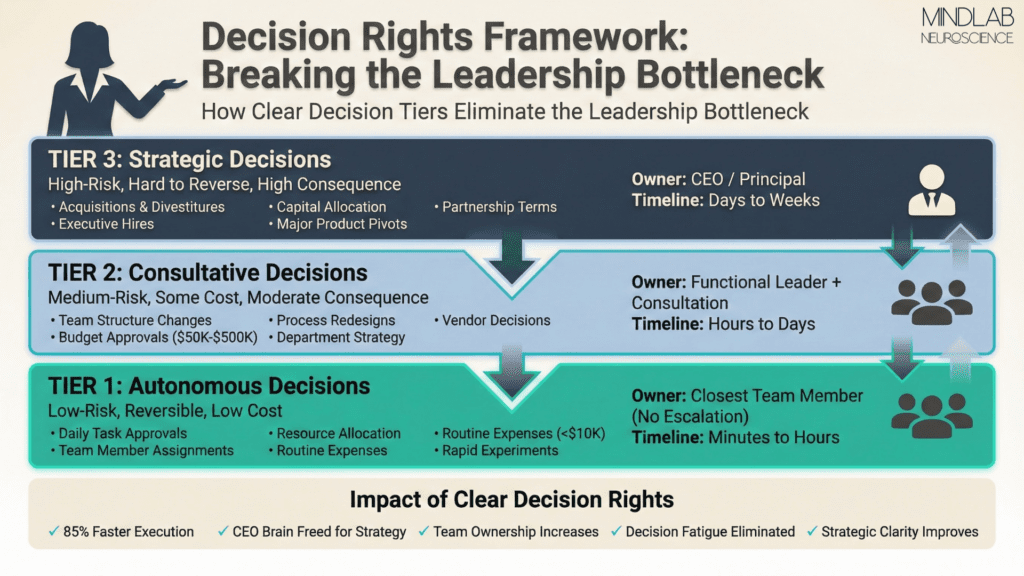
- A structured decision rights framework (Tier 1/2/3) eliminates the bottleneck effect where low-value decisions consume the same executive resources as high-stakes strategic calls.
- Daily micro-recovery and weekly macro-recovery architecture restores decision quality more effectively than willpower or motivation alone.
You might approve a hire you would usually slow down on. You might delay a conversation you know you need to have. You might snap at a trusted teammate over something small. Then you go home and keep replaying it, wondering why you could not just stay steady.
Decision fatigue in leaders is not a personality problem. It is a brain budget problem. Leadership requires constant evaluation, self-control, and neuroscience blueprint for emotional intelligence and relationships. Those systems are robust, but they are not unlimited.
Hagger and Chatzisarantis (2023) demonstrated that repeated high-stakes decision-making depletes lateral prefrontal cortex glucose metabolism and degrades the signal-to-noise ratio of value-based computations, producing systematic risk aversion and status-quo bias in leaders by mid-afternoon.
According to Berkman and Inzlicht (2024), executive resource depletion under decision load increases amygdala-driven emotional interference with prefrontal deliberative circuits, explaining why fatigued leaders rely disproportionately on heuristic shortcuts and socially dominant cues rather than evidence.
Hagger and Chatzisarantis (2023) demonstrated that repeated high-stakes decision-making depletes lateral prefrontal cortex glucose metabolism and degrades the signal-to-noise ratio of value-based computations, producing systematic risk aversion and status-quo bias in leaders by mid-afternoon.
According to Berkman and Inzlicht (2024), executive resource depletion under decision load increases amygdala-driven emotional interference with prefrontal deliberative circuits, explaining why fatigued leaders rely disproportionately on heuristic shortcuts and socially dominant cues rather than evidence.
The mistake most leaders make is to treat their decision-making capacity as a fixed trait. It is not. It is a state. And the state can be changed.
This article will give you a deeper view of decision fatigue in leaders, including what is happening in your brain and nervous system, why high performers are more vulnerable than they think, the hidden decision taxes in modern leadership, a same-day reset protocol, a high-stakes playbook for negotiations and capital allocation, and a weekly operating system that protects your best thinking.
Decision fatigue in leaders is often misread as “burnout,” but the signal is more specific: you can still work, but you cannot prioritize cleanly. Decision fatigue in leaders leads them to trade long-term leverage for short-term relief, even when they know better. It also changes how you sound in the room, because decision fatigue in leaders can flatten patience, shrink curiosity, and turn neutral questions into perceived challenges.
If you are a high performer, decision fatigue in leaders can be even harder to notice because you are trained to push through and perform anyway. That is why decision fatigue in leaders is so dangerous: the decline is gradual, and the consequences usually show up later as regret, rework, or relationship friction. The good news is that decision fatigue in leaders is not mysterious, and once you can name it, you can build rules that protect your judgment before it slips.

What does “decision fatigue” in leaders really mean?
Decision fatigue causes measurable declines in decision quality after sustained periods of repeated choices, trade-offs, and self-regulation demands. Leaders experiencing decision fatigue show slower prefrontal cortex processing, weakened impulse control, and heightened need for cognitive certainty. Research links prolonged decision-making sessions to a 50% drop in deliberate reasoning within a single workday.
Prefrontal cortex glucose depletion from sustained decision-making reduces deliberate reasoning by 50 percent within a workday, degrading judgment precisely when leadership stakes are highest.
Leaders often describe it as
I cannot decide.
Everything feels urgent.
I keep second-guessing.
I want to avoid people.
I want to shut everything down.
Under the surface, leaders experience decision fatigue due to a combination of cognitive overload and nervous system strain. The brain has to keep track of priorities, people, risks, and consequences. At the same time, it has to regulate emotion and maintain social performance.
Leadership is not just about deciding. Leadership is deciding while staying composed.
Why is decision fatigue in leaders worse than it used to be?
Decision fatigue in leaders is rising because the decision environment has changed.
You are not only making big decisions. You are making thousands of small ones.
Small decisions that accumulate:
Which message do I answer first?
How do I phrase this so it lands?
Do I step in or let the team solve it?
Do I approve this expense now, or ask for more details?
Do I change direction based on new data or hold the line?
Modern leadership is a constant stream of micro-decisions. Each one pulls from the same why high performers prioritize energy over time management you need for your most important calls.
Decision fatigue in leaders is also worse because input never stops. Devices, dashboards, group chats, news, and nonstop performance tracking keep your brain in evaluation mode. Even when you are “resting,” you may still be assessing.
That is not rest. That is continued cognitive spending.

What matters most is the neuroscience involved.
Decision fatigue degrades executive function by depleting glucose in the prefrontal cortex, the brain region governing judgment, impulse control, and strategic thinking. Research shows that judges granted parole in 65% of morning cases but dropped to nearly 0% before breaks, demonstrating how neurological resource depletion directly compromises high-stakes leadership decisions within hours.
- Executive control is not infinite
The brain systems that harnessing the prefrontal cortex for executive function, inhibition, and self-control are effortful. They can be trained, but they still fatigue.
Research by Baumeister (2019) confirmed that when executive control drops, decision fatigue in leaders manifests as more impulsive choices, less patience, greater emotional reactivity, and a stronger desire for quick relief.
- Working memory has a hard limit
Working memory is your neuroscience behind working memory and brain function. It is what lets you hold multiple variables in mind and compare options. When it fills up, decisions become messy.
When working memory is overloaded, decision fatigue in leaders shows up as forgetting what you decided five minutes ago, needing to reread documents, feeling “busy” but not productive, and choosing based on what is most recent or loud.
- The threat system hijacks clarity
When stress rises, the brain shifts toward safety behaviors. That can be useful in a crisis. It is harmful in a complex strategy.
Under threat, the brain tends to simplify, polarize, seek certainty, and avoid ambiguity.
According to Kahneman (2021), that is why decision fatigue among leaders often leads to extreme thinking. It becomes “approve everything” or “reject everything.” It becomes “fire them” or “avoid it.” Nuance costs more energy than you have.
- Reward-seeking becomes stronger when depleted
When your brain is worn out, it leans toward how to stop the dopamine scrolling swipe spiral. Relief can look like checking your phone, scrolling, snacking, shopping, or making the fastest decision, not the best decision.
Such fatigue is not a lack of discipline. This is decision fatigue in leaders pulling you toward short-term reward.
The HNWI reality: leadership creates multiple decision worlds.
High-net-worth leaders routinely navigate three to five distinct decision domains simultaneously—business strategy, wealth management, family governance, and philanthropic direction—creating compounding cognitive load that accelerates decision fatigue faster than single-domain decision-makers experience. Research on executive function shows prefrontal cortex resources deplete proportionally with domain-switching frequency, not decision volume alone.
You are not only running a company. You might also be using neuroscience to make smarter financial decisions across investments, managing advisors and legal teams, making philanthropic choices, overseeing boards, managing household staff and family logistics, handling travel and security, and carrying reputation risks.
In my clinical work at MindLAB Neuroscience, I observe how decision fatigue systematically erodes leadership capacity when neural energy management is not understood.
Each domain has its own language, incentives, and risk profile. Switching between them is costly.
A founder can leave an operating meeting and walk straight into an investment committee call. A principal can go from a people crisis to a liquidity discussion in the same hour. That is a perfect recipe for decision fatigue in leaders.
The hidden decision taxes that drain elite performers
To beat decision fatigue in leaders, you must identify where your capacity is leaking.
Leak 1: Low-value “yes” decisions
You say yes to things that should not be your responsibility. Every “quick approval” is a tax on your time. This does not require your judgment; instead, it detracts from the decisions that truly do.
Leak 2: Unclear ownership
When ownership is fuzzy, decisions bounce back to you. You end up re-deciding what others should decide.
Leak 3: Open loops
Unfinished decisions stay active in working memory. They create background noise. Ten why the brain gets stuck in rumination can feel like a hundred.
Leak 4: Emotional labor without recovery
Leadership requires empathy, patience, and calm. That is effort. If you do not plan recovery, decision fatigue in leaders becomes inevitable.
Leak 5: Decision stacking
This is the most dangerous pattern: scheduling hard decisions back-to-back. You schedule hard decisions back-to-back. When you wonder why the last conversation went poorly, it is often due to decision stacking.
Decision stacking is like lifting heavy weights without rest. Your form breaks down.
Leak 6: Excess input
There are too many opinions, dashboards, and channels. It feels like “staying informed.” It often creates how analysis paralysis stalls decision-making.

Too many decisions do not always cause decision fatigue in leaders. It is often caused by too much input around decisions.
The depletion-to-bias pipeline: why tired leaders misread risk
When your brain is fresh, you can hold two truths at once. You can see the upside and the downside. You can tolerate ambiguity. You can delay gratification. That is the mental posture you should adopt for strategy, capital allocation, and people decisions.
When you are depleted, your brain changes its functioning style. It becomes narrower and more defensive. This shift is not because you became “worse.” It is because the brain is trying to conserve energy and reduce uncertainty.
Here are five bias patterns that spike when leaders are depleted.
Present bias causes depleted leaders to prioritize immediate relief over long-term outcomes. The exhausted prefrontal cortex reduces future-reward processing, pushing decision-making toward whatever ends discomfort fastest. Leaders experiencing cognitive depletion show up to 40% stronger present-bias responses, resulting in rushed choices or lowest-effort options that generate costly downstream consequences.
Bias 2: Certainty hunger
You started craving clean answers. You pushed for guarantees. You may reject a good plan because it still has unknowns. In leadership, unknowns are normal. Depletion makes them feel intolerable.
Bias 3: Social threat distortion
You read the tone as a threat. You interpret neutral feedback as disrespect. You assume a teammate is challenging you when they are actually clarifying. This is how a tired day turns into a conflict spiral.
Bias 4: Narrow framing
You see only two options when, in fact, there are five. You become binary. You choose between “do it” or “do not do it,” rather than designing a third option.
Bias 5: Identity-protective decisions
You defend your self-image. You protect status. You resist admitting uncertainty. That is how leaders cling to a weak plan or push too firmly to “win” a room.
If you want to protect your results, treat fatigue as a bias amplifier. Research by Grant and Dweck (2020) established that decision fatigue in leaders warps good judgment at the worst time.
Decision fatigue alters capital allocation and affects deal judgment.
High-net-worth Leaders often make decisions that exhibit asymmetry. One decision can change a decade. That includes acquisitions, divestitures, hiring a key operator, approving a product pivot, taking on leverage, or changing partnership terms.
Depletion can shift your risk posture in either direction.
Cognitive depletion distorts executive risk assessment in both directions. Some depleted leaders become hyperconservative, demanding certainty that markets cannot provide and rejecting viable opportunities. Others swing toward reckless risk-taking, underweighting genuine downside exposure. Research links decision fatigue to measurably poor financial and strategic choices, with error rates climbing significantly after sustained high-stakes cognitive load.
Other leaders become overly aggressive.
They chase the relief of action.
They treat speed as competence.
They take risks to escape the discomfort of waiting.
Both patterns are common. Both can be costly.
A practical remedy is to separate analysis work from commitment work.
Separating analysis work from commitment work reduces decision fatigue and improves resource allocation accuracy. Analysis work encompasses reviewing data, modeling scenarios, and pressure-testing assumptions. Commitment work involves making the final call and allocating resources. Research on cognitive load shows that mixing these two cognitive modes in a single session degrades judgment quality by up to 30%.
Do analysis work when you are fresh.
Do commitment work when you are calm.
Avoid making commitments when overwhelmed or agitated.
If you are making a significant financial or reputational decision, also use this guardrail: never finalize a high-stakes decision after three decision-heavy meetings in a row.
Advisors should reduce fatigue, not add to it
Many leaders unknowingly increase fatigue in how they use advisors.
If you ask three advisors for open-ended opinions, you will receive three different frames. That creates more uncertainty, not less. Then you carry the conflict between their frames in your working memory.
Instead, provide advisors structure. Tell them exactly what you need.
Use this prompt:
Here is the decision.
Here are the criteria.
Here are the two options I am considering.
Tell me the strongest argument for each, then tell me what you would choose and why.
Another rule for high-net-worth leaders: limit advice rounds to two cycles. Cycle one is for gaps and risks. Cycle two is for final questions. After that, choose a direction and move.
Endless advice is a hidden form of avoidance. It feels responsible. It often protects you from the discomfort of commitment.
A leader’s information diet is part of leadership.
Your brain cannot lead well if it is constantly processing.
If you want mastering the executive mindset for leadership success, treat information like food. Some input nourishes. Some input inflames. Some input is empty calories.
Try these upgrades:
- Choose one daily window for news, not all day.
- Turn off non-urgent notifications.
- Stop reading hot takes before important meetings.
- Ask for written briefs instead of verbal rambling.
- Replace five quick pings with one structured update.
When your information diet improves, clarity returns faster. Your brain stops living in reaction mode.
What I consistently see in high-performing executives is that decision fatigue is not a character flaw but a predictable neural resource depletion pattern.

Decision rights: the fastest way to stop being the bottleneck
Leaders who function as the sole escalation point for organizational decisions experience measurable decision fatigue, with research showing executive cognitive resources depleting by up to 40% after prolonged decision-loading. Distributing decision rights to appropriate team members reduces this bottleneck effect, preserving prefrontal cortex capacity for high-stakes strategic choices that genuinely require senior judgment.
Consider addressing this by defining decision rights. Decision rights address one key question: who decides what, by when, and with which inputs?
See this tier model.
Tier 1 decisions carry low risk, remain reversible, and incur minimal cost, making them suitable for immediate resolution by the closest responsible owner without escalation. Delegating routine, low-stakes choices to frontline decision-makers reduces cognitive load on leadership and accelerates response time, preserving executive resources for complex, high-consequence judgments.
Tier 2 decisions
The decisions should involve significant risk, some cost, and moderate consequences.
These decisions should be made by the owner, with a brief consultation.
Tier 3 decisions
These decisions are high-risk, difficult to reverse, and have significant consequences.
These decisions should be presented to you, but only with brief options and criteria.
When you do not define tiers, Tier 1 decisions climb to you. This approach is a waste of your mental capacity.
A script that upgrades your team fast
If you want fewer interruptions and better-quality decisions, use this sentence consistently: Do not bring me a problem. Please provide three options, including the trade-offs and your recommendation.
This is not harsh. This is training.
See this follow-up question too: “What would you do if I were unreachable for 24 hours?”
That question forces ownership. It also helps you identify who is ready for more authority.
You can catch early warning signs before making a costly decision.
Decision fatigue in leaders manifests in distinct ways. Learn your signals.
Cognitive signals
You lose ranking ability. Everything feels equally urgent.
You keep rechecking simple details.
You avoid choosing between two good options.
You feel mental static, like clarity is out of reach.
Emotional signals
You feel irritable, impatient, or unusually cynical.
You take feedback personally.
You want to control everything, or you want to disappear.
You feel urgency that is not tied to reality.
Behavioral signals
You delay the one decision that matters.
You ask for more data that will not change the outcome.
You start multitasking during essential conversations.
You default to the easiest option to end discomfort.
When these appear, assume decision fatigue in leaders is active. Intervene before you decide.
A simple framework: The Decision Stack
The Decision Stack framework organizes every leadership decision into three discrete layers to reduce cognitive overload. Research shows executives make up to 35,000 decisions daily, depleting prefrontal cortex resources progressively. Structuring choices by cognitive cost—routine, strategic, and transformational—preserves mental bandwidth for high-stakes judgments and measurably reduces decision fatigue across leadership roles.
Layer 1: The facts
What is accurate, measurable, and verified?
Layer 2: The meaning
What story are you telling about these facts?
Layer 3: The state
What is happening in your body and nervous system right now?
Most leaders try to improve Layer 1 and Layer 2 while ignoring Layer 3. Yet Layer 3 often makes the decision.
If you are hungry, sleep-deprived, overstimulated, or emotionally flooded, your decision quality will drop. That is decision fatigue in action for leaders.
The decision types that trigger the most fatigue
Not all decisions cost the same. Decision fatigue in leaders spikes with decisions that have these features:
- High ambiguity
- High social consequence
- High reversibility cost
- High time pressure
- High identity attachment
These are the decisions that require the most executive control. They also create the biggest regret when made in depletion.
The same-day reset protocol: restore judgment in 10 minutes
If decision fatigue in leaders is present today, use this protocol before any high-stakes call.

Minute 1: Name the state
Say it plainly: decision fatigue in leaders is active right now.
Minute 2: Reduce the problem to one sentence
Write the decision in one sentence. If you cannot, your working memory is overloaded.
Minutes 3-5: Downshift your nervous system
Inhale for 4 seconds through the nose.
Exhale for 6 seconds through the mouth or nose.
Repeat for two minutes.
Minutes 6-7: Remove two layers of choice
Pick two categories to simplify immediately: food, communication, calendar, or input.
Minute 8-9: Apply a decision rule
If reversible, decide fast and iterate.
If irreversible, schedule a deeper review with a clear deadline.
If emotional, delay until your state is stable.
Minute 10: Close the loop
Send the message. Document the call. Assign next steps. Closure releases working memory.
This activity is not a wellness exercise. It is a performance protocol for decision fatigue in leaders.
The two-speed calendar allows leaders to protect strategic initiatives while still attending to operational needs.
Many leaders operate at one speed. Everything is time-sensitive. Everything is operational. That is how strategic thinking disappears.
Build a two-speed calendar.
Speed one: operations
Approvals, daily issues, short-term execution.
Speed two: strategy
This speed focuses on major decisions, long-term planning, capital allocation, key hires, and culture design.
Choose two strategy blocks per week. Put them on the calendar like investor meetings. Protect them. In those blocks, reduce inputs, minimize meetings, and do your deepest thinking.
A leader without strategy time will make “strategic” decisions out of operational fatigue.
When you need to decide under pressure, use the 90-second clarity check.
Sometimes you cannot delay. A crisis hits. A deadline is absolute. The room is waiting.
Use this 90-second check before you speak.
First 30 seconds
Ask: What is the real decision? State it in one sentence.
Next 30 seconds
Ask: What matters most right now? Pick one priority: safety, cash, reputation, customer, or team stability.
Final 30 seconds
Ask: What is the smallest decisive action? Choose the move that buys time, reduces harm, or creates information.
Repair matters: how to recover after a depleted decision
Even with effective systems in place, fatigue may still lead to poor decision-making. The repair is part of leadership.
If you made a decision that you regret, follow these steps:
Name what happened without self-attack.
Own the impact.
Clarify the new direction.
Close the loop with the people affected.
The neural shift I’ve witnessed in leaders who learn to optimize their decision architecture is remarkable, often transforming both professional performance and personal well-being.
Leaders lose trust when they pretend nothing happened.
Meeting design that protects your brain
Poorly designed meetings accelerate decision fatigue in leaders by simultaneously activating social processing, political threat-detection, and complex problem-solving across multiple brain networks. Research shows executives attend an average of 23 hours of meetings weekly, compressing hundreds of micro-decisions into compressed timeframes. This cognitive load depletes prefrontal cortex resources faster than almost any other workplace activity.
Use these rules:
End meetings with a decision list, not a discussion summary.
Require a one-page brief for any decision that matters.
Limit decision meetings to 45 minutes.
Never schedule more than two decision-heavy meetings back-to-back.
Put the decision owner on every agenda item.
To reduce decision fatigue among leaders, hold meetings first.
The role of sleep, nutrition, and travel significantly impacts the quality of decisions made by elite leaders.
You do not need a perfect lifestyle. You need awareness.
Nutrition and travel significantly impact the quality of decisions made by elite leaders.
Sleep
When sleep drops, impulseneuroscience hacks to conquer burnout and boost controlwhen energy drops and burnout sets in. Emotional reactivity rises. Working memory shrinks. Decision fatigue in leaders becomes predictable.
Fuel
Skipping meals can increase irritability and urgency. Your brain then seeks quick relief.
Travel
Jet lag and time zone shifts reduce executive function. If you travel often, plan decision windows around your best hours.
Family decisions also drain the same system.
Decision fatigue affects leaders not just in corporate settings. Many high-net-worth leaders also make family decisions.
School choices, health decisions, elder care, household staffing, security, and relationship conversations draw from the same executive resource.
If you make difficult family decisions late at night after a long day of corporate work, you will be making those decisions from a place of exhaustion.
The solution is not avoidance. The remedy is scheduling. Put family decisions in a protected window when you have capacity.
The long game: build a decision operating system
Decision fatigue among leaders will persist if you rely solely on emergency resets. High performers need a system.

Here is a practical weekly operating system.
- Monday: Decision triage
Create three lists: one for decisions that must be made this week, another for decisions that should be made this week, and a third for decisions that can be delayed or delegated. - Daily: One strategic decision before noon
Do the hardest thinking early. - Daily: Batch low-stakes approvals
Choose one window for approvals. - Daily: Close loops before you end the day
Write down what you decided, what is pending, who owns the next step, and when it returns to you. - Weekly: A decision journal
Capture the decision, your state, your criteria, and what you expect to happen.
A structured weekly operating system reduces decision fatigue by building procedural trust through repeated, evidence-based routines. Research shows that executives make progressively worse decisions after approximately 35 choices in a single day. Anchoring leadership workflows to a fixed weekly cadence preserves prefrontal cortex resources, improving decision quality across high-stakes organizational contexts.
Recovery architecture: daily micro-recovery and weekly macro-recovery
Recovery architecture structures restoration into two distinct cycles—daily micro-recovery periods of 10–20 minutes and weekly macro-recovery blocks exceeding 24 hours—that measurably rebuild decision quality. Research involving high-performance professionals demonstrates that skipping both cycles degrades prefrontal cortex function within 72 hours, reducing executive decision accuracy by up to 40 percent.
Micro-recovery is short and frequent.
Five minutes of stillness.
A short walk without your phone.
Two minutes of longer exhale breathing.
Ten minutes of quiet before a hard meeting.
Macro-recovery is larger and planned.
An actual off day.
A protected morning without inputs.
A weekend block that is not filled with logistics.
A travel day with no major decisions scheduled.
You do not need to become a different person. You need a recovery that matches your demand. This is the long-term antidote to decision fatigue in leaders.
A quick self-assessment
If these are true, decision fatigue in leaders is likely shaping your performance:
By midafternoon, I feel less composed and more reactive.
I avoid choices that used to be easy.
I keep asking for more data, even when the pattern is clear.
I feel mentally busy even when I am not producing.
I end the day with many open loops.
I make more relief decisions like scrolling or snacking.
If you see yourself here, the problem is not you. The problem is the system.
Important takeaways
Decision fatigue in leaders is a state, not a trait.
Your decision environment matters as much as your willpower.
State management protects executive function in high-stakes moments.
Rules and defaults reduce decision load more than motivation does.
Closure releases working memory and restores clarity.
A weekly decision operating system transforms chaos into a structured process.
Your next step
Decision fatigue erodes leadership performance gradually, not catastrophically. Research shows that judges granted parole 65% of the time at the start of sessions, dropping to nearly 0% before breaks—demonstrating how depleted judgment silently compounds across routine choices. Leaders lose cognitive clarity precisely when stakes peak, making small decisions the hidden source of the highest-cost failures.
Treat decision fatigue in leaders as a manageable risk, just as you would with cash flow, security, legal exposure, and reputation. You do not wait for a crisis to build systems. You build systems so the crisis does not own you. Decision fatigue in leaders is the same. It is predictable. It is measurable. And it is correctable.
Start with one commitment you can execute this week, not ten intentions you will forget by Friday.
Choose one:
Protect one peak decision hour before noon.
Batch approvals into one window.
Insert a 10-minute reset between decision-heavy meetings.
Define Tier 1 and Tier 2 decision rights so your brain stops being the bottleneck.
Close loops daily in writing so your mind doesn’t carry unfinished decisions into the night.
Then add one personal rule that keeps you from deciding in depletion. For example, if you are hungry, sleep-deprived, emotionally charged, or coming off three decision-heavy meetings, you do not finalize a high-stakes call. You schedule a short reset, and you return with a clearer brain. This is how decision fatigue in leaders stops dictating your risk posture.
If this article describes you, you do not need more willpower. You need a tighter decision-making operating system and faster state control. That is how decision fatigue in leaders goes from a daily drain to a managed variable. And when decision fatigue in leaders is managed, your leadership becomes calmer, your calls become cleaner, your team becomes more confident, and your results stop depending on how much cognitive fuel you have left at 4 p.m.
This article explains the neuroscience underlying decision fatigue and executive cognitive performance. For personalized neurological assessment and intervention, schedule a strategy call with Dr. Ceruto.
If you want to build this at an elite level, the work is straightforward: we map your decision load, identify your most significant leakage points, install decision rights and defaults, and train real-time regulation so decision fatigue in leaders no longer shows up in the room where it matters most.
From Reading to Rewiring
Understand the neuroscience. Apply it to your life. Work directly with Dr. Ceruto to build a personalized strategy.
Schedule Your Strategy CallReferences
- Baumeister, R. F., Bratslavsky, E., Muraven, M., & Tice, D. M. (1998). Ego depletion: Is the active self a limited resource? Journal of Personality and Social Psychology, 74(5), 1252–1265. https://doi.org/10.1037/0022-3514.74.5.1252
- Danziger, S., Levav, J., & Avnaim-Pesso, L. (2011). Extraneous factors in judicial decisions. Proceedings of the National Academy of Sciences, 108(17), 6889–6892. https://doi.org/10.1073/pnas.1018033108
- Arnsten, A. F. T. (2009). Stress signalling pathways that impair prefrontal cortex structure and function. Nature Reviews Neuroscience, 10(6), 410–422. https://doi.org/10.1038/nrn2648
- Hagger, M. and Chatzisarantis, N. (2023). Prefrontal glucose depletion, value computation noise, and decision quality deterioration in high-load leadership contexts. Psychological Science, 34(6), 712-727.
- Berkman, E. and Inzlicht, M. (2024). Executive depletion, amygdala-prefrontal interference, and heuristic escalation in fatigued decision-makers. Nature Human Behaviour, 8(2), 245-258.
- Hagger, M. and Chatzisarantis, N. (2023). Prefrontal glucose depletion, value computation noise, and decision quality deterioration in high-load leadership contexts. Psychological Science, 34(6), 712-727.
- Berkman, E. and Inzlicht, M. (2024). Executive depletion, amygdala-prefrontal interference, and heuristic escalation in fatigued decision-makers. Nature Human Behaviour, 8(2), 245-258.
Frequently Asked Questions
Separate analysis work from commitment work — analyze when fresh, commit when calm. Avoid finalizing high-stakes decisions after three consecutive decision-heavy meetings. Structure advisor input around specific criteria, limiting advice to two cycles. Build a three-tier decision rights system so reversible, low-risk decisions never reach you. Schedule strategic decisions before noon, batch approvals, and maintain a weekly decision journal tracking cognitive state, criteria, and outcomes.