
Key Takeaways
- Social feeds use variable-ratio reinforcement, the slot-machine reward schedule, to produce compulsive scrolling.
- Dopamine drives prediction, not pleasure: the scroll loop hijacks the seeking system with perpetual almost-reward.
- Repeated dopamine spikes from scrolling raise the tolerance threshold, making ordinary offline experiences feel flat.
- Willpower cannot interrupt the scroll loop once the prefrontal cortex is depleted by that scrolling.
- Breaking the loop requires friction (raising scrolling’s cost) and prediction certainty (reliable reward without seeking).
A quick check of YouTube Shorts should not take an hour, yet it happens every day. You open your phone for one thing and find yourself in a state of dopamine scrolling, drawn automatically to the next video by the same habit loops that drive any compulsive behavior. If this is you, the most important thing to know is that dopamine scrolling is not a character flaw. It is a trainable nervous system pattern.
This guide is part of MindLAB’s work on addiction and reward architecture; the full reset protocol appears in The Dopamine Code.
In my MindLAB Neuroscience work, I see this in leaders, founders, physicians, and high-pressure professionals who are disciplined in every other area of life. They can manage real responsibility, but a feed can still pull them into a trance between meetings or late at night when the day finally goes quiet. The content feels like relief in the moment, then it leaves a familiar aftertaste: mental noise, sleep delay, and a subtle loss of self-trust.
This article breaks down what is actually happening in the brain and nervous system, why the swipe spiral feels so compelling, and how to rebuild control with a neuroscience-based protocol and a personalized dopamine menu. Think of the swipe loop as your brain running a tiny experiment: swipe, check, update, repeat. You can stop dopamine scrolling without deleting every app, but you do need a better system.
Habitual social media scrolling appears to engage the same striatal reward circuitry implicated in other behavioral reward compulsions, which can leave ordinary stimuli feeling less rewarding by comparison and pull the brain toward greater novelty.
Problematic phone and screen use has been linked in imaging studies to structural differences in prefrontal and cingulate regions that support impulse control and attentional switching between digital and real-world environments.
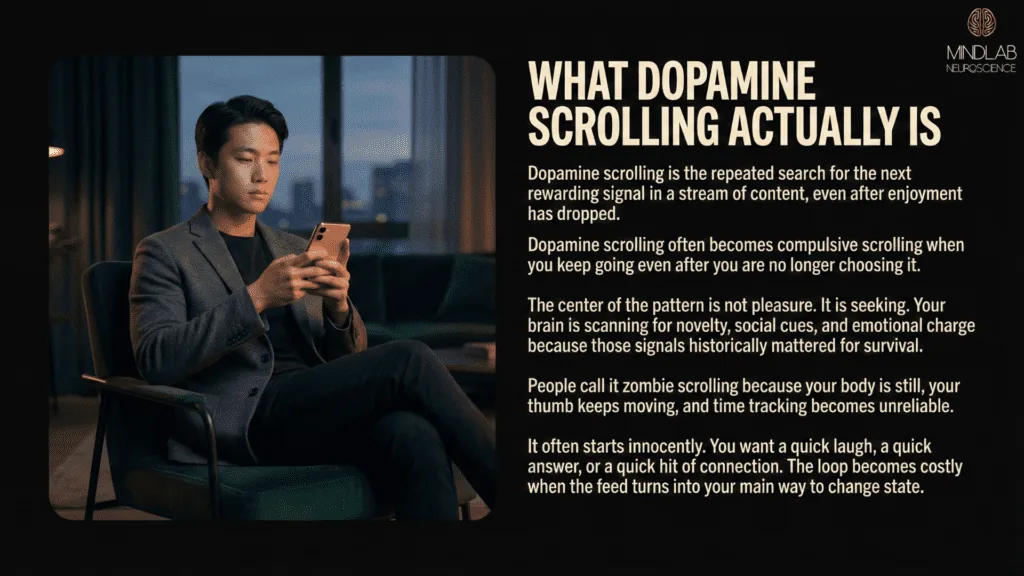
What dopamine scrolling actually is
Dopamine scrolling is the repeated search for the next rewarding signal in a stream of content, even after enjoyment has dropped. Dopamine scrolling often becomes compulsive scrolling when you keep going even after you are no longer choosing it. The center of the pattern is not pleasure. It is seeking.
People call it zombie scrolling because your body is still, your thumb keeps moving, and time tracking becomes unreliable. It often starts innocently. You want a quick laugh, a quick answer, or a quick hit of connection. The loop becomes costly when the feed turns into your main way to change state.
In neuroscience terms, dopamine scrolling is a shift from intentional attention to a cue-driven habit loop. A micro-stress signal, boredom, or a fleeting feeling of uncertainty often serves as the cue, with the phone acting as the fastest regulator. Each swipe gives your brain a tiny “maybe” reward, which keeps the seeking system turned on even when the content is not satisfying. That is why you can feel both stimulated and strangely numb at the same time.
Over time, this trains your nervous system to expect constant input, making silence or stillness feel uncomfortable. It can also blunt your sensitivity to slower rewards, such as reading, deep conversation, or focused work, because these rewards require sustained attention. The key detail is that the habit is learned through repetition, which means it can be unlearned and replaced with a more supportive reward system.
The neuroscience of why dopamine scrolling grips so fast
Dopamine is often described as pleasure, but it is more accurate to think of it as a motivation and salience signal. It helps the brain identify what matters and what to pursue. The feed keeps you engaged by turning “maybe” into a steady drip of possibility: the following clip might be better, the following headline.
Each swipe is a prediction. Your brain predicts a payoff and then checks whether that prediction was correct. That checking process is the hook. In a swipe loop, you are not chasing joy; you are chasing the possibility that the next clip will finally land. When you are stressed or exhausted, uncertainty feels louder, and the brain becomes more eager for a quick state change. That is why this pattern often spikes ultimately.
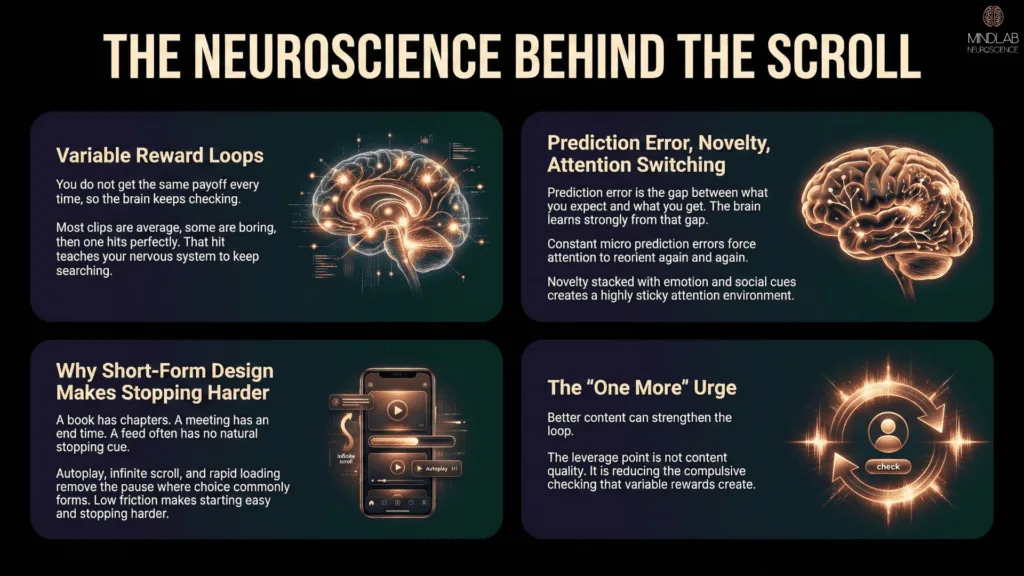
Variable reward loops and the “one more” urge
The strongest habit loops are built on variable rewards. You do not get the same payoff every time, so the brain keeps checking. Most clips are average, some are boring, and then one hits perfectly. That “hit” teaches your nervous system to keep searching.
This is why curating “better content” does not solve the problem. Better content can strengthen the loop. The leverage point is not content quality. It is reducing the compulsive checking that variable rewards create.
Prediction error, novelty, and attention switching
Prediction error is the gap between what you expect and what you get. The brain learns strongly from that gap. Short-form feeds deliver constant micro prediction errors, which force attention to reorient again and again. That is one reason the feed can leave you feeling mentally loud afterward. Your brain has been rapidly updating and switching.
Another piece is novelty. Novelty is a signal of potential opportunity and potential threat. It pulls attention. When you stack novelty with emotion and social cues, you create a highly sticky attention environment.
Why short-form design makes stopping harder
A book has chapters. A meeting has an end time. A show has credits. A feed often has no natural stopping cue. Autoplay, infinite scroll, and rapid loading remove the pause where choice commonly forms. The following input arrives before your thinking brain has time to decide.
This is not about you being weak. It is about friction. Low friction makes starting easy and stopping harder.
Doomscrolling and the dopamine loop
Doomscrolling is the threat-driven cousin of dopamine scrolling. Instead of seeking novelty and humor, the brain is scanning for danger, updates, and certainty. The reward is not joy. The reward is the brief relief of “I know what is happening.”
The problem is that threat information does not settle the nervous system for long. It often increases arousal, which then increases the urge to keep scanning. Many people bounce between the two patterns: a few threatening headlines create tension, then the feed of lighter content numbs the tension. Either way, your nervous system is using the phone as a regulator.
Here is the more technical layer: doomscrolling is basically predictive coding on overdrive. When the brain senses uncertainty, it treats information as a form of safety. Each refresh feels like an attempt to reduce prediction error, even if the content is upsetting. The reward is the brief relief of “I know what is happening.”
You also get a “salience cocktail.” Threat cues light up your alarm circuitry (amygdala) and body-sensing circuitry (insula), while your arousal system (norepinephrine) keeps you alert and scanning. That arousal can feel like urgency, making “just one more update” seem rational, even when it is not.
A final twist is that dopamine still plays a role here, just not as pleasure. The dopaminergic system flags what feels important. In doomscrolling, “important” gets confused with “unsafe if I stop paying attention.” The brain is not trying to be dramatic. It is trying to create control, and your feed offers an endless supply of control-shaped information that never fully resolves.
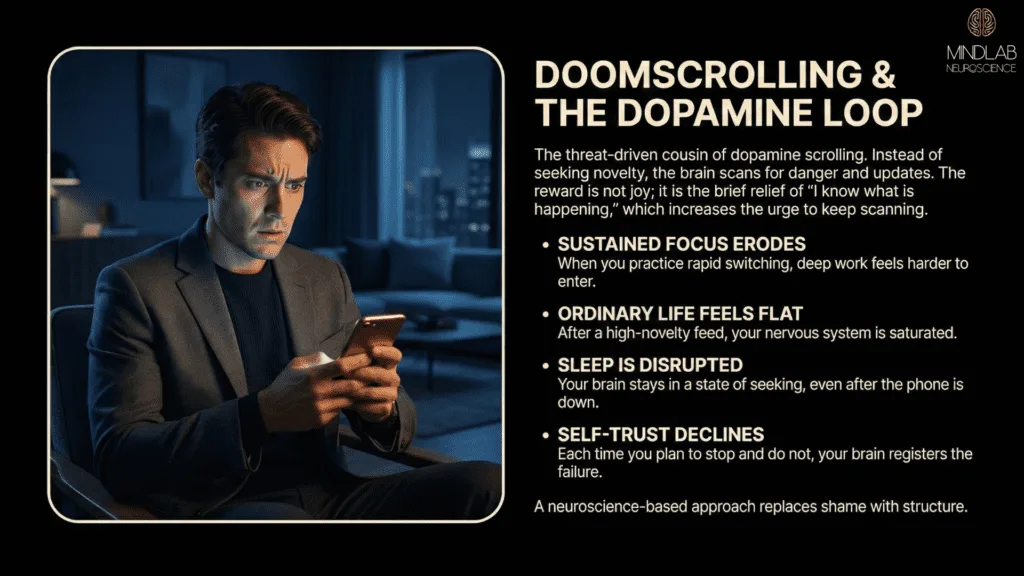
What this pattern costs you over time
Time loss is noticeable. The deeper cost is training. When you practice rapid switching, sustained focus can become uncomfortable. Reading feels slower. Deep work feels harder to enter. Even conversations can feel less stimulating right after a long phone session.
Many people also notice a contrast effect. After a high-novelty feed, ordinary life can feel flat for a while. Life did not become boring. Your nervous system is saturated.
Sleep is a high cost. If you scroll near bedtime, your brain stays in a state of seeking. You put the phone down, but your mind keeps moving. The next day, fatigue increases the odds of repeating the loop.
There is also a self-trust cost. Each time you plan to stop and do not, your brain registers a quiet signal of “I cannot rely on myself.” That signal fuels shame, and shame often pushes people right back into the feed for relief. A neuroscience-based approach replaces shame with structure.
Think of it as a smoke alarm for attention. Each time you catch dopamine scrolling within the first minute, you prevent a full trance. Early interruption is not dramatic. It is skill-building, and it restores momentum before the loop steals your evening.
Why are high performers and ADHD traits especially vulnerable
High performers live inside a delayed reward. They do hard things for long stretches: decisions, pressure, uncertainty, and responsibility. When the day ends, the nervous system wants a quick reward with no effort. A phone delivers that instantly. This process engages multiple interconnected neural pathways that work together.
This pattern also frequently overlaps with ADHD traits, whether diagnosed or not. ADHD is not a lack of intelligence. It is often a regulation difference: novelty hits harder, boredom feels sharper, and switching is more effortless than sustaining. If your nervous system aligns with this, dopamine scrolling may seem like the ideal solution.
The solution is not harsher self-discipline. The solution is better nervous system training and better environmental design.
A neuroscience-based protocol to stop dopamine scrolling in the moment
Willpower is least reliable when you are worn out, stressed, or emotionally loaded. The protocol that works starts where the urge actually lives: physiology first, meaning second, and behavior third.
The goal is not ever to use your phone again. The goal is to interrupt dopamine scrolling early, then meet the underlying need with a cleaner reward.
The 90-second regulation reset
When you catch yourself sliding into the feed, pause movement. Lock the phone or place it face down. Then take slow breaths with a longer exhale than inhale. Drop your shoulders. Unclench your jaw. Feel your feet. This downshifts arousal and restores access to your thinking brain.
Then name it once: dopamine scrolling. Naming reduces shame and brings choice back online.
The one-question pivot that restores choice
Ask one question: what am I actually needing right now? Relief, stimulation, connection, rest, or certainty. The feed often looks like a content issue, but it is usually a needs issue.
Once you name the need, choose a small action that matches it. Modify your body if you require relief. If you need stimulation, move. If you need a connection, reach out. Put the next step in writing if you require certainty. This technique is how you retrain the loop without turning your life into a state of deprivation.
The “draft, don’t binge” move
If your mind feels noisy, open a note and write for sixty seconds. Put the phone down and reread what you wrote. Many people use the feed to avoid unfinished thoughts. Offloading reduces the internal pressure that drives repeated checking.
The Dopamine Code method: personalized dopamine menu and dopamine optimization
A recurring problem I see is that the feed becomes the main reward valve in a person’s life. It is fast, available, and emotionally potent. The answer is not to remove dopamine. The answer is to optimize dopamine so your brain has multiple reliable reward pathways, not one.
In my latest book, The Dopamine Code, I teach people how to create a personalized dopamine menu. A dopamine menu is a practical system for choosing rewards that regulate your nervous system without hijacking your attention. It is designed for real life, not ideal life. For a deeper look, see what the research reveals about dopamine architecture protocol.
A useful dopamine menu includes quick options that take two to five minutes, like a brief walk, a stretch sequence, a hot shower start, a short voice note to someone safe, or a single page of journaling. It includes medium options, like a workout, cooking, reading a physical book, or a focused creative task. It also provides connection rewards, because the nervous system often uses dopamine scrolling as a substitute for belonging.
When clients practice the dopamine menu consistently, dopamine scrolling loses its monopoly. The brain learns a new rule: relief and reward can come from choices that build your life, not just from choices that steal your time. Over time, baseline motivation improves, focus stabilizes, and the urge becomes less dramatic.
Build friction so stopping becomes easier
Friction is not punishment. Friction is a pause that lets your thinking brain come online.
If the loop happens at night, charge your phone outside the bedroom. If it occurs on the couch, place the device across the room. If it happens during a task, put the phone in a drawer during work blocks. Remove autoplay where you can. Turn off notifications that pull you back into the feed. Each change reduces speed, and speed is fuel for dopamine scrolling.
The aim is not perfection. The objective was to reduce accidental starts and speed up exits.
Rebuilding boredom tolerance, the missing skill
Many adults have trained their nervous system to fill every gap. Waiting feels uncomfortable. Silence feels loud. Boredom feels like a problem to solve. The feed becomes the quickest fix.
To reverse that, train micro-gaps. Stand in the kitchen for one minute without opening an app. Walk to the bathroom without the phone. Sit in the car for ninety seconds before turning anything on. These moments look small, but they retrain your brain to stay present without demanding novelty.
As boredom tolerance improves, dopamine scrolling becomes easier to resist because the gap no longer feels threatening.
Use dopamine scrolling as a evaluative, not a label
One of the fastest ways to change this habit is to stop viewing it like a moral problem and start approaching it like data. When dopamine scrolling shows up, it is usually pointing to a moment your nervous system is trying to regulate: a spike of stress, a dip in energy, or a wave of loneliness.
Start tracking the timing. Does it happen right after conflict, right before a challenging task, right after an intense meeting, or right when the house gets quiet? Notice the setting too. Some people scroll most in bed. Others scroll in the kitchen, in the car, or in that in-between moment after work when they feel depleted.
Then build one simple if-then plan. If you feel the first pull, then do a ninety-second reset. If you feel mentally noisy, then do a sixty-second draft. If you feel alone, then send one voice note. If you feel behind, then write one next step. This is how you replace automatic behavior with trained choice, without forcing perfection.
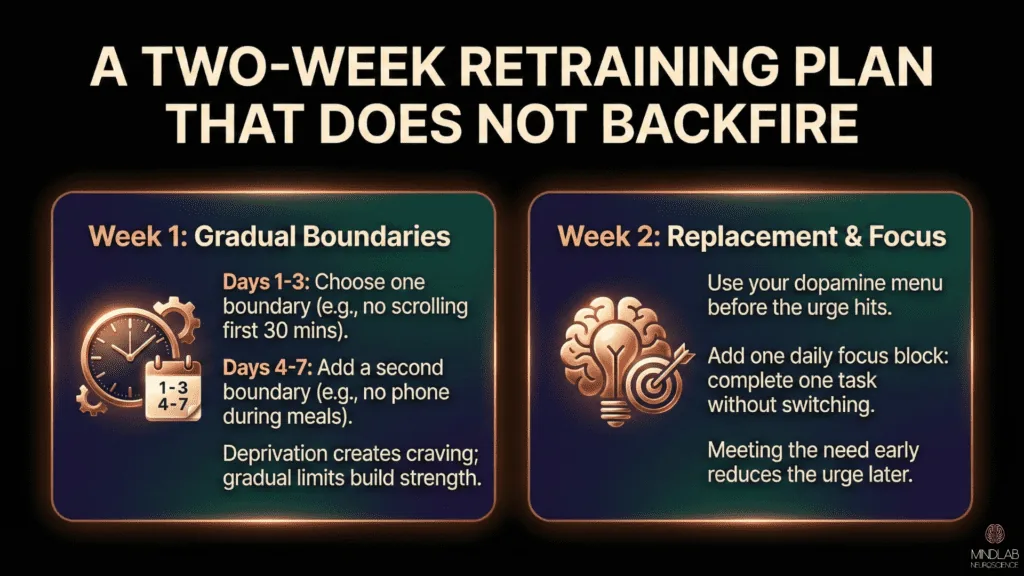
A two-week retraining plan that does not backfire
Trying to stop overnight can rebound. Deprivation creates craving, and craving creates a binge. A better plan is gradual retraining with clear boundaries and replacement rewards.
For the first three days, choose one boundary only, such as no dopamine scrolling in the first thirty minutes after waking or the last thirty minutes before bed. Then add a second boundary for the next four days, such as no phone feed during meals.
In the second week, use your personalized dopamine menu before your usual urge window. Meeting the need early reduces the intensity of the urge later. Add one daily focus block in which you complete one task without switching. Over two weeks, your nervous system relearns sustained attention, and dopamine scrolling weakens naturally.
Client stories from MindLAB Neuroscience
Identifying details are changed, but the nervous system patterns are real.
The executive who lost her nights to dopamine scrolling
She was a senior leader who could handle pressure all day and still felt powerless at night. Her evening looked harmless: dinner, a quick check of her phone, then a few minutes of videos to unwind. But the few minutes became an hour. What made it upsetting was that she was not even enjoying it.
Her trigger was silence. Meetings and decisions mobilized her system during the day. At night, the body finally noticed the backlog of stress. The phone delivered immediate relief, and her brain learned the association quickly: quiet equals discomfort, and the feed equals relief.
We started by approaching her evenings as nervous system recovery, not entertainment. She practiced the 90-second reset before touching the phone, especially when she felt the first pull. Then we built a personalized dopamine menu that fit real evenings, not fantasy routines. She chose a short shower, a ten-minute walk, a low-effort stretch, a chapter of a physical book, and one voice note to a friend. We added friction by charging the phone in the kitchen.
Within two weeks, her evenings shifted in a way that surprised her. The urge still appeared, but it felt less commanding. She could notice the pull, name dopamine scrolling, and choose a different reward. The most meaningful change was self-trust. She started waking up feeling proud instead of behind.
The founder who used the feed to avoid uncertainty
He described the phone as “turning my brain off,” but his brain was not off. It was seeking. His days were loaded with uncertainty: investor timelines, hiring decisions, and product pressure. At night, that uncertainty lived in his chest. The feed triggered a rapid state change.
We trained uncertainty tolerance directly. He practiced sitting with the discomfort for two minutes before opening any app, then naming what he was actually needing. Most nights, the need was certainty, not entertainment. So instead of scrolling, he wrote one clear next step for the morning. That single step reduced internal chaos far more than another hour in the feed.
We also created a dopamine menu that gave stimulation without hijacking him. He chose movement and music as his quick reset, then a short creative task as his medium reset. The result was not that he became anti-phone. He became choosy. Dopamine scrolling stopped being his only doorway out of discomfort.

The young professional with ADHD traits and a scattered mind
He came in saying he had “lost his focus.” He had always been sharp, curious, and fast, but now he could not stay with a task. Between work blocks, he reached for short videos, and those breaks turned into dopamine scrolling that bled into the next hour.
We approached it as training. He moved the phone feed to a planned window to stop it from fragmenting attention. He built a dopamine menu designed for an ADHD-leaning nervous system: quick movement, quick novelty that was offline, and short connection moments that calmed the social brain. He practiced micro-gaps to help his brain relearn how to tolerate “nothing happening.”
The change was measurable. Within a couple of weeks, he could stay with a task longer without discomfort. He did not become less motivated. He became less hijacked. Dopamine scrolling no longer set the rhythm of his day.
When dopamine scrolling is a signal to get extra support
Sometimes the phone is not just a habit. It is a coping strategy for anxiety, loneliness, grief, or chronic overwhelm. If you use the feed to avoid panic, emotional pain, or emptiness, taking it away won’t help. The answer is to build better regulations, connections, and support.
If dopamine scrolling is affecting your sleep, your work, your relationships, or your mental health, it is a valid reason to get help. Not because you are weak, but because your nervous system deserves a more effective protocol than endless stimulation.
Final Thoughts
Dopamine scrolling is not proof that you lack discipline. It is proof that your nervous system learns from reward, novelty, and uncertainty, and modern feeds deliver those ingredients with incredible speed. The way out is not shame. The way out is a neuroscience-based structure.
When you downshift your body first, name dopamine scrolling, and meet the real need underneath the urge, you regain choice. When you build friction, rebuild boredom tolerance, and use a personalized dopamine menu from The Dopamine Code approach to optimize dopamine, dopamine scrolling loses power over time.
You can enjoy content and still protect your attention. With practice, dopamine scrolling becomes an early signal you catch, not a trance you wake up from.
The patterns described in this article were built through thousands of neural repetitions, and they require targeted intervention to rewire. Real-Time Neuroplasticity™ provides the mechanism: intervening during the live moments when the pattern activates, building new neural evidence that a different response is architecturally possible.
| Phase | Brain State | What You Feel | Reset Protocol |
|---|---|---|---|
| Opening the feed | Anticipatory dopamine fires (seeking mode activated) | Mild curiosity, “just checking” | Add physical friction: device across the room |
| Scrolling without finding meaningful content | Dopamine system stays activated, reward pending | Restlessness, mild compulsion to continue | Hard close + non-digital activity with defined endpoint |
| Occasional hit (funny, surprising, or emotionally relevant post) | Variable ratio confirmation: loop reinforced | Brief satisfaction, then immediate return to seeking | Recognize pattern: the hit reinforces the loop, not ends it |
| Post-session | Dopamine baseline depleted, cortisol elevated | Flatness, regret, reduced motivation for other tasks | Schedule analog activity before first scroll of day |
“Your thumb keeps scrolling because your dopamine system is chasing a reward that never fully arrives. The loop is not weakness: it is your brain doing exactly what it was designed to do with a variable-ratio reward schedule.”
Why can’t you just stop scrolling when you want to?
The scroll loop engages the dopamine seeking system: specifically, the brain’s anticipatory circuit that responds to the possibility of reward. This circuit does not deactivate when you decide to stop; it is still predicting that the next scroll might produce the reward the previous one did not. Stopping requires overriding an active dopamine prediction with prefrontal executive control, but the prefrontal cortex is itself depleted by the prolonged scrolling session.
Is social media use actually comparable to addiction neurologically?
The behavioral and neurochemical patterns share structural features with compulsive use patterns: specifically, variable-ratio reinforcement, tolerance development, and interference with other reinforcing activities. Whether these patterns meet evaluative criteria for addiction is a clinical question with an ongoing evidence debate. What is neurologically clear is that the dopamine system responds to social media’s variable reward architecture in predictable ways, and that those responses can become self-reinforcing in a manner that makes volitional interruption difficult without structural intervention. This connects directly to the neuroscience of sex addiction.
Does scrolling actually raise your dopamine tolerance?
High-frequency, low-effort dopamine spikes, the pattern social feeds produce, appear to raise the threshold at which the dopamine system registers satisfaction. When the brain becomes accustomed to rapid, high-frequency prediction events, ordinary experiences (a conversation, a walk, a book) produce insufficient prediction activity to feel rewarding in comparison. This is not a permanent change, but it does create a temporary hedonic baseline shift where offline activities feel less compelling than they would otherwise.
What actually breaks the scroll loop neurologically?
Two mechanisms are effective: friction and prediction replacement. Friction increases the behavioral cost of initiating a scroll session: moving the device, adding a timed lockout, requiring a physical step before access. This pattern creates a pause that allows the prefrontal cortex to intervene before the seeking system activates.
How long does it take to reset a scroll-conditioned dopamine system?
The timeline depends on the depth of the conditioning and the consistency of the reduction strategy. Most people notice that offline activities feel more rewarding within 2-4 weeks of substantially reduced scroll frequency. The initial period (days 1-7) typically involves heightened restlessness and the pull of the loop: the dopamine system is still generating the seeking signal without the usual outlet.
References
- Schultz, W., Dayan, P., and Montague, P. R. (1997). A neural substrate of prediction and reward. Science, 275(5306), 1593-1599. https://doi.org/10.1126/science.275.5306.1593
- Berridge, K. C., and Robinson, T. E. (1998). What is the role of dopamine in reward: Hedonic impact, reward learning, or incentive salience? Brain Research Reviews, 28(3), 309-369. https://doi.org/10.1016/S0165-0173(98)00019-8
- Volkow, N. D., Wise, R. A., and Baler, R. (2017). The dopamine motive system: Implications for drug and food addiction. Nature Reviews Neuroscience, 18(12), 741-752. https://doi.org/10.1038/nrn.2017.130
- Wise, R. A. (2004). Dopamine, learning and motivation. Nature Reviews Neuroscience, 5(6), 483-494. https://doi.org/10.1038/nrn1406
- Kandel, E. R., Schwartz, J. H., Jessell, T. M., Siegelbaum, S. A., and Hudspeth, A. J. (2013). Principles of Neural Science, 5th Edition. McGraw-Hill.
- Damasio, A. R. (1996). The somatic marker hypothesis and the possible functions of the prefrontal cortex. Philosophical Transactions of the Royal Society B, 351(1346), 1413-1420. https://doi.org/10.1098/rstb.1996.0125
From Reading to Rewiring
Dopamine scrolling is a compulsive behavior driven by variable-ratio reinforcement in the mesolimbic reward system. Each unpredictable piece of novel content triggers a small dopamine release in the nucleus accumbens, reinforcing continued swiping. Research shows this pattern reduces sustained attention capacity and blunts baseline dopamine sensitivity within weeks of habitual use exceeding two hours daily.
One hour with Dr. Ceruto