Key Takeaways
- Disappointment triggers a dopamine prediction error: a sharp drop producing motivational flatness and initiation difficulty
- The anterior cingulate cortex detects errors, broadcasting a correction signal: navigational data or identity-confirming failure
- Stress inoculation, manageable challenges with adequate recovery, trains the hypothalamic-pituitary-adrenal axis to calibrate more precisely
- A growth mindset raises anterior cingulate cortex engagement with errors, sustaining dopaminergic motivation through difficulty
- Disappointment becomes momentum when meaning-making and micro-goals shift the dopaminergic crash into an approach state
Disappointment is not an emotional problem: it is a neurobiological event with a precise mechanism and a predictable recovery arc that can be accelerated through deliberate intervention. At MindLAB Neuroscience, I have spent 26 years working with individuals who arrived at a crossroads after significant setback: a career reversal, a relational collapse, a project that consumed years and produced nothing. The question they carry is always some version of the same one, can I recover from this, and how do I make sure it does not define me? The neuroscience of emotional resilience and setback processing provides answers that are both more specific and more hopeful than most people expect.

What Happens in Your Brain When You Experience Disappointment?
Disappointment activates a cascade involving the anterior cingulate cortex, the orbitofrontal cortex, and the dopaminergic reward system, producing a sharp drop in dopamine relative to expectation, triggering an error signal, and initiating a stress response that either resolves adaptively or locks into a ruminative loop depending on the individual’s existing neural architecture.
The experience of disappointment is not simply an emotion: it is a neurobiological recalibration. When an anticipated outcome fails to materialize, the brain’s reward prediction system registers a mismatch. The orbitofrontal cortex, which tracks expected versus actual outcomes, sends a correction signal that collapses dopamine tone in the nucleus accumbens. This is the neurological source of that flat, motivational deficit that follows setback.
Willmore and colleagues demonstrated that dopamine neuron activity is a causal driver of resilience versus susceptibility under stress, establishing that the dopaminergic response to setback is not simply reactive but predictive of recovery trajectory. In my practice, I describe this to individuals as the brain doing exactly what it was designed to do: recalibrating around a failed prediction. The distress is not weakness: it is the system working correctly.
The question that matters for lasting change is what happens in the hours and weeks after that initial signal fires. That trajectory is not fixed. It is shaped by the neural patterns an individual has built, or not yet built, around setback processing. An individual who has repeatedly moved through disappointment with structured support has built neural circuits that expect recovery. An individual whose disappointments have been met with isolation, self-blame, or premature suppression has built circuits that expect collapse. Both are learned responses, and both are modifiable.
How Does the Anterior Cingulate Cortex Process Failure and Setbacks?
The anterior cingulate cortex functions as the brain’s error detection and conflict monitoring center, registering the gap between expected and actual outcomes, flagging behavioral adjustments that need to occur, and calibrating the emotional weight assigned to failure based on prior learning history and current stress load.
When a setback occurs, the anterior cingulate cortex computes a discrepancy, the distance between where you expected to be and where you are, and broadcasts that signal broadly across the brain. The magnitude of the emotional response to failure is directly related to how large that computed discrepancy is, which explains why unrealistic expectations reliably produce disproportionately intense disappointment responses.
Alexander and Brown demonstrated that anterior cingulate cortex activation following errors predicts how quickly an individual adjusts behavior and recovers performance, suggesting it functions as much as a recovery-initiation system as an error-alarm. In my practice, this is one of the most clarifying pieces of neuroscience: the anterior cingulate cortex is not the region that causes suffering after failure: it is the region trying to course-correct. The suffering comes from what the rest of the brain does with that correction signal.
Individuals whose prior experience has associated error signals with shame often experience the anterior cingulate cortex’s correction signal as confirmation of inadequacy rather than as useful navigational data. Restructuring that interpretation is central to the work.
The anterior cingulate cortex is not the region that causes suffering after failure: it is the region trying to course-correct. The suffering comes from what the rest of the brain does with that signal.
Why Does Dopamine Crash After Disappointment, and How Does It Recover?
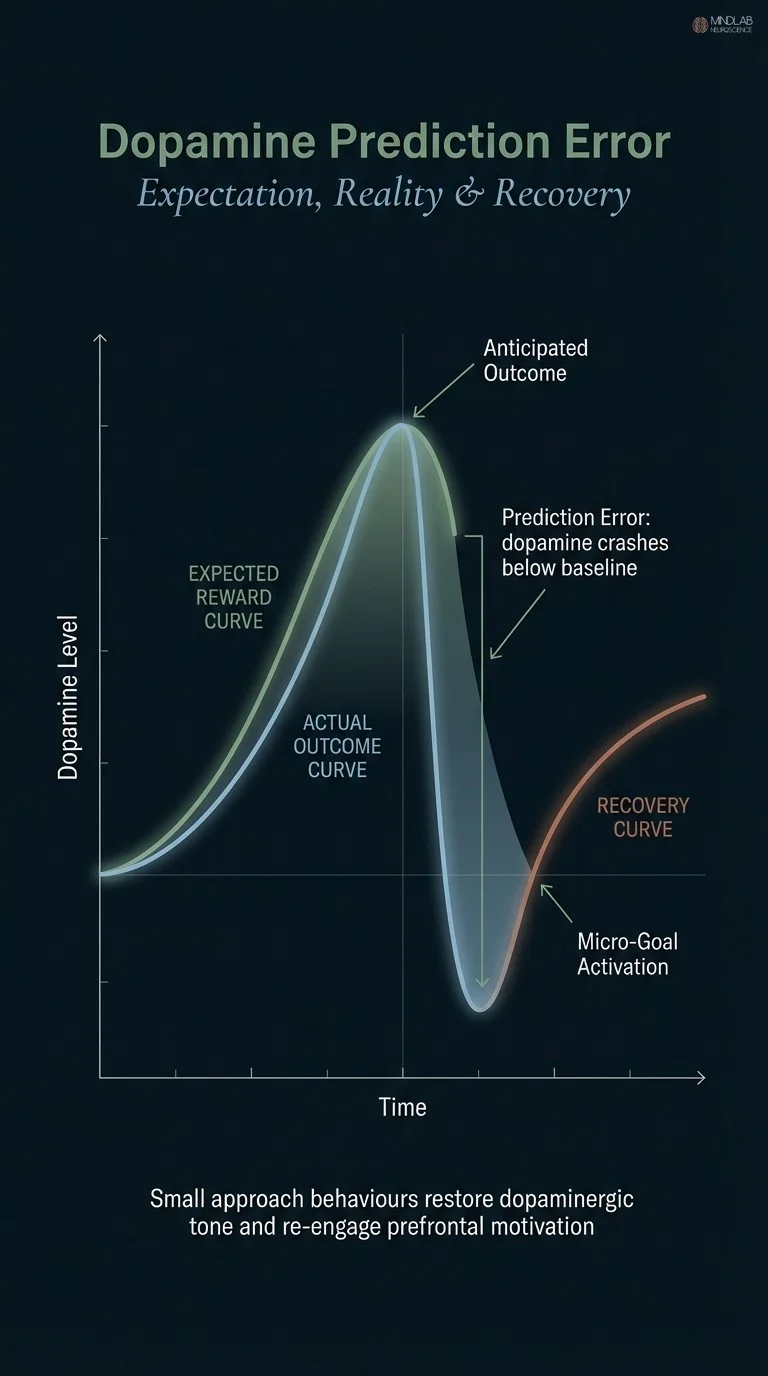
Dopamine drops sharply after disappointment because the brain’s reward prediction system registers the absence of an expected reward as a net negative, a signal that is neurochemically more destabilizing than a neutral outcome, but the system is designed to recover through revised expectation-setting, renewed goal engagement, and behavioral momentum.
The dopamine system is not a happiness meter. It is a prediction and motivation engine. When a prediction is violated by failure, dopamine release falls below baseline, producing the characteristic motivational flatness, reduced drive, and difficulty initiating effort that follows significant setback. The duration of this state depends heavily on what happens next neurologically.
In my practice, the distinction that changes how I work with individuals after significant loss or failure is this: the goal is not to make them feel better about what happened but to re-engage the motivational circuitry through small, achievable approach behaviors. Even modest forward movement restores dopaminergic tone and re-engages the prefrontal motivation circuitry that stress disrupts.
For some, dopamine tone recovers within hours through behavioral reengagement. For individuals carrying unprocessed prior setbacks, the recovery is slower and requires more deliberate intervention to interrupt the compounding effect of multiple unresolved prediction errors stacking together.
Can Your Brain Learn to Bounce Back Faster from Setbacks?
The brain can learn to recover from setbacks more rapidly through a process of repeated exposure and stress inoculation, which gradually strengthens prefrontal regulatory control over the amygdala and dopamine system while building a neurologically grounded expectation that setbacks are survivable and navigable rather than catastrophic.
This is not resilience as a personality trait. It is resilience as a trained neural capacity. Each time an individual moves through a setback, processes the disappointment, maintains behavioral engagement, and reaches an adaptive outcome, the neural circuitry supporting that recovery is strengthened. Over repeated cycles, the brain begins to anticipate recovery rather than defaulting to catastrophizing.
Tai and colleagues conducted a systematic review of neuroimaging correlates of resilience, identifying the anterior cingulate cortex and prefrontal regions as central to the brain’s capacity for adaptive recovery after adversity. In my practice, the most reliable predictor of how quickly someone recovers from a setback is not the magnitude of what happened but the density and quality of their prior recovery experiences. Individuals who have been supported through failure recover at a measurably different rate than those who have not.
The caveat is that this capacity is built prospectively. It cannot be fully installed in the moment of crisis. The time to build neural resilience is before the next significant setback, not during it.
What Is Stress Inoculation and How Does It Build Neural Resilience?
Stress inoculation is a structured process of repeated, controlled exposure to manageable stressors that trains the brain’s stress-response system to activate more precisely, recover faster, and maintain prefrontal function under pressure, producing a neural architecture that handles high-stakes situations with greater efficiency.
The principle draws directly from immunology: small doses of a stressor, with adequate recovery, produce an adapted system rather than a damaged one. In neural terms, controlled stress exposure trains the hypothalamic-pituitary-adrenal axis to calibrate its response more accurately, preventing both under-reaction and the kind of runaway stress response whose excessive catecholamine signaling, amplified by cortisol, compromises prefrontal function.
Stress inoculation produces prefrontal cortex volume expansion and increased myelination, demonstrating that manageable early stress exposure physically restructures the brain regions responsible for emotional regulation. In my practice, stress inoculation within a structured methodology involves deliberately exposing individuals to the emotional terrain of their most challenging situations, with real-time support for processing and integrating the experience.
The nuance that is critical: inoculation requires adequate recovery between exposures. Stress without recovery produces sensitization, not resilience. The training effect depends entirely on the recovery arc being sufficient to allow the nervous system to consolidate the adaptive response.
Resilience is not a personality trait: it is a trained neural capacity built through supported exposure to manageable challenge, with the recovery arc being as important as the exposure itself.
How Does a Growth Mindset Physically Change the Brain?
A growth mindset produces measurable neurological differences in how the brain processes challenge and failure, specifically increasing anterior cingulate cortex engagement with errors, enhancing prefrontal cortex participation in learning responses, and sustaining dopaminergic motivation in the face of difficulty.
This is not positive thinking. A growth mindset produces a different neural response to the same event. When someone with a fixed mindset encounters failure, their brain’s error signal is processed primarily as a self-threat, triggering defensive withdrawal. When someone with a growth mindset encounters the same failure, the error signal is processed as useful information, activating learning circuitry rather than the threat-defense system.
Cognitive training enhances growth mindset through measurable plasticity in cortico-striatal circuits, with the strength of that circuit plasticity emerging as the strongest predictor of growth mindset gains. In my practice, this research matters because it means that a belief, something that can be restructured, is producing a different brain. The mindset is not just a psychological posture. It is a neural operating condition.
Individuals navigating prolonged high-stakes challenges often arrive having concluded that their struggle is evidence of a fixed limitation. The neurological evidence says otherwise: the brain that has not yet developed a capacity and the brain that lacks the capacity are not the same brain.
Why Does Suppressing Disappointment Make Recovery Harder?
Suppressing the emotional response to disappointment extends the neurological disruption rather than resolving it, cortisol remains elevated, the amygdala stays activated, and the prefrontal cortex expends regulatory resources on containment rather than adaptive processing, delaying the transition from distress to forward momentum.
The impulse to suppress is understandable. Individuals managing multiple demanding domains, family obligations, professional responsibilities, relational needs pulling in competing directions, often cannot afford the perceived luxury of processing disappointment when it arrives. So they contain it. The problem is that containment is metabolically expensive for the brain and neurologically incomplete. The emotional signal has been generated; suppressing its expression does not cancel the neurochemical cascade already in progress.
What I observe consistently in my practice is that suppressed disappointment does not disappear. It compounds. Each unprocessed setback adds to a stress burden whose excessive catecholamine signaling, amplified by cortisol, progressively degrades prefrontal capacity, producing a state in which the individual is simultaneously carrying more unresolved emotional material and less equipped to process it. The individual who describes suddenly breaking down over a minor frustration is not overreacting to the minor event, they are finally exceeding the containment threshold for everything they have not processed. The neuroscience supports a counterintuitive but reliable principle: processing disappointment fully and immediately produces faster functional recovery than suppressing it, even when suppression appears more efficient in the short term.
What Neural Strategies Turn Disappointment into Forward Momentum?
Disappointment is converted into forward momentum when the brain is guided from the dopaminergic crash of a failed prediction into a renewed approach state, achieved through deliberate meaning-making, micro-goal activation, and the reframing of the failure signal as navigational data rather than identity evidence.
The neural sequence that produces this shift is specific. First, the individual must process the emotional content of the disappointment without suppression. Suppression extends cortisol exposure and delays recovery. Second, the anterior cingulate cortex’s error signal must be redirected into problem-solving rather than self-evaluation. Third, a small, achievable goal must be identified and engaged with, because even modest approach behavior restores dopaminergic tone.
The reframe that produces the most durable neural change is not “this didn’t matter” or “I’m fine”, both of which are suppressive and neurologically counterproductive. It is “this is data my brain can use,” delivered with enough structural support that the nervous system believes it. In 26 years of working with individuals through significant setbacks, I have consistently found that the ones who develop lasting resilience do not skip the grief of disappointment, they move through it faster because they have a reliable internal method for doing so. That method begins not with forcing determination but with fully processing the loss first, the acceptance phase of coping with disappointment that makes the subsequent shift into forward drive neurologically possible.

Is resilience something you are born with or can it be developed?
Resilience is a trained neural capacity, not a fixed personality trait: the brain regions governing setback recovery, including the anterior cingulate cortex and prefrontal regulatory circuits, retain significant plasticity throughout the lifespan. Genetic factors influence baseline stress reactivity and dopaminergic recovery speed, establishing a starting point that varies between individuals. However, neuroimaging research consistently demonstrates that structured exposure to manageable challenges, combined with adequate recovery periods, produces measurable increases in prefrontal regulatory capacity and stress inoculation regardless of genetic baseline.
Why do some people seem to recover from setbacks faster than others?
Recovery speed after setback is determined primarily by the strength of prefrontal-amygdala regulatory connectivity and the individual’s accumulated library of prior recovery experiences, not by emotional toughness or personality strength. Individuals with stronger prefrontal regulatory circuits process the error signal as navigational data rather than identity evidence, enabling faster transition from the initial dopamine crash to renewed approach behavior. Prior experience of supported recovery, moving through disappointment and reaching an adaptive outcome, builds the neural architecture that makes subsequent recovery progressively faster.
Can repeated disappointments make you more resilient or do they cause lasting damage?
Repeated disappointments produce either resilience or sensitization depending entirely on the recovery conditions. This distinction is the core principle of stress inoculation neuroscience. Manageable setbacks followed by adequate recovery and adaptive processing strengthen the stress-response system and build prefrontal regulatory capacity. However, repeated setbacks without sufficient recovery produce the opposite: sensitization of the amygdala, cortisol dysregulation, and progressive erosion of the prefrontal circuits needed for adaptive processing. The variable is not the frequency of disappointment but the quality of the recovery arc.
What is the difference between giving up and strategic withdrawal after a setback?
Strategic withdrawal and giving up produce different neural signatures: strategic withdrawal engages the prefrontal cortex in a deliberate evaluation of cost-benefit analysis while maintaining dopaminergic approach motivation for alternative goals, whereas giving up involves amygdala-driven disengagement with suppressed prefrontal activity and generalized motivational collapse. The distinction is whether the decision to step back is being driven by the brain’s rational evaluation system or by its threat-avoidance system. Strategic reallocation of effort preserves the neural capacity for future engagement; shame-driven abandonment erodes it.
References
- Chen, L., Chang, H., Rudoler, J., Arnardottir, E., Zhang, Y., de los Angeles, C., and Menon, V. (2022). Cognitive training enhances growth mindset in children through plasticity of cortico-striatal circuits. npj Science of Learning, 7, 30. https://doi.org/10.1038/s41539-022-00146-7
- Draganski, B., Gaser, C., Busch, V., Schuierer, G., Bogdahn, U., and May, A. (2004). Neuroplasticity: Changes in grey matter induced by training. Nature, 427(6972), 311-312. https://doi.org/10.1038/427311a
- Locke, E. A., and Latham, G. P. (2002). Building a practically useful theory of goal setting and task motivation: A 35-year odyssey. American Psychologist, 57(9), 705-717. https://doi.org/10.1037/0003-066X.57.9.705
- Pascual-Leone, A., Amedi, A., Fregni, F., and Merabet, L. B. (2005). The plastic human brain cortex. Annual Review of Neuroscience, 28, 377-401. https://doi.org/10.1146/annurev.neuro.27.070203.144216
- Tai, A. P. L., Leung, M.-K., Geng, X., and Lau, W. K. W. (2023). Conceptualizing psychological resilience through resting-state functional MRI in a mentally healthy population: A systematic review. Frontiers in Behavioral Neuroscience, 17, 1175064. https://doi.org/10.3389/fnbeh.2023.1175064
What the First Conversation Looks Like
When someone reaches out to MindLAB Neuroscience after repeated setbacks, they are rarely looking for motivation. They have tried that. What they describe is a pattern: disappointment arrives, the initial recovery attempt stalls, and the next effort carries the accumulated weight of every previous failure. The brain has learned to predict the outcome before the situation unfolds.
Dr. Sydney Ceruto will identify the neural architecture behind your specific recovery pattern, where the dopaminergic motivation system is stalling, how the amygdala is encoding setback as identity evidence rather than navigational data, and what needs to change at the circuit level for determination to become the default response. From that clarity, a structured intervention takes shape: specific, measurable, and built on how the brain actually consolidates resilience.