Prefrontal Cortex Optimization: Neuroscience-Based Protocols for Sharpening Executive Function
Key Takeaways
- Three core executive functions live in distinct prefrontal subregions; training one alone produces narrow gains.
- Prefrontal volume erodes under chronic stress, sleep disruption, and autonomic dysregulation: mainly excessive catecholamines, cortisol-amplified.
- Adaptive executive training rotating novel tasks every two to three minutes is the best-supported paradigm.
- Transcranial random noise stimulation of the bilateral DLPFC lowers the plasticity threshold during cognitive training.
- Transfer to fluid intelligence requires concurrent engagement of all three executive functions, not sequential isolation.
- Real-Time Neuroplasticity™ applies the lab’s novel-task principle inside live high-load executive moments clients actually use.
Optimizing the prefrontal cortex means training the three executive functions that live in it: working memory, cognitive flexibility, and inhibitory control, while removing the loads that erode them. The highest-signal levers are adaptive executive training that rotates novel tasks every two to three minutes, targeted neuromodulation of the bilateral dorsolateral prefrontal cortex, and protection of the sleep architecture that consolidates gains. Equally important is the removal of chronic stress that structurally shrinks the circuit. Prefrontal cortex optimization is not a supplement stack: it is a converging engineering problem across training, stimulation, recovery, and insult removal.


How Do You Optimize the Prefrontal Cortex?
You optimize the prefrontal cortex by simultaneously training its three core executive functions: working memory, cognitive flexibility, and inhibitory control, each mapped to distinct dorsolateral, anterior cingulate, and ventrolateral substrates. Training one in isolation produces narrow, domain-specific gains. Training all three in rapidly rotating novel configurations is what produces transfer to fluid intelligence. This work fits within the brain health and optimization hub that examines how the brain protects and extends its performance.
The unity-and-diversity model of executive function, formalized in the modern Friedman & Robbins (2021) synthesis in Neuropsychopharmacology, identifies a general “common EF” factor that shares heavy variance with response inhibition. Distinct components handle mental set shifting and working memory updating. The dorsolateral prefrontal cortex, or DLPFC, is the anatomical anchor for the updating component; the anterior cingulate carries the shifting load; the right inferior frontal gyrus and ventrolateral PFC handle inhibition. These regions operate as a network, not as independent modules.
Why working memory is the load-bearing function
Working memory is the load-bearing executive function because every other executive operation depends on holding the relevant representation online long enough to act on it. Inhibition requires holding the inhibited content. Flexibility requires holding the old rule while the new one is adopted. Updating requires holding the current state while a new state overwrites it.
In my practice I consistently observe a specific pattern in Young Professional clients, a product lead in her early thirties, for example, running three concurrent initiatives with the same cognitive architecture. When her working memory capacity degrades under sustained sprint load, it is not her attention that fails first. It is the slot depth, the number of items she can manipulate at once, not the number she can notice. That distinction changes the intervention entirely.
The prefrontal cortex is not fixed hardware. It erodes under chronic stress and broken sleep, and it rebuilds under the deliberate, novel demand that most routines never supply.
What Shrinks Your Prefrontal Cortex?
Chronic stress, sustained sleep deprivation, and persistent autonomic dysregulation shrink prefrontal volume through documented dendritic retraction and spine-loss mechanisms. The erosion is slow enough to be invisible quarter-to-quarter and rapid enough to reshape an individual’s executive performance within eighteen to twenty-four months of unprotected exposure to any of the three.
The structural evidence base is precise. Chronic stress produces measurable dendritic remodeling in the prefrontal cortex: apical dendrites retract, spine density drops, and the synaptic substrate for working memory is lost before any MRI-detectable volume change appears. A single night of total sleep deprivation shifts DLPFC-dependent task performance into a profile that looks identical to mild injury on a standard executive battery. Autonomic dysregulation (low resting heart rate variability, elevated sympathetic tone) tracks independently with reduced prefrontal recruitment during cognitive load. It also belongs to the broader cognitive architecture pillar that maps the regions driving executive function.
Consider a Burnt-Out Executive profile, a finance principal in his early fifties, sixteen-hour days for three years, four to five hours of fragmented sleep nightly. The order of operations is always the same. Inhibitory control goes first, visible as increased impulsive language and reactive decision-making. Cognitive flexibility goes next, visible as rigidity around problems that previously felt fluid. Working memory goes last, and by the time the client notices, the structural substrate is already compromised. The reversibility window is still open, but it narrows month by month.
The DLPFC rewires in the same live window the client is using it. That is the only moment the biology is cheap.
How Do You Rewire Your Prefrontal Cortex?
You rewire the prefrontal cortex by forcing it to hold multiple executive demands simultaneously under adaptive difficulty, optionally paired with neuromodulation that lowers the threshold for plasticity. The evidence base for this is the adaptive multitasking research originating with the Gazzaley lab’s NeuroRacer study and the parallel transcranial random noise stimulation literature.
The Anguera et al. (2013) study in Nature is the landmark paper. Older adults trained on an adaptive multitasking driving game (cognitive load scaled in real time, novel perceptual-motor demands rotated continuously) showed gains in cognitive control. Those gains transferred to untrained working memory and sustained attention tasks, with effects holding at six-month follow-up. The active ingredient was not the game content. It was the forced concurrency, the requirement to hold multiple demands online at an adaptive edge, the paradigm now generalized as flexible adaptive synergistic executive training. Readers often pair this with natural strategies to raise BDNF, since the growth factor supports the very circuits discussed here.
Pair that training with non-invasive DLPFC stimulation and the gain curve steepens. Snowball et al. (2013) in Current Biology showed that five consecutive days of transcranial random noise stimulation, or tRNS, over bilateral DLPFC during cognitive training produced learning-speed gains that persisted at six-month follow-up relative to sham controls. Near-infrared spectroscopy confirmed the mechanism: more efficient neurovascular coupling within the left DLPFC during the trained operations. Recent pilot work has extended the paradigm into mild cognitive impairment populations, confirming the DLPFC remains a translationally viable stimulation target in 2025.
This is where the lab’s paradigm becomes a live-moment intervention. When I work with a client managing a family health crisis alongside a charity board, the invisible-labor load fragments executive function through a fundamentally different pathway than corporate sprint load. The useful move is almost never a home training program alone. Real-Time Neuroplasticity™ is the framework I apply here. The DLPFC rewires in the same live window the client is using it, so the intervention lands on the actual circuit running the actual decision, not on a simulated version hours later. The lab’s novel-task rotation and the real-world analog, a cascade of concurrent unfamiliar demands under adaptive difficulty, are the same engineering principle operating in different contexts.
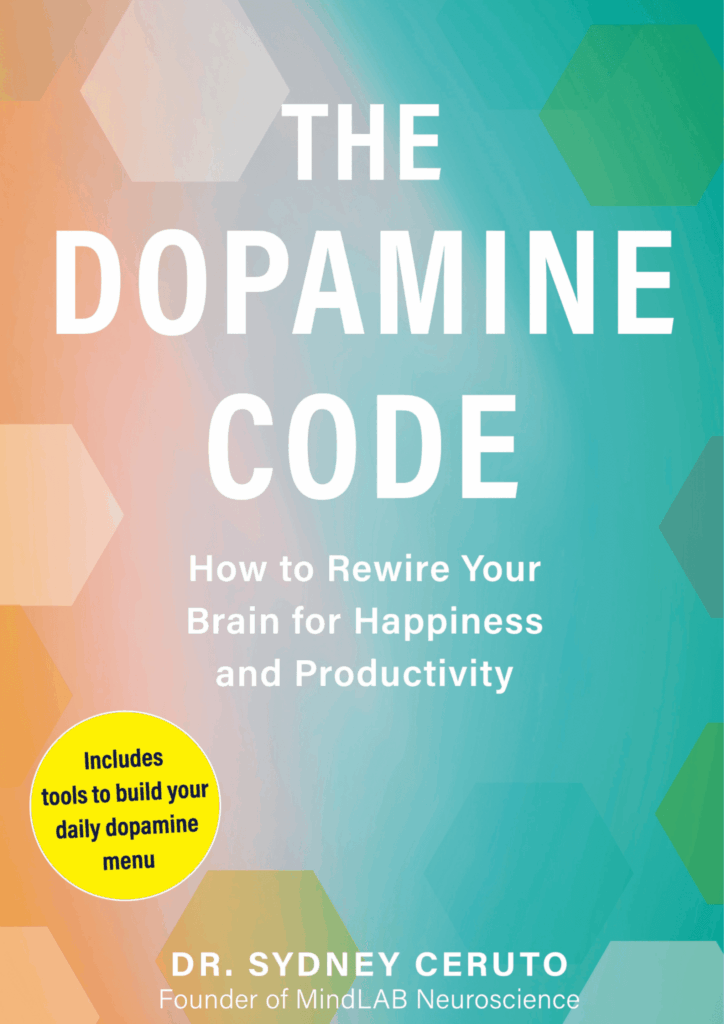
For a complete framework on understanding and resetting your dopamine reward system, I cover the full science in my forthcoming book The Dopamine Code (Simon & Schuster, June 2026). The dopamine-PFC coupling that routes through the ventral tegmental area sits one layer down from the executive architecture described above, relevant to inhibitory control specifically, but a distinct problem with its own intervention stack.
What Is the Role of Neurofeedback in Executive Function?
The published neurofeedback literature maps distinct electroencephalographic frequency bands to distinct executive subdomains: sensorimotor rhythm training relates to sustained attention, alpha training to processing speed, and theta training to memory consolidation. The evidence for transfer to real-world executive performance is genuinely promising, but methodologically uneven across studies to date.
The 2021 Viviani and Vallesi systematic review in Psychophysiology surveyed the existing EEG-neurofeedback studies targeting executive function in healthy adults. The qualitative conclusion is consistent: training protocols that target specific frequency bands produce measurable, band-aligned cognitive gains, but the design quality varies widely enough that meta-analysis remains premature. What the literature does converge on is the anatomical specificity: frontal midline theta tracks working memory demand in real time, and upregulating it during trained tasks produces the clearest generalization to untrained executive load. A related angle appears in how cognitive reserve protects aging brains, which shows why early investment compounds over decades.
This is a literature to read carefully, not to import wholesale. The research tells us which frequency bands correlate with which executive subdomains. It does not yet tell us that frequency-band training alone, absent the adaptive task load that gives the feedback something to modulate, produces durable rewiring. In my work the useful read identifies which executive subdomain is bottlenecking a specific client right now, and what live intervention that pattern calls for.
What Destroys the Frontal Cortex?
Acute destruction of frontal cortex arises from mechanisms distinct from chronic shrinkage. The agents are traumatic brain injury with diffuse axonal damage to DLPFC white matter, neuroinflammation driven by chronic infection or metabolic disease, and direct neurotoxic exposure through heavy alcohol, solvents, or protracted hypoxia. These are structural events, not slow erosion.
The traumatic-brain-injury literature gives the sharpest picture. Diffusion-tensor imaging after moderate-to-severe TBI shows localized damage in the bilateral dorsolateral prefrontal cortices that correlates specifically with impaired rational-choice performance on gambling tasks: the executive subdomain tracks the injured tissue with striking specificity. Neuroinflammatory insults produce a different pattern: blood-brain-barrier compromise, microglial activation, and a diffuse degradation of prefrontal efficiency that shows up before any region-specific structural change. Chronic heavy alcohol exposure produces volume loss across the frontal cortex that is partially reversible with six to twelve months of sustained abstinence in moderate-use populations, and partially irreversible in severe-use populations.
The distinction between this section and the prior one matters in practice. Chronic shrinkage under sustained stress is a slow-erosion problem: the response is load removal plus rebuilding. Acute destruction is a structural-insult problem: the response depends on the insult, starts with medical imaging, and operates on a different time course. Both can coexist, and in a meaningful fraction of the cases I see, both are present and require separate workstreams.
References
Arnsten, A. F. T. (2015). Stress weakens prefrontal networks: Molecular insults to higher cognition. Nature Neuroscience, 18(10), 1376–1385. https://doi.org/10.1038/nn.4087 Diamond, A. (2013). Executive Functions. Annual Review of Psychology, 64, 135–168. https://doi.org/10.1146/annurev-psych-113011-143750 McEwen, B. S., Nasca, C., & Gray, J. D. (2016). Stress Effects on Neuronal Structure: Hippocampus, Amygdala, and Prefrontal Cortex. Neuropsychopharmacology, 41(1), 3–23. https://doi.org/10.1038/npp.2015.171 Viviani, G., & Vallesi, A. (2021). EEG-neurofeedback and executive function enhancement in healthy adults: A systematic review. Psychophysiology, 58(9), e13874. https://doi.org/10.1111/psyp.13874 Newcombe, V. F. J., Outtrim, J. G., Chatfield, D. A., Manktelow, A. E., Hutchinson, P. J., et al. (2011). Parcellating the neuroanatomical basis of impaired decision-making in traumatic brain injury. Brain, 134(3), 759–768. https://doi.org/10.1093/brain/awq388What the First Conversation Looks Like
When clients come to the MindLAB Neuroscience practice asking about prefrontal cortex optimization, the first conversation is never a lecture on the DLPFC. It is a mapping of the specific executive subdomain currently bottlenecking their work: working memory slot depth, cognitive flexibility under a new problem type, inhibitory control under emotional load. I listen for the load structure shaping that bottleneck right now. I listen for the exact pattern of what is failing first, what is compensating, and where the structural erosion is most active. From there the work is specific. We map the architecture as it is currently functioning. Then we identify the two or three levers with the largest return and build the feedback loop that lets the rewiring land inside the live executive moments that matter. Reach me for a strategy call.
– Dr. Sydney Ceruto, MindLAB Neuroscience
What is the difference between the prefrontal cortex and the DLPFC?
The prefrontal cortex is the entire anterior portion of the frontal lobe; the dorsolateral prefrontal cortex, or DLPFC, is one specific subregion within that broader cortex. The DLPFC carries the working memory updating function and is the primary target of executive function training and non-invasive neuromodulation research. Other prefrontal subregions handle distinct executive subdomains: the ventromedial prefrontal cortex governs value-based decision-making, the ventrolateral PFC contributes to inhibition, and the anterior cingulate routes attention and flexibility.
How long does prefrontal cortex optimization take?
Functional gains in the targeted executive subdomain appear within four to six weeks of adaptive executive training. Transfer to fluid intelligence emerges at the eight to twelve week mark in the Anguera NeuroRacer lineage of studies. Structural recovery from chronic stress erosion operates on a much slower timeline: three to six months of unprotected stress removal before dendritic rebuild becomes measurable. The order matters: load removal first, then training, then consolidation through protected sleep.
Can supplements improve prefrontal cortex function?
No supplement in the current evidence base produces durable executive function gains comparable to adaptive executive training, targeted neuromodulation, or protected sleep architecture. Some compounds (omega-3 fatty acids, magnesium threonate, creatine monohydrate) show modest effects on components of working memory under specific deficit conditions, typically small in effect size. These are adjuncts to a training-and-recovery architecture, never a substitute for it. The effect matters at the margin, not the mechanism. The DLPFC rewires under sustained load, not under consumption.
Is transcranial stimulation safe for executive function training?
Non-invasive transcranial random noise stimulation and transcranial direct current stimulation, applied within published safety parameters, have a well-documented and favorable tolerability profile in healthy adult populations across multiple decades of research. Side effects are typically mild and transient: skin sensation under the electrodes, rare short-lived headache. The methodology remains a research paradigm rather than a consumer intervention; quality depends heavily on operator expertise, electrode placement precision, and stimulation-parameter selection for the specific cognitive target.
Does meditation strengthen the prefrontal cortex?
Focused-attention contemplative practices produce measurable shifts in prefrontal recruitment and gamma-band oscillations after eight to twelve weeks of consistent daily practice. The effect on executive function transfer is real but smaller than adaptive multitasking training or DLPFC neuromodulation, and it emerges only under genuinely consistent practice regimes. In the intervention hierarchy, contemplative practice occupies a supporting tier, useful as a recovery and autonomic-regulation input, not the primary mechanism for rewiring the executive architecture itself.