Key Takeaways
- Negative thought patterns are reinforced default mode network pathways, not habits, firing automatically under triggers.
- Negativity bias is asymmetric by design: negative inputs register three times more intensely than positive.
- Rumination is associated with increased amygdala reactivity and decreased prefrontal regulation, changing threat-assessment architecture.
- Not forced positivity: overcoming negative patterns means competing neural pathways triggered by the same conditions.
- Pattern interruption disrupts the activation cascade before consolidation, so earlier interruption is more effective.
Overcoming Negative Thought Patterns: A Neuroscience Perspective

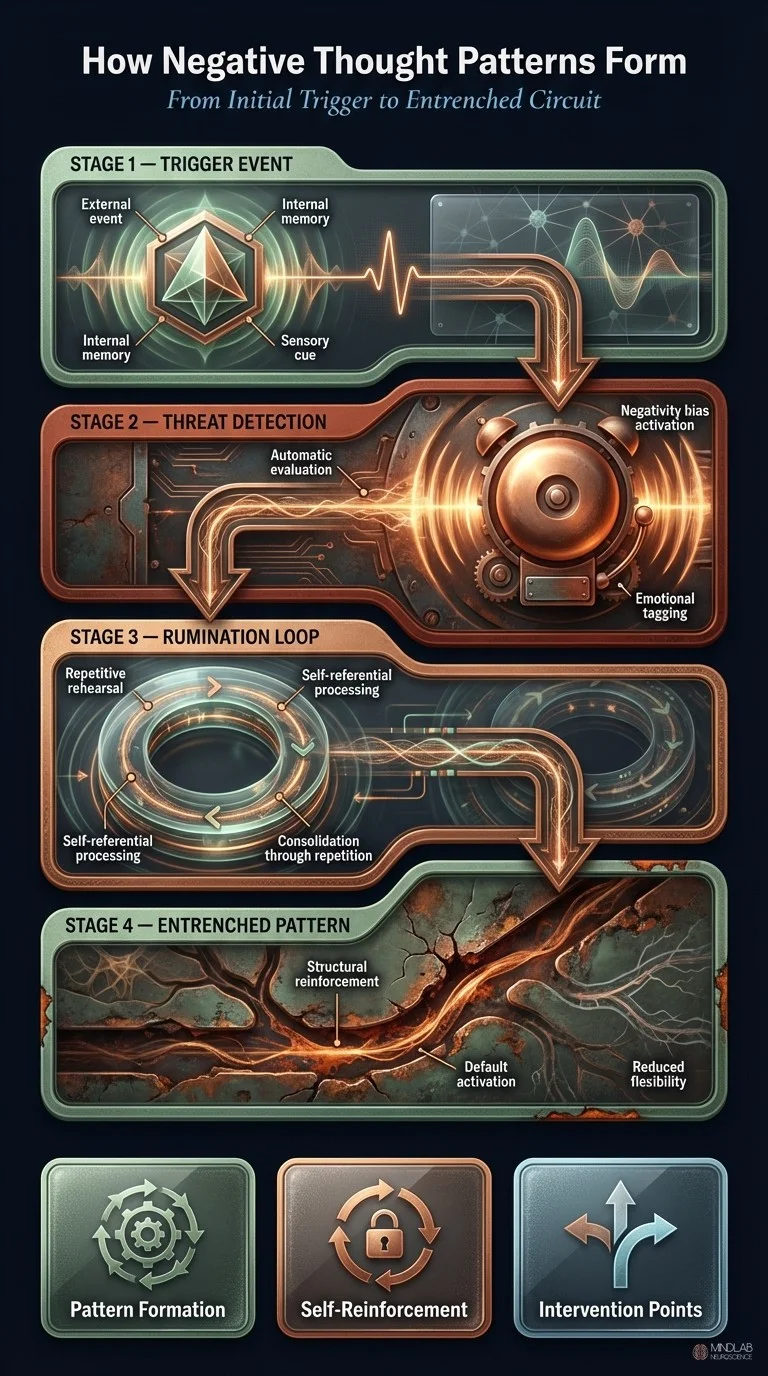
Overcoming negative thought patterns begins with a reframe the brain itself supports: these patterns are not permanent traits or character flaws, they are reinforced neural pathways that fire automatically under trigger conditions. Because they are learned circuits, they can be retrained. In my practice, the clients who break long-standing negativity are rarely the ones who try hardest to think positively, they are the ones who learn to build a competing pathway in the exact moment the old one wants to fire.
This cognitive shift in perspective highlights that negative thought patterns are not permanent traits, but habits of the brain that can be unlearned and replaced with healthier alternatives. When we view these patterns as modifiable rather than fixed, we gain both clarity and agency in the process of change. Importantly, this reinforces the idea that no matter how long someone has been stuck in cycles of negativity, it is never too late to retrain the brain and cultivate new ways of thinking.
The Neural Pathways of Negative Thought Patterns
Negative thought patterns, one of the cognitive flexibility and thought patterns the brain can retrain, trace back to specific neural pathways. Once formed, these pathways can become the default routes for our thoughts, especially when triggered by certain stimuli or situations. A stressful workplace interaction might immediately trigger self-critical thoughts if those pathways have been reinforced over time.
However, the principle of neuroplasticity offers hope. Just as these pathways were formed, they can also be reformed or redirected. With consistent practice, individuals can strengthen alternative pathways that support resilience, optimism, and constructive self-reflection. This finding means that every intentional thought and action, no matter how small, contributes to rewiring the brain toward healthier outcomes.
Strategies Rooted in Neuroscience for Overcoming Negative Thoughts
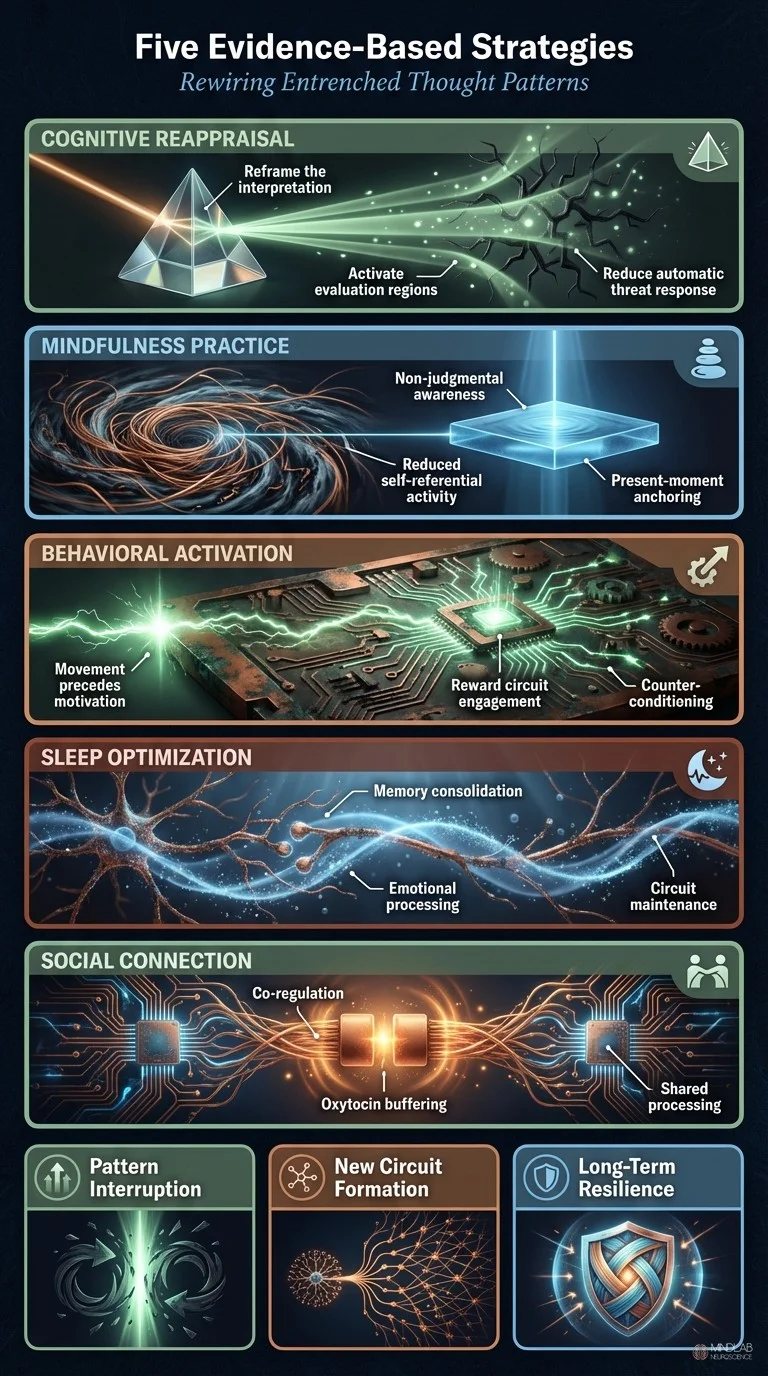
- Intentional awareness and Focused stillness: Engaging in intentional awareness practices can help in recognizing negative thought patterns as they arise. By being present and observing these thoughts without judgment, we can weaken the neural pathways associated with them. Intentional awareness also reduces activity in the amygdala, the brain’s fear center, while enhancing connectivity in regions associated with focus and emotional regulation.
- Cognitive Restructuring: This technique involves challenging and replacing negative thoughts with more balanced and positive ones. Over time, this can lead to the formation of new, healthier neural pathways. For instance, reframing “I always fail at this” into “I am still learning and improving with each attempt” builds circuits that encourage perseverance rather than avoidance.
- Positive Reinforcement: Rewarding oneself for recognizing and challenging negative thoughts can activate the brain’s reward system, making the process of overcoming negative patterns more ingrained. Small rewards, like celebrating progress, acknowledging effort, or taking breaks for enjoyable activities, help the brain associate change with positivity, encouraging consistency.
- Exposure-Based Practice: Gradually facing and The Default Mode Network and Automatic Negativity
The default mode network, a constellation of brain regions that activates during rest, daydreaming, and self-referential thought, plays a central role in sustaining negative thought patterns. When the mind is not engaged in a specific task, the default mode network generates spontaneous internal narratives. For individuals with entrenched negative patterns, these narratives skew heavily toward self-criticism, worst-case projections, and rehearsal of past failures. The medial prefrontal cortex, posterior cingulate cortex, and angular gyrus, key nodes in this network, become the staging ground for repetitive negative content that feels involuntary precisely because it is generated by a network that operates outside deliberate control.
Critically, the default mode network does not distinguish between productive reflection and unproductive rumination. The same neural infrastructure that enables planning, empathy, and creative problem-solving also generates the looping, self-referential negativity that characterizes persistent thought patterns. The difference lies in how effectively the brain’s executive control network, anchored in the dorsolateral prefrontal cortex, can modulate default mode activity. In individuals with strong negative patterns, the executive control network is less effective at interrupting default mode output, creating the experience of thoughts that arrive uninvited and resist dismissal.
The Role of Sleep in Consolidating or Weakening Thought Patterns
Sleep architecture has a profound and often underappreciated influence on negative thought patterns. During slow-wave sleep, the hippocampus replays the day’s experiences and transfers them to long-term cortical storage. During REM sleep, the brain processes emotional content, stripping some of the emotional charge from memories while integrating them into broader narrative structures. When sleep quality is compromised, through insufficient duration, disrupted architecture, or chronic stress-related cortisol elevation, the emotional processing function of REM sleep is impaired. Negative experiences retain a disproportionate emotional charge, and the neural pathways encoding those experiences are consolidated without adequate emotional regulation. The result is a progressive deepening of negative thought patterns that becomes self-reinforcing: poor sleep intensifies negative thinking, and negative thinking disrupts sleep quality, creating a cycle that must be addressed at both ends simultaneously.
Neuroscience provides a framework for understanding and overcoming negative thought patterns. By leveraging the brain’s inherent plasticity and combining it with targeted neural techniques, individuals can pave the way for healthier thinking and improved mental well-being. The process requires patience and repetition, but the reward is lasting change: a brain that is wired not for cycles of negativity but for growth, resilience, and fulfillment. When individuals commit to this process, they don’t just reduce negative thoughts, they actively build a foundation for greater clarity, creativity, and long-term well-being.
The patterns described in this article were built through thousands of neural repetitions, and they require targeted intervention to rewire. Real-Time Neuroplasticity™ provides the mechanism: intervening during the live moments when the pattern activates, building new neural evidence that a different response is architecturally possible.
Negative Thought Pattern Neural Substrate Why Common Approaches Fail What Works Rumination (replaying past) DMN activation + low prefrontal interruption; hippocampal over-consolidation Suppression amplifies; distraction temporary; insight doesn’t stop the circuit Specific actionable focus: “What is the one next step?” moves to prefrontal problem-solving Worry (catastrophizing future) ACC threat-prediction overactivation; amygdala amplification Reassurance temporary; probability arguments don’t reach the threat circuit Written worry capture + defined worry window: contains rather than cycles Self-comparison (others are doing better) Social reward circuit comparing current status to perceived others’ status Gratitude lists don’t recalibrate the comparison circuit Redirect comparison toward temporal self (past vs. current vs. future self) Worst-case anchoring (assuming negative outcomes) Negativity bias + confirmatory attention toward threat-consistent evidence Positive reframes feel false to the circuit because they lack evidence Evidence-based outcome history: what actually happened in previous similar situations Global negative labeling (“I always,” “I never”) Overgeneralization from single-event to permanent trait; identity fusion with the pattern Counter-examples feel like exceptions rather than disconfirmations Specific behavioral observation rather than character labeling 
Negative thought patterns are not a sign that something is wrong with your character. They are a sign that a neural pathway has been used more than its alternatives, and neural pathways do what they are practiced to do. The question is not why you think negatively. It is what circuit could you be practicing instead, in the exact moments the negative pattern wants to fire.
 Frequently Asked Questions
The following questions address common points of confusion about negative thought patterns, their neural basis, and why standard approaches often fall short. Each answer draws on current neuroscience to clarify what is actually happening in the brain and what interventions are most likely to produce lasting change.
Why do negative thoughts seem to appear automatically?
Negative thought patterns fire automatically because they are consolidated neural circuits in the default mode network, and consolidated circuits activate in response to their trigger conditions without requiring deliberate initiation. The brain maintains its default mode network at relatively high background activity during low-engagement states, producing self-referential thought generation as a biological baseline.
Can rumination actually change your brain?
Yes, sustained rumination produces measurable structural and functional changes in the brain over time. Prolonged rumination is associated with increased amygdala volume and reactivity, reduced prefrontal gray matter density, and hippocampal changes that affect memory consolidation and context-processing. These changes create a feedback loop: the rumination pattern weakens the prefrontal regulation capacity that could interrupt it, making future rumination more likely and harder to stop.
What is the difference between processing a problem and ruminating on it?
Processing produces movement, toward a decision, a plan, an acceptance, or a changed perspective. Rumination cycles through the same material repeatedly without generating new information or producing action. Neurologically, processing engages the dorsolateral prefrontal cortex ‘s problem-solving function alongside the default mode network’s self-referential circuit; rumination is predominantly default mode network activation with insufficient prefrontal engagement.
How does physical movement affect negative thought patterns?
Physical movement interrupts negative thought patterns through multiple mechanisms. Aerobic movement activates the norepinephrine and dopamine systems, which reduce default mode network dominance and increase prefrontal engagement, directly counteracting the neural conditions that sustain rumination. Movement also provides a different sensory and motor focus that competes with the self-referential content of negative patterns for the brain’s attentional resources.
Why is forcing positive thinking ineffective for negative thought patterns?
Forced positive thinking asks the brain to counter a strongly consolidated negative pattern with a weakly consolidated positive one, and the neurochemical competition is uneven. The negative pattern has more repetitions, stronger emotional loading due to the negativity bias, and faster activation under trigger conditions. More importantly, the positive frame often feels experientially false because the threat circuit has evidence supporting the negative pattern and no equivalent evidence for the positive claim.
References
- Doidge, N. (2007). The Brain That Changes Itself. Penguin Books.
- Hanson, R. (2013). Hardwiring Happiness: The New Brain Science of Contentment, Calm, and Confidence. Harmony Books.
- Kabat-Zinn, J. (2013). Full Catastrophe Living: Using the Wisdom of Your Body and Mind to Face Stress, Pain, and Illness (Revised ed.). Bantam Books.
- LeDoux, J. (2015). Anxious: Using the Brain to Understand and Treat Fear and Anxiety. Penguin Books.
From Reading to Rewiring
Understand the neuroscience. Apply it to your life. Work directly with Dr. Sydney Ceruto to build a personalized strategy.
One hour with Dr. Ceruto