The Default Mode Network and Why the Brain Keeps Replaying the Same Scenes
Most people describe rumination as a thinking problem: the inability to stop replaying a conversation, a failure, a decision that can’t be undone. What the neuroscience reveals is something more precise and more actionable: this pattern is what happens when the brain’s default mode network locks into a self-referential processing loop with no exit condition.
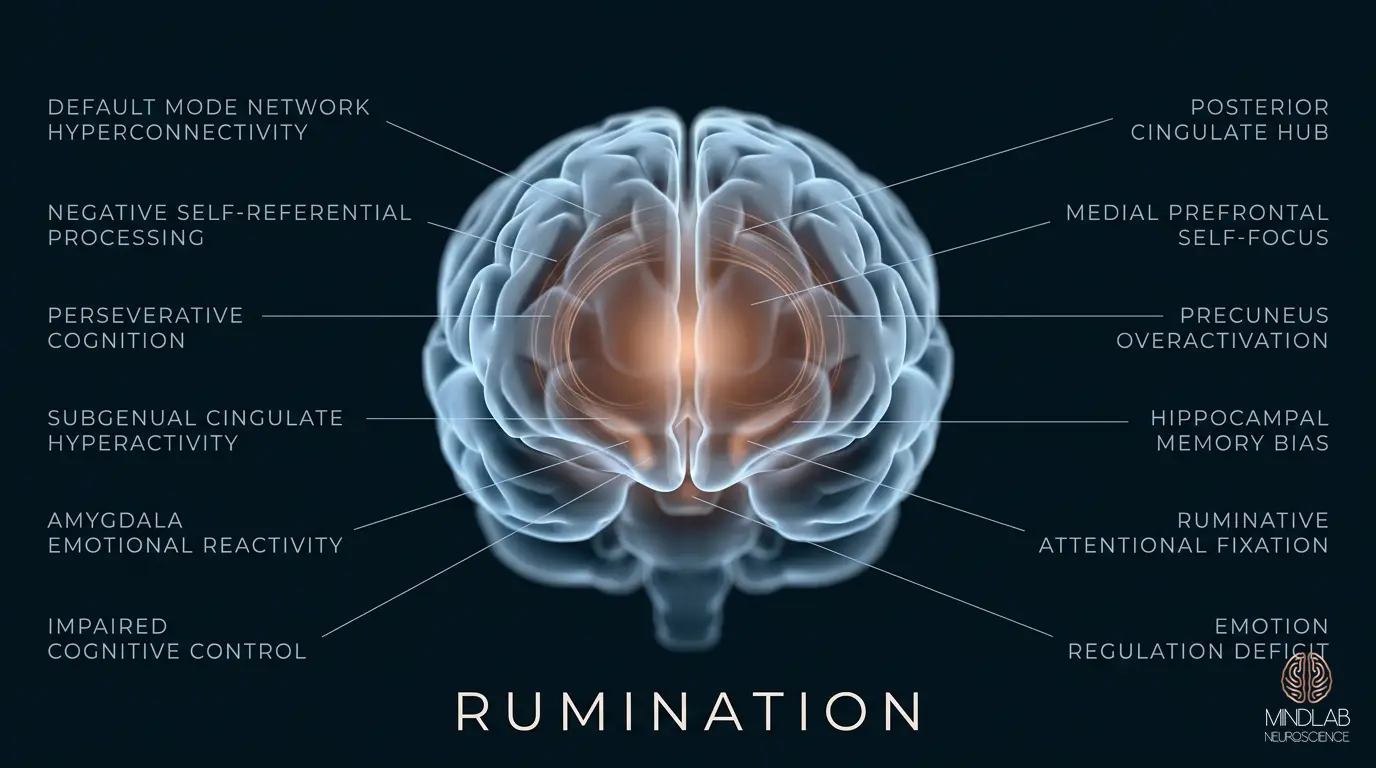
The default mode network (a distributed neural system involving the medial prefrontal cortex, the posterior cingulate cortex, and the angular gyrus) is the architecture the brain activates during self-referential thought. When you are not actively engaged with the external environment, the default mode network switches on. It replays past events, models hypothetical futures, evaluates the self in social context, and maintains the narrative identity that gives experience coherence. This is its function. It is not a malfunction.
The loop begins when the default mode network’s self-referential processing gets stuck. Instead of moving fluidly through past-present-future modeling and arriving at updated understanding, the kind of cognitive flexibility that healthy thought patterns require, the cycle becomes recursive. The same material recycles. The same interpretations fire. The same emotional valence, usually aversive, reactivates with each pass. What should have been self-reflection has become something neurologically different: a resonating circuit that generates the feeling of thinking without producing cognitive progress.
Research using fMRI imaging has identified a specific signature in individuals prone to this pattern: elevated and prolonged default mode network activity that fails to disengage when task demands require it. In healthy cognition, the default mode network deactivates when external attention is needed, and reactivates during internal processing. In those caught in these loops, this toggle is dysregulated. The network stays active. The cycle keeps running. And the emotional cost accumulates with every pass.
Dr. Sydney Ceruto’s approach to this pattern begins with this architecture. Understanding which neural system is sustaining the loop, and what conditions maintain the lock, determines what recalibration actually requires. Rumination is not a personality trait. It is a regulatory failure in a circuit that is otherwise performing exactly the function it was built for.
Rumination vs. Productive Reflection: A Neural Boundary That Most People Miss
The question I encounter most often from high-capacity individuals is this: how do I know when I’m thinking something through versus spinning in a loop? It is the right question, and the neuroscience provides a meaningful answer: one that has nothing to do with effort or willpower.
Productive reflection is characterized by cognitive movement. The brain processes new information, updates its model of the situation, reduces uncertainty, and generates novel options or conclusions. Activity during genuine reflection involves the prefrontal cortex’s executive network working in coordination with default mode network structures: the prefrontal cortex providing regulation and direction, the default mode network contributing autobiographical context and self-relevant integration. The result is forward movement: the mind engaging material and emerging with something it didn’t have before.
Rumination lacks this forward movement entirely. The defining neurological signature is repetition without update: the same circuits activating, the same representations arising, the same affective charge re-experienced, with no change in the underlying model or the conclusions it generates. The prefrontal cortex’s regulatory influence is degraded. The anterior cingulate cortex, which should be flagging the absence of progress and triggering a strategy shift, is failing to do so. The loop continues because the brain’s error-monitoring system is not identifying the recursive cycling as a failure state requiring interruption.
The practical implication of this distinction is significant. Telling a person to “think about it differently” or to “move on” is not engaging the actual problem. The prefrontal regulatory capacity that would redirect the loop is precisely what the cycle degrades. This is why willpower-based interruption strategies produce such short-term results: they require the neurological resource that the loop itself is consuming.
Amygdala-ACC Coupling and Why Rumination Feels Impossible to Stop
The subjective experience most people describe, the sense that stopping is not simply a matter of deciding to stop, has a direct neurological explanation. It involves the coupling between the amygdala and the anterior cingulate cortex (ACC), and the way this coupling creates a self-sustaining cycle that doesn’t require a new trigger to keep running.
The amygdala encodes emotional significance. When a memory, an interpretation, or a self-evaluation carries aversive emotional weight, the amygdala tags it with a threat or failure signal that elevates its neural priority. The anterior cingulate cortex responds to conflict and error: it monitors for discrepancies between what the brain expects and what it observes, and it signals the need for processing when that discrepancy exists. In ruminative cycles, these two structures form a problematic partnership: the amygdala flags the material as threatening or unresolved, the ACC registers the unresolved state as a conflict requiring attention, and the default mode network is then tasked with processing the flagged material. But the processing produces no resolution: the material remains affectively charged, and so the amygdala continues to flag it, the ACC continues to register conflict, and the loop sustains itself.
This amygdala-ACC coupling in ruminative cycles explains something that every person dealing with rumination recognizes: the pattern intensifies under stress. When the amygdala is more reactive (because of sleep deprivation, elevated cortisol, social threat, or accumulated fatigue) the threat signal attached to the ruminative material increases. The ACC registers greater conflict. The loop runs faster and with greater emotional intensity. The individual is not spiraling because they have less willpower in that moment. They are spiraling because the neural circuit driving the pattern is being amplified by systemic physiological factors outside the loop itself.
Dr. Ceruto’s work engages this directly. Recalibrating rumination requires addressing the amygdala’s threat-tagging of specific material, not just interrupting the loop, but changing what the amygdala registers as requiring sustained threat-priority processing. Until that shift occurs, interruption is temporary. The material resurfaces. The loop restarts.
Depressive vs. Anxious Rumination: Two Separate Neural Circuits, Two Different Problems
One of the most important distinctions in the neuroscience of rumination is the difference between its depressive and anxious forms. These are frequently collapsed in popular descriptions, treated as variations of the same pattern, but the neural circuitry involved is meaningfully different, and the intervention requirements follow from that difference.
Depressive rumination is characterized by backward orientation. The mind repeatedly returns to past events, failures, losses, and regrets. The default mode network activity is heavily concentrated in posterior medial cortex structures, particularly the posterior cingulate cortex, which anchors the processing to autobiographical memory. The affective signature is one of heaviness, hopelessness, and diminished self-concept. Neurochemically, this pattern involves sustained activation of the hypothalamic-pituitary-adrenal axis and the suppression of dopaminergic reward signals: the brain stuck in a loop that reinforces the absence of forward pull. The characteristic functional impairment in depressive rumination is motivational: the individual cannot generate genuine engagement with future-oriented tasks because the circuitry generating anticipatory reward is being suppressed by the ruminative activation.
Anxious rumination operates on a different axis: one that maps directly onto the neural circuitry of anxiety and threat calibration. It is forward-oriented, not replaying what has happened but repeatedly modeling what might happen. The neural profile involves elevated activity in the ventral default mode network structures involved in future simulation, combined with heightened amygdala reactivity that attaches threat valence to the simulated outcomes. The bed nucleus of the stria terminalis (BNST), which maintains sustained vigilance states even in the absence of specific triggers, plays a larger role here than in depressive rumination. The functional impairment is different: less about motivational depletion, more about an inability to commit to decisions, tolerate uncertainty, or disengage from threat-modeling even when the threats being modeled are remote or hypothetical.
These distinctions carry direct implications for what recalibration requires. An approach calibrated for depressive rumination, targeting the backward-facing default mode loop and its dopaminergic suppression, will produce limited results applied to the forward-facing threat-modeling loop of anxious rumination. The neural targets differ. The intervention architecture differs. Identifying which pattern is primary, or whether both are present and how they interact, is a necessary precondition for effective work.
The Attention Capture Model: How Rumination Hijacks Cognitive Resources
Rumination does not simply occupy conscious thought. It consumes attentional resources that the brain requires for effective executive functioning, and the mechanism by which it does this helps explain the wide range of cognitive impairments that accompany chronic ruminative patterns.
The attention capture model proposes that ruminative content acquires a form of attentional priority, driven by the amygdala’s threat-tagging and the ACC’s unresolved-conflict signaling, that competes directly with task-relevant processing. When ruminative content is neurally active, it functions like a high-priority interrupt in the brain’s attentional allocation system. Working memory capacity is reduced because neural resources are being diverted to maintain and process the ruminative loop. The dorsolateral prefrontal cortex, which governs executive attention and working memory, operates with degraded bandwidth. The result is a measurable reduction in cognitive performance that the individual often attributes to distraction or low motivation, rather than recognizing it as the functional consequence of attentional capture.
What this means practically is that rumination imposes a hidden cognitive tax on everything else. High-capacity individuals dealing with ruminative patterns frequently notice that their analytical clarity, creative output, and decision-making precision are inconsistent, the same cognitive disruption that characterizes chronic overthinking and recursive analytical loops, performing well at some moments and poorly at others without an obvious external cause. The neural explanation is consistent: performance degrades when the ruminative loop has captured sufficient attentional resources to impair the prefrontal systems those capacities depend on.
The attention capture model also illuminates why task-switching is so difficult during active rumination. The brain’s attentional system, under normal conditions, releases captured resources when a task is completed or interrupted. Ruminative content has no completion condition: the loop doesn’t resolve because the underlying emotional and cognitive conflict it is processing remains unresolved. Attentional resources remain captured indefinitely. The individual is trying to redirect attention with a cognitive system that is already at partial capacity.
The Intensity Gradient: Why Rumination Worsens Under Pressure
Individuals who experience rumination consistently report that the pattern intensifies at the worst possible moments: before high-stakes decisions, during periods of accumulated stress, in the middle of the night when physiological recovery processes are supposed to be running. The neural explanation for this gradient is not complicated, but it is frequently misunderstood in ways that generate additional suffering.
The intensity of ruminative loops scales with amygdala reactivity, and amygdala reactivity scales with cortisol load, sleep quality, and the degree of perceived social or performance threat. When these variables are elevated, as they are during genuinely demanding periods, the amygdala’s threat-tagging of ruminative material intensifies. Material that would cycle moderately under normal conditions cycles with much greater intensity and emotional weight under high-stress conditions. The individual experiencing this often interprets it as evidence that the ruminative content is genuinely more threatening during those periods, when what has actually changed is the amplitude of the neural signal driving the loop.
This intensity gradient has an important implication: the periods during which rumination feels most overwhelming and most impossible to interrupt are the periods when the loop is running hardest, and that is when Real-Time Neuroplasticity™ engages it live. These are not the worst moments for intervention. They are the highest-plasticity windows. The neural pattern is most active, most accessible, and most available for recalibration precisely when the experience feels most acute.
Dr. Ceruto’s embedded model exists precisely to engage these windows. Rumination recalibration that happens retrospectively (away from the high-stress context, in a calm and reflective frame) is working with a reduced neural signal. The amygdala’s contribution is dampened. The loop is less active. The plasticity window is narrower. The work produces insight but often insufficient neural change. Real-time engagement during the live ruminative cycle accesses the circuit at full amplitude, which is where the structural work can actually occur.
Dr. Ceruto’s Rumination Interruption Methodology
Dr. Sydney Ceruto’s approach to rumination is built around a foundational premise: the loop must be engaged at the neural level, not managed at the behavioral level. Interrupting a ruminative cycle by redirecting attention, engaging distraction, or applying willpower addresses the output of the pattern without touching the circuitry generating it. The loop suspends. The underlying signal (the amygdala’s threat-tagging, the ACC’s unresolved-conflict registration, the default mode network’s recursive engagement with self-relevant material) remains intact. The loop resumes.
Her rumination interruption methodology begins with circuit identification. Not all rumination is the same, and treating it as though it were produces the partial results that most standard approaches generate. The first step is mapping: which neural signature is dominant: depressive, anxious, or compound? What material is being flagged as threat-priority by the amygdala, and what history encoded that flagging? What failure of the ACC’s error-monitoring is allowing the loop to sustain without generating a strategy-shift signal? The answers to these questions determine the intervention architecture.
The recalibration itself operates through Real-Time Neuroplasticity™: engagement with the actual neural event as it is occurring, in the contexts where the ruminative loop activates with the highest amplitude. This is not discussion of rumination in retrospect. It is presence during the live cycle: identifying the moment the default mode network locks, recognizing the specific cognitive and affective signature of the pattern as it fires, and intervening to introduce updated information into the circuit at the precise window when the loop is most neurologically active and most available for restructuring.
What changes through this work is not coping strategy. The amygdala’s threat-valuation of specific material updates. The ACC begins registering the loop’s recursive cycling as a failure state, triggering the strategy-shift signal it was failing to produce. The default mode network, deprived of the conflict-registration input that was sustaining the loop, disengages. Rumination does not diminish gradually through better thought management. The circuit that generates it is recalibrated. The neural architecture itself functions differently.
For individuals who have spent years managing rumination through effort, avoidance, distraction, or insight accumulation, and who recognize that these strategies provide relief without resolution, this is the distinction that matters. The loop is not a habit to be replaced. It is a circuit to be recalibrated. The neuroscience specifies what that requires, and it does not require more willpower, more analysis, or more understanding of why the pattern exists. It requires engagement with the circuit at the moment it is operating, with the precision that two and a half decades of neuroscience practice produces.
This content explores the neuroscience of rumination. For personalized assessment of the neural patterns driving your experience, contact MindLAB Neuroscience directly. To explore whether Real-Time Neuroplasticity™ is the appropriate intervention for your specific ruminative profile, schedule a strategy call with Dr. Ceruto.