Key Takeaways
- Limerence is neurochemical, driven by uncertainty, not love: your feelings hinge on one person’s signals.
- Serotonin suppression disables the thought-interrupt mechanism, so intrusive thinking dominates waking thought at peak intensity.
- Anxious attachment is the vulnerability: childhood intermittent reinforcement builds the circuit behind adult romantic obsession.
- Limerence frequently dissolves upon reciprocation: the attraction was to the uncertainty, not the person.
- The work is not finding the right feeling, but understanding why it requires someone’s absence.
What Limerence Actually Is: And Why Your Brain Mistakes It for Love
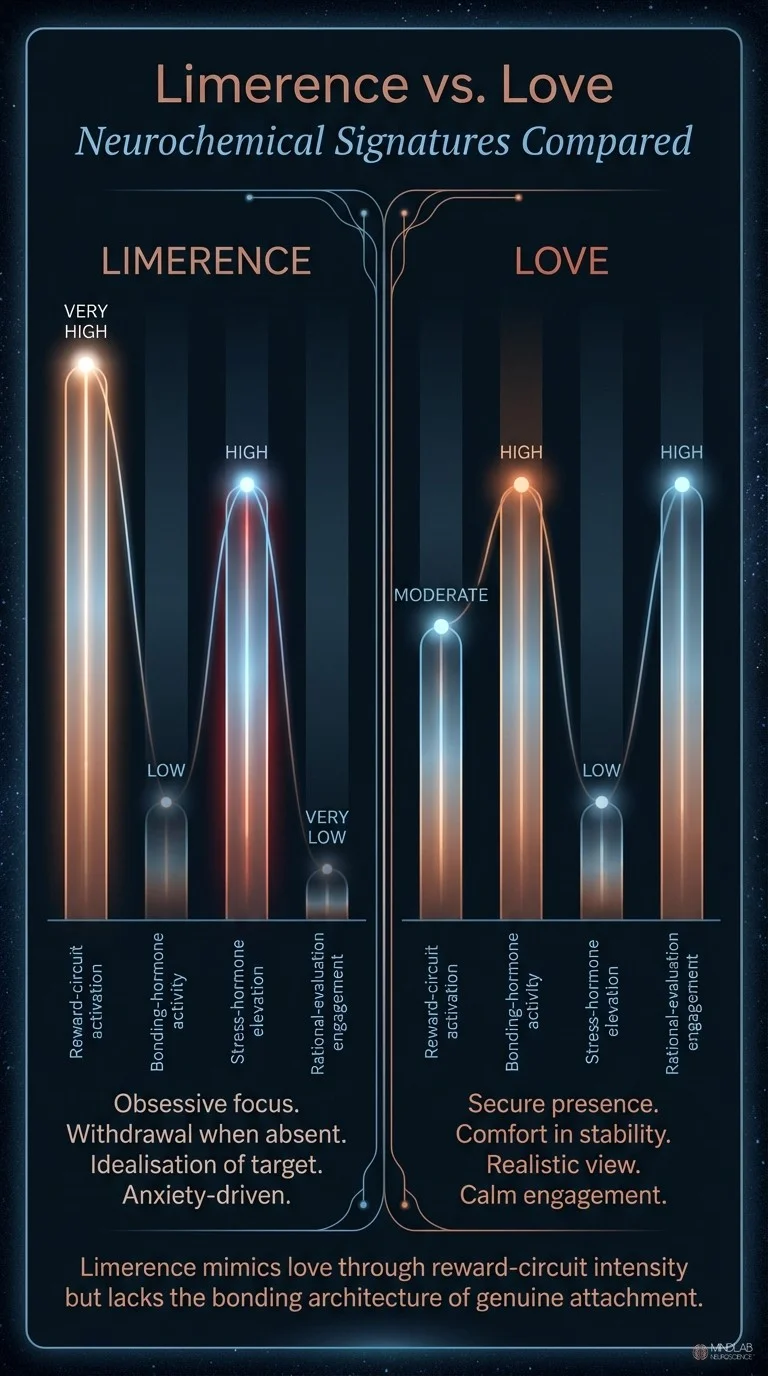
Limerence is not love. It is a neurochemical state generated by uncertainty, intermittent reward, and unmet attachment needs, nearly indistinguishable from love at the experiential level. The autonomic nervous system encodes these reward-seeking patterns at a subcortical level. Understanding the difference between limerence and genuine attachment is a matter of neurobiological literacy, not romantic philosophy.

What Is Limerence and How Is It Different from Love?
Limerence is an involuntary state of obsessive romantic preoccupation with another person, first named by psychologist Dorothy Tennov in her 1979 research. The defining feature is not intensity of feeling: love can be intense too. The defining feature is contingency: your internal emotional state becomes entirely dependent on the perceived signals of one other person.
Tennov’s interviews with over 500 individuals revealed that limerence produces intrusive, involuntary thoughts about a specific person that can occupy as much as 85% of waking hours at peak intensity. That is not a metaphor for passion. That is a measurable disruption of executive function. What makes limerence neurologically distinct is that it is driven primarily by uncertainty rather than connection. The limerent brain is not responding to who the other person actually is: it is responding to the gap between wanting reciprocation and not knowing whether it will arrive.
Limerence activates the brain’s obsessive-compulsive circuitry, including the caudate nucleus and orbitofrontal cortex, in patterns distinct from secure romantic attachment, producing intrusive ideation about the limerent object that persists even when the individual consciously wishes it to stop.
Individuals with anxious attachment styles show significantly higher limerence proneness, with hyperactivation of the brain’s threat-monitoring system generating the characteristic preoccupation and fear of rejection that distinguishes limerence from mature love.
I consistently observe that individuals experiencing limerence cannot describe their limerent object’s values, decision-making patterns, or how they behave under stress. They can describe, in extraordinary detail, every ambiguous gesture that might signal interest. The obsession is not with the person. It is with the question.
What Causes Limerence in the Brain?
The neurochemistry of limerence overlaps significantly with addiction. When you encounter someone who triggers limerence, dopamine floods the nucleus accumbens, the brain’s primary reward-processing structure. This subcortical activation bypasses prefrontal regulation, producing the euphoric pull that limerent individuals describe as irresistible and all-consuming.
The mechanism that makes limerence so durable is serotonin suppression. Research led by psychiatrist Donatella Marazziti found that individuals in early romantic obsession show platelet serotonin-transporter levels comparable to those observed in people with obsessive-compulsive disorder, roughly 40% lower than in unaffected individuals. Serotonin modulates the rumination circuits. When it drops, the prefrontal cortex loses its ability to redirect intrusive thoughts, which is precisely why the limerent brain loops on a single person despite conscious attempts to stop.
You do not keep thinking about this person because they are special. You keep thinking about them because your brain’s interrupt mechanism has been pharmacologically disabled.
What the research does not fully capture is what I see happen when the limerent object finally does reciprocate. In a significant number of cases, the limerence dissolves almost immediately. The person who consumed every waking thought becomes, within weeks of a committed relationship, someone ordinary. The “love” was not for them. It was for the neurochemical state that their unavailability was generating: a pattern neuroscience identifies as the dopamine paradox of wanting without satisfaction.

Limerence vs. Secure Attachment: What Actually Distinguishes Them?
The distinction that matters most is not duration or intensity: both limerence and love can be long-lasting and intense. The distinction is the direction of emotional energy and what drives its continuation. Secure bonding activates ventromedial prefrontal regions, while limerent states bypass this regulatory architecture entirely.
In secure understanding your attachment style, the emotional connection deepens as you learn more about the actual person: their contradictions, their ordinary moments, their failures, their effort. Familiarity builds the bond. Psychologist Sue Johnson‘s research on adult attachment, using brain imaging, found that secure connection dampens the brain’s threat response: when a partner offers reassurance and contact, the neural alarm quiets, which is part of how couples co-regulate when they navigate difficulty together. The brain is rewarding the relationship for being real.
Limerence operates on the opposite principle. Familiarity dissolves it. The neurochemical engine runs on uncertainty and idealization, both of which are structurally incompatible with genuine knowledge of another person. You cannot idealize someone you know well. This is why limerence tends to target people who are unavailable, ambiguous, or only intermittently present. Those conditions are not incidental inconveniences. They are neurologically necessary for the state to sustain itself.
The Resonance Evaluation Protocol™ assesses exactly this distinction: whether the neurochemical signature between two people reflects genuine bonding architecture or the dopamine-loop intensity that limerence generates and secure attachment does not. The protocol evaluates the neurochemical and attachment-pattern “resonance” between partners, identifying whether the pull is toward the person or toward the state their unavailability produces.
I see this architecture clearly in individuals who describe “never feeling this way” about their long-term partners: partners who are kind, stable, available, and genuinely in love with them. They feel the pull only toward people who are uncertain. They have interpreted that pull as evidence that the uncertain relationship is the real one. In every case, what they have identified is not depth of connection. They have identified the specific conditions their nervous system requires to produce the neurochemical state they have learned to call love.
What Attachment Style Is Most Prone to Limerence?
Anyone can experience limerence. The neurochemical machinery is present in all human how our brains get trapped in codependency. But its intensity and duration vary significantly based on attachment history, and that variation follows a predictable pattern. Early relational disruption calibrates reward circuitry toward intermittent signals.
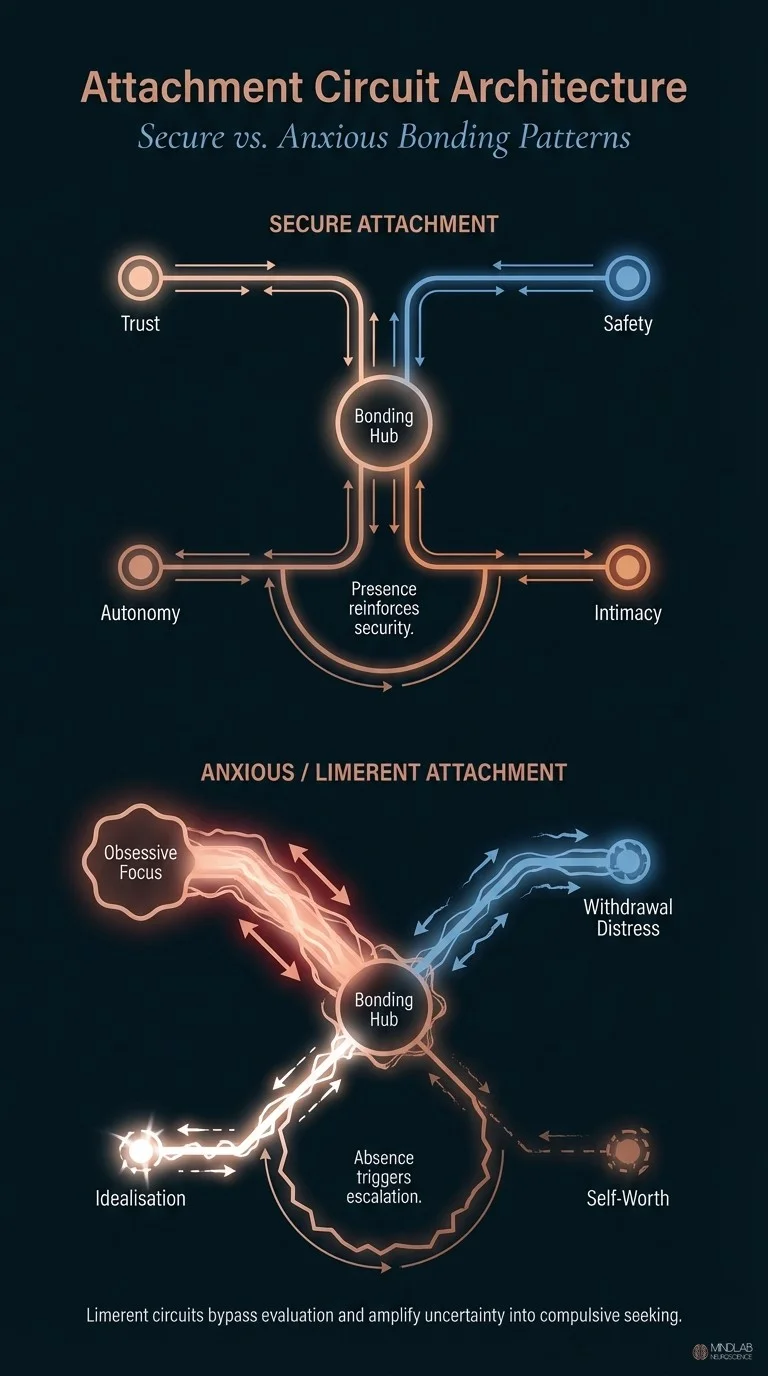
How anxious attachment creates the neural conditions for limerent obsession is rooted in developmental experience. Individuals with anxious attachment (those whose early caregiving environments were inconsistent, requiring constant monitoring of caregiver availability to predict when care would arrive) are neurologically primed for limerence. Their nervous systems learned, at a developmental level, that love is something you earn through hypervigilance. Intermittent reinforcement was the delivery mechanism. The limerent state replicates that structure precisely: intense focus on reading another person’s signals, extreme emotional reactivity to perceived approach or withdrawal, and a reward system that activates most strongly under uncertainty.
This is not a character flaw. It is a learned neural architecture. The brain built the circuits that helped a child navigate an unpredictable attachment environment. Those same circuits, in adult relationships, generate limerence and mistake it for passion.
What I see in practice is that the composite profile of a high-intensity limerent individual is someone with significant cognitive and professional capability who applies that capability almost entirely to relationship monitoring. They analyze texts with forensic precision. They model the other person’s internal states with extraordinary sophistication. All of that intelligence is running in service of a surveillance system the brain built in childhood. It is not a small thing to redirect. This connects directly to the Relationship Intelligence pillar overview.

What Does It Mean If You Only Feel “Alive” in Uncertain Relationships?
This is the question beneath the question: the one that individuals rarely arrive asking but that turns out to be the actual work. If the pull toward uncertain, intermittently available people is consistent across relationships, the pattern is not about partner selection. It is about a reward system calibrated to require uncertainty as the price of activation. This pattern is examined in the full Relationship Patterns & Partner Selection hub.
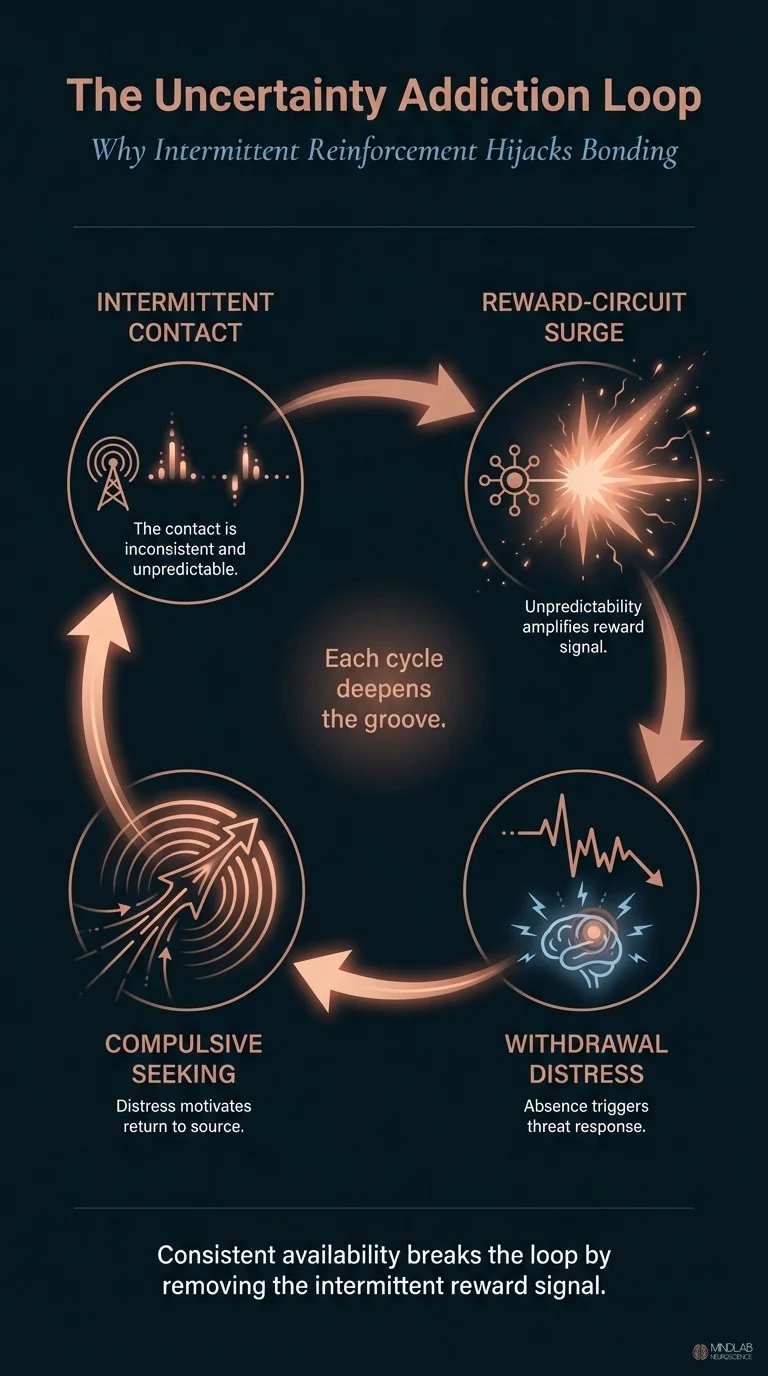
In my observation, this pattern operates on a specific circuit: the nucleus accumbens responds to unpredictable reward delivery with stronger activation than it shows for consistent reward. This is the same mechanism that makes variable-ratio reinforcement (the schedule used in slot machines) more compelling than fixed-ratio reinforcement. The nervous system is not choosing poorly. It is doing exactly what it was trained to do: seeking the conditions that produce the strongest neurochemical response.

The result is that stable, available, consistently caring partners produce a neurochemical profile that the limerence-prone brain reads as “boring” or “missing something.” The something that is missing is the uncertainty. The brain has never learned to associate safety with reward. It has only learned to associate uncertainty with activation, and it has labeled that activation as love.
Recalibrating this architecture is not a cognitive exercise. It requires sustained, structured engagement with what it feels like to be in a relationship where the reward comes from presence rather than absence. That recalibration is uncomfortable. Available connection, for a nervous system wired to uncertainty, initially feels flat precisely because the dopamine spike is missing. The work is staying with that flatness long enough for the oxytocin-mediated bonding architecture to emerge: a quieter, more stable, and ultimately more sustaining form of connection.
Can Limerence Turn Into Genuine Love?
Occasionally, yes, but more often, no. The conditions for transition require something most limerent states are structurally designed to prevent: genuine knowledge of the other person. Sustained emotional learning demands prefrontal engagement that limerent neurochemistry actively suppresses.
If a limerent neuroscience-backed relationship red flags progresses into sustained, mutual, available contact, one of two things tends to happen. Either the idealization collapses (the real person turns out to be different from the projected version, and the limerence dissolves) or something more interesting occurs: the relationship survives idealization’s collapse and a different kind of attachment begins. The second outcome is rarer, but it happens. What shifts is not the intensity of feeling but its source. The person stops being a mirror for the limerent’s unmet needs and starts being an actual person worth knowing.
Neurologically, this transition correlates with a shift in the dominant neurochemical profile. The dopamine-norepinephrine spike of limerence gives way to the oxytocin-vasopressin architecture of secure bonding: less euphoric, more stable, deeply sustaining in ways that limerence never is. Most people who have only experienced limerence describe genuine attachment as feeling “less exciting.” That assessment is accurate. It is also deeply misleading about which state is more valuable.
People who repeatedly experience limerence but rarely experience secure attachment have not found the wrong partners. They have built a reward system that routes away from availability.
How Do You Know If You Are in Limerence or Real Love?
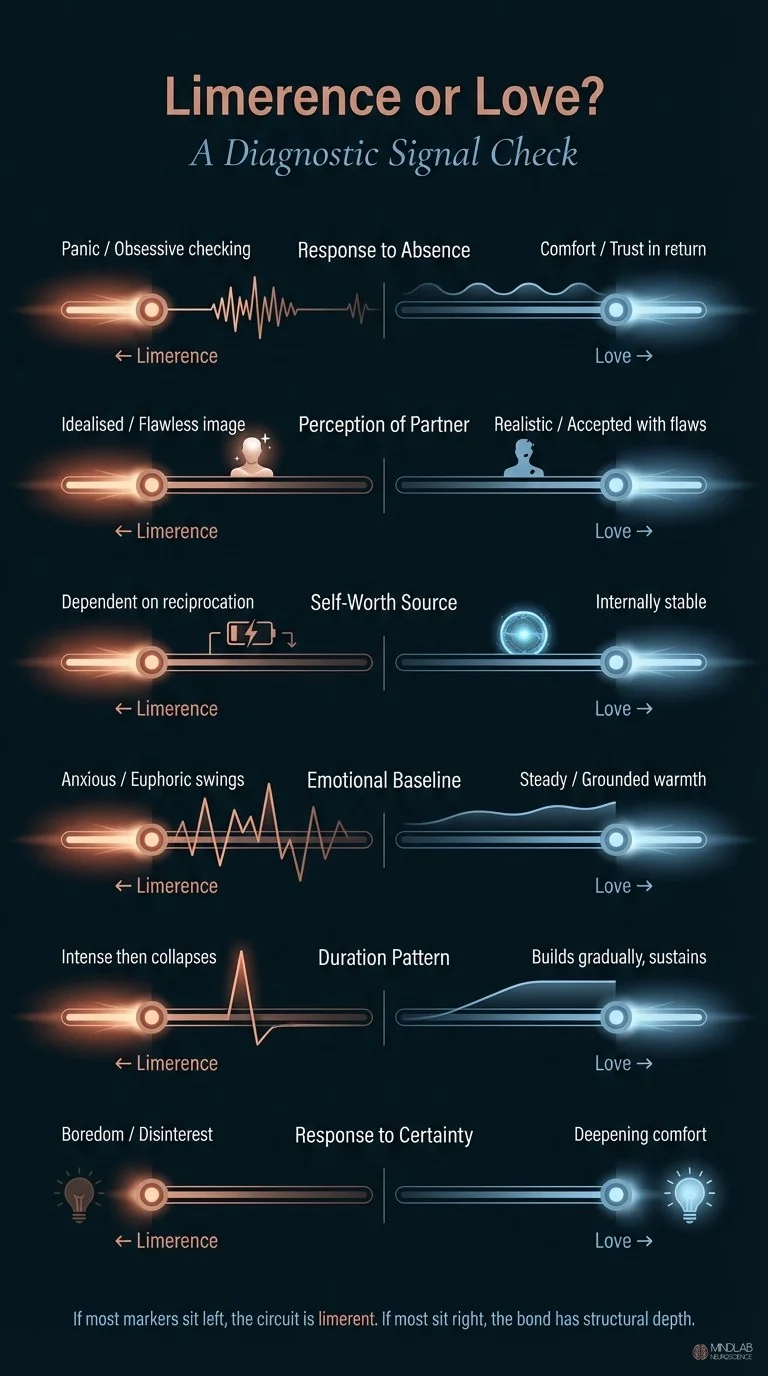
The evaluative question I find most useful is not about the feeling itself: it is about what happens when circumstances change. Ask yourself whether you would still want this person if they were fully available, consistent, and pursuing you directly. Ask whether you can describe their actual character in specific, honest terms.
Limerence thrives on the question mark. Secure attachment thrives on the answer. If removing the uncertainty would remove most of the draw, you are not in love with the person. You are in love with the unresolved question they represent, and that question has an answer that has nothing to do with them.
In my 26 years working with the neuroscience of behavior and relationship, the single most consistent observation I can offer is this: people who repeatedly experience limerence but rarely experience secure attachment have not found the wrong partners. They have built a reward system that routes away from availability. The work is not to find someone who produces the right feeling. The work is to understand why the “right feeling” has been wired to require someone’s absence. Real-Time Neuroplasticity™ provides the mechanism for that rewiring: intervening in the live moments when the pull toward uncertainty activates, building new neural evidence that connection without uncertainty is not only tolerable but is the actual substrate of durable partnership. Understanding compatibility at the nervous system level is part of that same recalibration. The neurochemical shift from limerent obsession to genuine secure attachment is not automatic: it is an architectural change that requires building new relational evidence at the circuit level.
If the pattern described in this article (choosing unavailability over connection, mistaking neurochemical intensity for love) is one you recognize across multiple relationships, the architecture driving it is identifiable and addressable. A strategy call with Dr. Sydney Ceruto maps the specific attachment and reward circuitry sustaining the pattern and identifies whether the limerent cycle can be interrupted at its source rather than managed from its surface.

How long does limerence last?
Limerence typically lasts between six months and three years without reciprocation. With intermittent reinforcement, occasional contact, ambiguous signals, partial availability, it can persist for a decade or longer. The duration is determined by the reinforcement schedule, not the depth of feeling. Consistent availability or consistent absence both resolve it. Only uncertainty sustains it.
Can you be limerent and in love at the same time?
Limerence and love can coexist, but they operate on different neurochemical systems. The limerent component runs on dopamine-norepinephrine and is driven by uncertainty. The love component runs on oxytocin-vasopressin and is driven by genuine knowledge and mutual care. If the relationship stabilizes into mutual availability, the limerent component typically fades while the attachment component either grows or reveals its absence.
Is limerence a mental illness?
Limerence is not classified as a mental illness. It is a neurochemical state that the brain generates under specific conditions, primarily uncertainty and intermittent reward in an attachment context. The mechanisms overlap with OCD (serotonin suppression driving intrusive thought) and addiction (dopamine-driven compulsive seeking), but it is not pathological in itself. This pattern becomes significant when it is chronic, repetitive across relationships, and prevents the development of secure attachment.
Why does limerence feel so much stronger than love?
Limerence produces higher-amplitude neurochemical responses than secure attachment. Dopamine and norepinephrine create euphoria and hypervigilance. Serotonin suppression creates obsessive focus. These signals are neurologically louder than the oxytocin-mediated calm of secure bonding. The mistake is equating signal amplitude with signal value. A fire alarm is louder than a heartbeat. That does not make it more important.
How do you break the limerence cycle?
Breaking the cycle requires structural change in the reward system, not willpower. The approach involves graded exposure to available relationships without escaping the flatness that initially accompanies them, combined with understanding the attachment architecture that calibrated the reward system toward uncertainty. The brain needs repeated evidence that connection without dopamine spikes is not only tolerable but is the actual foundation of sustaining partnership.
How do you know if it’s limerence or love?
The distinguishing signal is what happens with familiarity over time. Love deepens as you learn more about the actual person, their contradictions, ordinary moments, and real character. Limerence dissolves with familiarity because the neurochemical engine requires uncertainty and idealization. If knowing someone better reduces the pull, that pull was limerence rather than genuine attachment.
Can limerence turn into genuine love?
This transition can occur, but it requires a fundamental neurochemical shift, from dopamine-driven pursuit to oxytocin-mediated bonding. This cognitive shift only happens when the relationship becomes stable and mutual enough for the brain’s bonding circuits to activate. The idealization must collapse and be replaced by genuine knowledge of the other person for secure attachment to develop.
Is limerence related to attachment style?
Anxious attachment is the primary vulnerability factor for limerence. A nervous system trained on intermittent reinforcement during early development builds circuits that interpret uncertainty as a bonding signal. This wiring means the brain activates its strongest reward responses under conditions of unpredictability rather than safety, making limerent states feel more compelling than stable connection.
References
- Tennov, D. (1979). Love and Limerence: The Experience of Being in Love. Stein and Day.
- Marazziti, D., Akiskal, H.S., Rossi, A., & Cassano, G.B. (1999). Alteration of the platelet serotonin transporter in romantic love. Psychological Medicine, 29(3), 741-745. https://doi.org/10.1017/s0033291798007946.
- Aron, A., Fisher, H., Mashek, D.J., Strong, G., Li, H., & Brown, L.L. (2005). Reward, Motivation, and Emotion Systems Associated With Early-Stage Intense Romantic Love. Journal of Neurophysiology, 94(1), 327-337. https://doi.org/10.1152/jn.00838.2004.
From Reading to Rewiring
Understand the neuroscience. Apply it to your life. Work directly with Dr. Sydney Ceruto to build a personalized strategy.
Schedule Your Strategy Call