


Master Your Motivation Neurology: The Executive Function Protocol
At the elite level—whether you are scaling a unicorn startup, navigating the C-Suite, or biohacking for longevity—a lack of motivation is rarely a character flaw. It is a signaling error in the brain’s reward circuitry. Standard coaching addresses the symptom (procrastination); Neuroscience addresses the source (the Mesolimbic Pathway).The Veblen Standard of Cognitive Performance
In economics, a Veblen good is a luxury item where demand increases as the price increases. Your brain’s executive function operates on a similar principle of exclusivity. High-performers do not operate on cheap, fleeting spikes of cheap dopamine (social media, sugar, distraction). You operate on high-cost, high-reward neurochemistry. If you are reading this, you are likely experiencing a "rich man's problem": You have achieved success, yet the drive that got you here feels blunted. This is not burnout; this is Reward Prediction Error fatigue. Your baseline has risen so high that "normal" wins no longer trigger the release of dopamine required to initiate action. We are not here to "talk" about your feelings. We are here to re-calibrate your baseline to restore the visceral drive to conquer.Dopamine is Distance, Not Dessert
There is a pervasive myth, often corrected by my colleague Andrew Huberman, that dopamine isKey Takeaways
Latest Articles


Dopamine & Motivation
Overcoming Procrastination: Neuroscience-Based Strategies
Procrastination isn't just a bad habit—it’s a battle between your brain’s emotional and logical centers. Discover how neuroscience can reveal...
Read article : Overcoming Procrastination: Neuroscience-Based Strategies
Dopamine & Motivation
Dopamine Depletion: The Hidden Epidemic in Brain Health
Dopamine depletion affects motivation, pleasure, and cognitive health. This comprehensive guide offers advanced neuroscience insights, reveals unexpected causes, and provides...
Read article : Dopamine Depletion: The Hidden Epidemic in Brain Health
Dopamine & Motivation
The Dopamine Genetics Connection: Personalized Neuroscience for Optimizing Your Unique Brain
Your genetic blueprint determines how your brain processes dopamine, the neurotransmitter driving motivation, focus, and reward. Understanding dopamine genetics personalized...
Read article : The Dopamine Genetics Connection: Personalized Neuroscience for Optimizing Your Unique Brain
Dopamine & Motivation
Dopamine Workplace Performance: Neuroscience Insights
Elite executives don't succeed by working harder—they succeed by optimizing dopamine workplace performance. Groundbreaking neuroscience reveals how dopamine, the brain's...
Read article : Dopamine Workplace Performance: Neuroscience Insights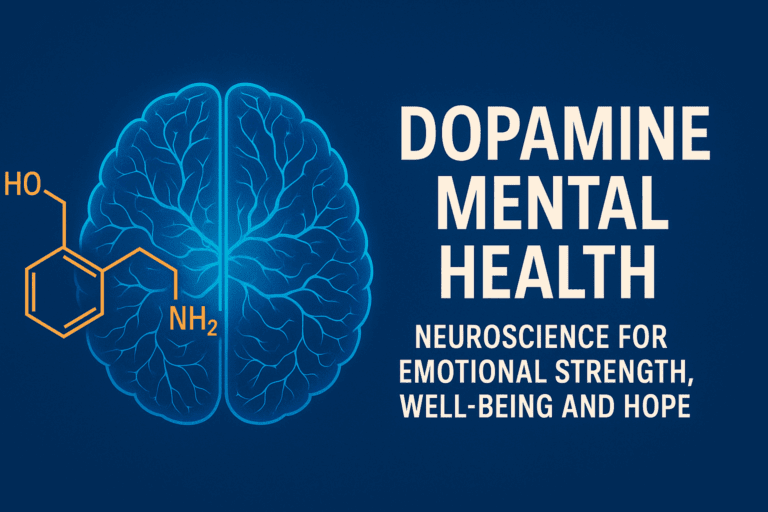
Dopamine & Motivation
Dopamine Mental Health: Neuroscience for Emotional Strength; Well-Being and Hope
2025 research reveals dopamine's precision role in mental health and emotional strength. Explore how neuroscience-based coaching targets dopamine circuits to...
Read article : Dopamine Mental Health: Neuroscience for Emotional Strength; Well-Being and Hope
Dopamine & Motivation
Dopamine and Mood Swings: The Neuroscience-Based Approach to Emotional Stability
This expert guide explores how neuroscience-based coaching harnesses dopamine’s power to regulate mood swings and build emotional stability. Drawing on...
Read article : Dopamine and Mood Swings: The Neuroscience-Based Approach to Emotional Stability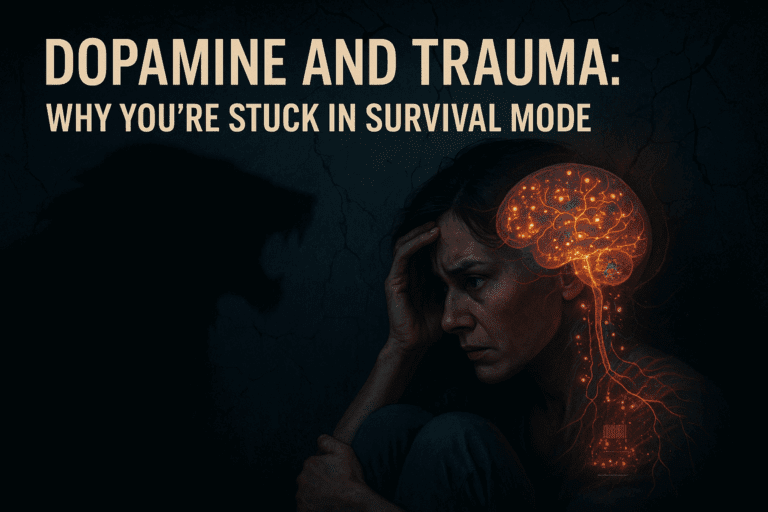
Dopamine & Motivation
Dopamine and Trauma: Why You’re Stuck in Survival Mode
Childhood trauma rewires how your brain produces and processes dopamine, the neurotransmitter responsible for motivation, reward, and emotional resilience. When...
Read article : Dopamine and Trauma: Why You’re Stuck in Survival Mode
Dopamine & Motivation
Precision Dopamine Signaling: Unlocking Cutting-Edge Brain Optimization
Precision dopamine signaling is transforming neuroscience. Learn how pinpoint dopamine activity opens new doors for optimizing performance, mood, motivation, and...
Read article : Precision Dopamine Signaling: Unlocking Cutting-Edge Brain Optimization
Dopamine & Motivation
Optimizing Behavior Change: Addressing Neurological Resistance
Behavior change is what separes people who want help from people who actually transform. Most struggle because the neuroscience of...
Read article : Optimizing Behavior Change: Addressing Neurological Resistance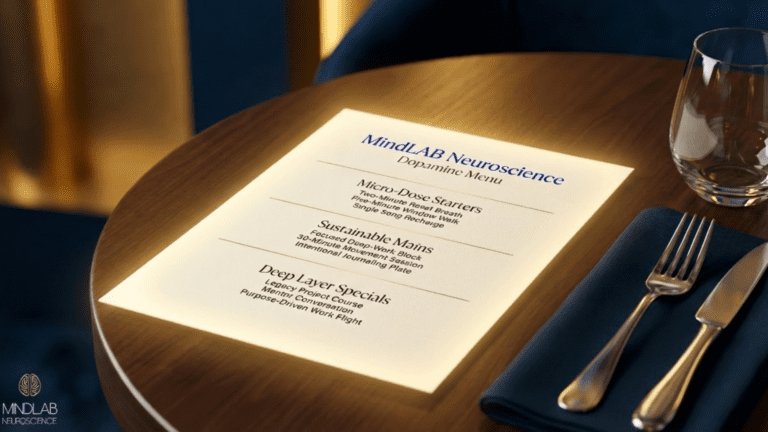
Dopamine & Motivation
Build Your Dopamine Menu: Optimize Your Brain for Sustained Happiness
Discover how to design a dopamine menu that rewires your reward system and creates sustained happiness, not temporary highs. Clinical...
Read article : Build Your Dopamine Menu: Optimize Your Brain for Sustained Happiness
about pleasure. It is not. Dopamine is not the dessert at the end of the meal; it is the hunger that drives you to the restaurant.
Think of your motivation circuitry like the fuel injection system in a Formula 1 car:
- Tonic Dopamine (The Idle): This is your baseline hum. If this is too low, you feel lethargic and apathetic. You can't get the car out of the garage.
- Phasic Dopamine (The Turbo): These are the spikes in response to a specific stimulus. This is the "Go" signal.
The Neurobiology of Drive and Determination
To master motivation, you must stop viewing it as a mood and start respecting it as a computational process. In the realm of Neuro-Optimization, we look at the functional connectivity between specific brain regions that dictate whether you engage in goal-directed behavior or succumb to inertia. Your brain is a miser. It evolved to conserve energy. Every time you consider a high-effort task—preparing a keynote, restructuring a portfolio, initiating a difficult conversation—your neural circuitry runs an instantaneous cost-benefit analysis. This is not "laziness"; it is evolutionary efficiency gone wrong in a modern context.The Neural ROI: The VTA, Nucleus Accumbens, and PFC
The core of your motivation lies in the Mesocorticolimbic Pathway. This is the highway connecting your primitive survival instincts to your sophisticated executive planning.- The VTA (Ventral Tegmental Area): Think of this as the manufacturing plant. It produces dopamine when it anticipates a reward.
- The Nucleus Accumbens (NAcc): The gatekeeper. It receives the dopamine and calculates the "salience" (importance) of the task.
- The Prefrontal Cortex (PFC): The CEO. It plans the steps required to achieve the goal.
The Anterior Midcingulate Cortex (aMCC): The Seat of Willpower
Recent neuroimaging research, frequently cited by Huberman and colleagues, points to the Anterior Midcingulate Cortex (aMCC) as a critical hub for tenacity. This structure is unique: it connects the autonomic centers (heart rate, breathing) with the motor centers (movement). The aMCC is essentially your "Anti-Comfort" muscle. Studies suggest this brain region is smaller in obese individuals and larger in elite athletes. Why? Because the aMCC activates specifically when you perform a task you do not want to do. When you rely solely on "feeling like it" (passive dopamine), the aMCC atrophies. When you force action through friction, you physically alter the neuroplasticity of this region, reducing the metabolic cost of future effort.The Chemistry of Agitation: Noradrenaline’s Role
We often obsess over dopamine, but we ignore its necessary partner: Noradrenaline (Norepinephrine). While dopamine provides the focus and the "why," noradrenaline provides the agitation and the "go." High-achievers often misinterpret the sensation of rising noradrenaline—that feeling of restlessness, slight anxiety, or internal pressure—as a negative stress response to be suppressed. This is a critical error. That physiological agitation is the mobilization of neural resources. It is the engine revving. You cannot have high motivation without a spike in arousal. The goal of Neuro-Optimization is not to eliminate this stress, but to learn to leverage it as kinetic energy to propel you into the dopamine stream. Our hub on Emotional Regulation strategies explores how to channel arousal states without being overwhelmed by them.Evolutionary Anomalies: The "Satiety Trap"
Here lies the paradox of the Ultra-High-Net-Worth individual. Evolution designed us to hunt because we were hungry. The hunt (effort) released dopamine. The kill (reward) released opioids and serotonin, inducing satiety and rest. In your world, "the kill" is constant. You have resource abundance. Your brain is constantly bathed in the neurochemistry of satiety. When the brain perceives that survival needs are met with zero effort, it downregulates dopamine receptors (D2 receptors) to maintain homeostasis. This creates a biological ceiling on ambition. Understanding how dopamine drives mood swings illuminates why even high-achievers experience motivational collapse at the peak of success. To regain the edge, we must artificially reintroduce scarcity and friction into the system to wake up the hunter.Why Standard Interventions Fail the Elite Brain
If you are a high-performing executive or founder, you have likely tried traditional routes to reignite your drive. You have engaged in conventional behavioral approaches, you have read the stoic philosophy, and perhaps you have dabbled in pharmacology. Yet, the friction remains. This is not a failure of your will; it is a failure of the modality. Standard mental health interventions are designed for the median neurological profile—to bring a dysfunctional individual back to "average." You are not aiming for average; you are aiming for optimization. Here is why the standard toolkit is insufficient for your neurobiology.The Fallacy of "Top-Down" Processing
Traditional conventional talk-based approaches relies on a Top-Down mechanism. It assumes that by using your Prefrontal Cortex (PFC) to analyze your thoughts, you can override the primitive signals of the Limbic System. For the highly intelligent, this is a trap. You are likely an expert rationalizer. You can intellectually deconstruct your lack of motivation, categorize your trauma, and articulate your goals with precision. But insight does not equal change. When you are in a state of low dopaminergic drive, the connection between the PFC (logic) and the Striatum (action) is functionally impaired. Trying to "talk" yourself into motivation is like trying to update the software on a computer with a fried motherboard. You cannot use the PFC to fix the PFC when the PFC is the very system that is offline due to fatigue or stress. You need a Bottom-Up approach: altering the neural hardware and neurochemistry first, so the psychology can follow. This principle underlies the neuroscience of cognitive restructuring through neuroplasticity.The Serotonergic Blunting Effect
In the medical model, the standard response to "lack of drive" (often misdiagnosed as depression) is the prescription of SSRIs. While these are necessary for some, for the high-performer, they can be catastrophic to ambition. Serotonin and Dopamine have an inverse relationship. Serotonin is the "Here and Now" molecule—it promotes contentment, satiety, and peace. Dopamine is the "There and Then" molecule—it promotes craving, agitation, and pursuit. By artificially elevating serotonin to flatten anxiety, standard medication often inadvertently blunts the dopaminergic edge. It raises the floor of your mood, but it drastically lowers the ceiling. You lose the "neurotic" edge that drives perfectionism. The interplay between motivation and sustained output is central to mastering deep work and dopamine regulation. You stop caring about the marginal gains. For a biohacker or CEO, this emotional flatlining is indistinguishable from failure.The Cognitive Bandwidth Paradox
Your brain consumes 20% of your body’s metabolic energy. High-stakes decision-making increases this load. Conventional programs often add more cognitive load (journaling, complex frameworks, homework). When your executive function is already taxed by high-level strategy, adding complex cognitive tasks creates Cognitive Overload. This triggers the amygdala, increasing resistance. We do not need to give you more to do; we need to streamline the neural pathways of action. We must remove the neurological drag so that "doing" becomes metabolically cheaper than "procrastinating."Protocols for Executive Optimization
We do not rely on hope; we rely on mechanics. To bypass the resistance of the amygdala and engage the executive centers of the Prefrontal Cortex, we must utilize Bottom-Up Cognitive Restructuring. These protocols are designed to manually override the brain’s "energy conservation" mode and force the release of neurochemicals required for high-output performance.Protocol 1: The Visual Aperture Lock
The Mechanism: Research indicates a direct bidirectional link between your visual system and your state of alertness. When you are stressed or overwhelmed, your vision naturally dilates (panoramic vision) to scan for threats. This signals your brain to remain in a reactive, distracted state. To trigger goal-directed behavior, we must mechanically restrict the visual field. The Drill:- Before engaging in a high-friction task (e.g., deep work, financial modeling), sit comfortably and identify a specific target point on the wall or screen.
- Stare at this point for 30 to 60 seconds without blinking or moving your eyes.
- The Result: This overt visual focus recruits the Frontal Eye Fields and triggers a release of acetylcholine in the brainstem. This acts as a chemical spotlight, suppressing neural noise and priming the Prefrontal Cortex for linear, duration-path-outcome processing. You are physically narrowing your cognitive bandwidth to the task at hand.
Protocol 2: The "Friction-First" Calibration (aMCC Training)
The Mechanism: As discussed, the Anterior Midcingulate Cortex (aMCC) grows only when you resist the urge to quit. Most high-achievers try to "layer" dopamine (music, stimulants, tasty snacks) to make hard work feel easier. This is a mistake. It trains the brain to depend on external scaffolding. The Drill:- Select one task per day that is purely administrative or tedious—something with high "metabolic drag."
- Remove all external dopamine supports. No music, no podcasts, no coffee immediately beforehand.
- Engage in the task for 10 minutes strictly.
- The Reframe: As you feel the agitation and the urge to distract yourself, visualize that sensation as neural traction. You are not "bored"; you are structurally reinforcing the aMCC. By leaning into the friction rather than masking it, you increase the density of receptors in the tenacity center of the brain.
Protocol 3: Random Intermittent Reinforcement (Casino Physics)
The Mechanism: The Ventral Tegmental Area (VTA) releases the most dopamine not when a reward is guaranteed, but when it is unexpected. This is the neurology behind gambling addiction. We can weaponize this to hack your own productivity loops. The Drill:- After completing a "sprint" or a major milestone, do not automatically reward yourself (e.g., checking your phone, getting a latte).
- Flip a coin.
- Heads: You get the reward immediately.
- Tails: You get nothing and must proceed to the next block of work.
- The Result: This introduces Reward Prediction Error into your workflow. If you reward yourself every single time, the dopamine response habituates and fades. By keeping the reward uncertain, you keep the VTA hypersensitive and the motivation circuitry firing at maximum capacity, mimicking the obsessive drive of a gambler but directed toward your executive goals.
Frequently Asked Questions
Q: Is my lack of motivation actually just burnout? A: They are distinct neurobiological states, though they often overlap. Burnout is typically characterized by HPA-axis dysfunction—chronically elevated cortisol leading to systemic exhaustion. Dopaminergic desensitization (lack of motivation), however, is a failure of the reward prediction error system. You have energy, but you cannot mobilize it because the "neural carrot" isn't big enough. If you can doom-scroll for hours but cannot start a spreadsheet, your energy systems are intact; your dopaminergic gating is the issue. Q: Can I just use Nootropics or stimulants (Modafinil/Adderall) to fix this? A: Exogenous stimulants are a loan, not a gift. They force the release of stored dopamine and norepinephrine into the synaptic cleft. While effective for acute sprints, chronic use leads to receptor downregulation (tolerance). You are essentially red-lining an engine while the oil level drops. Neuro-Optimization focuses on increasing your baseline receptor density and natural production, so you can access high-drive states without the metabolic debt or the inevitable crash. Q: I am over 40. Is it too late to rewire these pathways? A: Absolutely not. While childhood neuroplasticity is passive (the brain changes just by being exposed to the world), adult neuroplasticity is active. It requires two specific neurochemicals: Acetylcholine (focus) and Epinephrine (urgency/agitation). If you are willing to engage in high-focus, high-friction protocols (like the aMCC training above), you can restructure your motivation circuitry at any age. The brain remains plastic until death; it simply requires a higher "activation energy" to initiate the change. Q: How does this relate to the "Dopamine Fasting" trend? A: The popular concept of "Dopamine Fasting" is scientifically misunderstood. You cannot "fast" from a neurotransmitter that regulates your heart rate and movement. However, the core principle is sound: Dopamine Homeostasis. By restricting high-intensity, low-effort inputs (social media, processed sugar, video games), you allow your dopamine receptors to "upregulate" (become more sensitive). This resets your baseline, making "boring" tasks (like building a business) feel chemically rewarding again. Our guide to the dopamine paradox explains why the very rewards you pursue can sabotage your drive.The Executive Conclusion: Your Neural Competitive Advantage
In a marketplace saturated with talent, technical skill is merely the entry fee. The true differentiator at the elite level is Neural Efficiency. The ability to command your brain to perform high-friction tasks in the absence of immediate reward is not a personality trait; it is a biological asset. By shifting your perspective from "psychological willpower" to "neurological management," you stop fighting yourself and start engineering yourself. You move from the volatile peaks and valleys of cheap dopamine to the sustained, powerful drive of a calibrated Mesolimbic pathway. You have optimized your portfolio, your team, and your body. It is time to optimize the machine that controls them all. Welcome to the era of Neuro-Optimization.About Dr. Sydney Ceruto
Founder & CEO of MindLAB Neuroscience, Dr. Sydney Ceruto is the pioneer of Real-Time Neuroplasticity™ — a proprietary methodology that permanently rewires the neural pathways driving behavior, decisions, and emotional responses. Dr. Ceruto holds a PhD in Behavioral & Cognitive Neuroscience (NYU) and two Master's degrees — Clinical Psychology and Business Psychology (Yale University). Lecturer, Wharton Executive Development Program — University of Pennsylvania.
Frequently Asked Questions
Berridge and Robinson’s landmark distinction between dopaminergic “wanting” and opioidergic “liking” circuits explains this dissociation precisely. Dopamine does not produce pleasure — it produces motivational salience, the neural signal of anticipated reward that drives pursuit behavior. The opioid system generates the hedonic experience of satisfaction upon receiving the reward. In sustained high-achievement environments, the wanting circuit undergoes sensitization — progressively lower thresholds for triggering pursuit, progressively higher targets required to satisfy the drive — while the liking circuit undergoes tolerance, producing diminished pleasure from rewards that once felt meaningful. The result is an individual who is neurologically compelled to continue achieving while neurologically incapable of finding what they are compelled to pursue satisfying. This is not a psychological condition. It is a predictable consequence of dopaminergic architecture under sustained demand.
Sustained high-demand environments produce a characteristic dopaminergic adaptation pattern. Schultz’s reward prediction error research established that dopamine neurons fire in response to reward prediction — not reward receipt — and that the signal scales with surprise, not magnitude. In environments where high performance is the baseline expectation, successes generate progressively smaller prediction errors and proportionally smaller dopamine responses. Simultaneously, Nestler’s work demonstrated that chronic stress depletes mesocortical dopamine — the prefrontal dopamine projection — reducing the signal that sustains goal-directed motivation, working memory maintenance, and executive control. The executive who has sustained peak pressure for years often presents with a profile that looks like depression but is actually mesocortical dopamine depletion: motivational flatness, reduced goal engagement, and impaired prefrontal function despite normal or elevated output.
The functional distinction lies in prefrontal cortex authority over the mesolimbic circuit. Goal-directed motivation is governed by the prefrontal cortex’s projections to the nucleus accumbens core — the circuit that evaluates anticipated reward against current state and generates flexible, updating pursuit behavior. Compulsive overwork involves the same mesolimbic pathway but with reduced prefrontal regulatory input, shifting control to the dorsal striatum’s habit circuit — the system that executes behaviors automatically in response to context cues, independent of current outcome value. Corbit and Balleine’s research on goal-directed versus habitual behavior showed that this shift from prefrontal to striatal control is precisely what occurs under stress and overtraining: the behavior becomes autonomous, continues when the individual consciously wants to stop, and is maintained by the habit circuit rather than genuine motivational drive.
The dopamine system retains structural plasticity throughout adulthood, but restoration requires understanding the specific locus of the dysregulation. Salamone and Correa’s research distinguished between hedonic pleasure deficits (opioid system, responding to different interventions) and motivational effort deficits (mesolimbic dopamine, particularly nucleus accumbens dopamine for effort allocation). Recovery protocols that address only one miss the other. At the circuit level, Blanco and colleagues demonstrated that dopaminergic signaling normalizes with elimination of the dysregulating input, targeted aerobic exercise (which elevates BDNF and promotes dopamine receptor sensitivity recovery), and restoration of the variable reward structures that maintain healthy dopaminergic phasic firing — the “small wins with uncertainty” pattern that Schultz’s prediction error research identified as the optimal driver of dopaminergic system health.
The diagnostic markers are behavioral specificity, temporal pattern, and intervention history. Motivational dysregulation rooted in dopaminergic architecture presents with characteristic features: inability to initiate tasks despite clear intention (amotivation reflecting nucleus accumbens dopamine depletion), reward insensitivity across previously pleasurable domains (hedonic anhedonia reflecting opioid system dysregulation), and the ability to execute urgent or novel tasks while failing to sustain engagement on important-but-familiar work (prediction error sensitivity pattern consistent with Schultz’s research). If structured behavioral approaches, environmental redesign, and disciplined motivation strategies have produced limited or temporary results, the intervention likely has not reached the neural level where the pattern operates. A strategy call with Dr. Ceruto maps your specific dopaminergic profile and determines the targeted approach your architecture requires.
Ready to Understand What Your Brain Has Been Trying to Tell You?
A strategy call is one hour of precision, not persuasion. Dr. Ceruto will map the neural patterns driving your most persistent challenges and show you exactly what rewiring looks like.
Schedule Your Strategy Call
Dr. Sydney Ceruto
Neuro-Advisor & Author
Dr. Sydney Ceruto holds a PhD in Behavioral & Cognitive Neuroscience from NYU and master's degrees in Clinical Psychology and Business Psychology from Yale University. A lecturer in the Wharton Executive Development Program at the University of Pennsylvania, she has served as an executive contributor to Forbes Coaching Council since 2019 and is an inductee in Marquis Who's Who in America.
As Founder of MindLAB Neuroscience (est. 2000), Dr. Ceruto works with a small number of high-capacity individuals, embedding into their lives in real time to rewire the neural patterns that drive behavior, decisions, and emotional responses. Her forthcoming book, The Dopamine Code, will be published by Simon & Schuster in June 2026.
Learn more about Dr. Ceruto