The Neuroscience of Relationships Reveals a Neural Capacity — Not a Soft Skill
The phrase "relationship intelligence" has been diluted by self-help culture into something vaguely aspirational — be a better listener, show more empathy, communicate your needs. This framing is not just incomplete. It is neurologically backward. The neuroscience of relationships reveals a measurable capacity of the brain — a set of integrated neural circuits that determine how accurately you read social signals, how efficiently you regulate emotional responses during interpersonal contact, and how effectively you build and sustain trust over time.
It is not personality. It is architecture.
In 26 years of working with people navigating the most demanding personal and professional landscapes, I have observed a consistent pattern: the individuals who struggle most in relationships are rarely deficient in intelligence, effort, or intent. They are operating with neural circuitry that was calibrated for a different environment — often one that no longer exists. Their brains learned relational strategies that were adaptive at a key point in their history and then automated those strategies into patterns that now fire without conscious deliberation. The relational capacity they need is not more knowledge about relationships. It is a restructuring of the circuits that govern how they actually behave inside them.
This is what distinguishes neuroscience-informed insights from the advice industry. Advice operates at the level of conscious intention. Neural architecture operates underneath it. When the two conflict — and in relationships, they conflict constantly — architecture wins every time.
The Neural Architecture Behind Social Cognition and Relational Processing
The neuroscience of relationships emerges from the coordinated activity of several brain networks mapped with increasing precision over the past two decades. The mentalizing network — anchored in the medial prefrontal cortex (mPFC), the temporoparietal junction (TPJ), and the posterior superior temporal sulcus — is responsible for theory of mind: the ability to construct accurate models of what another person is thinking, feeling, and intending. Saxe and Kanwisher (2003), working at MIT, demonstrated that the TPJ activates specifically when people attribute mental states to others — not when they process physical characteristics, but when they attempt to understand the internal world behind another person's behavior.
The second key network is the mirror neuron system, distributed across the premotor cortex and the inferior parietal lobule. Rizzolatti and Craighero (2004) at the University of Parma identified neurons that fire both when an individual performs an action and when they observe the same action performed by another person. This system provides the neurological substrate for embodied empathy — the capacity to feel, at a physiological level, what someone else is experiencing.
In my practice, I consistently observe that these two systems must work in concert for relational competence to emerge. Mentalizing without embodied empathy produces cold analysis — the person who can describe what their partner is feeling but cannot feel it themselves. Embodied empathy without mentalizing produces emotional flooding. The integration of these two capacities is what produces genuine relational competence, and that integration is a function of neural connectivity, not personality type.
How the Brain Builds Trust — A Key Pillar in the Neuroscience of Relationships
Trust is not a feeling. It is a neurobiological computation. The brain continuously evaluates whether another person is safe to be vulnerable with, and it makes this evaluation using circuitry largely inaccessible to conscious awareness. The neural substrate of this relational capacity — trust architecture specifically — depends on two peptide hormones — oxytocin and vasopressin — and the neural circuits they modulate.
Zak (2012), in a decade-long research program at Claremont Graduate University, demonstrated that oxytocin release tracks directly with perceived trustworthiness. When the brain determines that another person's behavior is predictable, reciprocal, and non-threatening, it releases oxytocin — reducing amygdala reactivity and increasing activation in brain regions associated with social reward. This data reveals a neurochemical feedback loop: trust generates oxytocin, oxytocin reduces threat sensitivity, reduced threat sensitivity allows deeper trust.
When this loop breaks, the consequences are severe. Betrayal — whether through infidelity and violations of trust architecture or through subtler forms of relational rupture — damages the neurochemical system that makes trust possible. The anterior insula becomes hyperactivated. The brain shifts from a trust-default to a distrust-default, and every subsequent relational contact is filtered through a threat-detection lens calibrated by the original injury.
What I have found is that the trust circuitry does not spontaneously recalibrate. Time does not heal this wound at the neural level. The brain requires specific conditions — what I call structured neurochemical safety — to reopen the trust computation. This is one of the most consequential insights for anyone seeking to learn how their relational brain operates: your current distrust may have nothing to do with the person in front of you and everything to do with a circuit rewired by someone no longer in your life.
Attachment Neuroscience and the Foundations of Relational Capacity
Coan, Schaefer, and Davidson (2006), in a landmark fMRI study at the University of Virginia, demonstrated that when people held the hand of a trusted partner while receiving mild electric shocks, their neural threat response was significantly attenuated compared to holding a stranger's hand or no hand at all. The brain literally processes threat differently based on the quality of relational connection available.
This data has profound implications. Your brain's capacity to manage stress, maintain cognitive clarity under pressure, and make sound decisions is not solely a function of individual neural resources. It is co-regulated — continuously modulated by the relational environment you inhabit. A secure relationship is a neurological resource that expands your cognitive and emotional bandwidth. An insecure relationship is a neurological drain that contracts it. This insight reframes relationship health as a key performance variable, not a lifestyle preference.
In my practice, the individuals who present with the most sophisticated professional capabilities often show the most significant gaps in relational capacity around attachment. The very neural strategies that make them effective in high-stakes professional environments — emotional containment, rapid evaluation, decisive action — become liabilities in intimate relationships, where the required skill set is vulnerability, patience, and sustained emotional presence. The brain optimizes for the environment it spends the most time in. If that environment rewards emotional control, the circuits that enable emotional openness atrophy from disuse.
Understanding how early attachment experiences wire the brain's relational templates is central to the work explored in understanding relationship patterns and partner selection. The patterns you repeat are not choices. They are automated neural programs running on hardware installed decades ago. You cannot learn your way out of them with insight alone — but you can restructure the circuits that generate them.
Emotional Regulation and the Neuroscience of Relationships: The Amygdala-Prefrontal Circuit
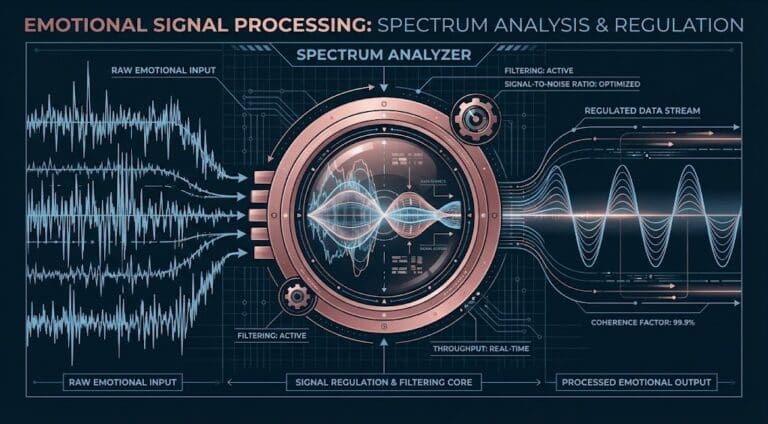
Every relationship that matters will, at some point, activate the brain's threat-detection system. A dismissive comment. A perceived slight from a team member. A child's defiance that triggers a parent's own unresolved material. In these moments, relational capacity is determined by amygdala-prefrontal coupling — the brain's capacity to detect the emotional signal, evaluate it against context, and generate a response that serves the relationship rather than merely defending the self.
Ochsner et al. (2004), at Columbia University, used fMRI to demonstrate that conscious emotion regulation depends on the lateral prefrontal cortex exerting top-down control over the amygdala. When this circuit is strong, the individual can experience a strong reaction and still choose a measured response. When it is weak — often as a result of chronic stress or simple disuse — the amygdala overwhelms prefrontal control, and the person reacts before they think.
What the research does not adequately capture is the relational cost of prefrontal shutdown. The damage in relationships is almost never caused by the original trigger. It is caused by what happens in the 4-7 seconds after the trigger fires — the window during which the amygdala has responded but the prefrontal cortex has not regained control. In that window, words are spoken and tonal shifts occur that the other person's relational brain registers as threat. Now both amygdalae are firing. The conversation has become a neurological emergency where neither party has access to their actual intelligence.
This is why relational capacity cannot be developed through conversation about relationships. It must be developed during live relational moments — when the circuits are actually engaged. This is the foundational principle that makes Real-Time Neuroplasticity effective where retrospective analysis fails.
How the Social Brain Processes Team and Group Dynamics
The neuroscience of relationships extends beyond dyadic interactions. The brain maintains a complex social mapping system — anchored in the default mode network and the medial prefrontal cortex — that continuously tracks status hierarchies, alliance structures, and reputational data across entire social networks. Dunbar (1998), at the University of Oxford, identified the correlation between neocortical volume and social group size across primate species, suggesting that human brain evolution was driven significantly by the computational demands of managing complex social relationships.
For people managing multiple high-stakes relationships simultaneously — executive teams, family systems, intimate partnerships — this social mapping capacity is under constant demand. Relational competence in these contexts requires maintaining accurate models of dozens of individuals' motivations, tracking shifting alliances, predicting how information will propagate through a network, and calibrating behavior differently for each relational contact. The metabolic cost is substantial.
The pattern I see repeatedly is that cognitive fatigue from professional social demands directly erodes relational capacity in personal domains. The executive who spends ten hours navigating boardroom dynamics, managing team conflicts, and reading political undercurrents arrives home with a depleted prefrontal cortex — and encounters a partner or family system that requires the same neural resources. This is not a time management problem. It is a neural resource allocation problem.
Multigenerational Neural Patterns and Relational Neuroscience in Family Systems
The family is the original training ground for relational capacity. It is where the brain first learns how relationships work — what happens when you express need, show anger, become vulnerable, or withdraw. These early experiences create neural templates: automated response patterns that the brain consults, unconsciously, in every subsequent relationship.
Meaney (2001), at McGill University, demonstrated that maternal care patterns physically alter gene expression in offspring brain tissue — specifically in the hippocampus and the HPA axis — affecting stress reactivity for life. Human longitudinal data confirms parallel patterns: early relational environments leave neurobiological signatures that persist into adulthood and shape relational capacity decades later.
The multigenerational family dynamics hub explores these patterns in depth. Most people are operating with relational software written by their family of origin — completely unaware of the code running underneath their conscious choices. The executive who cannot tolerate disagreement from team members is often running a neural program learned from a parent who treated dissent as betrayal. The partner who withdraws during conflict is executing a protective strategy that was adaptive in a childhood home where emotional expression was punished. These are the relational legacies people carry into every new contact — and learning to identify them is a key step in understanding multigenerational family dynamics at the neural level.
The neuroscience of relationships at the family level requires recognizing that these patterns are automated neural programs to be identified, interrupted, and restructured — not personality traits to be managed. Understanding does not restructure the circuit. It merely adds a cognitive layer on top of an automated response — which the automated response overwhelms under stress.
Why Relational Capacity Breaks Down During Conflict
Conflict is the stress test of relational capacity. Under calm conditions, most cognitively capable adults can demonstrate reasonable empathy and functional communication. Under conflict conditions, the brain undergoes state changes that systematically dismantle these capacities.
The first casualty is mentalizing accuracy. Fonagy and Luyten (2009) at University College London demonstrated that stress significantly impairs the brain's reflective function. Under threat, the brain shifts from mentalizing to teleological mode: it stops trying to understand why someone is behaving a certain way and reacts to the behavior itself. Intentions are no longer inferred — they are projected. This shift explains the pattern I see repeatedly in high-conflict relational dynamics: both parties report with absolute conviction that they understand the other person's motives, and both are wrong.
The second casualty is cognitive flexibility. Under threat, the brain narrows its processing — a phenomenon called attentional tunneling. The dorsolateral prefrontal cortex reduces activity during acute stress. The result is binary thinking: right/wrong, safe/dangerous, with me/against me. The nuanced both-and thinking that effective relationship management requires becomes neurologically unavailable. Learning to maintain contact with your own prefrontal capacity during conflict — rather than surrendering it to the amygdala — is one of the key outcomes of targeted neural restructuring. When this capacity is absent, relational dynamics can escalate into the patterns explored in depth in our work on high-conflict personalities and relationship management.
The Neuroscience of Relational Repair and Relationship Management
Gottman's research established that the distinguishing feature of lasting relationships is not the absence of conflict but the presence of effective repair. The neuroscience adds an understanding of what repair actually requires at the circuit level.
Repair is not apology. Repair is the re-establishment of co-regulatory safety — the neurochemical state in which both people's threat-detection systems have stood down and the ventral vagal complex has resumed its role in social engagement. Porges' (2011) polyvagal theory describes three hierarchical autonomic states: ventral vagal (social engagement), sympathetic (fight or flight), and dorsal vagal (freeze and shutdown). Effective repair requires both parties to return to ventral vagal functioning — and this cannot be accomplished through words alone.
In my work, effective relationship management during repair depends on the brain's capacity to generate what I call reconciliation signals — vocal prosody shifts, facial micro-expressions, postural changes, and touch patterns that communicate safety to the other person's limbic system. These signals operate below conscious awareness. The person who can generate authentic reconciliation signals — not rehearsed apologies but genuine neurobiological shifts from threat to safety — is the person whose intimate bonds survive rupture. The person who cannot watches relationship health erode through accumulated unrepaired damage.
Intimate Bonding and the Neurochemistry of Deep Connection
Intimate bonding represents the most neurochemically complex expression of relational neuroscience. The brain's bonding circuitry involves a coordinated interplay of oxytocin, vasopressin, dopamine, and endogenous opioids. Young and Wang (2004), at Emory University, mapped this circuitry and demonstrated that the distribution of oxytocin and vasopressin receptors in the reward system determines bonding capacity at the neurological level.
The neuroscience of intimacy and bonding examines how these systems create and sustain deep connection. What I observe is that many accomplished individuals have intact cognitive relational capacity but impaired neurochemical bonding capacity. They can analyze relationships brilliantly. They understand attachment theory intellectually. But the brain circuits that generate the felt experience of bonding — the warmth, the safety, the desire for proximity — have been downregulated by years of self-protective emotional containment.
This is a key distinction. The brain's relational capacity is not purely cognitive. It has a somatic, neurochemical dimension that must be functional for relationships to move beyond strategic interaction into genuine connection. The person who operates relationally from cognition alone — analyzing, strategizing, optimizing — is doing relationship management, not exercising genuine relational capacity. The brain knows the difference.
What the Brain Does When Bonds Break: Separation and Neural Withdrawal
Fisher et al. (2010), using fMRI at Stony Brook University, demonstrated that people experiencing romantic rejection show activation in the same brain regions associated with physical pain and addiction craving — the anterior cingulate cortex, the insula, the ventral tegmental area, and the nucleus accumbens. The brain processes the loss of a significant bond using the same circuitry it uses for physical injury and substance withdrawal.
The neurobiology of separation explores these mechanisms in detail. The individual experiencing separation is not simply sad. Their brain is undergoing withdrawal from a neurochemical system that had become integrated into baseline regulatory functioning. The partner was not just a person. They were a neurobiological regulatory resource, and losing them creates a genuine physiological deficit. Understanding the neurobiology of how separation affects the brain means learning to interpret this data — recognizing that the intensity is not weakness but the predictable output of a brain forced to reorganize without a key resource it had incorporated into its operating system.
Why Traditional Approaches Fail to Build Lasting Relational Capacity
Conventional approaches to improving relational capacity rely on two methods: conversation-based exploration and skill-based training. Both have informational value. Neither produces durable change in the neural circuits that govern actual relational behavior.
The limitation of conversation-based approaches is timing. the brain's relational circuits are only modifiable when active — when the person is in a live relational moment where the pattern is firing. Nader, Schafe, and LeDoux (2000), in their seminal work on memory reconsolidation at NYU, demonstrated that neural circuits must be reactivated under specific conditions for restructuring to occur. Discussing the pattern afterward, in a calm setting, engages different circuits entirely. The insight does not transfer because the amygdala-driven circuitry was not engaged during the conversation.
The limitation of skill-based training is complexity. Real relational moments involve simultaneous processing of vocal tone, facial expression, body language, verbal content, and internal emotional state — all within milliseconds. A communication technique you learn in a workshop requires conscious retrieval and serial processing through the prefrontal cortex. By then, the automatic relational response has already fired. The team of neural circuits that generates spontaneous behavior operates faster than the team that implements learned techniques.
Real-Time Neuroplasticity Applied to the Neuroscience of Relationships
The approach I have developed over 26 years addresses the fundamental gap between understanding and doing. Real-Time Neuroplasticity targets relational capacity circuits during their live activation — in the actual moments where patterns fire, defenses engage, and the brain's automated relational programs execute without conscious permission.
This is why the work embeds into the client's actual life rather than confining itself to scheduled engagements. Relational capacity patterns do not fire on schedule. They fire during the argument at 11 p.m., during the tense negotiation, during the family dinner that activates a thirty-year-old neural program. The restructuring happens when the circuit is hot — when the synapses are actively engaged and maximally susceptible to reorganization.
Three specific protocols apply to the neuroscience of relationships in practice:
- The DECODE Protocol — maps the precise trigger-signal-response chain in the individual's relational patterns. What specific stimuli activate the automated response? Which neural pathway carries the signal? What is the behavioral output, and where in the chain can intervention redirect it? This mapping is essential because each person's relational patterns are highly specific — different triggers, different neural substrates, different intervention points.
- The CALM Protocol — recalibrates amygdala sensitivity thresholds in relational contexts. Many people have threat-detection systems calibrated to register normal relational friction — disagreement, disappointment, distance — as genuine danger. The CALM Protocol works during live relational moments to raise the activation threshold, allowing the person to remain in ventral vagal engagement during interactions that would previously have triggered fight-or-flight.
- Relational Circuit Training — strengthens amygdala-prefrontal coupling specifically in interpersonal contexts, distinct from general emotional regulation. The brain processes relational threats through dedicated social circuitry — the TPJ, the mPFC, the superior temporal sulcus — that requires targeted training during real interactions to develop.
Emotional Intelligence and Relational Neuroscience: Understanding the Integration
Emotional intelligence and relational capacity are frequently conflated. They are related but distinct neural capacities. Emotional intelligence mastery — the ability to identify, understand, and regulate one's own emotional states — is a prerequisite for relational capacity but not a substitute for it. You can have high emotional intelligence and low relational capacity if your capacity for self-regulation does not extend to the co-regulatory dynamics that relationships demand.
What the neuroscience of relationships adds is the interpersonal dimension: not just knowing what you feel, but accurately reading what the other person feels, predicting how your response will affect their neural state, and calibrating your behavior to serve the relationship rather than merely managing your own internal experience. When I work with individuals on developing relational capacity, the initial assessment always includes emotional intelligence data, because deficits at the self-regulation level will undermine every relational intervention. You cannot co-regulate with another person if you cannot self-regulate first. People who learn to master their emotional intelligence build the foundation that makes every other dimension of relational capacity possible. The insights from that assessment determine where the restructuring work needs to focus.
The Neuroscience of Relationships in the C-Suite: When Professional Brilliance Masks Relational Gaps
The pattern I observe most frequently among high-performing professionals is a striking asymmetry between professional relational competence and personal relational competence. The same individual who can read a boardroom with surgical precision — detecting shifts in alliance structure, anticipating objections, calibrating persuasion in real time — goes home and misreads their partner's emotional state, or triggers their teenager's defensive response.
This asymmetry is not hypocrisy. It is context-dependent neural optimization. The professional environment rewards a specific subset of relational skills — and relationship management in the C-suite deploys a different neural toolkit than relationship management at home:
- Professional relationship management — strategic empathy (understanding what people want in order to influence outcomes), status detection (reading hierarchical dynamics), and transactional trust (calibrated vulnerability that serves strategic goals)
- Intimate relationship management — unconditional attunement (being present without an agenda), emotional vulnerability (allowing oneself to be seen in states of need or pain), and sustained repair (returning to rupture with genuine willingness to learn from the other person's perspective)
These engage different neural circuits — circuits that may have been underutilized or actively suppressed in people who have spent decades optimizing for professional contact.
The neuroscience of partner selection and relationship patterns addresses these dynamics directly. Partner selection itself is often an expression of automated relational programming — the brain selecting relational configurations that match its existing wiring, even when that wiring produces unsatisfying outcomes. Learning to recognize these automated choices is a key step toward relationship health.
Infidelity and the Limits of Relational Neuroscience Under Maximum Stress
Infidelity represents the most acute stress test of relational capacity. The neuroscience reveals it as a complex intersection of reward system dysregulation, attachment circuit vulnerability, and impulse control variability reflecting the state of multiple neural systems simultaneously.
For the betrayed partner, the discovery activates the brain's social pain network with an intensity that neuroimaging data shows is comparable to physical trauma. The neuroscience of infidelity and trust architecture maps the specific neural processes involved in both the violation and the potential for repair.
The neuroscience of relationships in the aftermath of infidelity requires holding complexity — the person who caused this pain is also the person you love. Their action was a violation, and it also emerged from unmet needs and neural vulnerabilities. This both-and processing demands extraordinary prefrontal capacity and is often where relational neuroscience work produces the most transformative results.
The Neuroscience of Relationships as a Learnable Neural Capacity: Key Principles
The most important insight from the neuroscience is this: relational capacity is not fixed. The circuits governing social cognition, emotional regulation, trust computation, bonding, and conflict resolution are all subject to neuroplasticity. Davidson and McEwen (2012), publishing in Nature Neuroscience, reviewed evidence demonstrating that social and emotional circuits exhibit significant plasticity throughout the lifespan. Epigenetic changes once assumed permanent have been shown to be reversible under the right conditions.
The key phrase is "under the right conditions." Not all experience produces plasticity. Targeted, emotionally engaged practice during live relational moments produces restructuring. Passive understanding does not. The question is not whether relational capacity can be developed — the data has settled that. The question is whether the intervention engages the actual circuits that need restructuring, during the moments when those circuits are active, with the precision necessary for lasting change.
The neuroscience converges on several principles that distinguish effective development from conventional advice:
- Timing determines effectiveness. Neural circuits are modifiable during activation and stable outside it. The neuroscience of relationships shows that change occurs when interventions happen during live relational moments — not retrospective analysis.
- Embodied practice supersedes cognitive understanding. The relational brain processes data through sensory, motor, and interoceptive channels — not primarily through language. Effective development includes somatic awareness and physiological regulation training.
- Co-regulation precedes self-regulation. The brain learns to regulate itself through being regulated by another person. People whose early relational environments did not provide adequate co-regulation often lack the neural template. Rebuilding it requires a relational context.
- Pattern specificity matters. Relational capacity is a constellation of distinct capacities — mentalizing, embodied empathy, amygdala regulation, trust computation, repair signaling, bonding chemistry — each mediated by different circuits. Assessment must identify the specific circuits that need development.
The Cost of Undeveloped Relational Capacity to Health and Performance
The consequences of low relational capacity extend far beyond relationship dissatisfaction. Holt-Lunstad, Smith, and Layton (2010), in a meta-analysis of 148 studies encompassing over 300,000 participants, found that the quality of social relationships predicted mortality risk with an effect size comparable to smoking 15 cigarettes per day — exceeding the effects of obesity and physical inactivity.
The biological mechanisms are specific: chronic relational stress elevates cortisol, suppresses immune function, accelerates hippocampal atrophy, and increases systemic inflammation. For people navigating demanding careers, professional stress plus relational stress does not simply add — it multiplies, because each domain depletes the same neural resources the other requires. Developing your relational capacity is not a lifestyle enhancement. It is a neurological investment in relationship health that pays dividends across every domain of performance.
What Developed Relational Capacity Looks Like in Practice
When relational capacity is well-developed, the observable behaviors are distinctive and the insights people gain about their own relational patterns become self-reinforcing. The individual can remain cognitively flexible during emotionally charged interactions. They can hold their own perspective and the other person's perspective simultaneously — double decentering — without collapsing into agreement or escalating into conflict. They can tolerate ambiguity without forcing premature resolution. They repair ruptures quickly because their brain generates authentic reconciliation signals rather than performative apologies.
Perhaps most importantly, people who have learned to develop their relational capacity can distinguish between their own emotional responses and the other person's actual behavior. They do not confuse the feeling of being threatened with the reality of being threatened. Their mentalizing accuracy remains high even under stress. These are not personality traits. They are measurable neural capacities that reflect the strength and calibration of specific brain circuits — and they can be developed when the methodology engages those circuits where they actually live.
Schedule a Strategy Call to Explore the Neuroscience of Your Relationships
Developing genuine relational capacity through the neuroscience of relationships requires a precise assessment of where your specific circuits need development. The same relational difficulties can arise from very different neural substrates. Two people who struggle with intimacy may have entirely different circuit-level issues: one may have an overactive threat-detection system, while the other may have a downregulated bonding system. The intervention must match the circuit.
Schedule a strategy call with Dr. Ceruto to map your relational capacity profile — identifying which neural circuits are well-developed, which are underdeveloped, and which have been miscalibrated by past relational experiences. This assessment forms the foundation for targeted restructuring that addresses your actual neural architecture rather than offering generic advice that fails to reach the circuits where the patterns live.
The neuroscience of relationships is not about learning to be a better partner, parent, or colleague in the abstract. It is about restructuring the neural systems that determine how you perceive, process, and respond to the people who matter most — so that your behavior reflects your actual values and intelligence rather than the automated programs your brain installed before you had any say in the matter.