Dopamine anchoring solves both problems by correcting timing and keeping the reward clean:
- The reward comes after effort, not before
- The reward is small enough to be satisfying, but not so big that it derails you
- The sequence repeats until the brain expects follow-through as the normal outcome
If you are competent but inconsistent, it is rarely because you are lazy. More often, it is because your brain has learned that effort does not reliably pay off. Dopamine anchoring rebuilds that trust, one repeatable loop at a time.
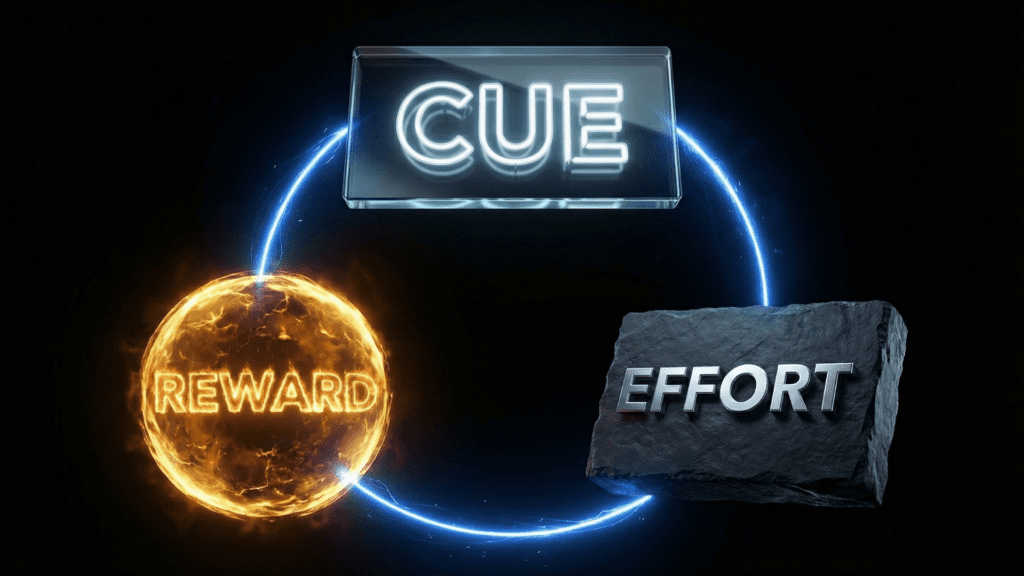
The three parts of a dopamine anchor
Every effective dopamine anchor has three parts.
- The Effort Block
A short, clearly defined unit of work. Most people fail because the “work” is vague and endless. - The Reward Signal
A small reward that is immediate, predictable, and does not hijack you. - The Closure Cue
A clear ending that tells your brain: we completed the cycle.
This is the missing piece for many people. If there is no closure, the brain does not register completion. No completion means weaker learning.
The dopamine anchoring rule that changes everything
Consider adjusting the work to be more manageable than your current level of resistance
If you set an effort block that is larger than your current capacity, your brain predicts failure. That prediction creates a sense of threat, which in turn hinders motivation.
Your first job is not to be impressive. Your first job is to be consistent.
Consistency is how you earn trust from your own nervous system.

How to choose rewards that actually work
A reward works when it is
Immediate
Repeatable
Small
Non-addictive
Not disruptive to focus
Here are examples of clean rewards:
A short walk outside
A cup of tea or coffee that you genuinely enjoy
Two minutes of stretching or mobility
One song you love (one song, not a playlist)
A quick check-in text to a friend
A five-minute “sunlight break” by a window
A small visual progress mark (a check, a sticker, a tally)
Here are rewards that often backfire:
Scrolling
Sugar binges
Online shopping
Anything that turns into “just one more.”
Anything that makes it harder to return to the next focused work session is a distraction.
Dopamine anchoring is about training, not escaping.
The dopamine anchoring ladder
The dopamine anchoring ladder is a simple way to match your effort block to your current nervous system capacity. Most people fail because they pick an anchor that is too advanced for their level and then interpret that mismatch as “I have no discipline.” In reality, you just chose an effort block that your brain predicted it could not sustain.
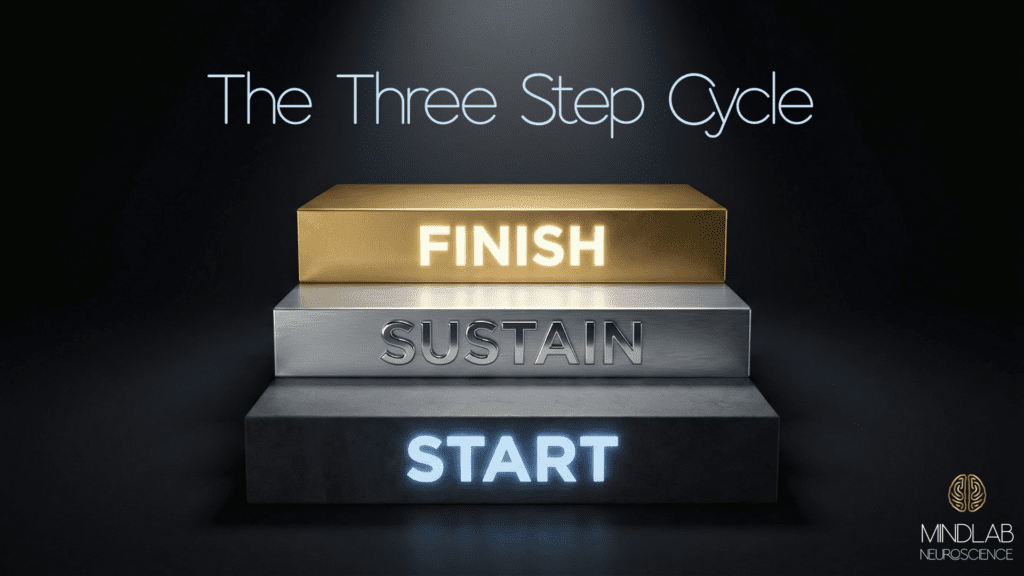
Think of the ladder like strength training for motivation. You do not start with the heaviest weight. You start with the weight you can lift consistently, then you scale.
A key rule before you choose a level: your anchor is only working if you can repeat it without a debate. If you need to inflate yourself, negotiate, or “wait to feel ready,” your anchor is too large, and you should consider stepping down.
Level 1: Start anchors
Purpose: get you to begin, especially when you feel resistance.
Effort block: 2–5 minutes (sometimes even 60–90 seconds).
Reward: immediate and tiny.
Closure cue: quick, clear, and consistent.
Start anchors are for the person who keeps circling the task but cannot enter it. The only goal here is to teach your brain: starting is safe, and starting pays off.
Examples
Effort block: open the document and write one sentence.
Reward: one sip of coffee you genuinely enjoy.
Closure cue: put a check mark on paper or in a tracker.
Effort block: put on workout clothes and do 3 minutes of movement.
Reward: one song.
Closure cue: “done” out loud plus a quick tally mark.
Level 2: Sustain anchors
Purpose: keep you going once you start, so you build rhythm and stamina.
Effort block: 10–20 minutes (12 minutes is a strong starting point).
Reward: a short break plus closure.
Closure cue: a clear “end” signal that locks in completion.
Sustain anchors are for the person who can start but fades fast or gets pulled into distraction. The main training target is follow-through without burnout.
Examples
Effort block: 12 minutes of focused work with notifications off.
Reward: 2 minutes of movement or stretching.
Closure cue: close the tab, write the next micro-step, then checkmark.
Effort block: 15 minutes of studying.
Reward: step outside for 3 minutes of fresh air
Closure cue: underline what you finished and physically put the book away.
Level 3: Finish anchors
Purpose: train for completion, not perfection, especially when you are at the “last 10%.”
Effort block: the final portion of a task you usually avoid: proofreading, submitting, cleaning up, and sending.
Reward: more substantial, but still clean and time-bound.
Closure cue: a firm “shutdown” ritual so your brain registers the cycle as complete.
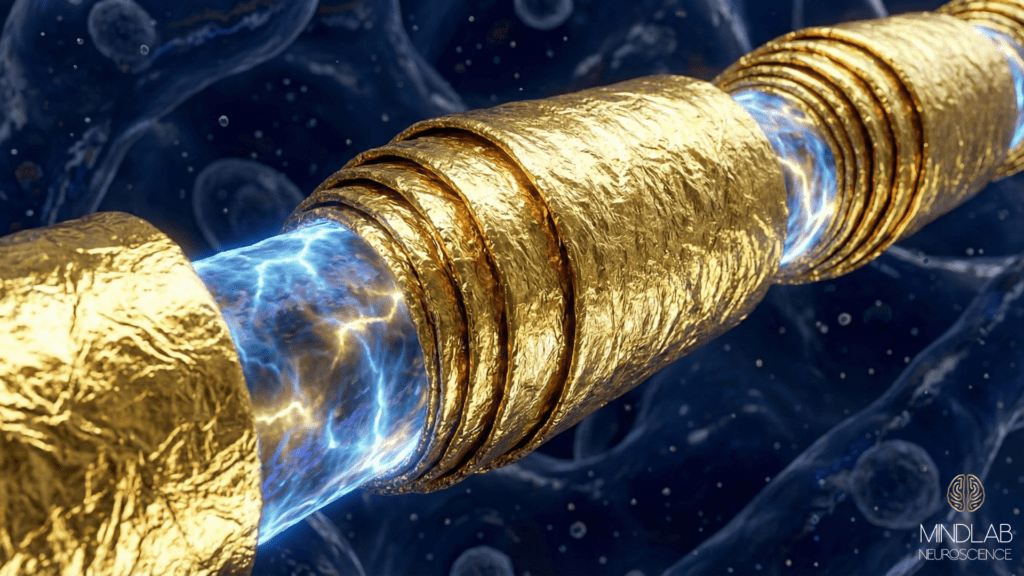
Finish anchors are for the person who produces a lot but leaves things open. Open loops drain dopamine. Completion restores it. This level teaches your brain that finishing is not dangerous, and it creates a reliable “done” signal that prevents procrastination from returning right at the end.
Examples
Effort block: finalize and send the email you have been rewriting.
Reward: a 10-minute walk or a specific relaxing ritual.
Closure cue: shut the laptop, clear the desk for 60 seconds, and mark “sent.”
Effort block: complete the last pass on a project and hit submit.
Reward: a planned meal, a short social break, or a restorative activity.
Closure cue: write “closed” or “submitted” in your tracker and set tomorrow’s start cue.
What counts as a good closure cue
Closure is not optional. It is the neurological “stamp” that tells your brain the effort was worth it. Pick one or two cues and keep them consistent, such as
A check mark in a notebook or habit tracker
Writing one sentence: “The next step is ____.”
Closing the laptop or shutting down your computer
Clearing your workspace for 30–60 seconds
Saying “done” out loud (yes, it matters)
Common mistake: choosing the wrong rung
Most people skip Level 1 and wonder why they never build momentum. If starting is hard, make a start anchor first. Once starting becomes automatic, you earn the right to scale into sustained anchors and finish.
The four-step dopamine anchoring protocol
This is the core method. You can use it for work, fitness, studying, creative projects, and even difficult conversations.
Step 1: Name the effort block
Make it specific and measurable.
Examples:
Write 150 words
Answer five emails
Read three pages
Do 10 minutes on the bike
Organize one drawer
Practice one complicated paragraph on the piano
Step 2: Choose the reward signal
One reward. Short. Clean.
Step 3: Set the closure cue
This can be as simple as saying out loud, “Done.”
Or writing a check mark.
Or closing the laptop.
Or tidying your workspace for 30 seconds.
Step 4: Repeat daily
The brain learns through repetition, not intensity.
In this guide, I will show you how dopamine anchoring works, why it is effective, and how to apply it in daily life.
Dopamine anchoring for focus in a distracted world
Many people think they cannot focus because they lack discipline. More often, they cannot concentrate because their brains have been trained to expect constant novelty.
Novelty spikes attention. That is normal. But when your day is built around novelty, effort starts to feel flat.
Dopamine anchoring rebuilds focus by making effort rewarding again.
Here is a simple focus setup:
Effort block: 12 minutes of focused work
Reward: 2 minutes of movement
Closure: check mark plus a sip of water
Repeat: 3 cycles
Twelve minutes sounds small. That is the point. Your brain needs proof that focus is survivable and worth it.
Over time, you scale up to 20 minutes, then 30.
Dopamine anchoring for procrastination
Procrastination is not a time management problem. It is a threat prediction problem.
Your brain procrastinates when a task predicts:
Failure
Judgment
Boredom
Overwhelm
Loss of freedom
Pain with no payoff
Dopamine anchoring changes the prediction by doing two things:
Shrinking the effort block so it feels doable
Guaranteeing a reward that your brain trusts
Try this today:
Effort block: 3 minutes on the task you are avoiding
Reward: one song
Closure: write the next tiny step on a sticky note
You are not trying to finish the task. You are trying to teach your brain to approach it.
Dopamine anchoring for gym consistency
Many people fail with exercise because they tie the reward to a future body outcome. That is too delayed to train the brain.
Instead, reward the behavior.
Example anchor:
Effort block: 8 minutes of movement
Reward: a hot shower with a specific scent you love
Closure: mark it on a calendar
When your brain learns “movement equals payoff,” it stops negotiating.
Dopamine anchoring for emotional regulation
This is where dopamine anchoring becomes powerful in a deeper way.
Emotional regulation is also a skill learned by reinforcement. If your brain learns that the only ways to feel better are to avoid, numb, or explode, then those behaviors become a repetitive cycle.
You can build an anchor for regulation.
Effort block: 90 seconds of slow breathing, or a short vagal toning practice
Reward: warmth, tea, a short grounding routine
Closure: one sentence in a journal: “I chose regulation.”
You are training a new identity: I am the person who can ride discomfort and return.
The most common dopamine anchoring mistakes
Mistake 1: The reward is too big
If the reward hijacks you, your brain will start chasing the reward, not respecting the effort.
Mistake 2: The effort block is too vague
“Work on my business” is not an effort block. It is a threat.
Mistake 3: No closure
Without closure, your brain does not encode completion.
Mistake 4: Inconsistency
Random rewards create a gambling brain. Consistent rewards create a learning brain.
Mistake 5: Using dopamine anchoring only when you feel good
You build the circuit on ordinary days. That is how it shows up on hard days.
A 7-day dopamine anchoring reset
If you want a clean start, do this for one week.
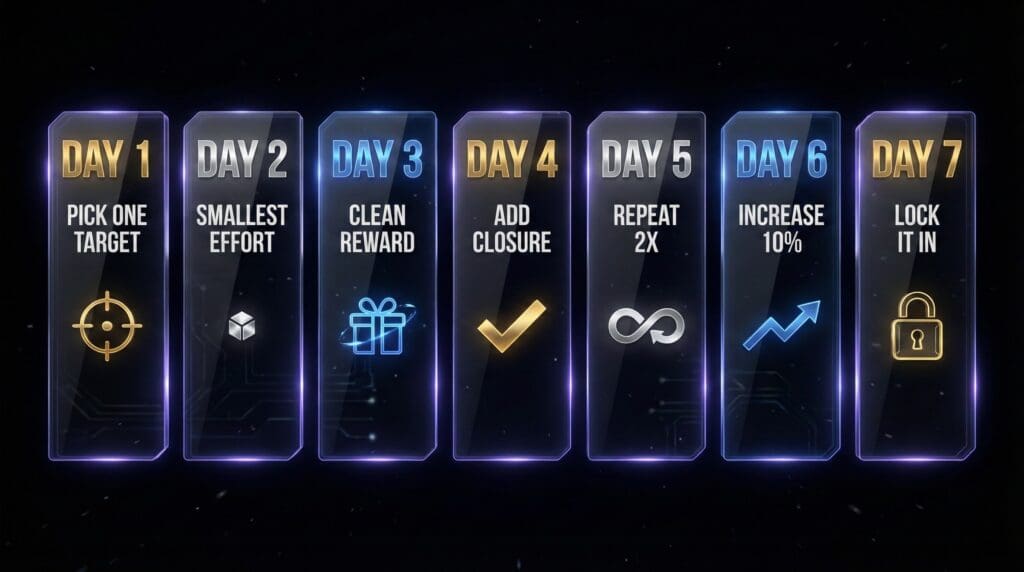
Day 1: Pick one target behavior
Only one. Not five.
Day 2: Define the smallest effort block
So small it feels almost silly.
Day 3: Choose one clean reward
Make it easy to access.
Day 4: Add closure
Decide on your closure cue and keep it identical.
Day 5: Repeat twice
Two cycles in one day.
Day 6: Increase effort by 10%
Do not double it. Do not prove anything.
Day 7: Review and lock it in
Ask: What made it easier to start? What reward felt clean? Did I close the loop?
This is how you build a motivation system that respects your brain.
Dopamine anchoring and “internal rewards”
At first, external rewards help you build the bridge. Over time, the internal reward grows.
Internal rewards are signals like
Pride
Relief
Competence
Clarity
Momentum
Identity reinforcement
You start to feel good because you did the thing, not because you received the reward.
That is the goal.
A helpful transition step is to pair a small external reward with a short internal reflection:
“I started when I did not feel like it.”
“I kept my promise to myself.”
“I am becoming consistent.”
That reflection is not cheesy. It is reinforcement.
Dopamine anchoring for high performers
If you are a high performer, your most significant risk is making effort blocks too large and rewards too rare.
Your brain is not impressed by your ambition. Your patterns train your brain.
High performers often need dopamine anchoring most when:
They are successful but numb
They are productive but inconsistent
They are driven but secretly exhausted
They keep raising the bar and losing the joy
Dopamine anchoring brings you back to a fundamental truth:
The brain performs best when effort is paired with a predictable reward and enough recovery.
Where dopamine anchoring fits inside neuroplasticity
Neuroplasticity is your brain’s ability to change through experience.
Dopamine helps decide which experiences get stored as “important.” That is why dopamine anchoring works so well for behavior change. You are using the brain’s learning rules instead of fighting them.
When you repeat the same effort-reward-closure cycle, you are not just building a habit. You are strengthening a pathway.
That is how “hard” becomes “normal.”
Important takeaways and examples of dopamine anchoring
Dopamine anchoring is about training motivation, not forcing it.
Small effort blocks beat big plans.
Rewards should be clean, immediate, and repeatable.
Closure matters because it teaches completion.
Consistency builds trust in your nervous system.
Over time, external rewards can become internal reinforcement.

Your next step
Dopamine anchoring is not a hack. It is a respectful way to work with your brain rather than bully it. If you have been stuck, inconsistent, or exhausted from trying to “push through,” take that as a sign you need a better system, not a harsher inner voice. Your current pattern is not a character flaw. It is a training history.
Here is the hard truth, and also the hopeful one: if you keep rehearsing the same loop, you will keep getting the same result. Insight alone will not change that. Motivation does not arrive first. Momentum does. And momentum is built when your brain gets repeated proof that effort reliably pays off.
Key Takeaways
- Dopamine anchoring works on anticipatory dopamine — the signal released before a reward, not after, which is what actually drives motivation to begin.
- Task initiation difficulty is often not laziness but a ventral striatum mismatch: the brain has not learned to associate starting with a pleasure signal.
- By pairing a genuine micro-reward with the precise moment of task initiation, the brain begins automating “starting = good” as a conditioned response.
- The anchor must be deployed at the initiation moment, not as a pre-task reward — timing determines whether the dopamine signal links to the start or to procrastination.
- Over 3-6 weeks of consistent anchoring, the conditioned association strengthens to the point where initiation resistance measurably decreases.
| Approach | Dopamine Mechanism | Brain’s Prediction | Initiation Result |
|---|---|---|---|
| Willpower-based start | No dopamine signal at initiation | “Starting = effort, no reward” | Resistance maintained or grows |
| Pre-task reward (coffee, music before starting) | Dopamine links to pre-task ritual, not start | “Pre-ritual = good; starting = still effortful” | Procrastination with enjoyable warm-up |
| Dopamine anchoring (reward at exact start moment) | Anticipatory dopamine fires at initiation cue | “Starting = pleasure signal incoming” | Resistance decreases with repetition |
| Completion reward only | Dopamine at finish, not start | “Getting started = long delay until reward” | High initiation barrier, strong finish drive |
“Willpower tells you to start. Dopamine anchoring trains your brain to associate starting with a pleasure signal — so the motivation arrives automatically, without the fight.”
What is dopamine anchoring and how is it different from habit stacking?
Dopamine anchoring is a neuroplasticity technique that pairs a genuine pleasure signal with the exact moment of task initiation. Habit stacking (attaching a new behavior to an existing one) addresses behavioral sequencing. Dopamine anchoring addresses the neurochemical signal at the initiation point — specifically targeting the ventral striatum’s anticipatory response. The distinction matters because a habit stack without a dopamine signal still leaves the initiation feeling effortful; anchoring changes what the brain predicts about starting itself.
Why is it so hard to start tasks even when you know you need to?
The ventral striatum generates anticipatory dopamine when it predicts a reward-associated action. For tasks the brain has learned to associate with discomfort, uncertainty, or effort-without-payoff, no anticipatory signal fires at the start — and without that signal, the brain’s action system lacks the push to initiate. This is not a willpower failure. It is a missing prediction. The brain is doing exactly what it is designed to do: conserving energy for actions it predicts will yield a return.
What counts as a valid micro-reward for anchoring?
The micro-reward must produce a genuine, immediate positive response — not something you think should feel good but something that actually does. Common anchors include a specific scent (such as an unusual coffee blend reserved only for starting work), a physical sensation (a particular stretch or temperature change), a piece of music played only at initiation, or a one-sentence affirmation that genuinely activates positive affect. The brain is not fooled by rewards you feel neutral about. The signal must be real to condition an anticipatory dopamine response.
How long does dopamine anchoring take to work?
Habit formation research suggests most behavioral-neural associations require 18-254 days depending on complexity, with a median around 66 days for moderately complex behaviors. Dopamine anchoring, applied consistently at the exact initiation moment, typically begins showing reduced resistance within 3-4 weeks. The first few repetitions feel artificial — the brain has not yet built the conditioned prediction. By weeks 5-8, most people report that the initiation anchor produces a noticeable “ready to start” response without deliberate effort.
Can dopamine anchoring work for tasks you genuinely dislike?
Yes — and this is where the technique is most useful. You do not need to enjoy the task. You need the brain to associate the initiation moment with a genuine pleasure signal that fires reliably enough to become a conditioned prediction. Over time, the anchor becomes the stimulus that triggers the “let’s go” dopamine response — and the task itself becomes a secondary concern. You are not learning to love the task; you are recalibrating the neural prediction about what starting feels like.
Dopamine & Motivation — MindLAB Locations
References
- Berridge, K.C. & Robinson, T.E. (1998). “What is the role of dopamine in reward: hedonic impact, reward learning, or incentive salience?” Brain Research Reviews, 28(3), 309-369. DOI: 10.1016/S0165-0173(98)00019-8
- Salamone, J.D., Correa, M., Farrar, A.M., Nunes, E.J., & Pardo, M. (2009). “Dopamine, behavioral economics, and effort.” Frontiers in Behavioral Neuroscience, 3, 13. DOI: 10.3389/neuro.08.013.2009
- Lally, P., van Jaarsveld, C.H.M., Potts, H.W.W., & Wardle, J. (2010). “How are habits formed: modelling habit formation in the real world.” European Journal of Social Psychology, 40(6), 998-1009. DOI: 10.1002/ejsp.674
At MindLAB Neuroscience, Dr. Ceruto applies Real-Time Neuroplasticity™ (RTN™) to build personalized dopamine anchoring protocols — identifying the specific initiation barriers that are most entrenched for each client and calibrating the anchor to the individual’s actual neurochemical response pattern. The Dopamine Code framework, detailed in Dr. Ceruto’s forthcoming book, provides the broader architecture within which dopamine anchoring operates as one targeted technique.
Therefore, I encourage you to make the decision today to stop waiting until you feel ready. Pick one behavior that has been quietly costing you time, money, confidence, or peace. Make the effort small enough that your resistance cannot win. Make the reward clean enough that it does not steal your attention. Close the loop so your brain registers completion. Then repeat the same sequence tomorrow, even if you do not feel like it. That’s how you go from “I know what to do” to “I do it.”
Pick one behavior. Make the effort small. Make the reward clean. Close the loop. Repeat.
If you want help building a dopamine anchoring plan that fits your exact brain, schedule, and goals, that is the work I do every day. You do not have to keep guessing your way into consistency or trying to white-knuckle your way through another year. You can train this system with precision, and you can start now.
FAQ: Dopamine Anchoring
How fast does dopamine anchoring work?
Many people feel a shift in a few days because starting becomes easier. Stronger habit wiring usually takes weeks of repetition.
Do I have to reward myself forever?
No. You use rewards to train the pattern. As the brain learns, the behavior becomes more automatic, and the internal reward grows.
What if I “fail” a day?
Consider it as data, not a moral issue. Restart the next day with a smaller effort block. The brain learns by returning.
Can dopamine anchoring help with phone habits?
Yes, but the reward must not be the phone. If the phone is the reward, you train the very loop you are trying to break.
What if rewards feel childish?
Your nervous system isn’t concerned about adult pride. It cares about learning signals. Use rewards as training wheels, then taper.
How many anchors should I build at once?
Start with one. Build momentum. Then add a second anchor when the first feels stable.
Dopamine Anchoring: A Neuroscience Guide to Motivation
Dopamine anchoring is a neuroscience-based strategy that pairs effort with a predictable reward signal, so your brain learns that starting is worth it. If you have ever said, “I know what to do, I just cannot make myself do it,” you are not lazy. You are dealing with a brain that learns through reward.
Most people think motivation is a personality trait. Either you have it, or you do not. That is not how the brain works. Your brain is a prediction machine. It is constantly asking one question: Is the effort worth it?
Dopamine is one of the key chemicals your brain uses to answer that question. Dopamine functions not merely as a “pleasure chemical,” but also as a teaching signal. Dopamine helps your brain tag actions as valuable, repeatable, and worth doing again.
Dopamine anchoring takes that biology seriously. It gives your nervous system a clear pattern: effort, followed by a clean and consistent reward, followed by closure. Over time, your brain stops perceiving effort like a threat and starts viewing it like a path.
As a neuroscientist and the author of my Simon and Schuster book, The Dopamine Code, I care about one thing above all: turning brain science into results you can feel on a Tuesday afternoon when you are exhausted, distracted, and tempted to quit.
A note on The Dopamine Code
When I wrote The Dopamine Code with Simon & Schuster, my goal was not to publish “motivation advice.” My goal was to translate dopamine science into a practical operating system that works in real life, especially for high performers who are smart enough to understand the theory but still struggle with consistency when stress is high and attention is fragmented.
to rewire your brain and create a customized plan
to begin sustained dopamine anchoring.
In the book, I break down how dopamine actually trains behavior through learning, prediction, and reinforcement, and why so many people accidentally wire their brains to associate effort with pressure and reward with escape. That distinction matters because the brain does not change through intention. It changes through patterns that repeat.
If this dopamine anchoring guide feels like it is speaking directly to your experience, that is not a coincidence. It comes from the same framework: take neuroscience seriously, break the steps into small enough chunks to repeat, and build motivation as a circuit you train, not a mood you wait for.
What is dopamine anchoring
Dopamine anchoring is a practical way to train motivation by pairing a specific effort with a specific reward, on purpose, in the same sequence each time. You are teaching your brain that starting and finishing reliably lead to something good, not just “someday,” but now.
It is not bribing yourself. It is conditioning your prediction system, meaning the part of your brain that constantly asks, “If I do this, what happens next?” When the brain cannot predict a payoff, it labels effort as costly and delays action. The brain increases follow-through and decreases resistance when it can anticipate a reward.
Think of an anchor as a stable bridge between:
- The effort you resist
- And a reward your brain trusts
When that bridge is stable, you don’t require motivation to cross it. You cross it because your brain expects the effort to be worth it.
A clean dopamine anchoring sequence has three parts:
- A clear start cue (what tells your brain, “We begin now”).
- A defined effort block (what you do, for how long, and what “done” means)
- A small, immediate reward (something pleasant that does not steal your attention)
Example: 25 minutes of focused work, then 3 minutes of a favorite song, a short walk, or a specific coffee ritual. The anchor is not coffee. The anchor is the predictable order: effort first, reward second, repeated until the brain trusts the pattern.
What dopamine anchoring is not
Dopamine anchoring is not chasing bigger and bigger rewards. That turns motivation into escalation, which is how people burn out. Your brain adapts quickly. If you keep raising the reward, you teach your system that “ordinary effort is not enough,” which makes it harder to start.
Dopamine anchoring is not using a reward that hijacks your attention for an hour after five minutes of work. Doomscrolling, gaming, and endless video clips are not rewards in this context. They create a reward hangover: your dopamine spikes, then drops, and suddenly the original task feels even more boring and painful to return to.
Dopamine anchoring is not forcing discipline through shame. Shame activates threat circuitry. Threat can narrow focus for a moment, but it also makes your nervous system associate effort with danger, which destroys consistency over time. Consistency is the entire point.
Dopamine anchoring is not becoming dependent on rewards. The goal is to build a stable motivation circuit first, then gradually shift the reward from external to internal. Early on, you borrow motivation from a small external reward. Over time, the internal reward becomes a feeling of competence, closure, and momentum.
A simple rule: if the “reward” makes it harder to get back to work, it is not an anchor. It is an escape.

The neuroscience that makes dopamine anchoring work
Dopamine anchoring works because the brain learns through prediction and prediction error, not through willpower speeches.
Prediction is what your brain expects to happen when you take action.
Prediction error is the gap between what you expected and what you actually got.
When the brain experiences a positive prediction error (the result is better than expected), dopamine signals, “Remember this. Repeat this.”
When the brain experiences a negative prediction error (the result is worse than expected), dopamine signals, “Avoid this next time.”
Here’s the motivation trap that many high performers fall into:
- Effort feels expensive right now
- Rewards feel uncertain later
- So the brain predicts: not worth it
Dopamine anchoring changes the prediction in two direct ways:
- It shrinks the time gap between effort and payoff
- It makes the payoff predictable, so the brain stops viewing effort like a gamble
This is not just a mindset. It is reinforcement learning in action. When the effort-reward pairing is consistent, circuits involved in habit and motivation start to automate the sequence. Over time, “start” becomes less of a debate and more of a default.
The key is reliability. The brain does not need a massive reward. It requires a dependable one.
Why smart people still struggle with motivation
Smart, driven people often struggle with motivation for a particular reason: they accidentally train their brain to regard daily effort as unrewarded labor.
A typical hidden pattern is this:
You only reward yourself when you finish something enormous.
It sounds mature, but, neurologically, it teaches your brain that small daily efforts don’t count. Your brain cannot process a future payoff as a reward. It learns from patterns it can sense repeatedly in real time. If the only payoff is far away, the brain becomes stingy with motivation.
The opposite pattern is just as common:
You reward yourself before the effort.
That trains your brain to associate the reward with avoidance, not progress. Then, when you try to start, your brain has already gotten the “hit,” so effort feels even harder because there is no reason to move.
Dopamine anchoring solves both problems by correcting timing and keeping the reward clean:
- The reward comes after effort, not before
- The reward is small enough to be satisfying, but not so big that it derails you
- The sequence repeats until the brain expects follow-through as the normal outcome
If you are competent but inconsistent, it is rarely because you are lazy. More often, it is because your brain has learned that effort does not reliably pay off. Dopamine anchoring rebuilds that trust, one repeatable loop at a time.
The three parts of a dopamine anchor
Every effective dopamine anchor has three parts.
- The Effort Block
A short, clearly defined unit of work. Most people fail because the “work” is vague and endless. - The Reward Signal
A small reward that is immediate, predictable, and does not hijack you. - The Closure Cue
A clear ending that tells your brain: we completed the cycle.
This is the missing piece for many people. If there is no closure, the brain does not register completion. No completion means weaker learning.
The dopamine anchoring rule that changes everything
Consider adjusting the work to be more manageable than your current level of resistance
If you set an effort block that is larger than your current capacity, your brain predicts failure. That prediction creates a sense of threat, which in turn hinders motivation.
Your first job is not to be impressive. Your first job is to be consistent.
Consistency is how you earn trust from your own nervous system.
How to choose rewards that actually work
A reward works when it is
Immediate
Repeatable
Small
Non-addictive
Not disruptive to focus
Here are examples of clean rewards:
A short walk outside
A cup of tea or coffee that you genuinely enjoy
Two minutes of stretching or mobility
One song you love (one song, not a playlist)
A quick check-in text to a friend
A five-minute “sunlight break” by a window
A small visual progress mark (a check, a sticker, a tally)
Here are rewards that often backfire:
Scrolling
Sugar binges
Online shopping
Anything that turns into “just one more.”
Anything that makes it harder to return to the next focused work session is a distraction.
Dopamine anchoring is about training, not escaping.
The dopamine anchoring ladder
The dopamine anchoring ladder is a simple way to match your effort block to your current nervous system capacity. Most people fail because they pick an anchor that is too advanced for their level and then interpret that mismatch as “I have no discipline.” In reality, you just chose an effort block that your brain predicted it could not sustain.
Think of the ladder like strength training for motivation. You do not start with the heaviest weight. You start with the weight you can lift consistently, then you scale.
A key rule before you choose a level: your anchor is only working if you can repeat it without a debate. If you need to inflate yourself, negotiate, or “wait to feel ready,” your anchor is too large, and you should consider stepping down.
Level 1: Start anchors
Purpose: get you to begin, especially when you feel resistance.
Effort block: 2–5 minutes (sometimes even 60–90 seconds).
Reward: immediate and tiny.
Closure cue: quick, clear, and consistent.
Start anchors are for the person who keeps circling the task but cannot enter it. The only goal here is to teach your brain: starting is safe, and starting pays off.
Examples
Effort block: open the document and write one sentence.
Reward: one sip of coffee you genuinely enjoy.
Closure cue: put a check mark on paper or in a tracker.
Effort block: put on workout clothes and do 3 minutes of movement.
Reward: one song.
Closure cue: “done” out loud plus a quick tally mark.
Level 2: Sustain anchors
Purpose: keep you going once you start, so you build rhythm and stamina.
Effort block: 10–20 minutes (12 minutes is a strong starting point).
Reward: a short break plus closure.
Closure cue: a clear “end” signal that locks in completion.
Sustain anchors are for the person who can start but fades fast or gets pulled into distraction. The main training target is follow-through without burnout.
Examples
Effort block: 12 minutes of focused work with notifications off.
Reward: 2 minutes of movement or stretching.
Closure cue: close the tab, write the next micro-step, then checkmark.
Effort block: 15 minutes of studying.
Reward: step outside for 3 minutes of fresh air
Closure cue: underline what you finished and physically put the book away.
Level 3: Finish anchors
Purpose: train for completion, not perfection, especially when you are at the “last 10%.”
Effort block: the final portion of a task you usually avoid: proofreading, submitting, cleaning up, and sending.
Reward: more substantial, but still clean and time-bound.
Closure cue: a firm “shutdown” ritual so your brain registers the cycle as complete.
Finish anchors are for the person who produces a lot but leaves things open. Open loops drain dopamine. Completion restores it. This level teaches your brain that finishing is not dangerous, and it creates a reliable “done” signal that prevents procrastination from returning right at the end.
Examples
Effort block: finalize and send the email you have been rewriting.
Reward: a 10-minute walk or a specific relaxing ritual.
Closure cue: shut the laptop, clear the desk for 60 seconds, and mark “sent.”
Effort block: complete the last pass on a project and hit submit.
Reward: a planned meal, a short social break, or a restorative activity.
Closure cue: write “closed” or “submitted” in your tracker and set tomorrow’s start cue.
What counts as a good closure cue
Closure is not optional. It is the neurological “stamp” that tells your brain the effort was worth it. Pick one or two cues and keep them consistent, such as
A check mark in a notebook or habit tracker
Writing one sentence: “The next step is ____.”
Closing the laptop or shutting down your computer
Clearing your workspace for 30–60 seconds
Saying “done” out loud (yes, it matters)
Common mistake: choosing the wrong rung
Most people skip Level 1 and wonder why they never build momentum. If starting is hard, make a start anchor first. Once starting becomes automatic, you earn the right to scale into sustained anchors and finish.
The four-step dopamine anchoring protocol
This is the core method. You can use it for work, fitness, studying, creative projects, and even difficult conversations.
Step 1: Name the effort block
Make it specific and measurable.
Examples:
Write 150 words
Answer five emails
Read three pages
Do 10 minutes on the bike
Organize one drawer
Practice one complicated paragraph on the piano
Step 2: Choose the reward signal
One reward. Short. Clean.
Step 3: Set the closure cue
This can be as simple as saying out loud, “Done.”
Or writing a check mark.
Or closing the laptop.
Or tidying your workspace for 30 seconds.
Step 4: Repeat daily
The brain learns through repetition, not intensity.
In this guide, I will show you how dopamine anchoring works, why it is effective, and how to apply it in daily life.
Dopamine anchoring for focus in a distracted world
Many people think they cannot focus because they lack discipline. More often, they cannot concentrate because their brains have been trained to expect constant novelty.
Novelty spikes attention. That is normal. But when your day is built around novelty, effort starts to feel flat.
Dopamine anchoring rebuilds focus by making effort rewarding again.
Here is a simple focus setup:
Effort block: 12 minutes of focused work
Reward: 2 minutes of movement
Closure: check mark plus a sip of water
Repeat: 3 cycles
Twelve minutes sounds small. That is the point. Your brain needs proof that focus is survivable and worth it.
Over time, you scale up to 20 minutes, then 30.
Dopamine anchoring for procrastination
Procrastination is not a time management problem. It is a threat prediction problem.
Your brain procrastinates when a task predicts:
Failure
Judgment
Boredom
Overwhelm
Loss of freedom
Pain with no payoff
Dopamine anchoring changes the prediction by doing two things:
Shrinking the effort block so it feels doable
Guaranteeing a reward that your brain trusts
Try this today:
Effort block: 3 minutes on the task you are avoiding
Reward: one song
Closure: write the next tiny step on a sticky note
You are not trying to finish the task. You are trying to teach your brain to approach it.
Dopamine anchoring for gym consistency
Many people fail with exercise because they tie the reward to a future body outcome. That is too delayed to train the brain.
Instead, reward the behavior.
Example anchor:
Effort block: 8 minutes of movement
Reward: a hot shower with a specific scent you love
Closure: mark it on a calendar
When your brain learns “movement equals payoff,” it stops negotiating.
Dopamine anchoring for emotional regulation
This is where dopamine anchoring becomes powerful in a deeper way.
Emotional regulation is also a skill learned by reinforcement. If your brain learns that the only ways to feel better are to avoid, numb, or explode, then those behaviors become a repetitive cycle.
You can build an anchor for regulation.
Effort block: 90 seconds of slow breathing, or a short vagal toning practice
Reward: warmth, tea, a short grounding routine
Closure: one sentence in a journal: “I chose regulation.”
You are training a new identity: I am the person who can ride discomfort and return.
The most common dopamine anchoring mistakes
Mistake 1: The reward is too big
If the reward hijacks you, your brain will start chasing the reward, not respecting the effort.
Mistake 2: The effort block is too vague
“Work on my business” is not an effort block. It is a threat.
Mistake 3: No closure
Without closure, your brain does not encode completion.
Mistake 4: Inconsistency
Random rewards create a gambling brain. Consistent rewards create a learning brain.
Mistake 5: Using dopamine anchoring only when you feel good
You build the circuit on ordinary days. That is how it shows up on hard days.
A 7-day dopamine anchoring reset
If you want a clean start, do this for one week.
Day 1: Pick one target behavior
Only one. Not five.
Day 2: Define the smallest effort block
So small it feels almost silly.
Day 3: Choose one clean reward
Make it easy to access.
Day 4: Add closure
Decide on your closure cue and keep it identical.
Day 5: Repeat twice
Two cycles in one day.
Day 6: Increase effort by 10%
Do not double it. Do not prove anything.
Day 7: Review and lock it in
Ask: What made it easier to start? What reward felt clean? Did I close the loop?
This is how you build a motivation system that respects your brain.
Dopamine anchoring and “internal rewards”
At first, external rewards help you build the bridge. Over time, the internal reward grows.
Internal rewards are signals like
Pride
Relief
Competence
Clarity
Momentum
Identity reinforcement
You start to feel good because you did the thing, not because you received the reward.
That is the goal.
A helpful transition step is to pair a small external reward with a short internal reflection:
“I started when I did not feel like it.”
“I kept my promise to myself.”
“I am becoming consistent.”
That reflection is not cheesy. It is reinforcement.
Dopamine anchoring for high performers
If you are a high performer, your most significant risk is making effort blocks too large and rewards too rare.
Your brain is not impressed by your ambition. Your patterns train your brain.
High performers often need dopamine anchoring most when:
They are successful but numb
They are productive but inconsistent
They are driven but secretly exhausted
They keep raising the bar and losing the joy
Dopamine anchoring brings you back to a fundamental truth:
The brain performs best when effort is paired with a predictable reward and enough recovery.
Where dopamine anchoring fits inside neuroplasticity
Neuroplasticity is your brain’s ability to change through experience.
Dopamine helps decide which experiences get stored as “important.” That is why dopamine anchoring works so well for behavior change. You are using the brain’s learning rules instead of fighting them.
When you repeat the same effort-reward-closure cycle, you are not just building a habit. You are strengthening a pathway.
That is how “hard” becomes “normal.”
Important takeaways and examples of dopamine anchoring
Dopamine anchoring is about training motivation, not forcing it.
Small effort blocks beat big plans.
Rewards should be clean, immediate, and repeatable.
Closure matters because it teaches completion.
Consistency builds trust in your nervous system.
Over time, external rewards can become internal reinforcement.
Your next step
Dopamine anchoring is not a hack. It is a respectful way to work with your brain rather than bully it. If you have been stuck, inconsistent, or exhausted from trying to “push through,” take that as a sign you need a better system, not a harsher inner voice. Your current pattern is not a character flaw. It is a training history.
Here is the hard truth, and also the hopeful one: if you keep rehearsing the same loop, you will keep getting the same result. Insight alone will not change that. Motivation does not arrive first. Momentum does. And momentum is built when your brain gets repeated proof that effort reliably pays off.
Key Takeaways
- Dopamine anchoring works on anticipatory dopamine — the signal released before a reward, not after, which is what actually drives motivation to begin.
- Task initiation difficulty is often not laziness but a ventral striatum mismatch: the brain has not learned to associate starting with a pleasure signal.
- By pairing a genuine micro-reward with the precise moment of task initiation, the brain begins automating “starting = good” as a conditioned response.
- The anchor must be deployed at the initiation moment, not as a pre-task reward — timing determines whether the dopamine signal links to the start or to procrastination.
- Over 3-6 weeks of consistent anchoring, the conditioned association strengthens to the point where initiation resistance measurably decreases.
| Approach | Dopamine Mechanism | Brain’s Prediction | Initiation Result |
|---|---|---|---|
| Willpower-based start | No dopamine signal at initiation | “Starting = effort, no reward” | Resistance maintained or grows |
| Pre-task reward (coffee, music before starting) | Dopamine links to pre-task ritual, not start | “Pre-ritual = good; starting = still effortful” | Procrastination with enjoyable warm-up |
| Dopamine anchoring (reward at exact start moment) | Anticipatory dopamine fires at initiation cue | “Starting = pleasure signal incoming” | Resistance decreases with repetition |
| Completion reward only | Dopamine at finish, not start | “Getting started = long delay until reward” | High initiation barrier, strong finish drive |
“Willpower tells you to start. Dopamine anchoring trains your brain to associate starting with a pleasure signal — so the motivation arrives automatically, without the fight.”
What is dopamine anchoring and how is it different from habit stacking?
Dopamine anchoring is a neuroplasticity technique that pairs a genuine pleasure signal with the exact moment of task initiation. Habit stacking (attaching a new behavior to an existing one) addresses behavioral sequencing. Dopamine anchoring addresses the neurochemical signal at the initiation point — specifically targeting the ventral striatum’s anticipatory response. The distinction matters because a habit stack without a dopamine signal still leaves the initiation feeling effortful; anchoring changes what the brain predicts about starting itself.
Why is it so hard to start tasks even when you know you need to?
The ventral striatum generates anticipatory dopamine when it predicts a reward-associated action. For tasks the brain has learned to associate with discomfort, uncertainty, or effort-without-payoff, no anticipatory signal fires at the start — and without that signal, the brain’s action system lacks the push to initiate. This is not a willpower failure. It is a missing prediction. The brain is doing exactly what it is designed to do: conserving energy for actions it predicts will yield a return.
What counts as a valid micro-reward for anchoring?
The micro-reward must produce a genuine, immediate positive response — not something you think should feel good but something that actually does. Common anchors include a specific scent (such as an unusual coffee blend reserved only for starting work), a physical sensation (a particular stretch or temperature change), a piece of music played only at initiation, or a one-sentence affirmation that genuinely activates positive affect. The brain is not fooled by rewards you feel neutral about. The signal must be real to condition an anticipatory dopamine response.
How long does dopamine anchoring take to work?
Habit formation research suggests most behavioral-neural associations require 18-254 days depending on complexity, with a median around 66 days for moderately complex behaviors. Dopamine anchoring, applied consistently at the exact initiation moment, typically begins showing reduced resistance within 3-4 weeks. The first few repetitions feel artificial — the brain has not yet built the conditioned prediction. By weeks 5-8, most people report that the initiation anchor produces a noticeable “ready to start” response without deliberate effort.
Can dopamine anchoring work for tasks you genuinely dislike?
Yes — and this is where the technique is most useful. You do not need to enjoy the task. You need the brain to associate the initiation moment with a genuine pleasure signal that fires reliably enough to become a conditioned prediction. Over time, the anchor becomes the stimulus that triggers the “let’s go” dopamine response — and the task itself becomes a secondary concern. You are not learning to love the task; you are recalibrating the neural prediction about what starting feels like.
References
- Berridge, K.C. & Robinson, T.E. (1998). “What is the role of dopamine in reward: hedonic impact, reward learning, or incentive salience?” Brain Research Reviews, 28(3), 309-369. DOI: 10.1016/S0165-0173(98)00019-8
- Salamone, J.D., Correa, M., Farrar, A.M., Nunes, E.J., & Pardo, M. (2009). “Dopamine, behavioral economics, and effort.” Frontiers in Behavioral Neuroscience, 3, 13. DOI: 10.3389/neuro.08.013.2009
- Lally, P., van Jaarsveld, C.H.M., Potts, H.W.W., & Wardle, J. (2010). “How are habits formed: modelling habit formation in the real world.” European Journal of Social Psychology, 40(6), 998-1009. DOI: 10.1002/ejsp.674
At MindLAB Neuroscience, Dr. Ceruto applies Real-Time Neuroplasticity™ (RTN™) to build personalized dopamine anchoring protocols — identifying the specific initiation barriers that are most entrenched for each client and calibrating the anchor to the individual’s actual neurochemical response pattern. The Dopamine Code framework, detailed in Dr. Ceruto’s forthcoming book, provides the broader architecture within which dopamine anchoring operates as one targeted technique.
Therefore, I encourage you to make the decision today to stop waiting until you feel ready. Pick one behavior that has been quietly costing you time, money, confidence, or peace. Make the effort small enough that your resistance cannot win. Make the reward clean enough that it does not steal your attention. Close the loop so your brain registers completion. Then repeat the same sequence tomorrow, even if you do not feel like it. That’s how you go from “I know what to do” to “I do it.”
Pick one behavior. Make the effort small. Make the reward clean. Close the loop. Repeat.
If you want help building a dopamine anchoring plan that fits your exact brain, schedule, and goals, that is the work I do every day. You do not have to keep guessing your way into consistency or trying to white-knuckle your way through another year. You can train this system with precision, and you can start now.
FAQ: Dopamine Anchoring
How fast does dopamine anchoring work?
Do I have to reward myself forever?
What if I “fail” a day?
Can dopamine anchoring help with phone habits?
What if rewards feel childish?
How many anchors should I build at once?
This article is part of our Dopamine & Motivation collection. Explore the full series for deeper insights into dopamine & motivation.