





Key Points
- Career stagnation persists because professional behaviors become encoded in the brain's automatic circuitry — not because you lack ambition or capability.
- Real-Time Neuroplasticity™ recalibrates the dopamine and executive function pathways that govern risk tolerance, decision-making, and professional momentum.
- The neural patterns behind early career success often become the exact patterns that create an invisible ceiling at senior levels.
- Dr. Ceruto maps your specific neural architecture during the Strategy Call to identify the precise circuits constraining your trajectory.
- MindLAB's methodology produces permanent structural change in career-related neural pathways — eliminating the need for ongoing motivational maintenance.
| Marker | Traditional Approach | Neuroscience-Based Approach | Why It Matters |
|---|---|---|---|
| Target of Intervention | Surface-level career strategies and goal-setting | Neural circuits governing professional behavior | Root-cause rewiring vs. strategy overlay |
| Approach to Stagnation | New tactics, accountability, motivation techniques | Recalibration of dopamine and executive function pathways | Structural brain change, not behavioral tips |
| Duration of Results | Fades when external accountability ends | Permanent neural pathway restructuring | Change that holds without constant reinforcement |
| Personalization | Standardized career frameworks and assessments | Mapped to your specific neural architecture | Precision targeting for your exact pattern |
Why Career Coaching for Professionals Matters in Miami
Career Coaching for Professionals in Miami
Miami’s professional landscape operates at the intersection of finance, technology, hospitality, and international commerce — a convergence that rewards adaptability but punishes hesitation. Professionals building careers in Brickell’s banking towers, the tech startups of Wynwood, or the hospitality empires stretching from South Beach to Coral Gables face a specific cognitive challenge: the neural patterns that produced early career success often become the exact patterns that create an invisible ceiling later. The associate who earned a promotion through relentless execution discovers that the same drive-without-pause wiring now prevents the strategic thinking required at director level. The entrepreneur whose rapid-fire decision-making launched a venture in the Design District finds that identical impulsivity is eroding the partnerships needed to scale. These are not motivation problems. They are architectural problems — patterns encoded deep in the brain’s prefrontal and striatal circuits that continue running their original program long after the professional context has changed.
Miami’s unique position as a gateway to Latin American markets adds another layer of neural complexity. Professionals here frequently navigate multiple business cultures simultaneously — the relationship-driven pace of Brazilian and Colombian commerce alongside the metrics-driven urgency of domestic finance. This constant context-switching taxes the brain’s executive function networks in ways that most career guidance completely ignores. The prefrontal cortex, responsible for planning and flexible thinking, can become overloaded when it is perpetually toggling between competing frameworks. The result is decision fatigue that masquerades as career confusion, or a persistent sense of being stuck that has nothing to do with capability and everything to do with neural resource allocation. A finance professional in Coral Gables managing both domestic portfolios and Latin American relationships is not lacking ambition. Their brain is allocating cognitive resources in a pattern that was never optimized for the demands they now face.
Dr. Ceruto’s methodology addresses career stagnation at the neurological level where the pattern actually lives. Rather than building strategies on top of existing neural architecture — the approach taken by conventional career guidance — Real-Time Neuroplasticity™ recalibrates the circuits themselves. This means restructuring the dopamine pathways that govern motivation and reward prediction, so that the brain stops defaulting to familiar but limiting career behaviors. For the hospitality executive in Miami Beach whose perfectionism prevents delegation, the issue is not about learning to trust others. The issue is a neural circuit that equates letting go of control with threat — a circuit that can be permanently rewired once it is accurately identified. For the tech founder in Wynwood whose impostor experience intensifies with every round of funding, the pattern is not psychological fragility. It is a specific configuration of the anterior cingulate cortex that flags success as incongruent with self-concept, producing anxiety precisely when things are going well.
What distinguishes MindLAB’s approach in Miami’s competitive professional environment is the precision of the intervention. Dr. Ceruto does not offer generalized career advice or accountability structures. She maps the specific neural patterns that are constraining your professional trajectory — whether that is risk aversion encoded in the amygdala’s threat detection system, a dopamine circuit that has been desensitized by years of high-stimulus work, or executive function patterns that produce brilliant tactical thinking but prevent strategic vision. The initial Strategy Call is a focused conversation that identifies these patterns with specificity. For professionals throughout Miami — from the financial advisors of Key Biscayne to the creative directors of the Design District to the healthcare administrators of Kendall — this represents a fundamentally different entry point into career advancement: one that starts with the brain’s actual architecture rather than motivational frameworks that ignore it.
Miami rewards people who move fast and project confidence, which means the neural patterns behind career stagnation often remain invisible until the cost becomes undeniable — a promotion that should have come two years ago, a business that plateaus despite obvious market opportunity, a professional reputation that quietly shrinks while competitors advance. These outcomes are not random. They are the predictable output of neural circuits running outdated programs. The brain does not spontaneously upgrade its career-related wiring when you read a leadership book or attend a networking event. It requires targeted intervention at the level where the pattern operates. That is what MindLAB provides — and the Strategy Call is where the mapping begins.


Dr. Sydney Ceruto, PhD — Founder & CEO, MindLAB Neuroscience
Dr. Ceruto holds a PhD in Behavioral & Cognitive Neuroscience from NYU and two Master’s degrees from Yale University. She lectures at the Wharton Executive Development Program at the University of Pennsylvania and has been an Executive Contributor to the Forbes Coaching Council since 2019. Dr. Ceruto is the author of The Dopamine Code (Simon & Schuster, June 2026). She founded MindLAB Neuroscience in 2000 and has spent over 26 years pioneering Real-Time Neuroplasticity™ — a methodology that permanently rewires the neural pathways driving behavior, decisions, and emotional responses.
Success Stories
“Every system, every supplement, every productivity method I tried collapsed within weeks — and nothing held because nothing addressed why my attention kept fragmenting. Dr. Ceruto identified the dopamine regulation pattern that was hijacking my prefrontal cortex every time I needed sustained focus. She didn't give me another workaround. She restructured the architecture underneath. My brain holds now. That's not something I ever thought I'd be able to say.”

Identifying details withheld to protect client confidentiality.
All outcomes represent genuine engagements with Dr. Ceruto.
Frequently Asked Questions About Career Coaching for Professionals
Why does career stagnation persist even when I have the right skills?
Career stagnation is typically driven by neural patterns — not skill gaps. The brain encodes professional behaviors into automatic circuits over time, and those circuits continue running their original program even when your career demands have evolved. Rewiring the architecture produces advancement that strategy alone cannot.
How does a neuroscience approach to career advancement differ from traditional career guidance?
Traditional career guidance builds strategies on top of your existing neural architecture. MindLAB's methodology uses Real-Time Neuroplasticity™ to recalibrate the circuits themselves — restructuring dopamine pathways, executive function networks, and threat-response patterns that constrain professional performance at their source.
What kinds of career challenges respond to neuroscience-based approaches?
Any persistent professional pattern that resists conscious effort — risk aversion that blocks advancement, perfectionism that prevents delegation, impostor experiences that intensify with success, decision fatigue, chronic procrastination on high-stakes projects, and difficulty transitioning into leadership roles.
What happens during the Strategy Call for career-related concerns?
The Strategy Call is a focused phone conversation with Dr. Ceruto where she maps the specific neural mechanisms constraining your professional trajectory. It replaces guesswork with a precise assessment of why the pattern has persisted and what restructuring would look like for your situation.
Is MindLAB's approach available to professionals throughout the Miami area?
Yes. MindLAB Neuroscience works with professionals across Miami including Brickell, Coral Gables, Coconut Grove, Key Biscayne, Miami Beach, Wynwood, and the broader Dade County area. The Strategy Call is conducted by phone to begin the process.
Also available in: Wall Street · Midtown Manhattan · Beverly Hills · Lisbon
Take the First Step
The Strategy Call is a focused conversation with Dr. Ceruto that maps the specific neural mechanisms constraining your career trajectory and determines the right path forward.
Book a Strategy Call
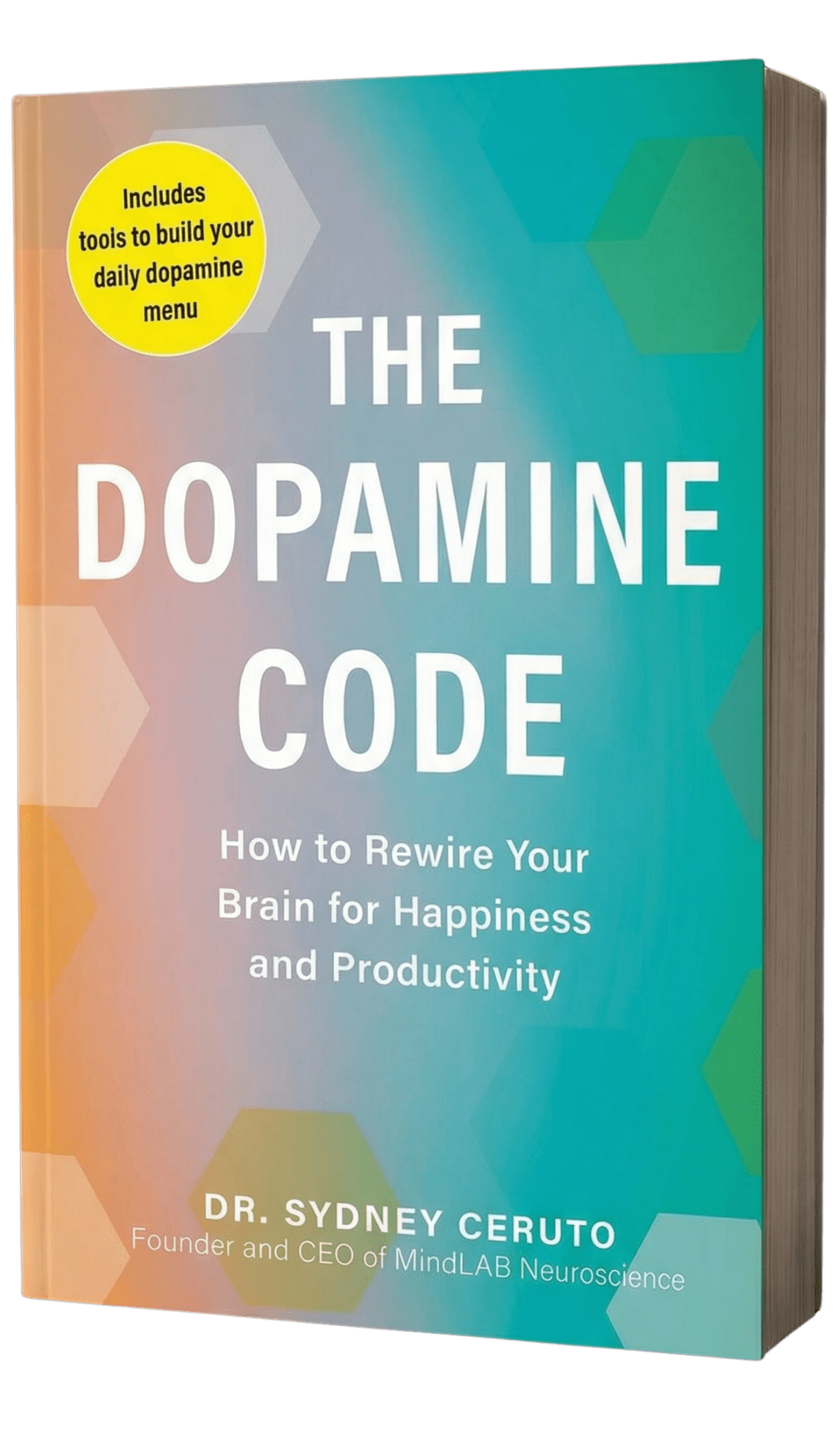
The Dopamine Code
Decode Your Drive
Why Your Brain Rewards the Wrong Things
Your brain's reward system runs every decision, every craving, every crash — and it was never designed for the life you're living. The Dopamine Code is Dr. Ceruto's framework for understanding the architecture behind what drives you, drains you, and keeps you locked in patterns that willpower alone will never fix.
Published by Simon & Schuster, The Dopamine Code is Dr. Ceruto's framework for building your own Dopamine Menu — a personalized system for motivation, focus, and enduring life satisfaction.
Order NowShips June 9, 2026