MindLAB Neuroscience — Midtown Manhattan
31 West 34th Street
7th Floor
Manhattan, NY 10001
Life Coaching Services in Midtown Manhattan
Breakthrough Sessions
A breakthrough is not a motivational event. It is a neurological reorganization — the measurable restructuring of the brain's self-belief circuits, reward pathways, and performance-identity patterns that have calcified around a fixed ceiling. MindLAB Neuroscience engineers this reorganization at the brain level.
Learn More →Burnout Prevention Coaching
The brain does not burn out suddenly. It erodes structurally — the region that governs value assessment and stress regulation loses volume, and the molecular engine of neuroplasticity gets switched off at the gene level. MindLAB Neuroscience intercepts this trajectory at the neurobiological level, before the damage consolidates.
Learn More →Career Coaching
Career transitions are identity reorganization events. The brain holds a self-referential schema built across years of professional reinforcement, and it does not update through strategy or willpower alone. MindLAB Neuroscience works at the neural level where career identity actually resides.
Learn More →Change Management Coaching
Resistance to organizational change is not a mindset problem. It is a neurological event centered in the extended amygdala — the brain's threat-alarm region. When the brain detects open-ended uncertainty, it triggers the same circuits that respond to physical danger. This impairs decision-making, strategic thinking, and interpersonal effectiveness at the moments that demand them most. MindLAB Neuroscience addresses change at the neural circuit level.
Learn More →Communication Skills Coaching
High-stakes communication failures are not skill deficits. They are circuit-level breakdowns in the brain's mirror neuron system, mentalizing network, and interoceptive accuracy — the neural infrastructure that determines whether your message lands or collapses under pressure. MindLAB Neuroscience addresses communication at the neurological origin.
Learn More →Confidence Coaching
Chronic self-doubt in high-achieving professionals is a measurable condition of specific brain circuits, not a belief system that willpower can override. MindLAB Neuroscience identifies and recalibrates the corticostriatal architecture that prevents success from updating your internal model of competence.
Learn More →Decision Making Support
The decisions that define careers and organizations are made by a brain operating under conditions that systematically degrade its decision architecture. MindLAB Neuroscience addresses decision-making at the prefrontal circuit level — where the actual breakdown occurs and where durable change begins.
Learn More →Emotional Intelligence Coaching
The capacity to perceive, regulate, and respond to emotions in yourself and in others is governed by identifiable brain circuits. These circuits are centered on the anterior insula — the brain's internal-signal processing hub — and the anterior cingulate cortex. MindLAB Neuroscience develops emotional intelligence at this neural level, where the actual architecture of empathy, regulation, and social cognition operates.
Learn More →Executive Life Coaching
The decisions that define your career are produced by neural architecture built over decades of professional pressure. MindLAB Neuroscience addresses executive performance at the biological level where cognitive capacity, decision quality, and sustained clarity actually originate.
Learn More →Leadership Coaching
The capacity to lead through genuine influence rather than positional authority is governed by specific, identifiable neural circuits. MindLAB Neuroscience addresses leadership at the architectural level where social cognition, empathic accuracy, and executive presence originate.
Learn More →Mindset Coaching
The difference between a mind that defaults to familiar patterns and one that adapts fluidly under pressure is not motivation or willpower. It is neural architecture — and MindLAB Neuroscience addresses mindset at the circuit level where strategic thinking, innovation capacity, and resilience actually originate.
Learn More →Personal Development Coaching
Personal development that lasts is not a cognitive exercise. It is a neural restructuring — addressing the emotion regulation circuits, interoceptive loops (relating to sensing internal body signals), and metacognitive architecture. This determines how you experience and respond to the demands of a high-pressure professional life.
Learn More →Public Speaking Confidence
Public speaking anxiety in high-stakes professional settings originates in specific neural circuits. These circuits govern threat perception, emotional regulation — the ability to manage emotional responses —, and audience connection. MindLAB Neuroscience addresses these circuits directly through Real-Time Neuroplasticity™. The goal is to restructure the brain's response architecture so that confidence under pressure becomes biologically available.
Learn More →Resilience Coaching
The capacity to recover from adversity, adapt under sustained change, and maintain executive function through prolonged pressure is grounded in specific neural architecture. MindLAB Neuroscience targets the biological infrastructure of resilience — the HPA axis — the brain's central stress-response system —, prefrontal cortex volume, and amygdala patterns that determine whether pressure builds adaptive capacity or erodes it.
Learn More →Stress Management Coaching
The stress response operating in high-demand professional environments is not a product of poor work-life balance or insufficient coping skills. It is a biological condition rooted in HPA-axis dysregulation — the breakdown of the brain's central stress-response system — and degraded prefrontal-amygdala communication. MindLAB Neuroscience addresses stress at the circuit level where it originates, producing durable biological change rather than temporary relief.
Learn More →Work Performance Coaching
The performance plateaus, motivational inconsistencies, and confidence erosion that high-functioning professionals experience are rooted in specific neural circuit conditions — dopamine reward dynamics, reward-learning pathways, and prefrontal control architecture. MindLAB Neuroscience addresses work performance at the biological level where durable change begins.
Learn More →Business Management Consulting Services in Midtown Manhattan
Business Transformation Consulting
Business transformation is not a strategic exercise alone — it is a neurological one. When the entire business model is being redesigned, the executive brain must hold two competing architectures at once while making irreversible decisions under genuine uncertainty. MindLAB Neuroscience addresses the cognitive infrastructure that makes transformation execution possible.
Learn More →Change Management Consulting
Change resistance is not an attitude problem. It is a neurological event — the brain's threat-detection system responding to disruptions in status, certainty, and autonomy with the same urgency it reserves for physical danger. MindLAB Neuroscience addresses organizational change at the neural level where resistance actually originates.
Learn More →Culture Transformation
Culture transformation programs fail at predictable rates because they target behavioral outputs while leaving the neural infrastructure of culture untouched. MindLAB Neuroscience addresses culture at the level where it actually lives the brain's threat-detection center — threat responses that produce the collective patterns organizations call culture.
Learn More →Executive Coaching
The executive functions that define leadership — working memory, cognitive flexibility, inhibitory control, strategic reasoning — are biologically measurable capacities governed by specific prefrontal circuits. MindLAB Neuroscience addresses leadership performance at the neural level where it originates, not the behavioral level where it is typically observed.
Learn More →Leadership Development
Leadership influence operates through measurable neural architecture — mirror neuron systems, theory of mind networks, and interoceptive circuits — sensing internal body signals — that determine how accurately you read people and how powerfully you move them. MindLAB Neuroscience develops these systems at the biological level.
Learn More →Performance Management
Performance management at the highest levels is not about effort, discipline, or review cycles. It is about the neural systems that sustain cognitive output, goal pursuit, and intrinsic motivation over months and years. MindLAB Neuroscience addresses performance at the level of brain architecture.
Learn More →Strategic Planning
Strategic planning under Midtown Manhattan's cognitive demands is a prefrontal cortex — the brain's executive control center — challenge. This affects the ability to shift thinking between concepts, decision quality, and executive attention in the moments when strategic reasoning matters most.
Learn More →Succession Planning
Succession planning is not a process problem. It is a neural architecture problem — governed by how leaders regulate emotion during identity-level transitions and how accurately they read their own readiness signals. The critical factor is whether their self-monitoring systems are calibrated to the demands of the next role rather than the patterns of the last one.
Learn More →Strategy & Organizational Consulting Services in Midtown Manhattan
Corporate Training
Corporate training programs spend billions annually yet produce results that evaporate within weeks. MindLAB Neuroscience designs development architectures grounded in the neuroscience of long-term potentiation — the strengthening of neural connections through repeated use —, emotional regulation, and metacognitive monitoring. These are the biological systems that determine whether learning persists or decays.
Learn More →Leadership Training
The capacity to lead depends on specific neural circuits that can be identified, assessed, and deliberately recalibrated. MindLAB Neuroscience addresses leadership at the biological level where durable change begins.
Learn More →Organizational Development Consulting
Organizational transformation succeeds or fails at the level of the human brain. MindLAB Neuroscience addresses the biological substrate that determines whether leaders can execute change under pressure. We recalibrate the amygdala-prefrontal circuitry (emotion-regulation), allostatic load — chronic stress wear on body — signatures, and threat-response patterns that conventional change management frameworks cannot reach.
Learn More →Performance Improvement Consulting
Sustained professional performance depends on neural circuits that operate below conscious awareness — the dopamine prediction systems, self-efficacy — belief in one's ability to succeed at specific tasks — architecture, and error-response patterns that determine whether talent translates into consistent output under pressure. MindLAB Neuroscience addresses performance at the biological level where the ceiling is set.
Learn More →Strategy Consulting
The binding constraint on strategic performance is not information quality or analytical sophistication. It is the neural architecture through which decisions are processed, weighed, and executed under cognitive load — the total demand on mental processing capacity. MindLAB Neuroscience addresses the biological substrate that determines whether strategy translates into execution.
Learn More →Career Guidance Services in Midtown Manhattan
Career Assessment
Career assessment at MindLAB Neuroscience moves beyond trait inventories and personality questionnaires. Dr. Ceruto maps the neural architecture of professional identity itself — the self-concept encoding, importance weighting, and future-self simulation that determine career alignment at the biological level.
Learn More →Career Counseling
MindLAB Neuroscience approaches career counseling as an intervention on the neural systems that construct, maintain, and update professional identity. Dr. Ceruto works at the level of self-concept architecture — where career direction is actually determined.
Learn More →Career Transition Planning
MindLAB Neuroscience addresses career transitions at the level where they actually occur — the neural circuits that encode professional identity, simulate possible futures, and determine whether a new direction registers as authentically yours.
Learn More →Executive Career Coaching
MindLAB Neuroscience approaches executive career decisions as a prefrontal cortex performance problem. Dr. Ceruto works at the level of the neural circuits that govern cognitive flexibility — the ability to shift thinking between concepts —, strategic option evaluation, and decision quality. This work occurs under the sustained pressure of Midtown Manhattan's executive environment.
Learn More →Personal Branding
MindLAB Neuroscience approaches personal branding as an identity architecture problem before it is a communications problem. Dr. Ceruto restructures the neural systems that encode professional self-concept -- producing brand coherence that emerges from who you actually are, not from what a strategist scripts.
Learn More →Salary Negotiation Coaching
MindLAB Neuroscience approaches salary negotiation as a brain performance problem. Dr. Ceruto works at the level of the neural circuits that govern self-valuation, threat processing, and strategic execution under the high-stakes pressure of Midtown Manhattan's compensation environment.
Learn More →Business Development Services in Midtown Manhattan
Business Growth Consulting
Every stalled revenue trajectory, every deferred expansion decision, and every missed market window traces back to specific neural circuits operating below conscious awareness. MindLAB Neuroscience addresses business growth at the biological level where real constraints live.
Learn More →Founder Coaching
The transition from operator to enterprise builder rewires the brain in ways no business framework accounts for. MindLAB Neuroscience works at the neural level where founder performance is actually determined — the circuits governing risk, motivation, and decision quality under sustained pressure.
Learn More →Investor Relations Coaching
Every earnings call, investor meeting, and capital raise activates a constellation of brain circuits that determine whether your narrative lands with conviction or collapses under pressure. MindLAB Neuroscience addresses investor relations at the neurological level where performance is actually won or lost.
Learn More →Brain Health & Optimization Services in Midtown Manhattan
Brain Fog & Cognitive Clarity
Brain Longevity & Neuroprotection
Circadian Biology & Cognitive Performance
Cortisol & HPA Axis Optimization
Gut-Brain Axis & Neurotransmitter Health
Hormones, the Brain & Cognitive Performance
Nervous System Regulation & Vagal Tone
Neuroinflammation & Brain Health
Sleep & Energy Services in Midtown Manhattan
Chronic Fatigue
Circadian Rhythm Optimization
The body’s internal clock governs far more than sleep timing. When it drifts out of alignment, cognition, mood, metabolism, and long-term brain health all degrade.
Learn More →Energy Management
Insomnia Support
Sleep Anxiety
Sleep Coaching
Overthinking & Mental Clarity Services in Midtown Manhattan
Analysis Paralysis
Analysis paralysis is not indecision. It is the brain's value-computation system overloaded beyond its biological capacity to resolve.
Learn More →Cognitive Overload
Cognitive overload is not a productivity problem. It is a biological capacity limit — and the brain’s load-management system can be strengthened and protected.
Learn More →Mental Fog
Overthinking & Rumination
Perfectionism
Perfectionism is not high standards. It is a neural computation error where the brain’s reward system cannot register satisfactory outcomes — and the circuitry can be recalibrated.
Learn More →Racing Thoughts
Dopamine & Motivation Services in Midtown Manhattan
Achievement Anhedonia
The goal is reached. The milestone is hit. The satisfaction does not follow.
Achievement anhedonia is an architecture problem — not a gratitude problem.
Learn More →Digital Overstimulation
The screen pulls harder than anything else. Focus fragments. Simple pleasures stop registering.
Digital overstimulation has recalibrated the brain's reward architecture.
Learn More →Dopamine Detox Coaching
Everything requires more stimulation to register. Simple inputs no longer produce a signal.
The receptor system has downregulated. It can recalibrate — with precision.
Learn More →Motivation Coaching
You know what needs to be done. The signal that would make starting possible is absent.
Motivation is architecture — not willpower. The architecture can be rebuilt.
Learn More →Pleasure-Pain Rebalancing
The baseline has shifted toward discomfort. The input that once felt good now just feels normal.
The brain's pleasure-pain balance has tipped. It can be restored.
Learn More →Procrastination & Avoidance
You know exactly what needs to happen. Starting feels structurally impossible.
Procrastination is a cost-benefit miscalculation — not a character flaw.
Learn More →Reward System Reset
Things that once brought genuine satisfaction no longer register.
The reward system has recalibrated upward. It can be reset.
Learn More →Self-Esteem & Identity Services in Midtown Manhattan
Authenticity & Self-Expression
There is a version of you that knows exactly who it is. And there is the version you've learned to perform — the one that gets accepted, succeeds in the room, and keeps everything running. The gap between those two versions has a neural signature, and it costs more than most people realize.
I work with people who have spent years — sometimes decades — living inside a performance that works by every external measure and feels hollow from the inside. This is not a character flaw or a failure of self-awareness. It is a learned neural pattern. And patterns can be changed.
Learn More →Identity After Major Life Change
The work is not introspective journaling or affirmations — it is neurological reconstruction. The brain forms identity through repeated, coherent signals about who you are, what you value, and what roles you occupy. When those signals are disrupted, the reconstruction process requires deliberate, structured engagement with the systems that process self-relevant information. At MindLAB, that process is precise, evidence-based, and built around how your specific brain reorganizes after role loss — not a generic framework applied to every person navigating change. Learn More →
Imposter Syndrome
There is a specific kind of exhaustion that comes from succeeding — and not believing it. Every recognition, every accomplishment, every moment of visible progress triggers the same internal verdict: they don't know the real story. The evidence accumulates on the outside. The internal model refuses to update. This is not a confidence gap or a mindset problem. It is a structural issue in how the brain processes self-relevant information — and it has a neurological explanation.
I work with people who are objectively succeeding and privately convinced they are one mistake away from being found out. The gap between external reality and internal experience isn't closed by achievements. It's closed by understanding why the brain resists updating — and intervening at that level.
Learn More →People-Pleasing & Boundary Setting
If you consistently say yes when every part of you wants to say no, that isn't weakness or poor discipline — it's a brain running a deeply encoded approval-seeking program. The discomfort you feel at the idea of disappointing someone is real, neurological, and trainable.
At MindLAB Neuroscience, I work with the reward and threat circuits that drive people-pleasing behavior at its source. This isn't about rehearsing assertive phrases. It's about changing the neural architecture that makes "no" feel dangerous in the first place.
Learn More →Perfectionism & Self-Sabotage
You know exactly what you need to do. You have the skill. You have the plan. And then, at the moment it matters most, something shifts — you stall, you overcomplicate, you pull back right before the finish line. That is not a discipline problem. It is a neural one.
Perfectionism and self-sabotage are two expressions of the same underlying pattern: a brain that has learned to treat success as a threat. When achievement becomes dangerous to your sense of self, the brain's survival circuits will undermine your progress — not because you are broken, but because the system is doing what it was built to do. Working with that system, not against it, is how the pattern changes.
Learn More →Self-Esteem & Self-Worth
Low self-esteem is not a character flaw or a gap in confidence waiting to be filled. It is a pattern — a learned way your brain has organized information about who you are and what you deserve, reinforced over years through specific neural circuits that govern self-perception and self-valuation. When those circuits are locked in a negative configuration, the evidence doesn't matter. Accomplishments don't register. Praise slides off. The inner verdict was written long before the results came in.
At MindLAB Neuroscience, I work at the level where self-worth actually lives: the brain's self-referential processing networks and reward architecture. This is not about affirmations or "building confidence." It is about restructuring the neural framework through which you evaluate yourself — so that your brain stops generating a distorted picture of who you are and begins producing an accurate one.
Learn More →Shame & Self-Criticism
There is a voice that catalogues every mistake, replays every embarrassing moment, and delivers a verdict before you've even finished thinking. That voice isn't character. It's a neural circuit — one that can be changed. At MindLAB Neuroscience, I work with people whose inner critic has become the loudest presence in the room, not to silence it with willpower, but to rewire the brain systems driving it.
Shame and self-criticism are not signs of weakness or moral failure. They are patterns encoded in specific brain networks — networks with identifiable mechanisms and genuine plasticity. When those patterns are addressed at the level of the brain, the internal landscape changes in ways that no amount of positive affirmations or reframing exercises can reach.
Learn More →Trauma & Emotional Regulation Services in Midtown Manhattan
Childhood Patterns & Adult Behavior
The patterns that feel most like personality — the reflexive self-protection, the relationships that repeat, the situations you keep finding yourself in despite knowing better — often have nothing to do with character. They are neural architecture, encoded before you had language to name them. At MindLAB Neuroscience, I work with adults whose earliest experiences wrote behavioral programs that have been running, largely unexamined, ever since.
Understanding why childhood experiences persist into adult behavior is not a philosophical question. It is a neuroscientific one. The brain encodes early relational and environmental experiences as foundational operating principles — not memories exactly, but structural patterns that shape perception, reaction, and relationship long after the original circumstances have ended. Insight into this fact rarely dissolves the patterns. The work that changes them operates at a different level.
Learn More →Emotional Dysregulation
The reaction was bigger than the situation — and you knew it, even as it was happening. The intensity came out of nowhere, or so it seemed, and now there's the familiar aftermath: the confusion, the exhaustion, the gap between who you intend to be and what actually emerges when the pressure hits. At MindLAB Neuroscience, I work with people whose emotional responses no longer feel calibrated to the actual events triggering them — not to manage symptoms, but to address the neural architecture driving the pattern.
Emotional dysregulation is not a character flaw, an anger problem, or a lack of self-control. It is a disruption in the brain's emotional response calibration system — the network responsible for matching the intensity of a response to the actual weight of a situation. When that system is dysregulated, the signal is genuinely disproportionate. The brain is not overreacting. It is responding accurately to its own miscalibrated threat model. That distinction matters for how the work is done.
Learn More →Emotional Flashbacks
You are sitting in a meeting, or a restaurant, or your own living room — and something floods in. Not a memory. A feeling. Heavy, urgent, achingly familiar. You know it isn't about what's in front of you, but your body disagrees completely. The sensation is from somewhere else, some other time. The situation doesn't explain it. You can't find the source.
This is how emotional memory works when it is still unresolved. At MindLAB Neuroscience, I work with people whose past experiences left encoded emotional patterns that continue to fire in present circumstances — not because those people are fragile or broken, but because the brain stored the feeling long before it stored the story. The work is not about finding the memory. It is about reaching the circuit and changing what it does.
Learn More →Emotional Triggers & Reactivity
You already know the reaction was too big for what actually happened. You can see it afterward — the moment the door slammed, the conversation that ended badly, the silence that lasted three days over something that shouldn't have mattered. What you can't explain is why it keeps happening, or why knowing it's happening doesn't stop it. At MindLAB Neuroscience, I work with people whose emotional reactions have become decoupled from the current situation — firing at a volume that belongs to a different time, a different threat, a different version of their life.
Emotional triggers are not a character flaw or a sign of instability. They are a neural pattern — one with an identifiable mechanism, a specific origin in the brain's threat-detection architecture, and genuine capacity for change. When the pattern is addressed at the level of the brain, reactivity recalibrates. Not because you become less sensitive, but because the brain stops firing at threats that no longer exist.
Learn More →Hypervigilance & Safety
There is a specific exhaustion that belongs to people whose brain never fully stands down — who scan a room before relaxing into it, who read subtext in silence, who cannot sit with their back to a door. That is not paranoia and it is not weakness. It is a nervous system that learned to stay on guard because, at some point, staying on guard was the right call. The problem is that the system never got the signal that the threat had passed.
At MindLAB Neuroscience, I work with people whose threat-detection circuitry is running on a setting calibrated for a past environment — one that required permanent vigilance — and has never been updated to match the present one. The work is not about relaxing more or thinking more positively. It is about recalibrating the brain system responsible for evaluating danger, so that rest is neurologically possible rather than just theoretically available.
Learn More →Trauma Recovery
Trauma is not a memory. It is a neural reorganization — a structural change in how the brain scans for threat, interprets safety, and allocates attention across every waking moment. When something overwhelming happens and the brain does not complete its threat-response cycle, the pattern does not simply resolve with time. It encodes. The nervous system retains the alarm, even when the original event is over, because the circuits responsible for distinguishing past from present have been altered by the experience itself.
At MindLAB Neuroscience, I work at the level where trauma patterns actually live: the threat-detection architecture, the memory consolidation systems, the emotional regulation circuits that were shaped by experiences the brain could not fully process at the time. This is not about revisiting what happened. It is about restructuring how the brain is currently functioning as a result of what happened — so that the alarm stops firing when there is no fire, and the patterns that formed in response to danger stop governing a life that is no longer in it.
Learn More →Trust & Vulnerability
If you have spent years keeping people at a careful distance — not because you don't want connection, but because something in you treats closeness as a threat — that is not a personality trait. It is a neural pattern. At MindLAB Neuroscience, I work with people whose trust circuits have been recalibrated by experiences that made openness dangerous, and who now find that the protective system meant to keep them safe has become the thing standing between them and the life they want.
The brain that learned to guard against betrayal did exactly what it was supposed to do. The problem is that it kept doing it long after the original danger passed — scanning every relationship for threat signals, treating vulnerability as exposure, and encoding connection itself as risk. That architecture can be changed. Not by deciding to trust more, but by working at the level where the pattern actually lives.
Learn More →Compulsive Habits & Addiction Services in Midtown Manhattan
Addiction & Compulsive Behavior
Addiction is not a character flaw, a weakness of will, or a failure to want recovery badly enough. It is a specific set of changes in the brain's reward circuitry — the dopaminergic systems responsible for learning, motivation, and the encoding of what feels worth pursuing. When those circuits are hijacked by a substance, a behavior, or a pattern of stimulation that produces supraphysiological reward signals, the brain reorganizes around the hijack. The compulsion that follows is not a choice being made. It is the output of a neural architecture that has been fundamentally restructured — one that now treats the source of compulsion as a survival priority, not a preference.
At MindLAB Neuroscience, I work at the level where addiction and compulsive patterns actually live: the reward system architecture, the dopamine desensitization that drives escalating use, and the consolidation loops that make the pattern self-reinforcing over time. This is not a conversation about willpower or motivation. It is precision work on the circuitry that has learned the wrong thing — and on rebuilding the brain's capacity to assign value accurately, so that the compulsive pull loses the structural authority it has acquired.
Learn More →Behavioral Addictions
The brain does not have a separate category for behavioral addictions. Gambling, compulsive shopping, gaming, and binge-eating run through the same dopamine circuitry that chemical substances hijack — the same reward prediction machinery, the same variable reinforcement schedules, the same escalating loop of craving, engagement, and relief that never quite resolves. What differs is the delivery mechanism. What stays constant is the neural architecture being exploited.
At MindLAB Neuroscience, I work at the level where behavioral addiction patterns actually operate: the reward circuitry, the compulsion loops, and the consolidation process that transforms a behavior into something the brain defends as necessary. This is not about motivation or willpower. It is about restructuring the neural architecture that the behavior has reorganized — so that the loop loses its grip, and the brain regains the capacity to choose.
Learn More →Compulsive Eating & Food Patterns
Food compulsion is not a willpower problem. It is a reward-circuit problem — and the distinction matters, because willpower operates in the prefrontal cortex while the compulsive eating pattern lives several layers deeper, in the dopamine-driven reward architecture that hyper-palatable foods have learned to exploit with pharmacological precision. The brain does not distinguish meaningfully between the dopamine surge produced by a food engineered to maximize palatability and the surge produced by any other powerful reward. The neural mechanics are identical: anticipation, consumption, relief, tolerance, escalation. What changes is the object. What remains constant is the circuitry running the loop.
At MindLAB Neuroscience, I work at the level where food compulsion actually operates — the reward-sensitization architecture, the cortisol-driven stress-eating loop, the restrict-binge oscillation that encodes as a neural pattern independent of what you eat or how much you know about nutrition. This is not about food. It is about the circuitry that food has learned to activate, and what it takes to restructure that circuitry so the compulsive loop stops running the same program every time stress, boredom, or reward-deficit signals reach the threshold that triggers it.
Learn More →Porn & Sexual Compulsivity
Compulsive pornography use is not a moral problem. It is a reward-system problem — specifically, a dopamine problem. The brain's mesolimbic reward architecture — the circuitry that assigns value, drives approach behavior, and generates motivation — was not designed for the conditions that internet pornography creates. Unlimited novelty. Zero friction between impulse and reward. Infinite escalation without physical consequence. The result is a pattern of neural hijacking that mirrors every other compulsive behavior: escalating tolerance, diminishing return, and a widening gap between what the screen delivers and what real intimacy can produce.
At MindLAB Neuroscience, I work at the level where this pattern actually lives: the reward circuitry that has been systematically sensitized, the escalation architecture that demands increasing intensity to generate the same signal, and the real-world arousal and intimacy disruption that accumulates silently underneath a life that looks entirely intact from the outside. This is not a conversation about willpower. It is a conversation about neural architecture — and what it takes to restructure it.
Learn More →Relapse Prevention & Pattern Breaking
You broke the pattern. You know you did — there was a period, maybe a long one, when the loop simply was not running. And then it came back. Not gradually, but with the same pull, the same momentum, the same familiar quality it had before you stopped. That experience is not a moral failure. It is a neural one, and understanding the difference changes what the work looks like.
The compulsive loop does not disappear when behavior stops. It goes quiet. The underlying neural structure — the circuits that encoded the pattern, the environmental cues that activate them, the memory systems that hold the reward association — remains intact during every period of abstinence or behavioral change. When the right trigger arrives, the brain does not start learning a new pattern. It finishes executing the one it already holds. Understanding this mechanism is not the same as working with it. But it is where the work has to begin.
Learn More →Social Media & Phone Addiction
If you've picked up your phone to check something specific and found yourself still scrolling twenty minutes later — not because you wanted to, but because you couldn't find an exit — you're not dealing with a willpower problem. You're dealing with a system specifically engineered to exploit the way your brain assigns reward.
At MindLAB Neuroscience, I work with the compulsive patterns that phone and social media use has created in the brain's reward architecture. This is addiction neuroscience applied to the most accessible compulsion of our time. The trigger lives in your pocket. The circuit runs constantly. The work addresses it at the source.
Learn More →Substance Use Patterns
You are not drinking too much because you lack willpower. You are not unable to stop because something is morally wrong with you. Your brain's reward system has been structurally reorganized — and that reorganization is running the show every time you tell yourself this will be the last one.
Substances do not create dependency by accident. They exploit the brain's most fundamental motivational architecture: the dopamine system that determines what your brain decides is worth pursuing. Once that system has been recalibrated around a substance, the neural patterns that result are not a character defect. They are a learned response — and learned responses can be unlearned, but not by the methods most people try.
Learn More →Anxiety & Stress Services in Midtown Manhattan
Anticipatory Anxiety
There is a specific kind of exhaustion that comes not from what has happened but from what hasn't happened yet. The meeting that is three days away and already fully rehearsed in your head — every possible wrong turn, every potential failure, every version of the conversation that ends badly. The trip, the result, the phone call, the announcement. The dread that arrives weeks before the event and somehow outweighs the event itself when it finally comes. This is the brain's threat-modeling system doing exactly what it was built to do — just doing it without an off switch.
At MindLAB Neuroscience, I work with people whose brain has become expert at constructing threat scenarios about events that exist only in the future. Not as a thinking problem. As a neural architecture problem. The machinery generating those scenarios is running at a calibration that costs far more than it protects — and that calibration is changeable at the level of the brain, not the level of willpower.
Learn More →Anxiety Management
Anxiety is not a mood problem. It is a miscalibration in the brain's threat-detection architecture — a system that has learned to fire as though danger is present when the available evidence does not support that conclusion. The amygdala — the brain's primary threat-detection structure — is designed to err on the side of alarm. Under normal conditions, the prefrontal regulatory system provides a counterbalance: evaluating the signal, assessing context, and inhibiting the response when the perceived threat is not proportionate to actual risk. When that regulatory relationship breaks down, the alarm runs without adequate supervision, and the experience is anxiety — persistent, recurrent, and exhausting precisely because it is being generated by a system that does not stop to ask whether the threat is real.
At MindLAB Neuroscience, I work at the level of the neural architecture responsible for this miscalibration. Anxiety patterns are not character flaws, not failures of will, and not problems that insight alone resolves — because the circuits generating the alarm operate below the threshold of conscious reasoning. The path forward requires precision work at the level of the threat-detection system itself: resetting the amygdala's activation threshold, rebuilding the prefrontal system's regulatory capacity, and recalibrating the brain's threat-prediction circuitry so that the alarm fires when danger is present — not as a permanent default state.
Learn More →Health Anxiety
There is a specific kind of fear that lives in the body itself — the one that notices every sensation and files it as evidence. A flutter in the chest. A headache that has lasted three days. A muscle twitch that was not there last week. For most people, those sensations arrive and pass. For someone whose brain's internal monitoring system is stuck in threat mode, each one becomes a signal that demands investigation. The search for reassurance does not end the search. It only resets the timer.
At MindLAB Neuroscience, I work with people whose nervous system has recalibrated its internal body-monitoring so acutely that normal physiological signals are being processed as danger. The work is not about learning to ignore your body. It is about recalibrating the brain system responsible for interpreting what the body reports — so that sensation returns to being information rather than an alarm.
Learn More →Nervous System Dysregulation
There is a specific kind of exhaustion that belongs to people who cannot wind down — who end a night of sleep still tired, who feel braced for a threat that hasn't arrived, who find that nothing in the "relax" category actually produces relaxation. The body is tense when it should be loose. The mind is running when there is nothing left to process. The system that is supposed to shift into recovery mode has forgotten how to shift.
At MindLAB Neuroscience, I work with people whose autonomic nervous system has become stuck in a state of activation — unable to access the recovery end of its own range. The work is not about learning to breathe differently or adding more downtime to the schedule. It is about rebuilding the neural architecture that makes genuine rest physiologically possible rather than just theoretically available.
Learn More →Panic & Acute Anxiety
There is a specific kind of fear that arrives without a proportionate trigger — a sudden, full-body certainty that something is catastrophically wrong, that breathing has stopped working, that the heart is failing, that the world has become dangerous in a way that cannot be named. The brain is doing exactly what it was built to do in a genuine emergency. The problem is that there is no emergency. The alarm fired without the fire.
At MindLAB Neuroscience, I work with people whose threat system has crossed a particular threshold — where the brain has not only learned to fire the full emergency cascade inappropriately, but has begun to treat the cascade itself as a threat. The fear of the fear becomes its own signal. The brain enters a loop that most people spend years trying to manage from the outside, because no one has shown them where the loop actually lives — and how to reach it.
Learn More →Performance Anxiety
You have prepared. You know the material, the lines, the pitch. The preparation is not the problem — and that is precisely what makes performance anxiety so disorienting. The capability is real. The shutdown arrives anyway. At MindLAB Neuroscience, I work with people who experience the specific neural event that occurs at the moment of performance: the amygdala hijacking the very cognitive and motor systems that preparation was supposed to activate. This is not a confidence problem. It is a freeze response — and it has an identifiable mechanism.
Performance anxiety is distinct from nervousness, from self-doubt, from imposter syndrome. It is the brain's threat-detection architecture misreading a high-stakes performance moment as a survival emergency. When that misfiring is addressed at the neural level — at the source, not the symptom — the preparation you have already done is finally free to show up.
Learn More →Social Anxiety
Walking into a room and feeling the weight of every pair of eyes. Replaying a conversation from three days ago, still finding the sentence that sounded wrong. Declining the invitation because the relief of not going is greater than whatever might happen if you did. These are not personality quirks or shyness. They are a specific neural pattern — one in which the brain has been trained to read other people's judgment as a threat equivalent to physical danger.
At MindLAB Neuroscience, I work with the threat-detection circuits that drive social anxiety patterns at their source. Not the surface behaviors, not the avoidance strategies, not the conversation scripts — the underlying neural architecture that makes social evaluation register as danger in the first place.
Learn More →Stress Response Recalibration
There is a point at which stress stops being a response to difficult circumstances and starts being a default state. The transition is gradual and almost invisible: the pressure remains high for long enough that the nervous system stops treating it as an emergency and starts treating it as the environment. The brain recalibrates. What was once the alarm becomes the baseline. Stressed stops feeling like a response to something and starts feeling like who you are.
At MindLAB Neuroscience, I work with people whose stress-response system has been running at elevated activation for so long that the brain has reset its definition of normal. The goal is not to teach coping strategies for a system that is functioning correctly under difficult conditions. The work targets the recalibration itself — restoring the stress-response architecture to a baseline that reflects present-tense reality, not the accumulated history of sustained pressure.
Learn More →MindLAB Neuroscience is located at 31 West 34th Street, directly across from the Empire State Building, at the edge of Herald Square, and steps from Penn Station — the busiest rail hub in the Western Hemisphere, processing over 600,000 daily passengers across the Long Island Rail Road, NJ Transit, and Amtrak. This address sits at the intersection of six distinct professional neighborhoods — one of NYC’s most densely corporate corridors — and within a ten-minute walk of corporate headquarters spanning media, consulting, law, advertising, fashion, and technology.

Dr. Sydney Ceruto — PhD in Behavioral & Cognitive Neuroscience (NYU). Master’s degrees in Clinical Psychology and Business Psychology (Yale University). Lecturer, Wharton Executive Development Program. Executive Contributor, Forbes Coaching Council. Founder, MindLAB Neuroscience (est. 2000 — 26+ years). Author, The Dopamine Code (Simon & Schuster, June 2026).
Success Stories
“My communication was damaging every relationship in my professional life and I couldn't see it. Dr. Ceruto's neuroscience-based approach didn't just improve how I communicate — it rewired the stress response that was driving the pattern in the first place. The people around me noticed the change before I fully understood what had happened. That tells you everything.”

Identifying details withheld to protect client confidentiality.
All outcomes represent genuine engagements with Dr. Ceruto.
Frequently Asked Questions — Midtown Manhattan
What services does MindLAB Neuroscience offer in Midtown Manhattan?
MindLAB Neuroscience offers neuroscience-based programs for corporate leaders and senior professionals operating in Manhattan's most demanding business environments. Dr. Ceruto works with individuals navigating executive leadership challenges, organizational complexity, and career-defining decisions across five core areas: life coaching and personal development, business consulting and executive coaching, strategic consulting, career guidance, and business development. Each program is built on Real-Time Neuroplasticity™ — her proprietary methodology that identifies and restructures the neural patterns driving leadership behavior and decision quality. The first step is a Strategy Call, conducted by phone.
How do I schedule a consultation at the Midtown Manhattan office?
Start with a Strategy Call — a focused conversation with Dr. Ceruto to determine whether her methodology fits your situation. Book directly through our website. Strategy Calls are conducted by phone — an intentional format backed by research showing that eliminating visual stimuli activates deeper processing pathways and produces greater clarity. Program structure and investment details are discussed during the Strategy Call.
What is the investment for working with Dr. Ceruto?
Program investment varies based on scope, duration, and the nature of what you're navigating. Dr. Ceruto discusses investment during the Strategy Call after understanding your specific situation. Schedule a Strategy Call through our website to begin the conversation.
What makes MindLAB Neuroscience different from therapy or executive coaching?
Dr. Ceruto is a neuroscientist, not a therapist or coach. MindLAB's methodology — Real-Time Neuroplasticity™ — identifies the neural patterns driving your behavior and restructures them at the neurological level. This is not talk therapy, not accountability coaching, and not a framework you apply to yourself. Dr. Ceruto intervenes in real time, during the moments that matter, to create permanent change in how your brain operates under pressure.
Do you work with corporate executives and leadership teams?
MindLAB's Midtown location serves individuals navigating the specific pressures of corporate leadership in Manhattan — the pace, the visibility, the weight of decisions that cascade across organizations. Dr. Ceruto works one-on-one with individuals, not teams. The work is deeply confidential and designed for people who have reached a level where the patterns that built their success are now the patterns limiting it.
Other MindLAB Locations
Miami
North Miami Beach office in the Aventura-Sunny Isles corridor.
Wall Street
Financial District office at 99 Wall Street, Lower Manhattan.
Beverly Hills
Beverly Hills office at 9100 Wilshire Blvd.
Lisbon
Serving international professionals in Lisbon, Portugal.
Westchester County
Serving Westchester via Metro-North to Midtown and Wall Street.
Nassau County
Serving Nassau County via LIRR to Penn Station.
Greenwich, CT
Serving Greenwich via Metro-North to Grand Central.
Bergen County, NJ
Serving Bergen County via ferry and NJ Transit to Midtown.
Ready to Perform at Your Highest Level?
One conversation to determine if MindLAB's neuroscience-based methodology is the right fit for what you're navigating.
Book a Strategy Call
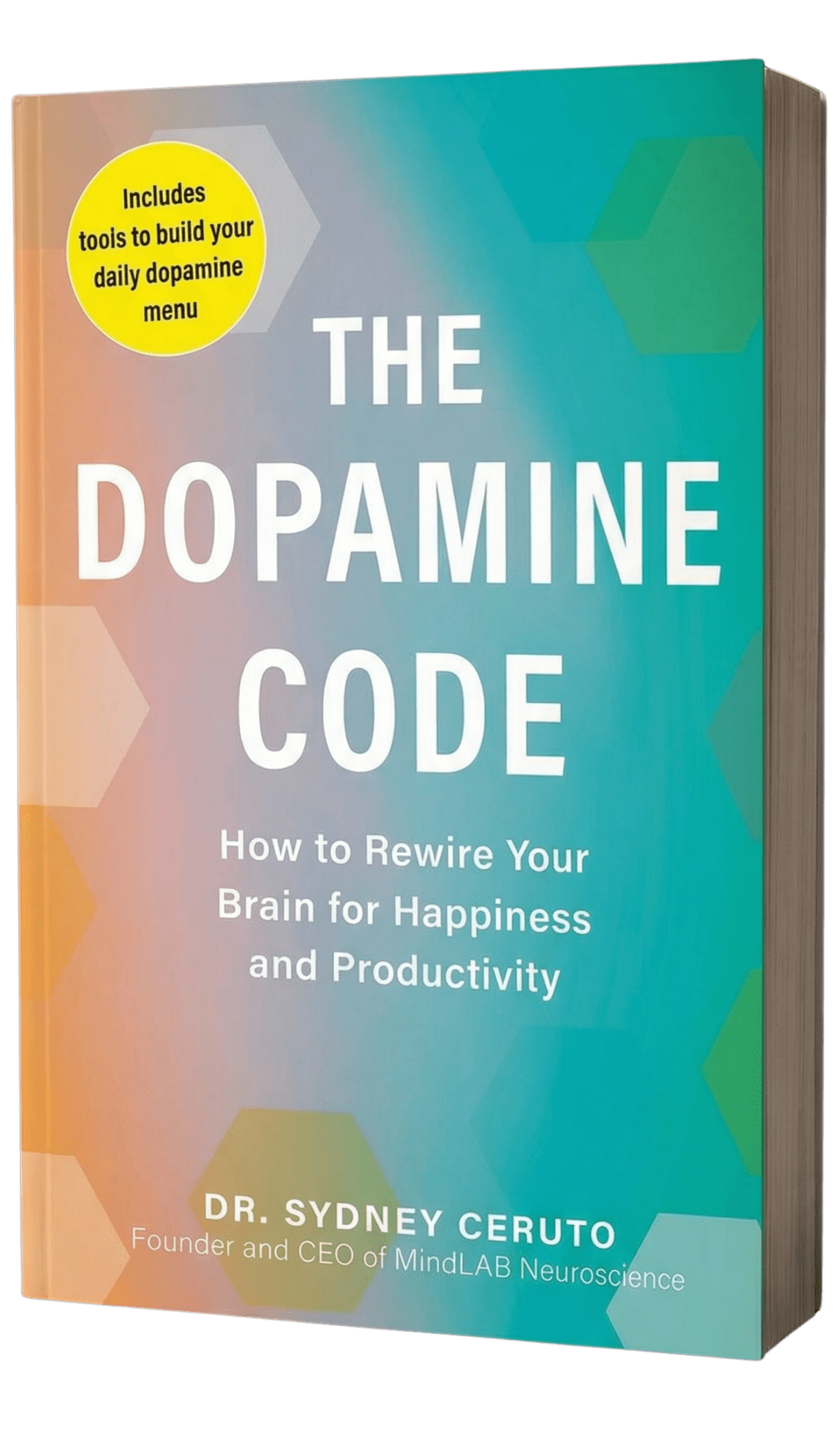
The Dopamine Code
Decode Your Drive
Why Your Brain Rewards the Wrong Things
Your brain's reward system runs every decision, every craving, every crash — and it was never designed for the life you're living. The Dopamine Code is Dr. Ceruto's framework for understanding the architecture behind what drives you, drains you, and keeps you locked in patterns that willpower alone will never fix.
Published by Simon & Schuster, The Dopamine Code is Dr. Ceruto's framework for building your own Dopamine Menu — a personalized system for motivation, focus, and enduring life satisfaction.
Order NowShips June 9, 2026