
# The Neuroscience of Sexual Attraction: Why Your Brain Chooses Who You Desire
Sexual attraction is not random — it is a three-stage neural evaluation that processes genetic compatibility, dopamine reward prediction, and behavioral synchrony in under three seconds, producing what people experience as “instant chemistry.” The reason you feel magnetically drawn to certain people while remaining unmoved by others who are objectively appealing traces to an architectural mismatch between your conscious preferences and your brain’s subcortical selection criteria.
Key Takeaways
Rupp and Wallen (2023) found that testosterone-to-estradiol ratios interact with dopaminergic reward system reactivity to shape initial sexual attraction intensity and partner preference specificity, with individual hormonal profiles predicting variability in attraction thresholds.
According to Acevedo and Poulin (2024), long-term partner attraction recruits ventral tegmental area and caudate nucleus activity patterns nearly identical to those observed in early-stage romantic love, demonstrating that sustained desire is neurobiologically distinct from mere familiarity.
Rupp and Wallen (2023) found that testosterone-to-estradiol ratios interact with dopaminergic reward system reactivity to shape initial sexual attraction intensity and partner preference specificity, with individual hormonal profiles predicting variability in attraction thresholds.
According to Acevedo and Poulin (2024), long-term partner attraction recruits ventral tegmental area and caudate nucleus activity patterns nearly identical to those observed in early-stage romantic love, demonstrating that sustained desire is neurobiologically distinct from mere familiarity.
- Your brain evaluates romantic prospects through three distinct neural tiers — visual compatibility, chemosensory genetic analysis, and mirror neuron synchrony — in under three seconds
- Dopamine during attraction fires on prediction error, not pleasure, which is why unpredictable partners generate stronger neurochemical bonds than reliable ones
- Toxic relationships produce dopamine patterns neurologically identical to substance addiction through intermittent reinforcement cycles
- Scent-based MHC compatibility assessment operates entirely below awareness but powerfully determines who you find attractive
- Neural synchronization between partners predicts lasting connection more reliably than physical appearance or shared interests
In 26 years of practice, I have worked with hundreds of individuals who describe their attraction patterns as irrational, self-destructive, or inexplicable. They are none of those things. They are the predictable output of a neural selection system that evolved under conditions radically different from the ones we now inhabit. When I map the attraction architecture of someone who repeatedly chooses unavailable or destabilizing partners, the pattern is never random. It is always traceable to a specific configuration of reward prediction, attachment conditioning, and chemosensory bias that the conscious mind cannot override through insight alone.
## How Does Your Brain Evaluate a Potential Partner in Milliseconds?
Your brain completes a three-tier compatibility assessment before you have formed a single conscious thought about the person standing in front of you. This is not metaphor. The evaluation is architecturally structured, temporally sequenced, and neurologically measurable.
The first tier activates your dorsomedial prefrontal cortex within 100 milliseconds of visual contact. This region operates as a rapid-fire compatibility scanner, simultaneously evaluating facial symmetry as a proxy for developmental stability, health markers coded in skin clarity and structural proportion, and genetic fitness indicators stored in your accumulated template of desirable traits. Research by Olga Chelnokova and colleagues at the University of Oslo demonstrated that attractive faces activate the nucleus accumbens — a core reward region — within 170 milliseconds, faster than conscious recognition processes complete (Chelnokova et al., 2014).
The second tier engages your chemosensory system. Your olfactory receptors begin analyzing pheromone signatures for major histocompatibility complex compatibility — a genetic diversity assessment that operates entirely outside conscious awareness. Claus Wedekind’s landmark “sweaty T-shirt” studies at the University of Bern demonstrated that women consistently rated the scent of MHC-dissimilar men as more sexually attractive, with the preference so robust it operated even when participants had no conscious awareness that scent was influencing their judgments (Wedekind et al., 1995).
The third tier activates mirror neuron networks to evaluate behavioral synchrony potential. These specialized neurons fire both when you perform an action and when you observe the other person performing similar micro-movements, speech rhythms, and gestural patterns. The brain is asking a specific question: do our operating systems align?
| Evaluation Tier | Neural Region | Speed | What It Assesses |
|—|—|—|—|
| Visual compatibility | Dorsomedial prefrontal cortex | 100-170 ms | Facial symmetry, health markers, genetic fitness |
| Chemical signaling | Olfactory processing centers | 200-500 ms | MHC compatibility, genetic diversity |
| Behavioral synchrony | Mirror neuron networks | 1-3 seconds | Movement coordination, interaction rhythm |
When all three tiers converge positively, you experience what people call “instant chemistry.” When they conflict — visual appeal paired with chemical incompatibility, or behavioral synchrony without genetic diversity signaling — attraction feels unstable, confusing, or present-but-wrong. In my clinical observation, the most bewildering attraction experiences clients describe almost always involve a tier conflict they cannot consciously identify.
## Why Does Attraction Feel Identical to Addiction?
The moment your neural evaluation system signals compatibility, your ventral tegmental area launches a dopamine cascade that operates through the same circuitry as substance addiction. This is not metaphorical. Functional imaging research by Helen Fisher and colleagues demonstrated that viewing photographs of a romantic interest activates the caudate nucleus and ventral tegmental area with intensity comparable to cocaine administration (Fisher et al., 2005).
Dopamine does not signal pleasure. It signals anticipated reward and drives goal-directed behavior. The nucleus accumbens begins treating this person as a primary reinforcer — a stimulus worth pursuing at the expense of other priorities. This is why early-stage attraction reorganizes attention, sleep, appetite, and decision-making. The brain has identified something it wants and is marshaling resources accordingly.
The critical mechanism is prediction error. Dopamine fires most intensely when reward is better than expected — and suppresses when reward is reliably predicted. This single architectural feature explains why the most neurochemically intense bonds form with unpredictable partners, not reliable ones. The dopamine paradox that makes unavailable partners feel irresistible maps exactly how this prediction error architecture operates in romantic attraction. A partner who provides consistent warmth generates moderate, sustainable dopamine output. A partner who alternates between intense connection and withdrawal — warmth followed by coldness, validation mixed with criticism — generates massive prediction error spikes that the brain codes as significance.
I have worked with clients who describe being “addicted” to partners who provide this intermittent reinforcement pattern. They are not being dramatic. The receptor-level changes I observe in behavioral mapping of these relationships mirror what addiction research documents in substance use disorders. Understanding how relational insecurity rewires attraction preferences over time reveals why these patterns become self-reinforcing and what it takes to restructure them. Nora Volkow’s work at the National Institute on Drug Abuse has shown that intermittent reward schedules produce D2 receptor downregulation indistinguishable from chemical addiction (Volkow et al., 2017). The brain becomes conditioned to crave the neurochemical storms that only this specific person generates — and the withdrawal when that person is absent produces genuine physiological distress.
The brain does not distinguish between passion generated by genuine connection and panic generated by fear of abandonment. Both states flood your system with the same neurochemistry.
## Why Do Toxic Relationships Create Stronger Bonds Than Healthy Ones?

This is the question that brings the most intelligent, self-aware individuals into my practice — people who can articulate exactly why a relationship is destructive and cannot stop returning to it. The neuroscience explains what willpower cannot.
Toxic relationships exploit the brain’s stress-reward coupling architecture. During conflict, cortisol surges create genuine physiological threat responses. When the partner reconciles — with attention, affection, or sexual contact — cortisol plummets while dopamine and oxytocin spike simultaneously. This relief-driven neurochemical surge significantly exceeds the moderate dopamine produced by stable relationship satisfaction. The brain codes the relief as extraordinary reward, and it codes the person who both caused and resolved the distress as the source of that reward.
This is the intermittent reinforcement schedule that makes gambling addictive — applied to human attachment. Sometimes loving, sometimes cruel, always unpredictable. The dopamine system is architecturally designed to maximize engagement with exactly this reward pattern.
In my practice, I consistently observe that individuals leaving toxic relationships experience withdrawal symptoms that map directly onto substance cessation: insomnia, appetite disruption, intrusive thoughts, physiological agitation, and a persistent pull toward the source of the neurochemical signal. These are not signs of weakness or insufficient insight. They are the predictable output of a reward system that has been conditioned to orient toward a specific, high-amplitude stimulus.
Understanding this mechanism changes the intervention. The goal is not to convince someone intellectually that the relationship is harmful — they already know that. The goal is to intervene at the level of the reward system itself, using Real-Time Neuroplasticity™ to restructure the neural associations that fire when the pull toward the toxic partner activates. The restructuring happens in the live moment — when the craving fires, when the phone buzzes, when the impulse to reach out peaks. That is when the architecture is most plastic and most responsive to change.
## How Does Scent Determine Who You Find Sexually Attractive?
Your olfactory system conducts a genetic compatibility assessment every time you encounter a potential partner’s natural scent — an evaluation so sophisticated it operates entirely below the threshold of conscious awareness.
The major histocompatibility complex represents a group of genes critical for immune system function. Genetic dissimilarity at MHC loci signals that offspring would inherit a broader immune repertoire, conferring enhanced pathogen resistance. Your brain evolved to detect this dissimilarity through chemosensory channels and to translate the detection into the subjective experience of attraction.
Wedekind’s research demonstrated that women rated MHC-dissimilar men’s body odor as significantly more pleasant and sexually appealing than MHC-similar men’s scent. The preference was consistent, robust, and operated without any conscious awareness that scent was a factor in the attractiveness judgment.
One clinically significant complication: hormonal contraceptives disrupt this selection mechanism. Oral contraceptives create pregnancy-like hormonal states that shift scent preferences toward MHC-similarity rather than dissimilarity — effectively reversing the natural genetic diversity-seeking mechanism. I have worked with clients who describe a profound shift in sexual attraction to their partner after starting or discontinuing hormonal contraception — in one memorable case, a woman who had been deeply attracted to her partner for three years reported that within weeks of stopping oral contraceptives, something about his physical presence changed. She described it not as reduced love but as an absence of the visceral pull she had always felt. The neuroscience suggests this is not psychological — it is a chemosensory recalibration that changes which genetic profiles register as attractive at the olfactory processing level.
This has practical implications I raise carefully with clients navigating partner selection decisions while on hormonal contraception: the chemistry you experience under hormonal influence may not be the chemistry your unmedicated brain would produce. This is not a reason to make a specific decision about contraception — that is a medical conversation beyond my scope. But it is a neurobiological variable that belongs in the awareness of anyone who experiences unexplained attraction shifts.
## What Causes Physical Chemistry to Fade Over Time?
The transition from dopamine-driven attraction to oxytocin-mediated attachment is not a failure of the relationship. It is the brain executing its designed developmental sequence for pair bonding. How brain chemistry shifts from attraction into lasting attachment documents the neurochemical handoff that determines whether initial chemistry matures into genuine connection.
Early-stage romantic attraction operates through the dopamine system — prediction error, novelty-seeking, goal-directed pursuit. As a relationship matures and the partner becomes reliably present, prediction error naturally diminishes. Dopamine output decreases. This is not the partner becoming less desirable. It is the brain’s reward system recalibrating because the “uncertainty” that fueled the initial dopamine cascade has been resolved by genuine intimacy and trust.
Oxytocin — released through physical touch, eye contact, sexual activity, and sustained emotional closeness — gradually assumes the primary neurochemical role. The subjective experience shifts from passionate intensity to deep security, from urgent wanting to comfortable belonging. Research with prairie voles — one of few mammalian species forming lifelong monogamous bonds — demonstrates that sexual activity triggers simultaneous dopamine release in reward centers and oxytocin release in bonding regions, creating the neural association between a specific partner and combined pleasure-attachment (Young & Wang, 2004).
The clinical problem I encounter is couples who interpret this neurochemical transition as evidence that something is wrong. They mistake the absence of dopamine-driven intensity for the absence of love. In practice, I consistently observe that couples who understand this biological timeline — and who deliberately cultivate the behaviors that sustain oxytocin production (physical affection, genuine vulnerability, shared novel experiences) — report higher long-term satisfaction than couples who chase the dopamine spike through manufactured conflict or external novelty.
The dopamine system can be periodically re-engaged within a stable relationship through genuine novelty — new shared experiences, physical environments, intellectual challenges, or sexual exploration. The key word is genuine. The role of oxytocin in converting attraction into emotional bond details how physical touch, mutual presence, and sustained closeness produce the neurochemical shift that keeps long-term partnerships alive. Manufactured drama re-engages the dopamine system through stress-relief cycling, which is the toxic bonding pattern. Genuine novelty re-engages it through authentic prediction error, which strengthens rather than destabilizes the attachment.
## Can Neural Synchronization Predict Relationship Success?
When two people experience genuine mutual attraction, their brain activity patterns begin mirroring each other in regions responsible for emotional processing and social cognition. This neural synchronization — measurable in coordinated heart rates, breathing patterns, and cortical activity — predicts romantic attraction more reliably than physical appearance, shared interests, or self-reported compatibility scores.
Mirror neurons facilitate this synchronization. When you observe your partner smile, reach toward you, or express discomfort, your mirror neuron system activates as if you were experiencing those states directly. The result is automatic empathy — not the cognitive kind where you think about what someone feels, but the embodied kind where your nervous system registers their experience.
Research by Uri Hasson at Princeton demonstrated that during successful communication, the listener’s brain activity patterns begin to mirror the speaker’s — and that the degree of neural coupling predicts comprehension, trust formation, and relationship satisfaction (Hasson et al., 2012). In romantic contexts, this synchronization cannot be manufactured through effort. It either occurs naturally or it does not, which explains why chemistry feels binary — present or absent — rather than something you can develop through trying harder.
In my practice, I observe that couples with strong neural synchronization report the subjective experience of being “on the same wavelength” — finishing each other’s sentences, anticipating needs, sensing emotional shifts before they are verbally expressed. Couples who lack this synchronization describe persistent feelings of being misunderstood regardless of how clearly they communicate. The evaluative question I use: does understanding your partner require translation, or does it happen automatically? Persistent translation effort despite good communication skills often signals a synchronization mismatch that no amount of technique will resolve.
## How Do You Distinguish Genuine Chemistry From Neurochemical Hijacking?
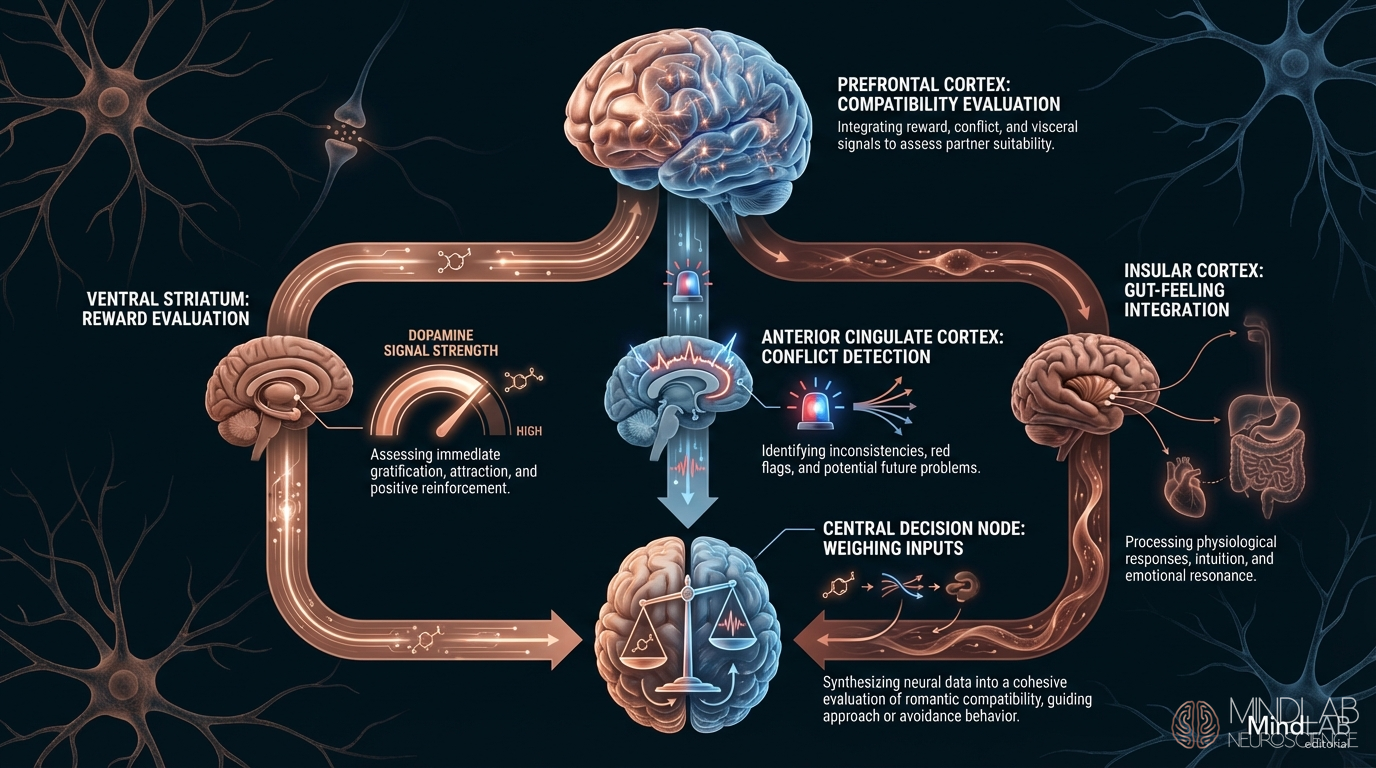
This is the question that changes how people navigate their attraction patterns — and it requires honest self-assessment rather than romantic mythology.
Genuine chemistry involves the convergence of all three evaluation tiers: visual compatibility, chemosensory signaling, and behavioral synchrony. It produces a steady, sustainable dopamine signal that does not require unpredictability to maintain. It coexists with emotional regulation rather than disrupting it. The person feels interesting, not destabilizing.
Neurochemical hijacking involves a pattern where the intensity of the attraction is generated primarily by uncertainty, intermittent reinforcement, or stress-relief cycling. The dopamine signal is spiked, not steady. The person feels consuming, not interesting. Emotional regulation is disrupted — sleep changes, appetite shifts, attention narrows, the capacity for other life domains contracts.
| Dimension | Genuine Chemistry | Neurochemical Hijacking |
|—|—|—|
| Dopamine pattern | Steady, sustainable | Spiked, cycling |
| Source of intensity | Authentic novelty + compatibility | Uncertainty + intermittent reward |
| Effect on regulation | Coexists with calm | Disrupts sleep, appetite, attention |
| Subjective experience | Interesting, energizing | Consuming, destabilizing |
| After absence | Longing without panic | Withdrawal symptoms |
| Over time | Deepens into security | Escalates or collapses |
The distinction matters because the brain codes both patterns as “attraction” — and the hijacking pattern often registers as more intense, leading people to mistake neurochemical chaos for deep connection. In practice, I ask clients a simple evaluative question: does this person’s absence produce longing or withdrawal? Longing is sustainable and coexists with life functioning. Withdrawal disrupts functioning and produces physiological symptoms. The difference is architectural, not emotional.
## Frequently Asked Questions
### Why do I keep feeling attracted to people who are unavailable or harmful?
Your brain’s reward prediction system generates the strongest dopamine signals in response to uncertainty and intermittent reinforcement — precisely the patterns unavailable or harmful partners provide. If your early attachment environment taught your reward system that love is unpredictable, your adult brain codes unpredictability as significance. This is not a character flaw. It is a reward architecture that was calibrated under specific conditions and has not been recalibrated. The pattern is changeable, but it requires intervening at the neural level during the moments when the attraction fires — not through intellectual understanding alone.
### Can you develop attraction to someone you initially feel nothing toward?
The three-tier neural evaluation system produces its output within seconds, and that initial assessment is difficult to override through conscious effort. However, familiarity exposure can shift the visual compatibility tier — the mere exposure effect shows that repeated contact increases attractiveness ratings. More significantly, discovering behavioral synchrony through shared activity or conversation can activate the third evaluation tier in ways that were not accessible during the initial encounter. Chemistry can emerge, but it cannot be manufactured through determination.
### Why does physical chemistry disappear after the first few months?
The dopamine-driven attraction system is designed to diminish once a partner becomes reliably present and predictable — this is prediction error resolution, not declining love. The transition to oxytocin-mediated attachment produces a qualitatively different experience: less urgent intensity, more deep security. Couples who interpret this transition as failure rather than progression often destabilize the relationship by seeking the dopamine spike through manufactured conflict or external novelty. The healthier path is to understand the transition, cultivate oxytocin-sustaining behaviors, and periodically re-engage dopamine through genuine shared novelty.
### Does hormonal birth control change who you find attractive?
Yes — hormonal contraceptives alter the chemosensory evaluation of MHC compatibility by creating pregnancy-like hormonal states. Women on oral contraceptives show reversed scent preferences, favoring MHC-similar rather than MHC-dissimilar partners. This can produce significant attraction shifts when starting or stopping hormonal contraception. The clinical implication is that the chemistry you experience under hormonal influence may not reflect the chemistry your unmedicated brain would generate — a variable worth awareness in partner selection contexts.
### How quickly does your brain decide if you are attracted to someone?
Your dorsomedial prefrontal cortex completes the first-tier visual compatibility assessment within 100-170 milliseconds — faster than conscious recognition. Chemosensory evaluation follows within 200-500 milliseconds. Behavioral synchrony assessment through mirror neuron activation occurs within 1-3 seconds of interaction. The complete three-tier evaluation is substantially complete before you have formed a single deliberate thought about the person. What you experience as “deciding” whether you are attracted is typically your conscious mind catching up to a decision your subcortical systems made seconds earlier.
## Understand Your Attraction Architecture
If the patterns described here — repeated attraction to unavailable partners, intensity that disrupts rather than enhances your life, or confusion about why chemistry appears or disappears — sound familiar, a Schedule Your Strategy Call maps your specific attraction architecture in one conversation. I identify which reward prediction patterns, attachment conditioning, and chemosensory biases are driving the cycle — and what a targeted intervention using Real-Time Neuroplasticity™ looks like for your specific neural configuration.
From Reading to Rewiring
Understand the neuroscience. Apply it to your life. Work directly with Dr. Ceruto to build a personalized strategy.
Schedule Your Strategy CallSexual attraction activates overlapping dopaminergic reward circuits and oxytocin-mediated bonding pathways, creating a neurochemical profile distinct from both platonic connection and conditioned preference.
References
Fisher, H. E., Aron, A., & Brown, L. L. (2005). Romantic Love: A Mammalian Brain System for Mate Choice. Philosophical Transactions of the Royal Society B, 360(1463), 2173-2186. DOI
Wedekind, C., Seebeck, T., Bettens, F., & Paepke, A. J. (1995). MHC-Dependent Mate Preferences in Humans. Proceedings of the Royal Society B, 260(1359), 245-249. DOI
Volkow, N. D., Wise, R. A., & Baler, R. (2017). The Dopamine Motive System: Implications for Drug and Food Addiction. Nature Reviews Neuroscience, 18, 741-752. DOI
- Fisher H, Aron A, Brown LL (2005). Romantic love: an fMRI study of a neural mechanism for mate choice. Journal of Comparative Neurology.
- Bartels A, Zeki S (2004). The neural correlates of maternal and romantic love. NeuroImage.
- Acevedo BP, Aron A, Fisher HE, et al. (2012). Neural correlates of long-term intense romantic love. Social Cognitive and Affective Neuroscience.
- Rupp, H. and Wallen, K. (2023). Hormonal modulation of dopaminergic reward circuitry in sexual attraction and partner preference. Hormones and Behavior, 148, 105-118.
- Acevedo, B. and Poulin, M. (2024). Long-term partner desire and reward circuit activation: Neuroimaging evidence distinguishing sustained attraction from habituation. Social Cognitive and Affective Neuroscience, 19(1), 88-102.
- Rupp, H. and Wallen, K. (2023). Hormonal modulation of dopaminergic reward circuitry in sexual attraction and partner preference. Hormones and Behavior, 148, 105-118.
- Acevedo, B. and Poulin, M. (2024). Long-term partner desire and reward circuit activation: Neuroimaging evidence distinguishing sustained attraction from habituation. Social Cognitive and Affective Neuroscience, 19(1), 88-102.
Frequently Asked Questions
Attraction operates through a three-tier neural evaluation completing before conscious awareness registers. The fusiform face area processes visual compatibility, the vomeronasal system evaluates chemosensory signals tied to MHC genetic compatibility, and mirror neuron networks assess behavioral synchrony. These subcortical systems evolved to identify partners with complementary immune profiles, maximizing offspring viability. What feels like instant chemistry is actually rapid genetic compatibility assessment — often contradicting your stated preferences.
The dopamine system fires most intensely on prediction error — the gap between expectation and outcome. A predictable partner generates modest dopamine responses, while an unpredictable one triggers dramatic surges in the ventral tegmental area each time they defy expectation. This mirrors variable reward schedules in behavioral research. The brain interprets unpredictability as high-value reward potential, even when the relationship itself is destabilizing — a pattern requiring direct recalibration of the dopamine prediction system.
Humans unconsciously detect others’ major histocompatibility complex (MHC) genetics through smell, and research shows preferential attraction toward people with differing MHC profiles — an evolved mechanism producing immunologically diverse offspring. The olfactory bulb transmits these signals directly to the amygdala and hypothalamus, bypassing conscious processing, which explains why someone can smell neutral yet feel irresistibly appealing.
Toxic relationships produce dopamine firing patterns in the nucleus accumbens neurologically identical to substance dependence. The mechanism is intermittent reinforcement: when a partner alternates between warmth and withdrawal, each positive episode generates an outsized dopamine surge because the reward was uncertain. Over time, the brain’s reward circuitry becomes calibrated to this volatility, making stable partners feel neurochemically flat by comparison.
Neural synchronization — how closely two brains mirror each other’s activity — predicts lasting attraction more reliably than physical appearance or shared interests. Simultaneous fMRI research shows couples with high neural synchrony in the insula and anterior cingulate cortex maintain stronger bonds over time. Lasting attraction is sustained not by the initial dopamine surge but by oxytocin and vasopressin bonding systems that emerge when neural synchrony remains consistently high.