


🎧 Audio Version
You’re not imagining it. The internet feels louder than it used to. The posts feel sharper. The comments think meaner. And somehow, even when you know a piece of content is trying to provoke you, your thumb still stops. Your chest still tightens. Your brain still wants to respond.
That’s the point of rage bait.
Rage bait is not just “annoying content.” It’s engineered friction. It’s a psychological tripwire designed to light up your threat system, steal your attention, and pull you into an emotional loop that keeps the platform profitable.
If you have ever closed an app and wondered, “Why do I feel worse than when I opened it?”, you have already experienced the lingering effects of rage bait.
In my work as a neuroscientist and coach, I’ve seen how this pattern doesn’t just ruin your mood; it can also undermine your confidence. It can affect your sleep, focus, relationships, and decision-making. High performers are especially vulnerable because they’re used to solving problems, correcting errors, and protecting standards. Rage bait mimics a “problem you should fix,” and your brain reaches for it like a reflex.
The good news is simple. Your brain isn’t broken. It’s doing what it was built to do. Once you understand the mechanics, you can stop getting hooked.
What is rage bait
So, what is rage bait?
Rage bait is content designed to trigger anger, disgust, or moral outrage so you’ll engage. That engagement can look like a comment, a quote tweet, a stitch, a duet, a share, or even a hate-watch that keeps you on the screen longer than you planned.
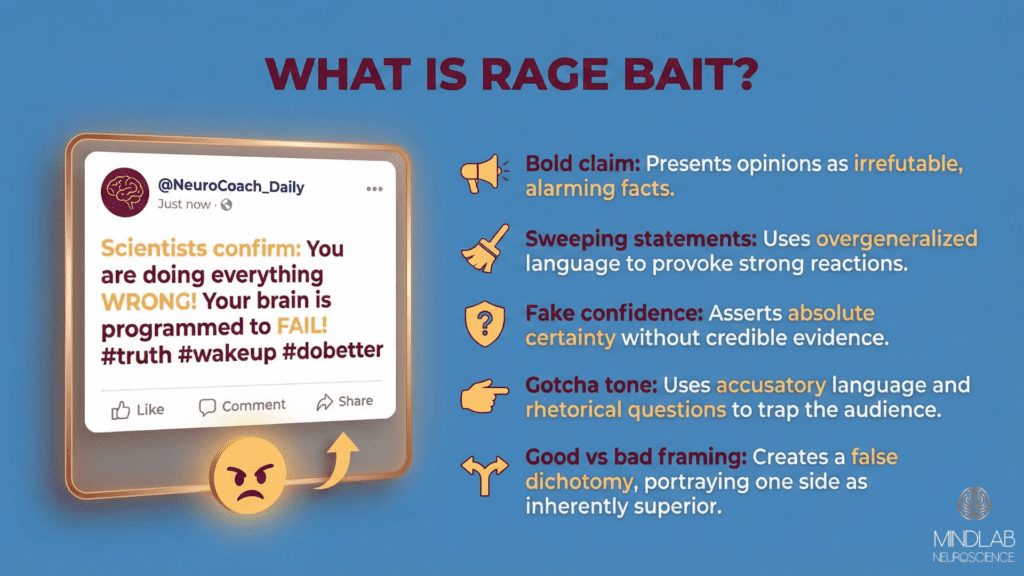
Rage bait often uses a predictable recipe:
- A bold claim that feels insulting or absurd
- A sweeping statement about a group of people
- Fake confidence with no nuance
- A “gotcha” tone that dares you to respond
- A caption that frames the world as good people vs bad people
It can be politics, parenting, money, fitness, dating, work culture, or anything else that touches identity. It doesn’t have to be true. It just has to be hot enough to light you up.
Here’s a quick self-check. If you feel an immediate urge to type, correct, expose, or shame, there’s a decent chance you’re looking at rage bait.
And one more key point: rage bait doesn’t require you to agree. In fact, it often works better when you disagree, because your nervous system brings more energy to opposition than to boredom.
Rage bait meaning
If you want the cleanest rage bait meaning, it’s this:
Rage bait is emotional manipulation used to gain attention.
It’s not a debate starter. It’s not education. It’s not “just a different opinion.” Its content is designed to trigger your nervous system so you’ll donate your focus.
A lot of people get confused because rage bait sometimes looks like a real conversation. It borrows the costume of honest discussion, but the goal isn’t understanding. The goal is ignition.
There’s a difference between:
- “Here’s my view; tell me yours.”
and - “If you don’t agree, you’re the problem.”
Rage bait lives in the second one.
And here’s why it spreads so fast: anger is contagious. Your brain handles social threats the same way it handles physical threats. When you see hostility, your nervous system prepares to defend. That defense can turn into a comment, a rant, or a scrolling spiral that keeps you in a tense state for hours.
Rage bait psychology
To understand rage bait psychology, you need to understand what your brain is always doing in the background.
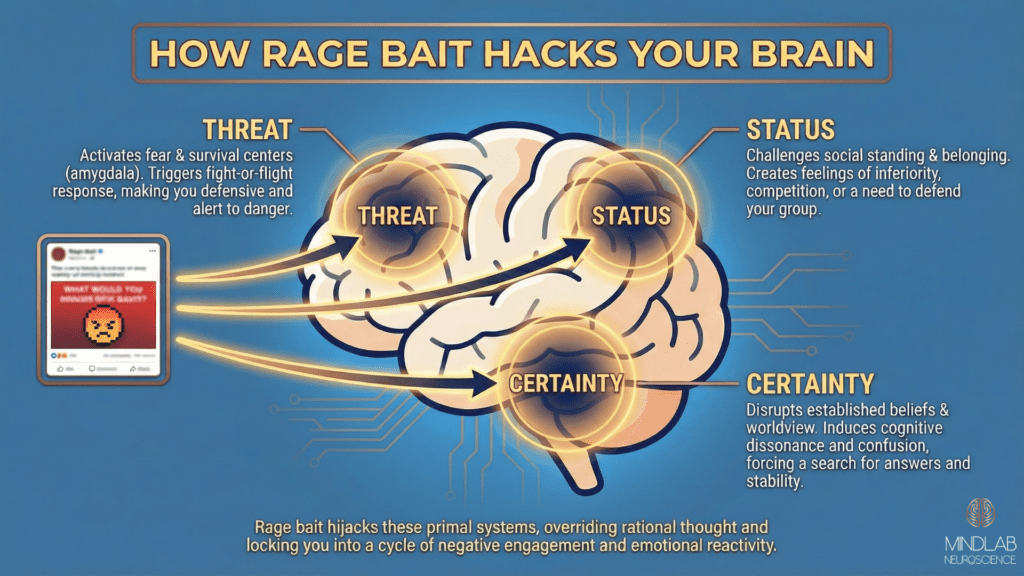
Your brain is scanning for three things:
- Threat
- Status
- Certainty
Rage bait hits all three.
It signals a threat because it implies something is wrong, unfair, or dangerous. It signals status because it often insults competence, intelligence, or morality. And it signals certainty because it offers a clean villain and a clean conclusion. Your brain loves clean findings, especially when you’re stressed.
The threat system is fast, and it wins the race
Your threat network can react before you’ve fully processed the details. That’s useful if you’re crossing a street and a car is speeding toward you. It’s not as helpful when you’re reading a post from a stranger who wants to provoke you.
When rage bait lands, your body often reacts first:
- Jaw tightens
- Shoulders lift
- Breathing gets shallow
- Heart rate rises
- Eyes lock in
That body shift is not “you being dramatic.” It’s a real physiological state change.
Why anger feels clarifying, even when it’s not
Anger can feel like clarity. It gives you energy. It gives you direction. It tells you who’s right and who’s wrong.
From a neuroscience angle, anger narrows attention. It reduces your mental bandwidth for nuance. It pushes your brain toward quick judgments and fast action.
That’s why you can feel certain while you’re angry and then feel embarrassed later. In the moment, your brain is in a “solve and strike” posture, not a “think and integrate” posture.
Rage bait exploits that posture. It makes you feel like you’re about to restore order, when you’re actually being pulled into noise.
Dopamine is not “pleasure,” it’s “pursuit”
A lot of people think dopamine means pleasure. In real life, dopamine is heavily tied to seeking. It’s the chemical that supports pursuit, curiosity, and “what’s next?”
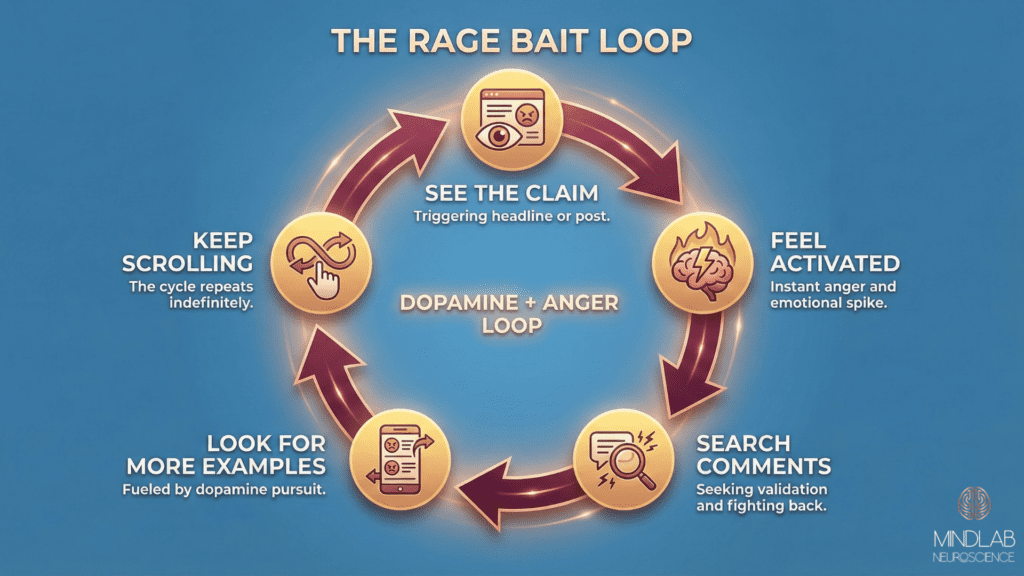
Rage bait creates a powerful “what’s next?” loop:
- You see a claim
- You feel activated
- You search comments for validation
- You look for more examples
- You keep scrolling for the next hit
Even if you hate it, your brain is still pursuing resolution.
That’s why rage bait can feel addictive. You’re chasing closure.
Two common client patterns I see
Case study 1: “The fixer”
A high-level executive I worked with, whom I’ll call Danny, was proud of his standards. He believed misinformation should be corrected. He told me, “If I don’t respond, I’m letting it spread.”
But his nights were disappearing into arguments. He’d go to bed wired, wake up foggy, and walk into meetings already irritated. His performance didn’t drop because he lacked discipline. It fell because rage bait had trained his brain to live in an alert state.
When we tracked it, the hook wasn’t the content. The hook was his identity as a protector. Rage bait kept pressing that button.
Case study 2: “The validator”
A founder I’ll call Maya didn’t comment much, but she read everything. She’d scroll posts that upset her, then scroll comments to find “her people.” She told me it felt like relief when she saw others agree.
That’s the social nervous system at work. Rage bait makes you feel threatened, then offers a quick sense of belonging. It’s a fast path from tension to belonging.
But it’s an unstable belonging, because it depends on staying angry.
The “aftertaste” effect
One of the most overlooked parts of rage bait psychology is what happens after.
You close the app, but your body stays activated. Your brain keeps replaying lines. You imagine what you should’ve said. You check again to see if anyone replied.
This is not weak willpower. This is a stress loop that got turned on and didn’t get turned off.
The goal isn’t to never feel anger. Anger is a valid emotion. The goal is to stop handing your nervous system to people who are trying to farm it.
After rage bait, your nervous system can stay in a low-grade fight state, even if you’re sitting on your couch. That state changes how you interpret everything, so a neutral text can feel rude and a normal delay can feel personal. Your attention gets “sticky,” which means your brain keeps scanning for more proof that you’re right to be upset.
This condition is why you can feel tired and wired at the same time: your body wants rest, but your mind won’t let go of the scene. The fastest way out is not more thinking; it’s downshifting the body so your brain stops viewing the moment like an emergency.
Rage bait vs clickbait
People mix these up, so let’s make it clean.
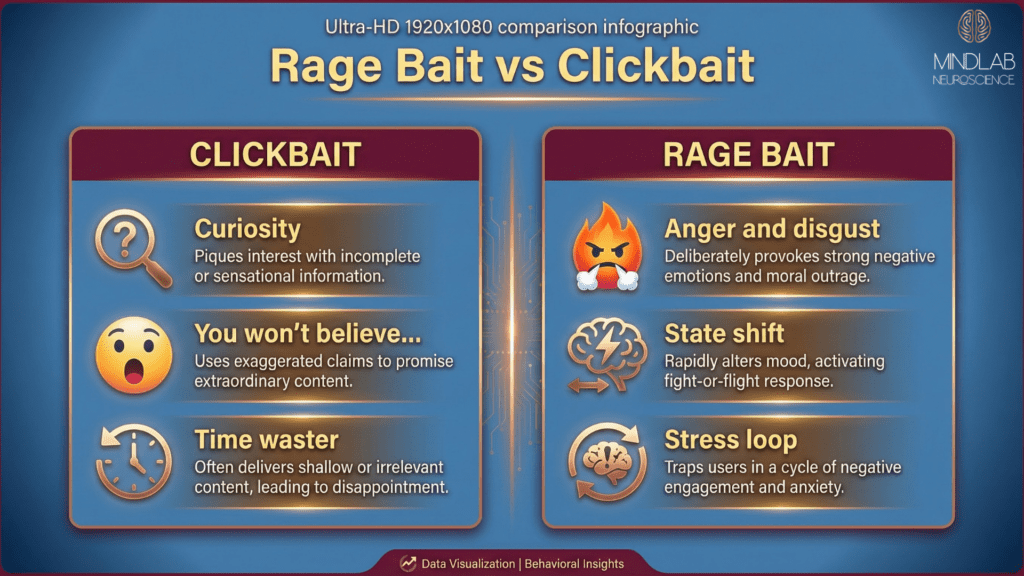
Rage bait vs clickbait comes down to the primary emotion being used.
Clickbait typically uses curiosity. It hints at a payoff.
“You won’t believe what happened next.”
“Doctors hate this one trick.”
It’s trying to pull you forward with mystery.
Rage bait uses activation. It aims for anger, disgust, and outrage.
“This is what’s wrong with people today.”
“Only an idiot would disagree.”
It’s trying to push your nervous system into fight mode.
They can overlap, but the feeling is different.
Clickbait makes you lean in.
Rage bait makes you clench.
And the cost is different too. Clickbait wastes time. Rage bait can change your mood, your tone, and how you interact with the people you actually care about.
Clickbait usually leaves you thinking, “That was dumb,” while rage bait leaves you feeling keyed up, like you’re carrying an argument into the rest of your day. Clickbait is a curiosity trap, but rage bait is a state shift that can raise stress hormones and narrow your thinking.
Clickbait often ends when you realize the promise was empty, but rage bait can keep going because anger craves closure and justice. Clickbait is about attention, while rage bait is about emotional energy, and that energy is what makes people comment, share, and escalate. If you know which one you’re dealing with, you can respond correctly: laugh off clickbait, but regulate your body before rage bait turns into a complete loop.
How to not fall for rage bait
If you want a practical answer to how to not fall for rage bait, think in two layers:
- What you do in the moment
- What do you change in your environment
You need both, because you’re not just fighting content. You’re fighting state.
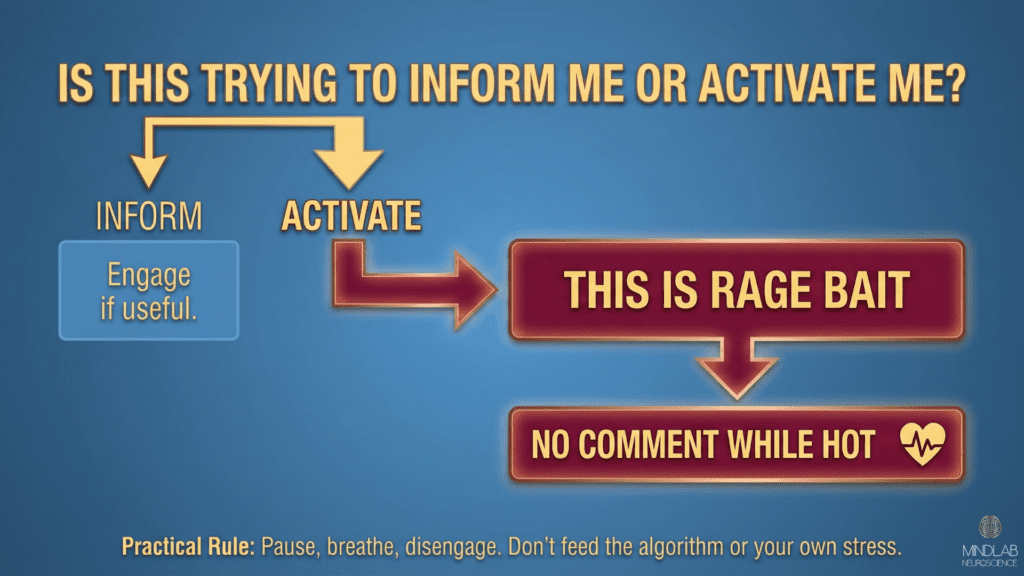
Step 1: Spot the hook in 3 seconds
Ask this one question:
“Is this trying to inform me or trying to activate me?”
Common rage bait signals:
- extreme certainty with zero evidence
- contempt, mockery, or name-calling
- “everyone knows” language
- moral superiority as a weapon
- a caption that dares you to respond
If it’s engineered to activate you, label it plainly:
“This is rage bait.”
That label matters. When you name the pattern, you reduce its power. You shift from being inside the emotion to observing it.
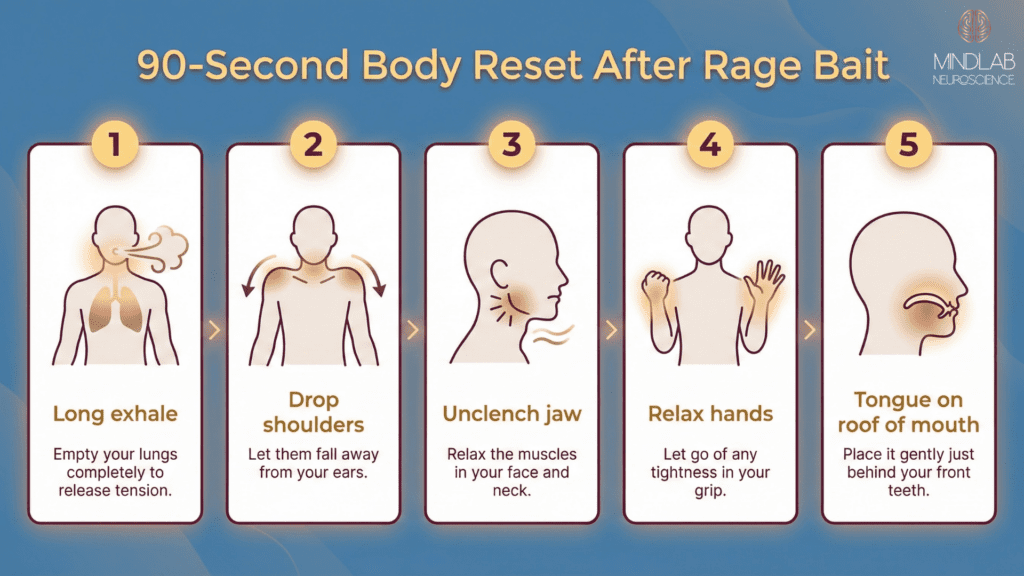
Step 2: Do the 90-second body reset
Your brain can’t downshift if your body stays braced.
Try this quick protocol:
- Exhale longer than you inhale, 5 times
- Drop your shoulders on each exhale
- Unclench your jaw
- Put your tongue on the roof of your mouth
- Relax your hands
This sounds almost too simple, but it works because you’re interrupting the physiology that rage bait triggers.
If your body is calm, your prefrontal cortex can come back online. That’s the part of you that can choose, not just react.
Step 3: The “No comment while hot” rule
If you’re activated, don’t comment.
Not because you’re powerless. Because you’re not at your best.
Make a rule you can follow:
If your heart is racing, you wait.
Even 10 minutes changes the brain state. Anger is fast. Regulation is slower. Give your brain time to regain range.
I often tell clients this: rage bait wants you to answer fast. Your power is answering slowly.
Step 4: Use the 3-question filter before you engage
Before you type, ask:
- “Will this change anything?”
- “Is this person reachable?”
- “What will this cost me today?”
If the answer is no, no, and a lot, you already have your decision.
A client I’ll call Elena used this filter during a stressful divorce. She told me the most challenging part wasn’t resisting the post. It was resisting the fantasy that the perfect comment would restore justice.
That fantasy is understandable. It’s also expensive.
Step 5: Replace the rage loop with a closure loop
Your brain wants closure. If you don’t give it closure, it will keep searching.
So give it a healthier closing action:
- Save one helpful post and leave
- Text a real person instead of commenting
- Stand up and take a 60-second walk
- write your thoughts in a note you don’t send
Closure tells the nervous system, “We’re done here.”
Step 6: Clean up your feed like you clean up your diet
Your attention is a metabolic resource. If you feed it junk all day, you’ll feel it.
Practical feed hygiene:
- Mute accounts that post constant outrage
- Unfollow “hot take” pages that make you feel tense
- Stop watching clips that leave you activated
- Choose a few creators who teach, not provoke
- Set a time limit for apps that trigger you most
This isn’t about being sheltered. It’s about being intentional.
Step 7: Train your brain for nuance again
Rage bait trains the brain toward extremes: all good, all bad, all right, all wrong.
To reverse it, you practice nuance on purpose.
Try this daily exercise:
Pick one topic you feel strongly about and write two true sentences that can both exist at once.
Example:
“I care about standards.”
“I don’t need to fight strangers to prove I care.”
That’s not a weakness. That’s emotional agility.
Step 8: A simple script for your own mind
When you feel pulled in, say this to yourself:
“This is trying to rent my nervous system.”
“I don’t lease my brain to strangers.”
“I choose what I feed.”
Short, direct, and repeatable wins are the key to success. In high-stress moments, your brain won’t reach for a long speech. It will come from a simple line.
The real reason rage bait works on smart people
Here’s the part most people miss: rage bait often hooks the people with the strongest values.
If you’re principled, you notice hypocrisy.
If you’re intelligent, you notice flawed reasoning.
If you’re sensitive, you notice cruelty.
If you’re driven, you want to fix what’s broken.
Those are strengths.
Rage bait doesn’t mean you’re gullible. It means you’re human and have a nervous system that responds to threats and injustice.
The goal is to protect your strengths from being exploited.
A realistic “in the wild” practice plan
If you want this to stick, don’t aim for perfect. Aim for measurable.
Try this for 7 days:
- Day 1–2: Label rage bait out loud and scroll past
- Day 3–4: Add the 90-second body reset
- Day 5–6: Use the 3-question filter before engaging
- Day 7: Do a feed cleanup and remove the top 10 triggers
At the end of the week, notice two things:
- How often do you feel calm during the day
- How quickly you recover after being triggered
That recovery speed is one of the best signs your nervous system is getting stronger.
Closing: you’re allowed to protect your mind
You don’t need to prove you’re informed by staying angry.
You don’t need to prove you’re moral by fighting strangers.
You don’t need to earn your worth through conflict.
Rage bait will always exist because it works. But it doesn’t have to work on you.
When you see rage bait, name it. Regulate your body. Choose your next action on purpose. That’s how you keep your attention, your mood, and your mind in your hands.
And if you catch yourself getting hooked sometimes, that’s not failure. That’s feedback. Each time you notice it, you’re already building the skill that breaks the loop.


