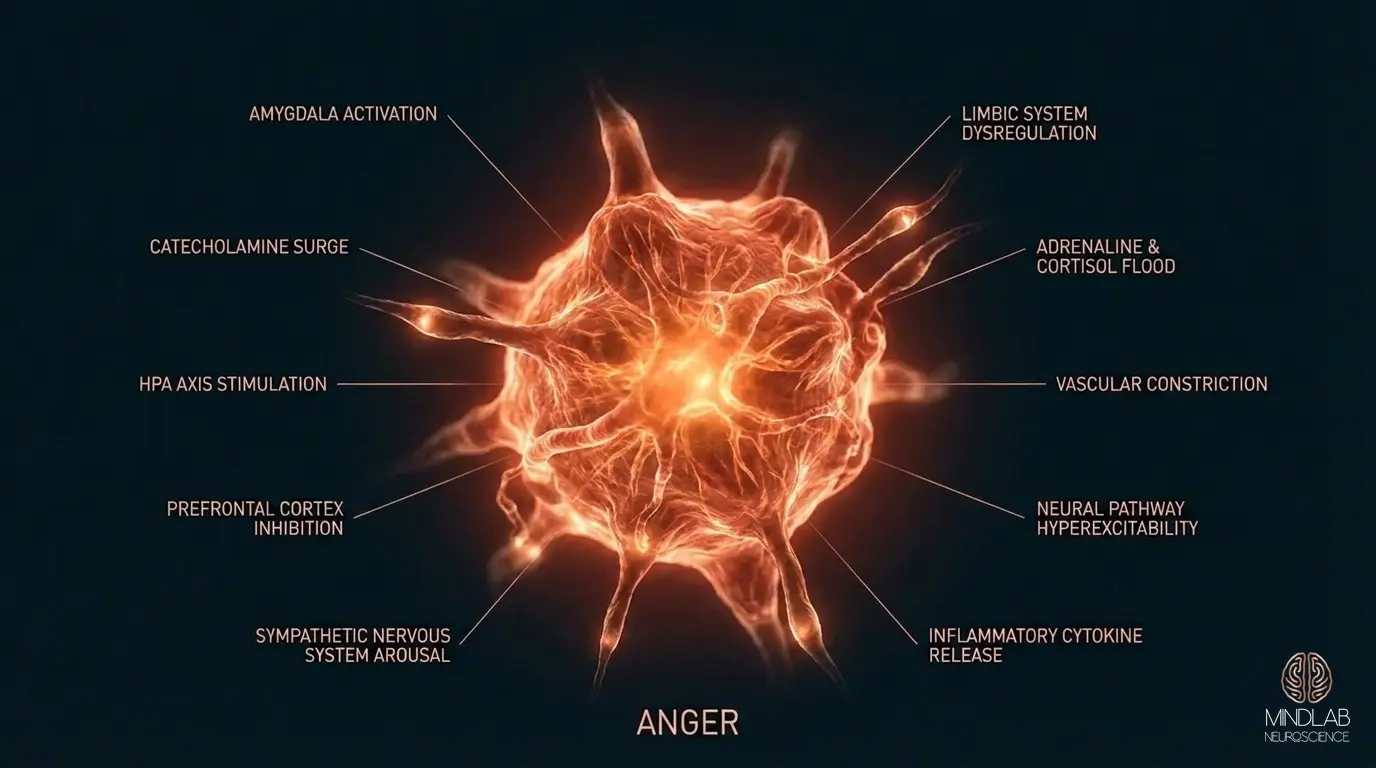
What Anger Looks Like at the Circuit Level
Anger is one of the most mischaracterized experiences in human neuroscience. It is treated as a behavioral problem, a character deficit, or evidence of poor self-regulation, and every one of those framings is neurologically incomplete. In 26 years of working with individuals whose anger has disrupted careers, destabilized relationships, and undermined their own self-concept, what I consistently observe is not a failure of willpower. It is a neural architecture problem: circuits firing in a sequence that bypasses the very systems capable of modulating the response.
The neuroscience of anger reveals something that surprises most people: anger is one of the brain’s fastest and most metabolically expensive responses. It recruits the amygdala, the hypothalamus, the periaqueductal gray, and the anterior cingulate cortex in a coordinated cascade that can reach full activation in less than a quarter of a second, far faster than the prefrontal cortex can mount a regulatory response. Smart, capable people do not lose control because they lack discipline. They lose control because the circuit that produces anger is faster than the circuit that regulates it.
Understanding this changes the entire conversation. The question is no longer “why can’t you control yourself?” The question is: what would it take to recalibrate the speed and threshold at which the anger circuit fires, so the prefrontal cortex has a viable window to intervene?
The Amygdala Hijack and What It Actually Means
Daniel Goleman popularized the term “amygdala hijack” in his work on emotional intelligence, but the neuroscience underneath it is more precise, and more actionable, than the popular version conveys. What happens during an anger response is not simply the amygdala “taking over.” It is a specific neural routing event in which sensory input reaches the lateral amygdala via the thalamic shortcut before the slower cortical pathway can process the same information.
This dual-pathway architecture, first mapped by neuroscientist Joseph LeDoux, exists for sound evolutionary reasons. The fast subcortical route (thalamus to amygdala, bypassing cortex entirely) is designed for survival. It trades accuracy for speed. The brain does not need to fully identify a threat before initiating a defensive response; by the time the cortex confirms the stimulus, the body is already in motion. For a species that evolved under predation pressure, this architecture saves lives.
The problem is that this same architecture is now operating in environments where the “threats” are a disrespectful email, a perceived slight in a meeting, or a partner’s tone of voice. The amygdala does not distinguish between a physical threat and a social one: it responds to the neural signature of threat regardless of category. The prefrontal cortex, which could contextualize the situation and downregulate the response, is receiving the information roughly 300 milliseconds later. By then, the physiological cascade is already underway.
In my practice, this is the pattern I see in nearly every individual who describes their anger as “coming out of nowhere”: the subjective experience of suddenness maps directly onto the thalamic shortcut. The anger does not come from nowhere. It comes from a circuit that was designed to be faster than conscious awareness. Recalibrating that circuit does not mean slowing it down. It means adjusting the threat detection threshold so that the amygdala’s rapid-fire system reserves its full activation for situations that genuinely warrant it.
The Neurochemical Cascade Behind Rage
Anger is not a single neurochemical event. It is a cascade: a coordinated release of multiple signaling molecules that transform the brain and body into a state optimized for confrontation. Understanding this cascade is essential because each molecule in the sequence contributes a distinct component to the experience, and each represents a different leverage point for recalibration.
The cascade begins with norepinephrine, which sharpens attention and narrows perceptual focus onto the perceived threat. Heart rate increases. Blood pressure rises. The body’s musculature receives increased blood flow. Simultaneously, the hypothalamic-pituitary-adrenal axis activates, releasing cortisol, the same cortisol and HPA axis dynamics that drive chronic stress responses, which sustains the arousal state and suppresses non-essential functions like digestion and immune activity.
Testosterone surges during anger episodes in both men and women, contributing to dominance-seeking behavior and reduced fear sensitivity. This is the neurochemical signature of approach motivation: the brain shifting from a defensive posture to an offensive one. Adrenaline (epinephrine) amplifies the physical readiness state, creating the trembling, flushing, and accelerated breathing that accompany intense anger.
What most people do not realize is that this cascade has a significant temporal lag. The subjective experience of anger may peak and begin to subside within minutes, but the neurochemical residue, particularly cortisol, remains elevated for 60 to 90 minutes after the triggering event. This is why secondary anger episodes cluster: the body is still primed from the first activation. A minor irritation that would normally register as trivial becomes a second detonation because the neurochemical threshold for anger has been temporarily lowered by the residual chemistry of the first episode.
This residual priming effect explains what individuals describe as “being on a short fuse all day” after a morning conflict. It is not metaphor. It is neurochemistry.
Why Anger Feels Good: The Dopaminergic Reward of Rage
Here is the piece of anger neuroscience that most accounts omit entirely, and it is the piece that matters most for understanding why anger persists in people who genuinely want to stop: anger activates the brain’s reward circuitry.
The ventral tegmental area and the nucleus accumbens, the core structures of the mesolimbic dopamine pathway, show increased activation during anger states. Dopamine release during anger produces a sense of certainty, righteousness, and energized motivation that the brain registers as inherently rewarding. This is why anger can feel clarifying. It is why people describe feeling “alive” or “powerful” during an anger episode. The subjective experience is not an illusion: it reflects genuine dopaminergic activation in the same circuitry that responds to achievement, sex, and other high-value rewards.
This reward component creates what I call a neurological paradox: the individual wants to stop the behavior that anger produces (the outburst, the damaged relationship, the regret), but the brain is simultaneously receiving a dopamine signal that reinforces the state that produced the behavior. The prefrontal cortex says stop. The reward circuitry says continue. And dopamine, at the circuit level, tends to win.
This is why willpower-based approaches to anger management produce such poor long-term results. They ask the individual to override a dopaminergic reward signal with conscious effort: a contest that the reward circuitry wins almost every time under high-arousal conditions, because the prefrontal regions responsible for effortful control are precisely the regions that go offline during the anger cascade. The intervention strategy cannot rely on the very system that the anger response disables.
Effective anger recalibration must address the reward component directly, not by eliminating dopamine release (which would flatten motivation broadly) but by restructuring which neural events trigger the dopaminergic activation in the first place.
Chronic Anger and the HPA Axis: What Sustained Activation Costs
There is a critical distinction between acute anger, a discrete episode that resolves, and chronic anger, which represents a sustained state of HPA axis activation with consequences that extend far beyond the emotional experience itself.
Acute anger is metabolically expensive but temporally limited. The body mobilizes resources, the confrontation occurs or resolves, and the parasympathetic nervous system restores baseline. The stress and nervous system regulation architecture is designed to handle these spikes: the system recovers.
Chronic anger is a different neurobiological phenomenon. When the anger circuit fires repeatedly without adequate recovery intervals, the HPA axis recalibrates its own baseline upward. Cortisol levels remain chronically elevated. The hippocampus, which is rich in cortisol receptors and essential for contextual memory and emotional regulation, undergoes volumetric reduction under sustained cortisol exposure. The prefrontal cortex, already disadvantaged in acute anger episodes, loses further regulatory capacity as chronic stress degrades its dendritic connections, mainly through excessive catecholamine signaling amplified by cortisol.
The result is a self-reinforcing degradation loop: chronic anger damages the neural structures responsible for anger regulation, which makes anger harder to regulate, which produces more chronic activation, which causes further structural damage. Each cycle through this loop makes the next episode more likely and more intense. This is not a behavioral spiral: it is a neuroanatomical one.
Contemporary neuroscience research by Bruce McEwen and others has documented the physiological toll of this sustained activation: increased cardiovascular risk, impaired immune function, disrupted sleep architecture, and accelerated cellular aging. Anger, left at chronic activation levels, is not just an emotional issue. It is a systemic health risk driven by neurobiological mechanisms that are well-understood and, critically, modifiable.
Anger Regulation vs. Anger Suppression: The Neuroscience of What Actually Works
The conventional wisdom around anger typically defaults to one of two positions: express it or suppress it. The neuroscience supports neither as a viable long-term strategy, and understanding why is essential for anyone whose anger is disrupting the life they actually want to live.
Suppression, the deliberate inhibition of anger expression while the internal state continues, is neurologically counterproductive. Research by James Gross at Stanford has demonstrated that suppression increases sympathetic nervous system activation rather than decreasing it. The subjective experience of anger may be partially masked, but the physiological cascade continues and, in many cases, intensifies. Cortisol remains elevated. Heart rate stays high. The prefrontal cortex expends enormous metabolic resources maintaining the suppression, leaving fewer resources available for other cognitive tasks. The individual appears calm while the brain is running at full threat-activation levels beneath the surface.
Worse, suppression prevents the consolidation of new learning. If the brain never processes the anger episode to completion, if the ventromedial prefrontal cortex never has the opportunity to encode a competing safety or resolution memory, the original trigger remains fully intact for the next encounter. Suppression creates the illusion of control while preserving every neural condition for recurrence.
Unmodulated expression carries its own costs: it strengthens the anger circuit through repetition, creates relational damage that becomes its own source of future threat activation, and does not produce the regulatory learning that would prevent the next episode.
What the neuroscience supports is cognitive reappraisal: the prefrontal process of reinterpreting the meaning of a triggering event before the full emotional cascade completes. Reappraisal, unlike suppression, actually reduces amygdala activation. It produces lower cortisol output. It preserves cardiovascular health markers. And it builds new neural patterns that, over time, shift the brain’s default response to previously triggering stimuli. The key requirement is that the prefrontal cortex must be online, which is precisely why reappraisal fails in high-intensity anger: the system needed for reappraisal is the system the anger cascade takes offline.
This is where the architecture of the intervention matters. Recalibration that targets the threat detection threshold, lowering the amygdala’s activation sensitivity before the cascade begins, preserves the prefrontal window needed for reappraisal to function. The goal is not to manage anger after it fires. The goal is to restructure the conditions under which it fires in the first place.
How Neural Recalibration Addresses Anger at the Circuit Level
In my practice, I approach anger the way a neuroscientist approaches a circuit, not as a behavior to be managed but as a neural pattern to be identified, mapped, and recalibrated. The distinction is not semantic. It determines whether the work produces temporary behavioral modification or genuine, durable change in how the brain processes the stimuli that previously triggered destructive responses.
The process begins with precise identification. What is the brain actually responding to? The surface trigger (the comment, the tone, the situation) is rarely the neural trigger. Beneath it is typically a threat signature that was encoded earlier: a perceived loss of status, a violation of fairness expectations, an echo of an earlier environment where anger was the only available survival response. The amygdala is not reacting to the present moment. It is reacting to the pattern the present moment matches, and that pattern is often decades old.
Real-Time Neuroplasticity™, the methodology I have developed over more than two decades, works within the live moments when the anger circuit activates. These are the brain’s highest-plasticity windows: the exact moments when the neural pathway is active, metabolically engaged, and most available for restructuring. Discussing the anger pattern later, in a calm environment, accesses a different brain state with different plasticity conditions. The neuroscience is explicit on this point: state-dependent learning means that the conditions under which a pattern was encoded are the conditions under which it is most efficiently revised.
What this looks like in practice is granular, individualized, and informed by the neuroscience at every step. The emotional resilience and regulation architecture that governs anger regulation is not the same in every brain. The threshold, the speed, the neurochemical profile, the historical encoding: all of these differ. The recalibration must match the specific architecture producing the specific pattern. This is not a protocol applied uniformly. It is neuroscience applied precisely.
Anger Is a Signal Worth Understanding
Anger is not the problem. Anger is data. It is the brain’s fastest, most metabolically committed signal that something the individual values is under threat: status, fairness, autonomy, safety, connection. The neuroscience confirms that the anger circuit is not a design flaw. It is a survival architecture that operates precisely as built. The issue is calibration: a system tuned for environments and threat levels that may no longer apply, firing at thresholds set by experiences the conscious mind may not even remember.
The individuals I work with are not people who lack intelligence, awareness, or motivation. They are people whose anger architecture is miscalibrated, producing responses at a speed and intensity that the prefrontal cortex cannot modulate in time. They have tried willpower. They have tried counting to ten. They have tried removing themselves from situations. And the anger persists, because none of those strategies address the circuit that produces it.
Every article in this section examines anger through the lens of the brain: the circuits, the neurochemistry, the threshold dynamics, and the plasticity conditions under which genuine change becomes possible. The neuroscience is clear: anger patterns are built, and built patterns can be restructured. What is required is work at the circuit level: precise, real-time, and matched to the individual architecture producing the pattern.
If anger is costing you in the arenas that matter most (your career, your relationships, your own experience of who you are) schedule a strategy call with Dr. Ceruto. She will identify what is actually driving the pattern and map what recalibration would require for your specific neural architecture.