where you strategize, innovate, and execute. This hub sits within the Stress, Resilience & Regulation pillar and targets the biological machinery that governs your autonomic stress response. When the Head of Security (Amygdala) pulls the alarm, the building goes into lockdown. The CEO is silenced, the elevators stop, and all resources are diverted to "survival." This is why, under stress, you lose access to your best thinking, your empathy, and your strategic vision.
The Vagus Nerve: Your Body's Master Regulation Switch
The solution lies in Vagal Tone. The Vagus Nerve is the direct communication line between the CEO and Security. It is the "all-clear" signal that helps regulate your body's stress response and restore nervous system balance.
High Vagal Tone is a biological luxury. It allows you to toggle instantly between intense focus and deep restoration. Low Vagal Tone means the alarm is stuck in the "ON" position, flooding your body with cortisol even when you are sitting safely in your office. The signs of poor vagal tone often manifest as persistent tension, elevated blood pressure, and an inability to recover between high-stakes demands. For people operating at the executive level, these signs of compromised nervous system health compound rapidly.
Before we can categorize the specific types of stressors attacking your body, we must first ensure your biological hardware is capable of handling the data. Nervous system regulation is not about eliminating stress — that is impossible for a person of your caliber. We are here to help you learn to modulate your response to it, ensuring that your internal CEO remains in charge, no matter the pressure on your mind or body.
The Neurobiology of Stress and Your Body's Response
To master your stress, you must first understand that your brain does not differentiate between a lion chasing you and a market crash threatening your portfolio. To your nervous system, the physiological requirement is identical: mobilize all available energy to survive.
When you encounter a stressor, your brain initiates a rapid-fire sequence known as the HPA (Hypothalamic-Pituitary-Adrenal) axis cascade. This is not a flaw; it is a highly evolved survival mechanism. However, for the modern high-performer, this mechanism often misfires, addressing abstract cognitive challenges as immediate physical threats to the body. This misclassification is the root of chronic dysregulation — and recognizing the signs of a dysregulated nervous system is the first step toward correction.
Evolutionary Anomalies: The Nervous System Hardware Mismatch
We are essentially operating with ancient hardware in a digital world. Your Amygdala — the primitive threat-detection center — was designed for a binary environment: safe or unsafe. It scans for predators, famine, and physical aggression.
In the modern professional landscape, "predators" have evolved into micro-stressors: a passive-aggressive email, a notification ping, or the subtle fear of reputational loss. The Amygdala perceives these social and informational inputs as life-threatening. It hijacks the cortex's resources, flooding the sympathetic nervous system with adrenaline and norepinephrine. Learning to calm the activity of your amygdala is essential, because this fight-or-flight reaction is biologically expensive and functionally useless when you are trying to negotiate a contract or lead a team. Many individuals who experience a chronically activated threat response do not recognize the pattern until their overall health begins to deteriorate.
The Metabolic Cost: Why Chronic Stress Is Expensive for Your Body
Every stress response carries a steep metabolic price tag. The nervous system is the most energy-hungry architecture in the body, consuming roughly 20% of your total glucose. When the stress response is activated, the organism engages in "resource shunting."
Blood flow and glucose are diverted away from the Prefrontal Cortex (PFC) — the seat of executive function, logic, and emotional control — and sent to the major muscle groups throughout your body. This is why you experience "brain fog" or difficulty articulating complex thoughts during high-pressure moments — a state that, left unaddressed, escalates into the chronic pattern of mental exhaustion mapped by modern neuroscience. Your body is stealing fuel from your CEO (the PFC) to power the security guards (the muscles).
Furthermore, chronic stress leads to sustained levels of Cortisol circulating through the body. While useful in short bursts, elevated cortisol over time becomes neurologically detrimental, literally shrinking the dendrites in the PFC and hippocampus. This weakens your ability to manage future stress, creating a feedback loop of reactivity that damages both cognitive health and physical health over time, increasing the risk of cardiovascular disease and immune dysfunction. Those who live under constant pressure rarely appreciate how deeply chronic stress reshapes the architecture of the nervous system itself.
The Neurotransmitter Imbalance and Neural Well-Being
Different types of stressors disrupt the delicate balance of your neurochemistry. Acute stress spikes Dopamine and Adrenaline, creating a feeling of urgency and hyper-focus that can be addictive for high-performers. However, without a recovery phase, this depletes your body's reserves.
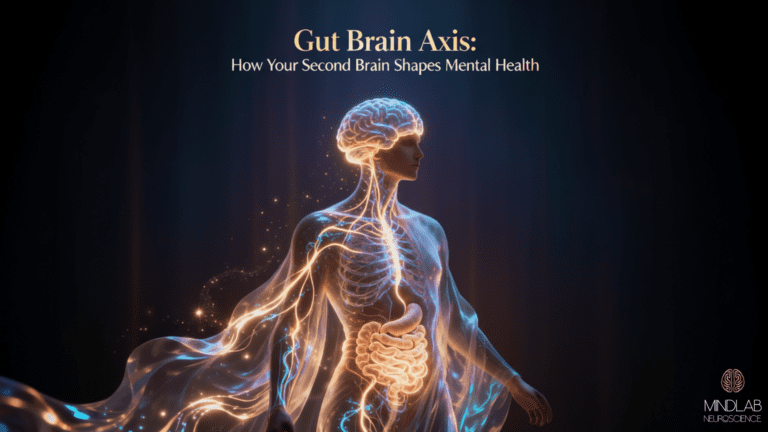
Eventually, the system depletes. You may find yourself with depleted Serotonin (affecting mood, brain health, and the restorative cycles explored in the sleep and circadian optimization hub) and GABA (the brain's natural "brakes"). Without sufficient GABA, your nervous system cannot power down, leaving you in a state of "tired but wired" — a condition often compounded by disruptions along the gut-brain axis that influences neural well-being. Rebalancing this chemistry is the first step in moving from a state of chaotic reaction to one of calculated control.
Trauma, the Nervous System, and Long-Term Health
For many people, the nervous system carries the imprint of unresolved trauma — experiences that occurred years or even decades ago but continue to drive the body's threat response. Trauma does not reside in the narrative alone; it lives in the nervous system as a pattern of hypervigilance, compressed breath, and elevated baseline cortisol. This is one reason conventional stress wellness programs often fail: they address the mind while the nervous system remains locked in survival mode.
When trauma is layered beneath the demands of high-performance leadership, the compounding effect on health is severe. The body never fully enters a restorative state, and the nervous system loses its capacity to self-correct. Recognizing this pattern is essential for people who have "tried everything" yet remain chronically destabilized.
Why Conventional Methods Fail the High-Performing Brain
If you have tried traditional avenues to manage your stress and found them lacking, do not mistake this for a personal failure. It is a strategic mismatch. Standard interventions — talk-based approaches and pharmaceuticals — often fail high-performers because they address the symptoms of the mind without correcting the dysregulation of the body's biology. There is no magic bullet in conventional wellness for a nervous system that has been wired for chronic threat detection.
The "Top-Down" Fallacy of Conventional Stress Management
Traditional talk-based approaches rely on "Top-Down" processing. They ask you to use your Prefrontal Cortex (your thoughts, logic, and language) to analyze and control your emotions. For the average individual, this can be effective.
However, for the high-performer under chronic stress, this approach is fundamentally flawed. As we discussed, when your body is in a sympathetic nervous state, your Prefrontal Cortex is chemically compromised. Its connectivity to the emotional centers is weakened.
Asking a stressed cortex to "think" its way out of a panic response is like trying to download a complex software update while your computer is on fire — which is precisely why so many high-performers search for real answers on how to stop a panic attack using neuroscience. You are likely already hyper-aware of your triggers and articulate about your problems. Re-hashing the narrative in this work often reinforces the neural pathways of the stressor without resolving the physiological alarm ringing in your body. You do not need more insight; you need to learn how to intervene at the neural level.
Pharmacology: The Blunted Edge
The pharmaceutical approach offers a different set of limitations. While pharmacological intervention can be necessary for acute stabilization, for the elite professional, it often acts as a blunt instrument for a precision problem.
Anxiolytics and SSRIs generally work by dampening neural activity throughout the body and nervous system. While this lowers the "floor" of your anxiety, it frequently lowers the "ceiling" of your performance. Many of my clients report feeling a "glass wall" between them and their brilliance — a reduction in creative drive, intuitive sharpness, and the dynamic range of emotion required for high-stakes leadership. For a precision alternative, explore the work on anxiety relief designed specifically for high performers.
You rely on your cognitive speed and acuity. Sacrificing your cognitive edge to achieve calmness is a trade-off you should not have to make. Neural Recalibration™ aims to retain your body's intensity and drive while eliminating the biological cost of the stress response. People seeking lasting change need a doctor of neuroscience — not another prescription — to help them understand and recalibrate their nervous system at its foundation.
Why You Need a Neurological Approach to Regulate Stress
You are essentially an endurance athlete of the mind. Just as an Olympic sprinter would not address a torn hamstring by simply "talking about running," you cannot address deep autonomic dysfunction with conversation alone.
We must use a "Bottom-Up" approach. By targeting the nervous system directly — specifically the Vagus Nerve and neuroplasticity protocols — we signal safety to the primitive brain first. Once the biological alarm is silenced, the Prefrontal Cortex comes back online naturally. This restores your executive function, clarity, and emotional control without dulling your edge. This is not about coping; it is about calibrating your body's biology to match your ambition.
Protocols for Executive Nervous System Optimization
We do not "think" our way out of a stress response; we must "sense" our way out. The following protocols are designed to leverage Bottom-Up Cognitive Restructuring. This means we intervene at the level of the brainstem and limbic system first, forcing the biological alarm to silence so that your higher executive functions can come back online.
These are not relaxation exercises; they are precision drills to manually override your autonomic nervous system and help your body return to a balanced state. Think of them as regulation exercises for the nervous system — neural conditioning that restores the parasympathetic nervous system to its proper authority.
Protocol 1: The Panoramic Gating (Visual Field Expansion)
The Mechanism: When you are stressed or hyper-focused on a problem, your visual field naturally narrows into "foveal vision" (tunnel vision). This is a fight-or-flight reflex designed to lock onto a target or threat. As long as your vision is locked, your brain remains in high-alert mode and your body stays mobilized.
The Drill:
- Keep your head still and look at a specific point on the wall in front of you.
- Without moving your eyes, begin to dilate your awareness to include the space to the immediate left and right of that point.
- Continue expanding your awareness until you can "see" the walls, ceiling, and floor in your periphery, all while maintaining a soft gaze on the center point.
- Hold this "panoramic" view for 60 to 90 seconds.
- Repeat daily as part of your nervous system health routine — consistency is what rewires the default response.
The Result: By mechanically widening your visual aperture, you send a direct signal to the brainstem that no immediate threat is present. This forces a parasympathetic nervous shift, instantly lowering cortisol production — a direct way to reduce cortisol levels throughout your body. Those who practice this technique consistently report a measurable reduction in baseline anxiety within days.
Protocol 2: The 4:8 Neural Reset (Baroreceptor Stimulation)
The Mechanism: Your heart rate variability (HRV) is the most accurate biometric of your resilience and overall health. When you inhale, your heart rate speeds up (fight-or-flight activation). When you exhale, it slows down (parasympathetic). Most high-performers chronically under-breathe or hold their breath, keeping the heart rate elevated and the body in a state of perpetual readiness.
The Drill:
- Sit upright. Inhale through the nose deeply for a count of 4 seconds.
- Exhale through the mouth (like you are blowing through a straw) for a count of 8 seconds.
- The ratio is critical: the exhale must be double the length of the inhale.
- Repeat for 2 minutes before a high-stakes meeting or decision to help your nervous system recalibrate.
- For deeper regulation, extend the practice to 5 minutes — this amplifies the relaxation response and accelerates vagal tone improvement.
The Result: This specific ratio stimulates the Vagus Nerve and activates the baroreceptors in your chest, physically forcing your heart rate to decelerate. It is a biological "brake" that overrides anxiety and helps lower blood pressure. Research confirms that yoga has been shown to activate a similar vagal mechanism, though this protocol delivers results in a fraction of the time. Learning to calm it — to calm the nervous system at will — is the single most valuable skill a high-performer can possess.
Protocol 3: Somatic Dissociation (Body Data vs. Narrative)
The Mechanism: The Amygdala thrives on "narrative." When you feel stress, your brain immediately attaches a story to it ("I am going to fail," "They don't respect me"). This story amplifies the chemical response throughout the body. However, the nervous system processes physical sensation and emotional narrative in different regions.
The Drill:
- When you feel a spike in stress, stop and locate the physical sensation in your body (e.g., tight chest, shallow stomach, clenched jaw).
- Describe the sensation strictly as raw data, stripping away the emotional story.
- Instead of "I am anxious about this deal," say silently: "I am experiencing a thermal sensation in my chest and a constriction in the solar plexus."
- Observe the sensation as if you were a scientist studying a specimen — learn to separate body signals from mental narrative and ease anxiety by removing its fuel source.
- Continue observing for 90 seconds; most people notice the intensity drops by half in that window.
The Result: By shifting from "experiencing" the emotion to "observing" the body's data, you move activity from the emotional centers to the Prefrontal Cortex. You are starving the Amygdala of the narrative fuel it needs to sustain the alarm. This training in somatic awareness is one of the most effective ways to ease anxiety and stabilize your nervous system, triggering a relaxation response that restores cognitive clarity under pressure.
When to Seek Professional Support for Nervous System Dysregulation
These protocols are powerful self-regulation tools, but they are not a substitute for professional guidance when the nervous system has been thrown severely out of whack. If you experience persistent dissociation, panic episodes that do not respond to these techniques, or trauma responses that override your daily function, it is time to schedule an appointment with a practice that specializes in neuroscience-informed nervous system care. Our staff at MindLAB Neuroscience are trained to assess autonomic nervous system function and design individualized regulation nervous system protocols that go far beyond generic advice.
A Note on the Parasympathetic Nervous System and Recovery
The autonomic highway has two lanes. The sympathetic branch accelerates your body toward action. The parasympathetic nervous system acts as the deceleration lane, guiding the body back to baseline after a threat has passed. When this recovery branch is weak — a hallmark of chronic stress — your body has no off-ramp. Every stressor stacks on the last, compounding the toll on your physical health and neural well-being. The protocols above are specifically designed to strengthen this parasympathetic pathway, building the regulation capacity your nervous system needs to sustain elite performance without burning through your health reserves.
Frequently Asked Questions
I cannot afford years of conventional approaches. How quickly does Neural Recalibration™ yield results?
Unlike conventional top-down approaches, which rely on narrative exploration, neuroplasticity is a mechanical process. It is akin to acquiring a new language or instrument. Because we are targeting the biological root of the stress response rather than analyzing its history, most clients experience a shift in their baseline state within weeks, not years. We are not aiming for catharsis; we are aiming for structural change in the body and brain.
Will reducing my stress response blunt my competitive edge?
This is the most common fear among high-performers. You worry that your anxiety is the fuel for your success. It is not; it is the friction. Anxiety burns energy, clouds judgment, and creates decision fatigue. Neural Recalibration™ removes the drag, not the drive. By helping you regulate your nervous system, you retain your ambition and intensity, but you execute with greater clarity, stamina, and strategic precision. You are moving from a frantic sprint to a calculated marathon pace.
I already meditate and exercise rigorously. Why am I still stuck in overdrive?
Meditation and exercise are excellent for general health maintenance, but they are often insufficient for repairing a compromised HPA axis. If your Vagus Nerve has low tone, you may feel calm during meditation, but your body snaps back to high-alert the moment you check your email. You need targeted protocols that function like a software patch, specifically rewriting the code that triggers your fight-or-flight response during work hours. The signs that you need deeper intervention include persistent brain health challenges despite consistent self-care. Try these techniques in combination with professional assessment to learn where your nervous system is actually breaking down.
Are these protocols a permanent fix, or a temporary coping mechanism?
Coping mechanisms are temporary; neuroplasticity is permanent. When you repeatedly use "Bottom-Up" protocols to interrupt the stress response, you physically alter the neural pathways in your nervous system. Over time, the "path of least resistance" changes. Your body stops defaulting to panic and starts defaulting to calibrated focus. We are building a new highway for your nerve impulses, rendering the old, reactive roads obsolete.
What does nervous system dysregulation feel like?
People often describe it as a persistent hum of tension that never fully resolves — a feeling of being "on" even when there is no active threat. Physical signs include shallow breathing, chronic muscle tightness, digestive disruption, and an exaggerated startle reflex. Mentally, it manifests as difficulty concentrating, emotional reactivity out of proportion to the trigger, and a sense that your mental wellness is slowly eroding despite outward success. The nervous system becomes essentially stuck in a loop, and breaking that loop requires targeted neurological intervention, not willpower alone.
How long does it take to heal from nervous system dysregulation?
Timeline depends on the depth of the pattern and the person's commitment to the protocols. Some people notice a tangible shift in nervous system responsiveness within two to three weeks of consistent practice. Deeper patterns — particularly those rooted in trauma — may require several months of targeted work. The critical distinction is that each session of targeted protocol work produces cumulative structural change. Unlike pharmaceutical approaches where cessation means regression, the gains in nervous system health are durable because they are built on neuroplasticity, not chemistry.
The Executive Conclusion
Stress is an inevitable component of a high-consequence life. However, suffering is a biological error. You have spent your career optimizing your portfolio, your team, and your strategy. It is time to apply that same rigor to your body's internal operating system.
By shifting from a surface-level view of stress to a neurological one, you stop fighting yourself. You realize that your reactions are not character flaws, but hardware limitations that can be upgraded. When you master your Vagal Tone and learn to recalibrate your Amygdala, you do not just feel better — you build the kind of durable emotional resilience that allows you to perform at a level inaccessible to those still trapped in survival mode. The health of your nervous system determines the ceiling of your performance.
You have the ambition. Now, let us build the nervous system capable of sustaining it.
This is Pillar 4 content — Stress, Resilience & Regulation — and the work in this hub addresses stress and autonomic recalibration at the level of neural architecture, not behavioral surface.
About Dr. Sydney Ceruto
Founder & CEO of MindLAB Neuroscience, Dr. Sydney Ceruto is the pioneer of Real-Time Neuroplasticity™ — a proprietary methodology that permanently rewires the neural pathways driving behavior, decisions, and emotional responses. Dr. Ceruto holds a PhD in Behavioral & Cognitive Neuroscience (NYU) and Master's degrees in Clinical Psychology and Business Psychology (Yale University). Lecturer, Wharton Executive Development Program — University of Pennsylvania.
Furthermore, chronic exposure to stressors leads to sustained levels of Cortisol. While useful in short bursts, elevated cortisol over time becomes neurologically detrimental, literally shrinking the dendrites in the PFC and hippocampus. This weakens your ability to regulate future stress, creating a feedback loop of reactivity.
The Neurotransmitter Imbalance
Different types of stressors disrupt the delicate balance of your neurochemistry. Acute stress spikes
Dopamine and
Adrenaline, creating a feeling of urgency and hyper-focus that can be addictive for high-performers. However, without a recovery phase, this depletes your reserves.
Eventually, the system downregulates. You may find yourself with depleted Serotonin (affecting mood and the restorative cycles explored in the sleep and circadian optimization hub) and GABA (the brain's natural "brakes"). Without sufficient GABA, your nervous system cannot power down, leaving you in a state of "tired but wired" — a condition often compounded by disruptions along the gut-brain axis that influences neural well-being. Understanding this chemistry is the first step in moving from a state of chaotic reaction to one of calculated regulation.