What Brain Fog Actually Is at the Neural Level
Brain fog is one of the most common complaints I hear in my practice, and one of the most consistently misunderstood. People describe it as feeling “cloudy,” “slow,” “unable to think clearly,” and then they dismiss it as stress, aging, or not getting enough sleep. In 26 years of neuroscience-based work with high-performing individuals, I have found that brain fog is never vague. It is neurologically specific. It has identifiable mechanisms, measurable correlates, and, critically, it responds to targeted intervention once the actual driver is identified.
The term itself is informal, which is part of the problem. Because “brain fog” does not appear in formal classification systems, it has been treated as a subjective complaint rather than a legitimate neurological phenomenon. But contemporary neuroscience has moved well past that dismissal. We now understand that brain fog reflects disruption in one or more of several discrete neural systems: prefrontal executive function, working memory consolidation, neuroinflammatory signaling, and default mode network regulation. It is not one thing. It is a convergence point: a common output of multiple distinct neural inputs, each of which requires a different approach.
This is why generic recommendations fail. Telling someone with brain fog to “sleep more” or “reduce stress” is the equivalent of telling someone with a check-engine light to “drive better.” The symptom is real. The question is which system is producing it.
Neuroinflammation and Microglial Activation
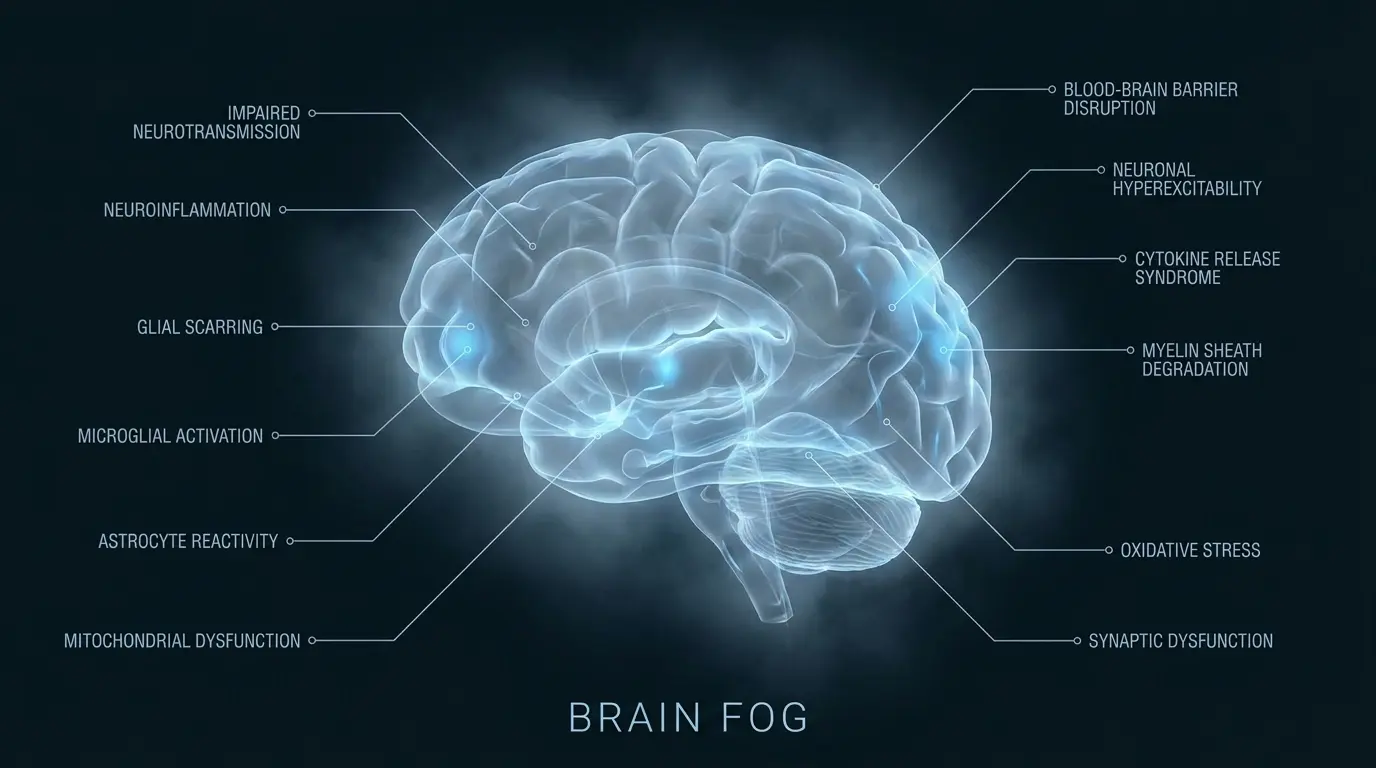
One of the most significant advances in understanding brain fog has come from the field of neuroimmunology: specifically, the discovery that the brain’s immune system can produce cognitive impairment without any visible injury or infection. The key players are microglia, the brain’s resident immune cells. Under normal conditions, microglia maintain neural health by clearing debris, pruning unnecessary synapses, and monitoring for pathogens. But when microglia shift into a chronically activated state, a phenomenon researchers call microglial priming, they begin releasing pro-inflammatory cytokines (interleukin-1 beta, interleukin-6, tumor necrosis factor alpha) that directly impair synaptic transmission.
The result is precisely what people describe as brain fog: slowed processing speed, difficulty sustaining attention, a subjective sense that thinking requires more effort than it should. The inflammation is not causing tissue damage: it is disrupting synaptic signaling efficiency. Neural networks that normally communicate at high speed are now operating through an inflammatory haze that degrades the signal-to-noise ratio across cortical circuits.
What makes this mechanism particularly important is how many upstream triggers can activate it. Chronic psychological stress elevates peripheral inflammation through the hypothalamic-pituitary-adrenal axis, which crosses the blood-brain barrier via cytokine transport. Poor sleep disrupts the glymphatic system’s nightly clearing of metabolic waste, leaving inflammatory byproducts in the interstitial fluid. Gut dysbiosis sends inflammatory signals through the vagus nerve and systemic circulation. Each of these pathways can independently activate microglial priming, and in many of the individuals I work with, multiple pathways are active simultaneously.
This is not a problem that responds to willpower. You cannot think your way through neuroinflammation. What you can do is identify which inflammatory pathway is primary and address it at the source, which is what a neuroscience-based assessment is designed to do.
Stress Signaling and the Prefrontal Shutdown
The relationship between stress-level catecholamine signaling and cognitive function follows a sharp inverted-U curve, and understanding that curve explains why stress produces brain fog in people who are otherwise cognitively exceptional. At moderate levels, that signaling enhances prefrontal function: it sharpens attention, supports working memory and mental clarity, and mobilizes cognitive resources for demanding tasks. This is the productive edge of the stress response. But when cortisol remains elevated chronically (as it does in sustained professional pressure, unresolved interpersonal conflict, or persistent uncertainty) the curve tips, and the prefrontal cortex begins to shut down, driven mainly by excessive catecholamine signaling and amplified by cortisol.
The mechanism is specific. The dorsolateral prefrontal cortex is exquisitely sensitive to stress-level catecholamines, and chronic cortisol exposure magnifies that signaling, reducing prefrontal activity. Simultaneously, the amygdala, which has a different receptor profile and responds to cortisol with increased activity, becomes hyperactive. The net effect is a brain that is more reactive and less reflective, more threat-sensitive and less capable of the sustained, organized thinking that defines executive function.
This is the stress-mediated prefrontal suppression that produces the specific flavor of brain fog high-performers describe most often: “I can still function, but I’ve lost my edge.” The raw intelligence is intact. The processing architecture is intact. But the prefrontal systems that organize, prioritize, and sustain complex thought are running at diminished capacity because the neurochemical environment has shifted beneath them.
I see this pattern constantly in executives, founders, and professionals who operate under sustained pressure. They interpret the cognitive decline as burnout, aging, or personal failure. It is none of those things. It is a neurochemical consequence of chronic HPA axis activation, and it reverses when the cortisol load is addressed. The neuroscience on this is clear: Amy Arnsten’s research at Yale has demonstrated that prefrontal networks are exquisitely sensitive to their neurochemical environment, and that restoring optimal catecholamine balance restores executive function. The cortex is not damaged. It is suppressed.
Sleep Architecture and Glymphatic Failure
Sleep is not rest. Sleep is active neural maintenance, and when that maintenance process breaks down, brain fog is among the first consequences. The glymphatic system, discovered by Maiken Nedergaard’s team at the University of Rochester, is a fluid-clearance network that operates primarily during slow-wave sleep. During deep sleep, the brain’s interstitial spaces expand by approximately 60 percent, allowing cerebrospinal fluid to flush metabolic waste products, including amyloid beta and tau proteins, from neural tissue.
When sleep architecture is disrupted (reduced slow-wave sleep, fragmented sleep cycles, insufficient total sleep duration) the glymphatic system cannot complete its clearance function. Metabolic waste accumulates. Adenosine, the neurotransmitter that builds during waking hours and signals sleep pressure, fails to fully clear. The result is exactly what people report the morning after poor sleep: cognitive sluggishness, impaired concentration, a pervasive sense that the brain is operating through resistance.
But here is what most people miss: the relevant variable is not just sleep duration. It is sleep architecture: the specific proportion and integrity of sleep stages. An individual sleeping seven hours with fragmented slow-wave phases may have worse glymphatic clearance than someone sleeping six hours with intact deep sleep cycles. The quality of the maintenance window matters more than its length.
For individuals experiencing chronic brain fog, sleep architecture assessment is not optional: it is one of the first systems I examine. The thalamocortical circuits that generate sleep spindles and slow oscillations can be disrupted by the same cortisol elevations discussed above, creating a vicious cycle: stress impairs sleep architecture, impaired sleep increases neuroinflammation, neuroinflammation worsens cognitive function, and worsened cognitive function increases stress. Breaking this cycle requires identifying where it started, not treating the symptom that is most visible.
Default Mode Network Overactivity and Cognitive Resource Drain
The default mode network (DMN) is the brain’s resting-state architecture: the set of regions that activate when you are not engaged in a specific external task. It includes the medial prefrontal cortex, the posterior cingulate cortex, and the angular gyrus, and it supports self-referential processing, autobiographical memory, and future simulation. Under normal conditions, the DMN deactivates when task-positive networks engage: a reciprocal relationship that allows the brain to shift cleanly between internal processing and external focus.
In individuals with chronic brain fog, this reciprocal switching often breaks down. The DMN remains partially active during tasks that should suppress it, creating a cognitive state that researchers describe as network interference. The subjective experience is unmistakable: you are trying to focus on a report, a conversation, a decision, but part of your brain keeps pulling toward unrelated thoughts, self-referential loops, or diffuse mental wandering. It is not a failure of discipline. It is a failure of network anticorrelation: the DMN is not releasing its hold on cognitive resources when the task-positive network needs them.
Marcus Raichle’s foundational research on the default mode network, combined with subsequent work by Andrews-Hanna, has demonstrated that DMN overactivity correlates with rumination, mind-wandering, and the subjective experience of mental fog. The mechanism is metabolic as well as functional: the DMN is one of the brain’s most metabolically expensive networks, consuming a disproportionate share of the brain’s glucose and oxygen budget. When it runs continuously, even in the background, fewer resources are available for the executive networks that support focused, organized thought.
This pattern is particularly prevalent in individuals who carry unresolved cognitive loads: decisions that haven’t been made, conflicts that haven’t been addressed, uncertainties that the brain keeps modeling without resolution. The DMN is doing what it was designed to do: simulate, project, and process. But it is doing it at the wrong time, in the wrong proportion, draining the very resources that would allow the individual to think clearly enough to resolve the issues driving the overactivity. Dr. Ceruto’s approach interrupts this cycle at the neural level, not through suppression, but through recalibration of the switching mechanism itself.
The Gut-Brain Axis: Inflammation That Starts Below the Neck
One of the most important developments in understanding brain fog has come from outside neuroscience entirely: from the emerging science of the gut-brain axis. The enteric nervous system, sometimes called the “second brain,” contains roughly 500 million neurons and maintains continuous bidirectional communication with the central nervous system via the vagus nerve, the endocrine system, and the immune system. When the gut’s microbial ecosystem is disrupted, a state known as dysbiosis, the consequences are not confined to digestion. They reach the brain.
The mechanism operates primarily through cytokine signaling. An imbalanced gut microbiome increases intestinal permeability (commonly referenced as “leaky gut”), allowing bacterial endotoxins, particularly lipopolysaccharides, to enter systemic circulation. These molecules trigger a peripheral inflammatory response that elevates circulating cytokines. Those cytokines cross the blood-brain barrier through active transport mechanisms and receptor-mediated signaling, activating the same microglial cascade described earlier. The brain fog that results is not psychosomatic. It is a direct neuroinflammatory consequence of peripheral immune activation originating in the gut.
Research by John Cryan and Ted Dinan at University College Cork has demonstrated that specific microbial populations directly influence neurotransmitter production (including serotonin, GABA, and dopamine precursors) and that disruptions to these populations produce measurable cognitive and emotional effects. The gut is not merely influencing mood. It is influencing the neurochemical substrate on which cognition depends.
For the individuals I work with, the gut-brain connection is frequently the missing variable: the reason their brain fog persists despite adequate sleep, manageable stress levels, and no obvious neurological explanation. When the inflammatory signal is coming from below the diaphragm, no amount of cognitive strategy will resolve it. Identifying and addressing the brain health and neural optimization picture requires looking at the whole system, not just the organ between the ears.
Why Brain Fog Is Not Laziness, Aging, or a Character Problem
I want to be direct about something I encounter in nearly every conversation about brain fog: the shame. People who are accustomed to operating at a high cognitive level experience brain fog as evidence of decline: personal, professional, intellectual. They question whether they are losing their edge. They wonder if this is simply what aging feels like. They blame themselves for not being able to push through it.
The neuroscience does not support any of those interpretations. Brain fog is not cognitive aging: age-related cognitive decline follows a different trajectory with different neural signatures, primarily involving gradual reductions in processing speed and episodic memory consolidation, not the diffuse executive impairment that characterizes brain fog. Brain fog is not laziness: the motivational circuitry of the mesolimbic dopamine pathway is distinct from the executive and attentional systems affected by brain fog, and many individuals with severe fog maintain extraordinary drive even as their cognitive clarity deteriorates. And brain fog is certainly not a character flaw. It is a neural system state: a measurable, identifiable disruption in one or more of the mechanisms described above.
The danger of misattributing brain fog to personal failing is that it delays appropriate assessment. Individuals spend months or years compensating (working harder, sleeping less, adding caffeine, attributing the fog to a “phase”) while the underlying neural driver continues unchecked. Neuroinflammation does not resolve through persistence. Cortisol and stress-related cognitive decline do not improve when the response is to work longer hours. Sleep architecture does not repair itself when the compensatory strategy is more stimulants.
Every mechanism that produces brain fog is addressable once it is correctly identified. That is the fundamental insight: the fog has a source. Finding that source (whether it is inflammatory, neurochemical, architectural, or a compound of several) is the prerequisite for every meaningful intervention.
Identifying the Neural Driver: Dr. Ceruto’s Approach
The central challenge with brain fog is that it is a convergent symptom: multiple distinct neural mechanisms produce an overlapping subjective experience. An individual whose brain fog is driven by chronic HPA axis activation and stress-mediated prefrontal suppression experiences something that feels similar to brain fog driven by gut-mediated neuroinflammation or DMN overactivity. The subjective report alone cannot distinguish between them. And because the interventions differ, an approach that does not identify the specific driver will, at best, produce partial improvement.
This is where my work begins. In my practice, brain fog is not a problem to be managed: it is a signal to be decoded. The assessment process maps which of the known mechanisms is primary: Is the prefrontal cortex being suppressed by catecholamine signaling driven past the productive range, with a cortisol load magnifying it? Is there evidence of systemic inflammation that would implicate microglial activation? Is sleep architecture compromised in ways that would impair glymphatic clearance? Is the default mode network running continuously, consuming metabolic resources that should be available for focused cognition? Is the gut-brain axis sending inflammatory signals that are crossing the blood-brain barrier?
In most cases, the answer is not a single mechanism but a primary driver with secondary contributors, and the sequence in which they are addressed matters. Targeting neuroinflammation while ignoring the cortisol load that is sustaining it produces temporary relief. Improving sleep architecture without addressing the DMN overactivity that is fragmenting sleep onset produces incomplete results. The neural systems that produce brain fog interact, and effective intervention respects those interactions.
What I have observed across 26 years of this work is that brain fog, once its specific architecture is understood, is among the most responsive patterns to targeted intervention. The fog lifts, not metaphorically, but literally. Individuals describe it as having a window cleaned that they forgot was dirty. Cognitive speed returns. Working memory capacity expands. The ability to sustain complex, organized thought over extended periods, the executive function that defines professional performance, comes back online.
If brain fog is limiting your cognitive performance, your professional output, or your confidence in your own mental sharpness, a conversation about what is actually driving it is the necessary first step. Not a generic wellness plan. Not a symptom-management strategy. A neuroscience-based assessment of the specific mechanism producing the fog, and a clear map of what it takes to resolve it. Schedule a strategy call with Dr. Ceruto to begin that process.