Cognitive Distortions Are Prediction Errors, Not Thinking Mistakes
The conventional framing treats cognitive distortions as flawed thought patterns: errors in logic that can be corrected by identifying and challenging them. Twenty-six years of neuroscience practice has shown me something different. What we call cognitive distortions are not mistakes in reasoning. They are prediction errors generated by the brain’s Bayesian inference system: a system that is functioning exactly as designed, operating on models that were calibrated under conditions that no longer apply.
The brain does not passively receive reality. It actively constructs expectations about what will happen next, based on weighted prior experience. Every perception, every emotional reaction, every interpretation of another person’s behavior passes through a predictive processing architecture that compares incoming sensory data against internally generated predictions. When the predictions are accurate, the brain processes the experience efficiently and moves on. When incoming data conflicts with the prediction, a prediction error signal fires, and the brain must decide whether to update the model or dismiss the data.
This is where cognitive distortions originate. In individuals whose prediction models were calibrated during high-threat, high-rejection, or high-uncertainty conditions, which describes the developmental environments of most of the individuals I work with, the priors are weighted toward negative outcomes. The brain predicts rejection before a conversation starts. It predicts failure before evidence is available. It predicts catastrophe in response to ambiguity. These are not irrational conclusions. They are statistically rational predictions based on the data the brain was trained on. The data has changed. The models have not.
Understanding cognitive distortions through this predictive coding framework changes what recalibration requires. The target is not the distorted thought itself: it is the prediction model generating the thought. And prediction models do not update through argument, logic, or awareness. They update through a specific neurobiological process that operates under precise conditions.
The Prefrontal-Limbic Imbalance Behind Distorted Thinking
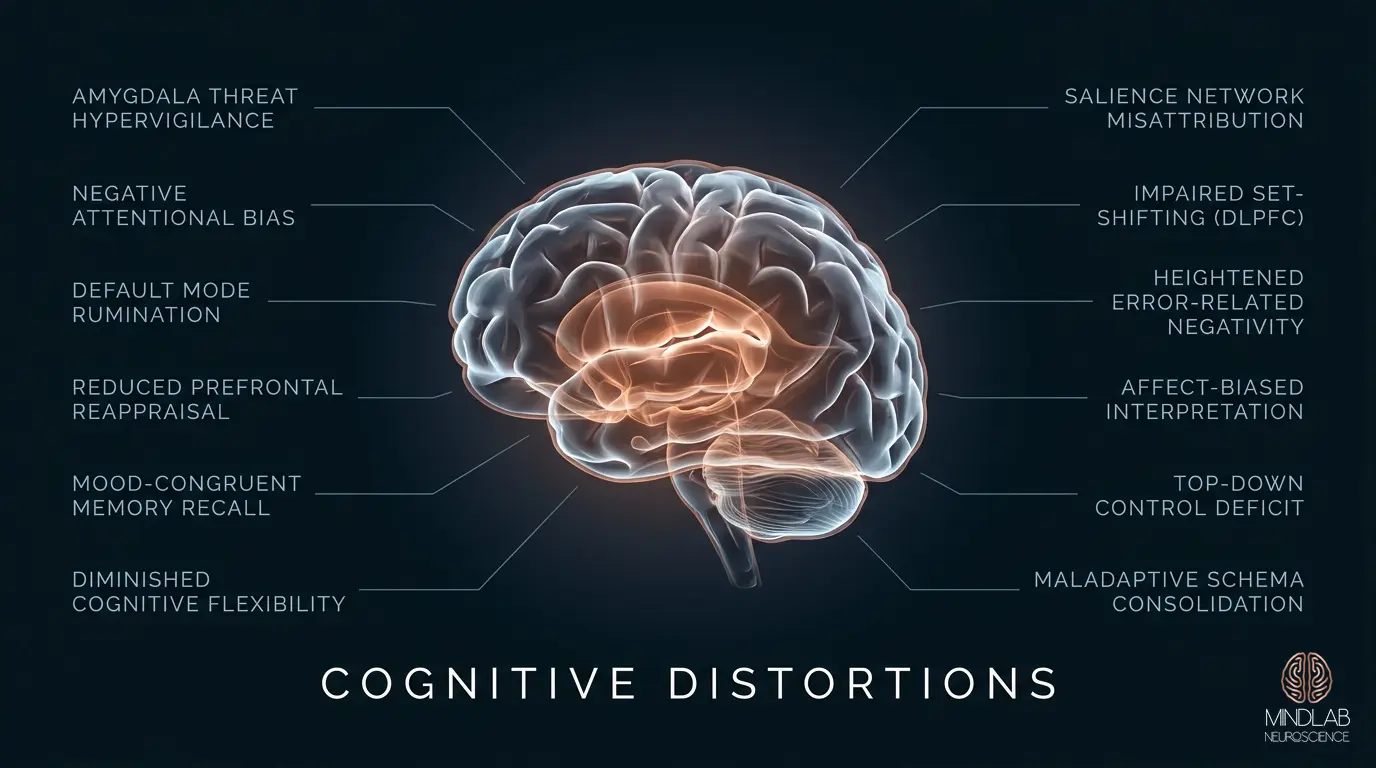
Every form of distorted thinking involves a characteristic imbalance between two neural systems: the prefrontal cortex, which generates top-down regulation, contextual evaluation, and flexible response selection, and the limbic system, particularly the amygdala, which generates rapid threat assessments and emotionally weighted predictions. In healthy cognition, these systems operate in dynamic balance. The amygdala flags potential threats. The prefrontal cortex evaluates those flags against context, prior outcomes, and current goals, then either validates or overrides the threat signal. The result is calibrated interpretation: emotional reactivity modulated by executive judgment.
In individuals experiencing persistent cognitive distortions, this balance is disrupted in a specific direction. The amygdala’s threat signals are amplified, either through developmental calibration, chronic stress exposure, or neurochemical conditions that elevate limbic reactivity. Simultaneously, the prefrontal regulatory capacity is degraded. Chronic stress elevates cortisol, and impairs prefrontal function mainly through excessive catecholamine signaling that cortisol amplifies. The regulatory system that should be contextualizing and modulating the amygdala’s signals is operating at reduced capacity, precisely when those signals are running at elevated amplitude.
The result is what I observe consistently in high-capacity individuals who arrive at my practice: people whose analytical intelligence is formidable in professional domains but whose personal interpretive frameworks are being driven by limbic signals that their prefrontal systems cannot adequately regulate. A CEO who can evaluate a billion-dollar deal with extraordinary nuance but catastrophizes a partner’s tone shift. An executive who manages teams of hundreds but personalizes a colleague’s neutral email into evidence of contempt. The intelligence is not the problem. The prefrontal-limbic coupling that governs automatic interpretation is the problem, and no amount of intellectual awareness alters that coupling without engaging the specific neural mechanisms that regulate it.
Negativity Bias Is Not a Flaw: It Is a Calibrated Survival Mechanism
One of the most important reframes I offer individuals who recognize their own distorted thinking patterns is this: negativity bias is not a defect. It is the brain’s most fundamental survival strategy, and every cognitive distortion is an expression of this strategy operating in contexts where it is no longer adaptive.
The amygdala processes negative stimuli faster, with greater neural amplitude, and with stronger memory encoding than positive or neutral stimuli. This asymmetry is not accidental: it was calibrated across millions of years of evolutionary pressure where the cost of missing a threat was death, while the cost of missing an opportunity was merely delay. The brain evolved to overweight threats because the survival math demanded it. A single false negative, failing to detect a predator, was fatal. A thousand false positives, startling at shadows, were merely metabolically expensive.
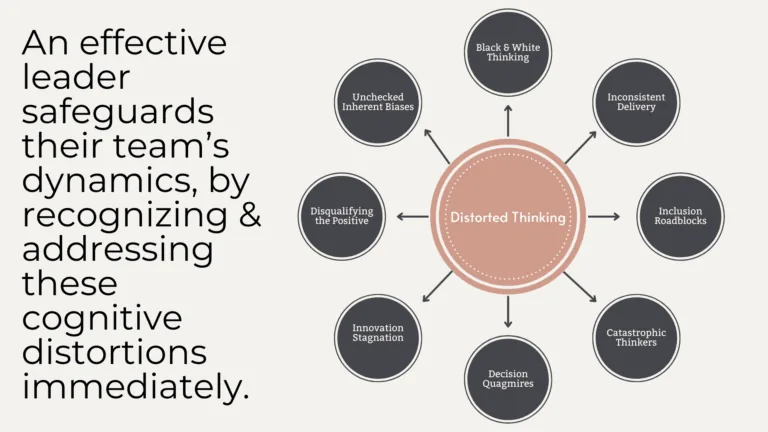
This architecture produces a brain that systematically overestimates threat probability, underestimates positive outcomes, and assigns disproportionate emotional weight to negative social signals. In other words, it produces cognitive distortions. Catastrophizing is the threat-detection system running its prediction models with the sensitivity dial set to maximum. Personalization is the social-threat monitoring system interpreting ambiguous data through the most threatening available lens. Black-and-white thinking is the rapid categorization system that evolved to make fast survive-or-flee decisions, now applied to nuanced interpersonal situations that do not benefit from binary classification.
The practical implication is significant. Telling someone their thinking is “distorted” implies the brain is malfunctioning. The neuroscience reveals the opposite: the brain is functioning precisely as its survival architecture specifies. The problem is that the calibration parameters (the thresholds at which threat is detected, the weights assigned to negative versus positive signals) are set for an environment that no longer exists. Recalibration, not correction, is what the circuitry requires.
Why Awareness Alone Cannot Fix Distorted Thinking: The Reconsolidation Requirement
The most common experience I encounter in individuals who have done significant self-work is this: they can identify their cognitive distortions in real time. They can name the pattern: catastrophizing, personalization, mind-reading, overgeneralization. They can articulate why the pattern is not serving them. They can construct alternative interpretations that they know, intellectually, are more accurate. And the distortion persists. The next time the triggering stimulus appears, the same automatic interpretation fires, the same emotional response activates, and the same cycle runs, now accompanied by the additional frustration of knowing it is happening while being unable to stop it.
This gap between awareness and change has a precise neurobiological explanation rooted in how prediction models are stored and updated. The brain’s predictive models are encoded in synaptic weights: the strength of connections between neurons that determine which predictions fire automatically in response to specific inputs. These synaptic weights are not accessible to conscious awareness. You cannot think your way to a different synaptic weight any more than you can think your way to a different heart rate. The weights that generate automatic predictions operate below the level at which cognitive insight can intervene.
Updating these weights requires a specific neurobiological event: memory reconsolidation. When a prediction model is activated, when the brain generates a distorted prediction in response to a triggering stimulus, there is a brief window during which the synaptic connections encoding that prediction become labile, temporarily destabilized, and available for modification. This is the reconsolidation window. During this window, the introduction of prediction-error information, genuinely new data that contradicts what the model predicted, can update the synaptic weights encoding the prediction. The model revises. The automatic prediction changes. Outside this window, the model is consolidated, stable, and resistant to modification regardless of how much insight, awareness, or logical counterargument is applied.
This is why individuals can understand their distortions perfectly and remain unable to change them. Understanding operates at the cortical level. The distortion operates at the synaptic level. The two levels do not communicate through the channel that insight provides. They communicate through the channel that reconsolidation provides, and reconsolidation requires activation of the prediction model under specific conditions, not reflection about it.
Catastrophizing, Personalization, and Black-and-White Thinking as Specific Circuit Patterns
While popular frameworks present cognitive distortions as a checklist, fifteen or twenty named patterns, the neuroscience reveals something more structured. The major distortion categories map onto distinct neural circuit patterns, each with a specific architecture and a specific recalibration target.
Catastrophizing involves hyperactivation of the brain’s threat simulation circuitry. The ventral medial prefrontal cortex and the amygdala collaborate to generate mental simulations of future scenarios, and in catastrophizing, the amygdala’s threat-weighting biases these simulations toward worst-case outcomes with a probability assignment far exceeding what the evidence supports. The anterior insula, which generates the felt sense of impending danger, amplifies the somatic component: the individual does not merely think something terrible will happen but feels it in their body as though it is already occurring. The recalibration target is the probability-assignment function: the system that converts ambiguity into predicted outcome.
Personalization, the automatic interpretation of external events as being about oneself, involves elevated activity in the brain’s mentalizing network, particularly the medial prefrontal cortex and the temporoparietal junction. In healthy cognition, this network models other people’s mental states with appropriate uncertainty, generating hypotheses about what others think or feel while maintaining awareness that these are inferences, not facts. In personalization, the mentalizing network generates self-referential interpretations of others’ behavior with inappropriately high confidence. A colleague’s neutral expression is not processed as ambiguous data requiring more information. It is processed as evidence of a specific negative evaluation of the self. The uncertainty buffer is missing. The inference is treated as perception.
Black-and-white thinking, or dichotomous categorization, reflects a failure of the brain’s capacity for graded evaluation. The orbitofrontal cortex, which normally generates nuanced value assessments along a continuous spectrum, is underperforming relative to the amygdala’s binary threat/safe classification system. Outcomes are good or bad. People are trustworthy or dangerous. Performance is perfect or worthless. This pattern is particularly prevalent in individuals whose early environments required rapid all-or-nothing evaluations, where nuanced assessment was a luxury the nervous system could not afford. The circuitry adapted to the demand. The demand has changed. The circuitry has not.
Understanding these as circuit-level patterns, not character flaws or thinking habits, determines how recalibration proceeds. Each pattern has a distinct neural target. Each requires engagement with a different component of the pattern recognition and cognitive automation architecture that generates the automatic interpretation.
The Anterior Cingulate Cortex: The Brain’s Distortion Detection Failure
The anterior cingulate cortex (ACC) functions as the brain’s error monitor, detecting conflicts between predictions and evidence, between competing interpretations, and between automatic responses and contextual reality. In healthy cognition, the ACC registers when a prediction model is producing outputs that conflict with available data, and it signals the prefrontal cortex to pause and re-evaluate.
In individuals with persistent distorted thinking patterns, the ACC’s error-detection function is compromised in a specific direction. It continues monitoring for computational and task-performance errors, but it fails to flag the prediction errors generated by emotionally weighted models. When the amygdala generates a threat-weighted prediction (“this person is angry at you,” “this failure defines your value”) the ACC does not register these as requiring scrutiny. The predictions pass through the error-monitoring gate unchallenged and arrive at conscious awareness as perceived reality rather than hypotheses requiring evaluation.
This ACC failure explains a phenomenon that every individual struggling with cognitive distortions recognizes: the distortion does not feel like a distortion in the moment it fires. It feels like accurate perception. It feels like truth. The internal experience is not “I am catastrophizing”: it is “something terrible is about to happen.” The distortion acquires the subjective quality of direct perception because the neural system that should be tagging it as a model-generated prediction, requiring verification, is not performing that function.
The ACC’s performance is also degraded by the same conditions that amplify limbic reactivity: chronic stress, sleep deprivation, and elevated cortisol. The periods during which distorted thinking is most intense are simultaneously the periods during which the brain’s error-detection system is least capable of identifying the distortions as distortions. This creates the escalation dynamic that so many individuals describe: stress amplifies the distortions, the distortions generate more stress, the additional stress further degrades the ACC’s capacity to flag the distortions, and the cycle intensifies without an internal mechanism to interrupt it.
Restructuring Prediction Models at the Neural Level: Dr. Ceruto’s Approach
Dr. Sydney Ceruto’s work with cognitive distortions begins with a premise that diverges fundamentally from conventional approaches: the distorted thoughts are outputs, not causes. The thoughts are what the prediction models produce. Engaging with the thoughts (challenging them, reframing them, replacing them with alternative thoughts) is engaging with the output of a system while leaving the system itself intact. The system will continue to produce the same outputs because the synaptic weights encoding the prediction models have not changed.
Her approach targets the prediction models directly. This requires three conditions that most standard approaches do not provide. First, the prediction model must be activated, not discussed retrospectively, but neurally active, generating its predictions in real time in response to genuine triggering stimuli. Second, the activation must occur within the reconsolidation window, the brief neurobiological period during which the synaptic connections encoding the model are labile and available for modification. Third, prediction-error information must be introduced during that window: genuinely new experiential data that contradicts what the model predicted, delivered at the moment the model is expecting its predicted outcome to confirm.
This is the neuroscience that governs how prediction models update. It is not a theoretical framework. It is the mechanism through which synaptic plasticity operates at the level of consolidated emotional memory. The research on reconsolidation (the work of Nader, Schiller, and their colleagues) has established that even deeply consolidated prediction models can be modified, but only through this specific sequence: activate, destabilize, introduce mismatch, reconsolidate with updated weights.
Real-Time Neuroplasticity™ is built around engaging these conditions in the live contexts where the prediction models fire. This is why Dr. Ceruto’s embedded model exists: it provides presence at the moment the distortion activates, not hours or days later in a reflective conversation. When an individual is catastrophizing about a presentation, personalizing a partner’s silence, or flattening a complex situation into binary categories, the prediction model is active, the reconsolidation window is open, and the neural architecture is available for the kind of precision intervention that produces durable change.
What I have observed across 26 years of this work is that cognitive distortions do not resolve gradually through accumulated insight or improved coping. They resolve when the prediction models that generate them update: when the brain’s Bayesian priors shift because the synaptic weights encoding them have been modified through the reconsolidation process. The distortion stops firing. The prediction model generates a different output because the model itself has changed.
For individuals who recognize these patterns (the catastrophizing that persists despite knowing it is catastrophizing, the personalization that fires despite understanding why) this is the distinction that determines outcomes. The question is not whether you can identify the distortion. The question is whether the neural architecture generating it can be reached, at the moment it is operating, with the precision required to update the prediction model at its source. To explore whether this approach applies to your specific patterns, schedule a strategy call with Dr. Ceruto.
This content explores the neuroscience of cognitive distortions. The patterns described here (catastrophizing, personalization, rumination and recursive thought loops, dichotomous categorization) each involve distinct neural circuits operating within the brain’s broader cognitive flexibility and thought pattern regulation architecture. For personalized neurological assessment and intervention, contact MindLAB Neuroscience directly.