

Key Takeaways
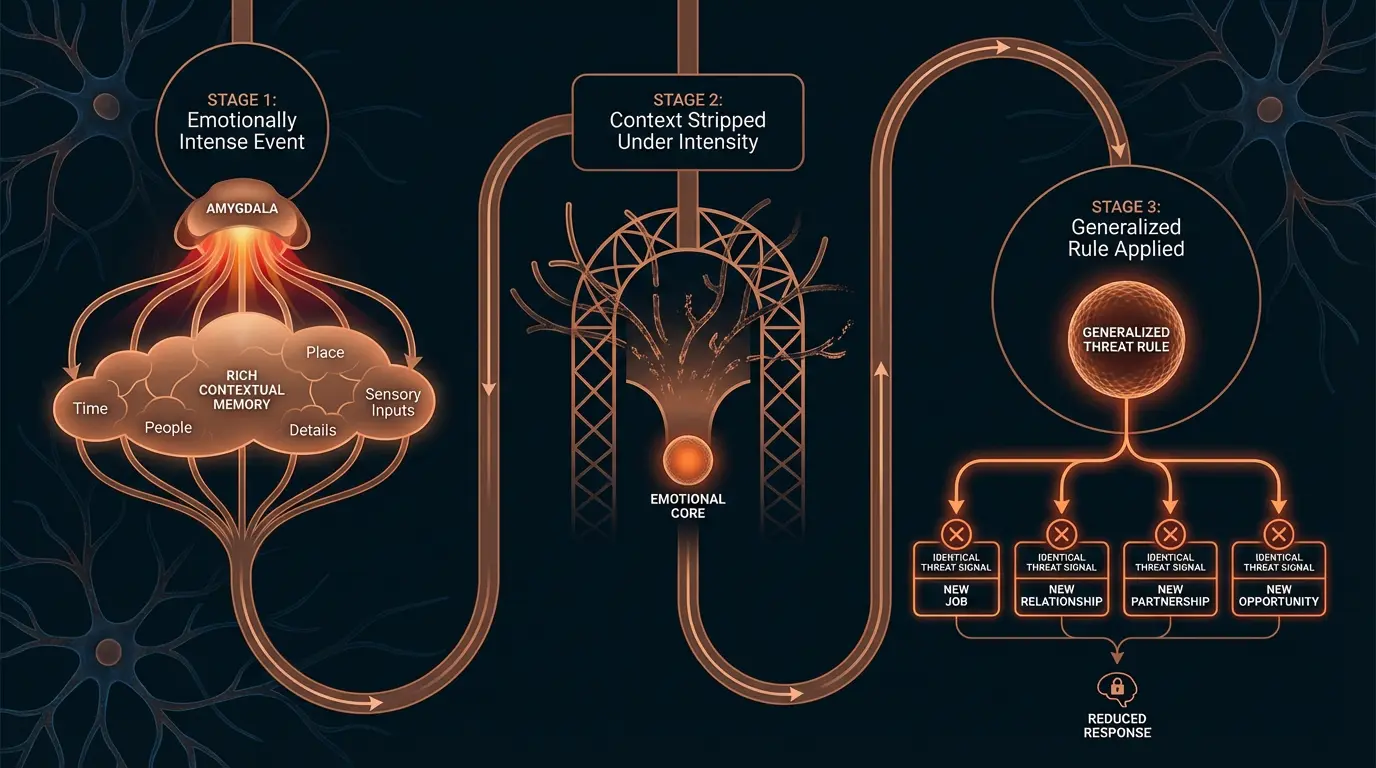
- The amygdala encodes one charged event as a permanent, context-independent rule before prefrontal cortex evaluation.
- Under emotional intensity the hippocampus strips contextual detail, storing the conclusion without its circumstances.
- In high-capacity individuals overgeneralization is premature closure, not absolutist language: belief drives behavior before reflection.
- The cortisol-hippocampal loop self-reinforces: overgeneralization drives chronic stress, stress impairs context-specific memory, which deepens overgeneralization.
- Relational overgeneralization lasts longest: the amygdala encodes betrayal at higher threat valence than professional failure.
- Cognitive reframing fails by arriving after the decision: intervention must land at premature closure.

Overgeneralization is a neurological pattern, not a thinking error willpower can correct. The amygdala encodes a single emotionally intense event as a permanent, cross-situational rule, and the pattern resists detection because the brain registers the distortion as hard-won wisdom, not inaccuracy.
Professional observation consistently reveals this pattern in clients who are otherwise highly self-aware. They don’t say “I always fail”: that would be too obvious, too easily challenged. What appears instead is premature closure: the client stops gathering data and moves to action based on the generalized belief before testing whether the new situation is actually equivalent to the old one. The overgeneralization is embedded in the decision, not spoken as a belief. That is what makes it so resistant to standard approaches, and what makes understanding the broader cognitive distortions pattern essential before you can interrupt this one specifically.
The Neuroscience at a Glance
- Overgeneralization activates the anterior cingulate cortex to assign categorical threat status to isolated negative events.
- The hippocampus encodes overgeneralized fear memories by collapsing contextual distinctions, broadening the conditioned stimulus boundary beyond the original experience.
- Prefrontal-amygdala connectivity deficits permit overgeneralized appraisals to persist unchecked by executive inhibition circuits.
- Repeated overgeneralization strengthens predictive coding errors in the orbitofrontal cortex, reinforcing distorted outcome expectations over time.
- Cognitive restructuring modulates default mode network self-referential processing, reducing overgeneralized negative attributions toward the self.
The Neuroscience Behind Overgeneralization
Overgeneralization occurs when the hippocampus and amygdala, brain regions governing pattern detection and threat assessment, misfire, converting isolated negative experiences into sweeping absolute beliefs. Research indicates cognitive distortions are common among adults experiencing anxiety or depression, with overgeneralization ranking among the three most frequently identified distortions in cognitive restructuring intervention settings.
Overgeneralization of fear responses involves stimulus generalization gradients that are steeper in individuals with high amygdala baseline activity, making threat-proximal neutral stimuli disproportionately likely to acquire conditioned threat value.
Inhibitory learning protocols targeting overgeneralized fear circuits produced significantly broader extinction generalization than standard exposure alone, reducing overgeneralization to novel stimulus categories.
The amygdala processes emotions and flags potential threats. When someone experiences emotional pain (rejection, failure, betrayal) the amygdala can store that event as a generalized “danger” memory, making the brain more likely to categorize similar future situations as negative or threatening before the prefrontal cortex has a chance to evaluate the evidence. This is directly connected to how rumination reinforces overgeneralized thinking: the same neural loop that stores the threat also replays it, strengthening the generalization with each repetition.
The hippocampus plays an equally critical role. Under emotional intensity, the hippocampus can encode memories in a context-independent manner, meaning the brain stores the emotional conclusion (“this is dangerous”) without preserving the specific context that made it true. Long-term potentiation under these conditions creates a neural pathway that fires whenever any superficially similar trigger appears, regardless of whether the actual circumstances match. One emotionally charged failure at a business pitch can generalize across every professional presentation for years, not because the situations are equivalent, but because the hippocampal encoding stripped the context and left only the conclusion.
The prefrontal cortex is responsible for overriding these automatic reactions with rational evaluation. However, when emotions run high, prefrontal regulation diminishes, and the amygdala’s generalized threat assessment wins. This is the same mechanism behind rigid thinking under threat.
Professional observation reveals a specific behavioral pattern that published literature rarely addresses: overgeneralization in high-capacity individuals doesn’t sound like absolutist language. It presents as premature closure: the moment when a client stops gathering evidence and commits to a course of action based on the generalized belief, without recognizing that the belief, not the evidence, made the decision. A client who was blindsided by a business partner’s exit doesn’t say “everyone betrays me.” Instead, they structure every future partnership with exit clauses so restrictive that no one can actually partner with them. The overgeneralization is invisible because it’s embedded in behavior, not stated as a belief. That is what standard cognitive approaches miss, and what Real-Time Neuroplasticity™ is specifically designed to interrupt.

| Dimension | Healthy Pattern Recognition | Overgeneralization |
|---|---|---|
| Data source | Multiple experiences across varied contexts | Single emotionally charged event generalized to all similar situations |
| Context preserved | Yes: the brain retains situational detail and distinguishes between contexts | No: the hippocampus strips context under emotional load, leaving only the conclusion |
| Prefrontal involvement | Active: evaluates evidence before forming conclusion | Bypassed: amygdala concludes before the prefrontal cortex engages |
| Flexibility | Updates when new evidence contradicts the existing pattern | Resistant to counterevidence: new data is filtered through the generalized belief |
| Behavioral signature | Informed caution with continued openness to new data | Premature closure and avoidance: the decision is made before the situation is evaluated |
| Stress response | Proportional to actual risk in the current situation | Disproportionate: calibrated to the worst-case memory, not present-moment reality |
| Neural pathway type | Context-dependent and revisable with new evidence | Context-independent and self-reinforcing through the cortisol-hippocampal loop |
How Overgeneralization Manifests in Everyday Life
Overgeneralization appears across every major life domain (relationships, work, health, and self-perception) creating rigid mental patterns that distort reality. Research indicates that cognitive distortions like overgeneralization contribute to depression in a substantial share of cases. Identifying domain-specific manifestations allows practitioners to interrupt automatic negative thought cycles before they consolidate into lasting beliefs.
Overgeneralization in Personal Development
Many individuals allow one failure to define their capabilities:
- A person who performs poorly on one exam concludes, “I’m bad at math,” and avoids further study, reinforcing the belief
- Someone struggling with fitness says, “I’ve never been athletic, so I’ll never get in shape”
- An aspiring entrepreneur whose first business idea fails thinks, “I’m not meant to be successful,” and quits instead of learning from the experience
In professional practice, the personal development version of overgeneralization is the quickest to form and the slowest to release, because the generalized belief often aligns with a pre-existing self-narrative. The brain doesn’t experience it as a distortion. It experiences it as confirmation.
Overgeneralization in Relationships
One of the most durable forms of overgeneralization operates in romantic and social relationships:
- A person who experiences a painful breakup concludes, “All relationships end in heartbreak, so there’s no point in trying”
- Someone rejected after asking a friend for help assumes, “No one cares about me”
- A person who has been lied to in the past decides, “You can never trust anyone”
In professional practice, the relationship version of this pattern is the most durable, because the amygdala encodes relational betrayal with higher threat valence than professional failure, making the generalization feel more “true.” The emotional intensity of relational pain produces stronger context-independent encoding, and the resulting overgeneralization resists counterevidence more stubbornly than in any other domain.
Overgeneralization rarely speaks. It hides inside the decision, closing the data set before the evidence is in, so the brain mistakes an old wound for hard-won wisdom.
Overgeneralization in Career and Work
Career setbacks frequently trigger broad negative beliefs about professional capability:
- A job seeker rejected after one interview believes, “I’ll never get hired anywhere”
- An employee who makes one mistake in a presentation thinks, “I’m terrible at public speaking“
- A freelancer who loses one client assumes, “My business will never succeed”
The career domain is where overgeneralization most directly damages outcomes, because premature closure here manifests as withdrawal from opportunities. The client doesn’t need to articulate the belief. They simply stop applying, stop pitching, stop putting themselves forward. The behavior speaks the generalization that the conscious mind never says aloud.
Overgeneralization in Social Perception
This cognitive distortion also fuels biases and stereotyping by driving broad conclusions from limited interactions:
- A traveler who has one negative experience in a foreign country assumes, “People from this culture are rude”
- A teacher who encounters one disruptive student from a particular background believes all students from that background are troublemakers
- A person who meets an unfriendly doctor assumes, “All doctors are cold and dismissive”
These assumptions create barriers to understanding, fuel prejudice, and limit meaningful connections. They also illustrate how overgeneralization operates not just internally, shaping how you see yourself, but externally, shaping how you see everyone around you.
How Overgeneralization Affects the Nervous System
Overgeneralization locks the nervous system into chronic low-grade threat readiness, forcing the amygdala into sustained hypervigilance. Each situation resembling the original negative event triggers cortisol elevation, suppresses prefrontal cortex engagement, and drives behavior calibrated to worst-case memory rather than present reality. Research links this pattern to measurably reduced cognitive flexibility and heightened anxiety sensitivity.
Over time, this pattern affects the body’s stress architecture. Chronic activation of the HPA axis, the brain’s stress-response pathway, produces sustained cortisol elevation that impairs hippocampal function, which in turn makes the brain less capable of encoding new, contextual memories that could counteract the generalization. The system becomes self-reinforcing: overgeneralization drives stress, stress impairs the brain’s ability to form context-specific memories, and reduced context-specificity strengthens overgeneralization. For a deeper look, see the Stress, Resilience & Regulation pillar.
This is why the downstream effects are so broad. Persistent overgeneralization doesn’t produce a single isolated effect: it degrades the entire decision-making and emotional regulation infrastructure. Anxiety increases because the nervous system is treating every new situation as a confirmed threat. Negative thought patterns reinforce themselves because the brain is no longer generating the contextual evidence that would challenge them. Self-doubt compounds because every new situation is being evaluated through the lens of the last failure, not on its own terms.
What It Actually Takes to Interrupt an Overgeneralization Pattern
Interrupting an overgeneralization pattern requires intervening before behavioral decisions solidify, not after. Research on cognitive automaticity shows that generalized beliefs drive behavior within 200–500 milliseconds of a trigger, faster than conscious thought-catching allows. Standard reframing techniques arrive retrospectively, after the neural decision cascade has already determined the response, rendering them structurally ineffective for high-capacity individuals.
The core problem is that overgeneralization operates before conscious reflection, not during it. The amygdala’s threat assessment and the hippocampus’s context-stripped memory produce a behavioral conclusion that feels like intuition, not like a distortion. By the time a client recognizes they’re overgeneralizing, they’ve already declined the opportunity, avoided the conversation, or structured the deal to prevent a risk that exists only in the generalized memory.
This is where Real-Time Neuroplasticity™ addresses what conventional methods cannot.
Pattern mapping. The first step is identifying the specific triggers and domains where the client consistently overgeneralizes. Not “you overgeneralize”: that’s too broad. Rather: “You overgeneralize specifically when the situation involves financial vulnerability and a partner you haven’t fully vetted. That is the trigger. Other partnership contexts don’t activate this pattern.” The specificity matters because it makes the pattern detectable before it fires.
Pre-decision interruption. Working in real time means catching the premature closure moment before the behavior, not after. This requires being present in the client’s decision context, which is why the Embedded Partnership Model matters. The intervention happens at the moment when the client is about to close the data set and act on the generalized conclusion. In that moment, the neural pattern is accessible and interruptible.
Evidence reintroduction. The question is not “Can you find counterexamples?”: that’s retrospective and abstract. The question is: “What would you need to see right now to keep the data set open?” This operates prospectively. It asks the prefrontal cortex to define the evidence threshold that would allow the current situation to be evaluated on its own terms rather than through the lens of the last one. That question, asked in the live moment, interrupts the amygdala’s premature conclusion and restores prefrontal authority over the decision.
The goal is not to eliminate pattern recognition: the brain’s ability to generalize is essential for survival and efficiency. The goal is to restore the prefrontal cortex’s authority to decide when a generalization is warranted and when it’s a distortion. Cognitive reappraisal is one component of this restoration, but it works best when paired with real-time pattern interruption rather than used as a standalone retrospective exercise.

Can You Rewire an Overgeneralizing Brain?
Can the brain actually change how it generalizes from experience?
Yes, but not through willpower or cognitive exercises alone. Neural pattern interruption requires consistent intervention at the moment the pattern fires, not in retrospect. The brain can form new, context-specific memories that compete with and eventually override the generalized ones, but this process requires the right conditions: the pattern must be active, the prefrontal cortex must be engaged, and the new evidence must be encoded with enough emotional salience to compete with the original generalized memory.
The timeline is not weeks. Clients working with Dr. Sydney Ceruto’s Real-Time Neuroplasticity™ method typically see durable pattern shifts within the 90-day intensive structure, because the intervention is embedded in the live context where the pattern actually runs, not isolated to a weekly conversation that the brain treats as separate from the situations where overgeneralization operates.
If you recognize this pattern in decisions that keep producing the same outcome (in relationships, in your career, in how you respond to setbacks) a conversation with Dr. Ceruto begins with mapping where the overgeneralization runs deepest and what the neural architecture requires to interrupt it.

What is the difference between overgeneralization and learning from experience?
The following peer-reviewed sources informed the research and neuroscience-based insights presented in this article on overgeneralization as a cognitive pattern. Citations include neuroscience research on pattern-matching circuits, predictive coding overfitting, and work on how the brain extends single-event learning into broad categorical rules that distort subsequent perception.
Can overgeneralization affect physical health?
Yes. Chronic overgeneralization keeps the nervous system in sustained threat-detection mode, which activates the HPA axis and maintains elevated cortisol. Over months or years, this produces measurable effects: impaired immune function, disrupted sleep architecture, increased inflammatory markers, and cardiovascular stress. The body does not distinguish between a real threat and a generalized one: it responds to the amygdala’s assessment with the same physiological cascade regardless of whether the perceived danger is present-moment or memory-derived.
Why is overgeneralization stronger in relationships than in other domains?
The amygdala encodes relational betrayal (infidelity, abandonment, deception by someone trusted) with significantly higher threat valence than professional setbacks. Attachment-related pain activates deeper subcortical circuits because relational bonds are neurologically tied to survival. The result: the emotional intensity during relational pain produces more thorough context-stripping in the hippocampus, creating more durable and more resistant overgeneralizations. A client who can evaluate new business opportunities with reasonable objectivity may still apply rigid, context-free rules to every new romantic relationship, because the neural encoding of relational pain was stronger.
How do I know if I am overgeneralizing or accurately reading a pattern?
The distinguishing question is not “Am I right about this?” but “Am I evaluating this situation on its own evidence, or am I applying a conclusion from a previous situation without checking whether the circumstances actually match?” Accurate pattern recognition draws from multiple data points across varied contexts and updates when new evidence arrives. Overgeneralization draws from one emotionally intense experience, applies it universally, and resists counterevidence. If you find yourself declining opportunities, avoiding people, or making preemptive decisions based on what happened last time, without investigating whether this time is actually similar, the generalization is likely driving the behavior.
Can overgeneralization be durably rewired?
The brain can form new, context-specific memories that compete with and eventually override the generalized ones, but this requires the right conditions. The overgeneralized pattern must be active (not discussed in retrospect), the prefrontal cortex must be engaged simultaneously (to provide the contextual evaluation the original encoding lacked), and the new evidence must carry enough emotional salience to compete with the original memory. This is why Real-Time Neuroplasticity™ works at the moment of premature closure rather than in retrospective analysis. Within the 90-day intensive structure, clients typically see durable pattern shifts because the intervention is embedded in the live context where the overgeneralization actually operates.
References
- Lissek, S., Kaczkurkin, A. N., Rabin, S., et al. (2014). Generalized anxiety disorder is associated with overgeneralization of classically conditioned fear. Biological Psychiatry, 75(11), 909-915. DOI
- Dunsmoor, J. E., and Paz, R. (2015). Fear generalization and anxiety: Behavioral and neural mechanisms. Biological Psychiatry, 78(5), 336-343. DOI
- Williams, J. M. G., Barnhofer, T., Crane, C., et al. (2007). Autobiographical memory specificity and emotional disorder. Psychological Bulletin, 133(1), 122-148. DOI