Key Takeaways
- In a small brain imaging study, people with narcissistic personality disorder (NPD) had less gray matter in the left anterior insula. This area is tied to feeling what others feel.
- On empathy tests, people with NPD showed reduced emotional empathy, while their ability to work out what others feel was not impaired.
- Two small studies also found less gray matter in parts of the prefrontal cortex in NPD, but they did not test how those areas work in daily life.
- In people high in narcissistic traits, threats to self-image and social rejection are linked to stress and brain responses that their own reports often miss.
- Training changed empathy-related brain responses in healthy adults, and the studies cited here did not test whether brain differences linked to NPD can change.
If you are reading this at 2am, searching for some neurological explanation for one person’s behavior, you are not imagining things. You may be thinking of someone who can read your emotions with surgical precision but seems unable to care about them. Research on the narcissist brain is young, and the studies cited here are small. Even so, these studies have found differences, on average, in brain areas tied to empathy. It also speaks to the confusion you feel: how can someone understand me so completely and hurt me so consistently?

Narcissistic personality disorder (NPD) is a lasting pattern of grandiosity, a strong need for admiration and low empathy. Researchers have begun to compare the brains of people with NPD, or with high narcissistic traits, to the brains of other people. The findings are averages across groups. They show links and can’t show causes. Understanding them will not undo the damage. It may help explain why your attempts to reach the person kept failing. This connects directly to the Relationship Intelligence pillar.
In over two decades of practice, I have seen the same pattern hundreds of times: someone walks in exhausted, carrying years of trying to love a person who could not receive that love in the way it was intended. They want to know if the person can change, if something is genuinely wrong, or if they themselves are the problem. The neuroscience speaks to all three questions, and the answers are more nuanced, and more useful, than the labels suggest.
The narcissist brain can read your pain with precision and feel little as it causes it.
What Does the Narcissist Brain Look Like on Neuroimaging?
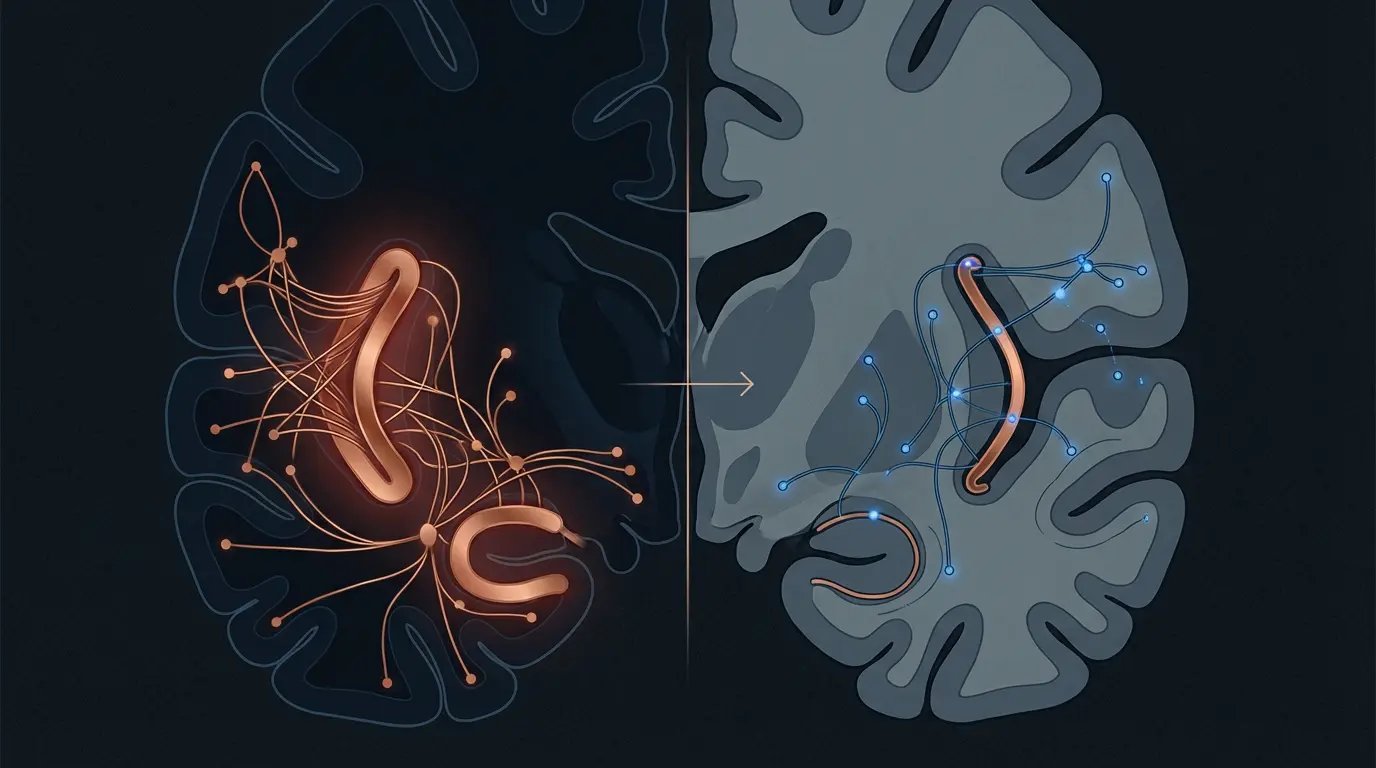
In 2013, Lars Schulze and colleagues reported what they called the first evidence of brain structure differences in NPD. They used voxel-based morphometry, a scan method that measures the volume of brain tissue. They compared 17 people with NPD to 17 healthy people matched for age, gender, handedness and intelligence. The NPD group had less gray matter, the brain’s cell-dense tissue, in the left anterior insula.

The insula is a region folded deep inside the brain. A review of brain imaging studies on empathy for pain links the anterior insula to feeling states, both your own and those you sense in others. In the Schulze study, people with more gray matter in the left anterior insula reported more emotional empathy, and this held across both groups. A scan of the whole brain also found less gray matter in parts of the cingulate cortex and in the dorsolateral and medial prefrontal cortex.
A 2015 pilot study by Igor Nenadić and colleagues found a similar picture. People with NPD had less gray matter in the right prefrontal cortex and in medial prefrontal and anterior cingulate areas. They also had lower fractional anisotropy in white matter of the right frontal lobe. White matter is the wiring that connects brain areas, and fractional anisotropy is one measure of how well organized that wiring is.
These are small studies. They compared groups at one point in time. So they can’t say whether these differences cause narcissistic behavior, result from it or come from something else. A 2021 review of 34 neuroscience studies by Emanuel Jauk and Philipp Kanske described the neuroscience of narcissism as an emerging field.
Other work has looked at narcissistic traits in people without a diagnosis. In an exploratory study by Fan and colleagues, 11 people high in narcissistic traits and 11 people low in them were scanned during an empathy task. The high group showed a smaller drop in activity in the right anterior insula during the task. They also scored higher on alexithymia, which means difficulty naming one’s own feelings.
In my practice, I frequently explain this distinction to clients who have spent years personalizing the empathy gap, believing they were not important enough, not articulate enough, not worth the effort. The insula finding reframes the entire dynamic. It was never about your value.
What Do Studies Show About the Prefrontal Cortex in Narcissism?
The prefrontal cortex, the brain’s planning center behind the forehead, helps with planning, self-control and seeing a situation from another person’s side. Researchers call that last skill mentalizing or theory of mind.
Both NPD imaging studies found less gray matter in parts of the prefrontal cortex. Schulze’s team found it in dorsolateral and medial areas. Nenadić’s team found it in right prefrontal and medial prefrontal areas. The medial prefrontal cortex is involved in processing information about the self. The dorsolateral prefrontal cortex, toward the sides of the forehead, helps with flexible thinking.
These studies measured tissue volume. They did not measure how the prefrontal cortex works during self-focused thinking, impulse control or social decisions in people with NPD. So the step from less gray matter to specific behaviors, such as poor impulse control, has not been shown in the studies cited here.
I frequently see high-functioning individuals who are extraordinarily capable in strategic domains but consistently fail to modulate interpersonal behavior. These are often the people whose partners describe the same bewildering experience: brilliant at work, devastating at home.
How Does the Narcissist Brain React to Threat and Rejection?
The amygdala is an almond-shaped area deep in the brain that helps detect threat. Whether the link between the prefrontal cortex and the amygdala works differently in NPD was not measured in the studies cited here.
Research on threat itself is clearer. In their review, Jauk and Kanske found that grandiose narcissism, the bold and self-assured form, is linked to heightened watchfulness for threats to self-image. It is also linked to stress responses after such threats, which people’s own reports often did not show.
In a brain imaging study by Christopher Cascio and colleagues, people played Cyberball, a computer game designed to leave a player out. People who scored higher on a narcissism questionnaire showed more activity in brain areas tied to social pain while they were left out. These areas included the anterior insula and parts of the anterior cingulate cortex. The authors noted that self-reports alone did not show this.
You may have watched someone say exactly what the right response should be and then do the opposite under pressure. If so, you may wonder what is going on inside. Threats to self-image may hit people high in narcissism harder than they let on. The studies cited here did not test whether that behavior is under their control.
Why Can Narcissists Understand Emotions Without Feeling Them?
This question may be what brought you here. The person in your life can tell you exactly what you are feeling, sometimes before you have fully put it into words yourself. They can describe your emotional state with remarkable accuracy. Then they can act as if that information carries no weight at all. It can look like a choice. Research on two kinds of empathy offers part of an explanation.
Psychologists separate two kinds of empathy. Cognitive empathy is the ability to work out what another person thinks or feels. Emotional empathy, also called affective empathy, is feeling along with them. In a 2011 study by Kathrin Ritter and colleagues, 47 people with NPD took empathy tests, along with 53 healthy people and 27 people with borderline personality disorder. The NPD group showed reduced emotional empathy on one of the tests. Their cognitive empathy was not impaired compared with either other group. This study measured behavior on tests and did not scan the brain.
Brain imaging in healthy people points to some of the areas involved. Claus Lamm and colleagues pooled 32 brain imaging studies of empathy for pain in a meta-analysis, a study that combines earlier studies. A core network showed up in the anterior insula and the medial and anterior cingulate cortex. In the same paper, tasks that showed another person’s state through abstract cues drew more on areas linked to understanding minds. One of these is the temporoparietal junction, where the temporal and parietal lobes meet. The NPD findings overlap this picture at the anterior insula, where Schulze’s team found less gray matter and a link to emotional empathy. Both NPD studies also found less gray matter in parts of the cingulate cortex. No study cited here scanned people with NPD while they took Ritter’s tests.
In my work, I see two kinds of people searching for information about the narcissist brain: those trying to understand someone who hurt them, and those quietly terrified that it might describe themselves. Both deserve clarity, not labels. For the first group, the cognitive-affective split explains the maddening paradox: the knowledge is there, the resonance is not. For the second group, the fact that you are concerned about your own empathy capacity is itself meaningful.
Can the Narcissist Brain Be Rewired Through Neuroplasticity?
Neuroplasticity is the brain’s ability to change with experience. The NPD imaging studies on this page each compared groups at one point in time, so they can’t show whether those differences are fixed. This pattern is examined in the brain science of histrionic personality disorder relationships.
Training studies in healthy adults show that empathy-related brain responses can shift. In one study by Olga Klimecki and colleagues, people watched videos of suffering. Empathy training raised their negative feelings and activity in the anterior insula and anterior midcingulate cortex. Compassion training that followed reversed the rise in negative feelings, raised positive feelings and increased activity in a different set of areas. A related study found that compassion training produced functional plasticity and increased positive affect compared with a memory training group. These studies trained healthy adults. The studies cited here did not test whether such training changes the brain or behavior of people with NPD.
This is where my approach differs from most clinical frameworks. Traditional interventions attempt to change narcissistic behavior through retrospective conversation, discussing events days or weeks after they occurred, when the emotional circuitry that drove the behavior is no longer active. Real-Time Neuroplasticity™ operates on a fundamentally different principle: engaging the brain’s plasticity mechanisms during moments of genuine emotional activation, when the circuits in question are online and accessible to restructuring. It is the reason I work the way I do, embedded in real-time rather than confined to a weekly hour.
Whether you are trying to understand someone else’s narcissistic patterns or examining your own, a consultation is where that work begins: it maps the neural profile and determines whether a targeted approach is the right next step.
What Role Does the Reward System Play in Narcissistic Patterns?
The reward system is a set of brain areas that help you learn what feels good and move you toward it. One key hub is the ventral striatum, deep in the brain.
In a study by David Chester and colleagues, 50 healthy college students had their brain wiring scanned and filled out a measure of grandiose narcissism. Students who scored higher had lower white matter integrity, a measure of how well organized the wiring is, in one pathway. That pathway links the medial prefrontal cortex, which handles thoughts about the self, with the ventral striatum. The authors proposed that a weaker link between self and reward may lead people to seek praise from others to make up for it. They called the finding purely correlational, so it can’t show cause.
If you have been on the receiving end of narcissistic behavior, you may know the constant need for validation from the outside. The studies cited here did not measure dopamine or brain reward responses to praise in people with NPD.
The narcissist brain is one pattern within MindLAB’s broader work on high-conflict personalities. Related reading covers the cortisol cascade in chronic conflict and the salience network and narcissistic empathy gaps.
What the First Conversation Looks Like
You have probably already tried to understand the person who hurt you. You may have read every article, watched every video, and diagnosed the pattern from a distance. And yet the understanding did not produce relief, because knowing what narcissistic personality disorder looks like does not explain why your specific experience felt the way it did, or what to do with the wreckage it left behind.
The first conversation with Dr. Sydney Ceruto starts somewhere different. Rather than cataloging symptoms or revisiting relational history, she maps the neural architecture driving the pattern you are dealing with, whether that pattern belongs to someone in your life or to circuitry you recognize in yourself. It is direct, grounded in the same neuroscience you just read, and designed to answer the question that brought you here: can this actually change, and what would it take?
This is a one-hour consultation with Dr. Ceruto, focused entirely on understanding the pattern and whether MindLAB’s Real-Time Neuroplasticity™ methodology is the right fit.
Is the narcissist brain permanently different from a typical brain?
The studies cited here can’t say. Small imaging studies have found less gray matter, on average, in some empathy-related and prefrontal areas in people with narcissistic personality disorder. These studies compared groups at one point in time. They can’t show whether the differences are permanent, whether they came before the disorder or whether they can change. Training has shifted empathy-related brain responses in healthy adults, and the studies cited here did not test such training in people with the disorder.
Can brain scans diagnose narcissistic personality disorder?
No. Brain imaging cannot diagnose narcissistic personality disorder in one person. The differences found in research are group averages from small studies, not cutoffs that can identify an individual. A diagnosis comes from a clinical assessment by a qualified mental health professional.
Why do narcissists seem to understand emotions but not care about them?
Research separates cognitive empathy, working out what another person feels, from emotional empathy, feeling along with them. In a study of 47 people with narcissistic personality disorder, the group showed reduced emotional empathy on a test, while their cognitive empathy was not impaired. That split fits the experience of someone who can describe your pain accurately and still not seem moved by it. A small imaging study also linked less gray matter in the anterior insula, an area tied to feeling states, to lower emotional empathy.
What is the relationship between narcissism and the brain’s reward system?
One study scanned 50 healthy college students. Those higher in grandiose narcissism had lower white matter integrity in one pathway. It links an area that handles thoughts about the self with a reward area called the ventral striatum. The authors proposed that seeking admiration may make up for this weaker link, and they noted that the finding is correlational. The studies cited here did not measure dopamine or reward responses to praise in people with narcissistic personality disorder.
Can someone with narcissistic brain patterns recognize the problem in themselves?
In the studies cited here, what people high in narcissism said about themselves missed part of the picture. In studies reviewed by Jauk and Kanske, people high in grandiose narcissism showed stress responses to threats to their self-image that their own reports often did not show. In one brain imaging study, people higher in narcissism showed more activity in social pain areas while being left out of a game. Self-reports alone did not reveal this. The studies cited here did not test what helps people recognize narcissistic patterns in themselves.
References
- Cascio, C. N., Konrath, S. H., and Falk, E. B. (2015). Narcissists’ social pain seen only in the brain. Social Cognitive and Affective Neuroscience, 10(3), 335-341. https://doi.org/10.1093/scan/nsu072
- Chester, D. S., Lynam, D. R., Powell, D. K., and DeWall, C. N. (2016). Narcissism is associated with weakened frontostriatal connectivity: A DTI study. Social Cognitive and Affective Neuroscience, 11(7), 1036-1040. https://doi.org/10.1093/scan/nsv069
- Fan, Y., Wonneberger, C., Enzi, B., de Greck, M., Ulrich, C., Tempelmann, C., Bogerts, B., Doering, S., and Northoff, G. (2011). The narcissistic self and its psychological and neural correlates: An exploratory fMRI study. Psychological Medicine, 41(8), 1641-1650. https://doi.org/10.1017/S003329171000228X
- Jauk, E., and Kanske, P. (2021). Can neuroscience help to understand narcissism? A systematic review of an emerging field. Personality Neuroscience, 4, e3. https://doi.org/10.1017/pen.2021.1
- Klimecki, O. M., Leiberg, S., Lamm, C., and Singer, T. (2013). Functional neural plasticity and associated changes in positive affect after compassion training. Cerebral Cortex, 23(7), 1552-1561. https://doi.org/10.1093/cercor/bhs142
- Klimecki, O. M., Leiberg, S., Ricard, M., and Singer, T. (2014). Differential pattern of functional brain plasticity after compassion and empathy training. Social Cognitive and Affective Neuroscience, 9(6), 873-879. https://doi.org/10.1093/scan/nst060
- Lamm, C., Decety, J., and Singer, T. (2011). Meta-analytic evidence for common and distinct neural networks associated with directly experienced pain and empathy for pain. NeuroImage, 54(3), 2492-2502. https://doi.org/10.1016/j.neuroimage.2010.10.014
- Nenadić, I., Güllmar, D., Dietzek, M., Langbein, K., Steinke, J., and Gaser, C. (2015). Brain structure in narcissistic personality disorder: A VBM and DTI pilot study. Psychiatry Research: Neuroimaging, 231(2), 184-186. https://doi.org/10.1016/j.pscychresns.2014.11.001
- Ritter, K., Dziobek, I., Preissler, S., Rüter, A., Vater, A., Fydrich, T., Lammers, C. H., Heekeren, H. R., and Roepke, S. (2011). Lack of empathy in patients with narcissistic personality disorder. Psychiatry Research, 187(1-2), 241-247. https://doi.org/10.1016/j.psychres.2010.09.013
- Schulze, L., Dziobek, I., Vater, A., Heekeren, H. R., Bajbouj, M., Renneberg, B., Heuser, I., and Roepke, S. (2013). Gray matter abnormalities in patients with narcissistic personality disorder. Journal of Psychiatric Research, 47(10), 1363-1369. https://doi.org/10.1016/j.jpsychires.2013.05.017