
Key Takeaways
- Dopamine menus fail: dopamine governs reward pursuit, not enjoyment, leaving you wanting more, enjoying less.
- The reward system’s three layers, Micro-Dose, Sustainable, Deep, must all be populated and balanced.
- Motivation collapses after a win because dopamine signals prediction error, the expected-actual gap, not reward.
- A dopamine reset lowers an overstimulated threshold: tool, not rebuild, the pathway returns unless reinforced.
- Dopamine Architecture Protocol™ is Real-Time Neuroplasticity™ for the reward system, rewiring pathways as they fire.
By Dr. Sydney Ceruto, Neuroscientist & Author
You built the dopamine menu. You scheduled the morning walk, the cold plunge, the ten minutes without your phone, the small reward after the hard task. For a week it worked, and then it went quiet. The problem was never your discipline. It was the architecture underneath the list, the way your reward system is actually built, and a list cannot rewire a structure.
A dopamine menu is a personalized set of activities chosen to regulate the brain’s reward chemistry across a day. The idea went viral on social media, and I can’t take credit for it. What I can explain is the neuroscience of why a menu holds or fades. The framework I use to build one, in three layers of reward engineered to work with your neurochemistry instead of against it, is the Dopamine Architecture Protocol™, and it is the difference between a habit that holds and a habit that fades by Thursday.
What is a dopamine menu, and why does one stop working?
A dopamine menu is a deliberate set of activities you choose in advance to manage your reward chemistry, so that motivation and focus do not depend on willpower in the moment. A menu stops working when it treats dopamine as a supply to be topped up; dopamine is actually a signal that governs pursuit. Stack more rewarding activities onto a depleted system and you can sharpen the wanting while dulling the satisfaction.
The concept entered the mainstream through the productivity and attention communities and went viral on social platforms. Whether a menu holds depends on what its activities do to your reward system, a dynamic circuit that adapts to whatever you feed it. It adapts fastest to the cheapest, fastest hits.
This is the pattern I see most often in the people I work with. They are capable, successful, and disciplined in every domain except this one, and they cannot understand why the same toolkit that organizes their professional life will not organize their attention. The answer is that attention and motivation are not problems of organization. They are problems of architecture. Before a menu can work, the structure beneath it has to be sound, which means understanding three mechanisms a menu has to respect. The first is the most counterintuitive of all.
For the practical side of building and balancing a menu, my work on optimizing dopamine for motivation and focus covers the day-level mechanics. This page is about the structure those mechanics sit inside.
Why you want more and enjoy it less: the dopamine paradox
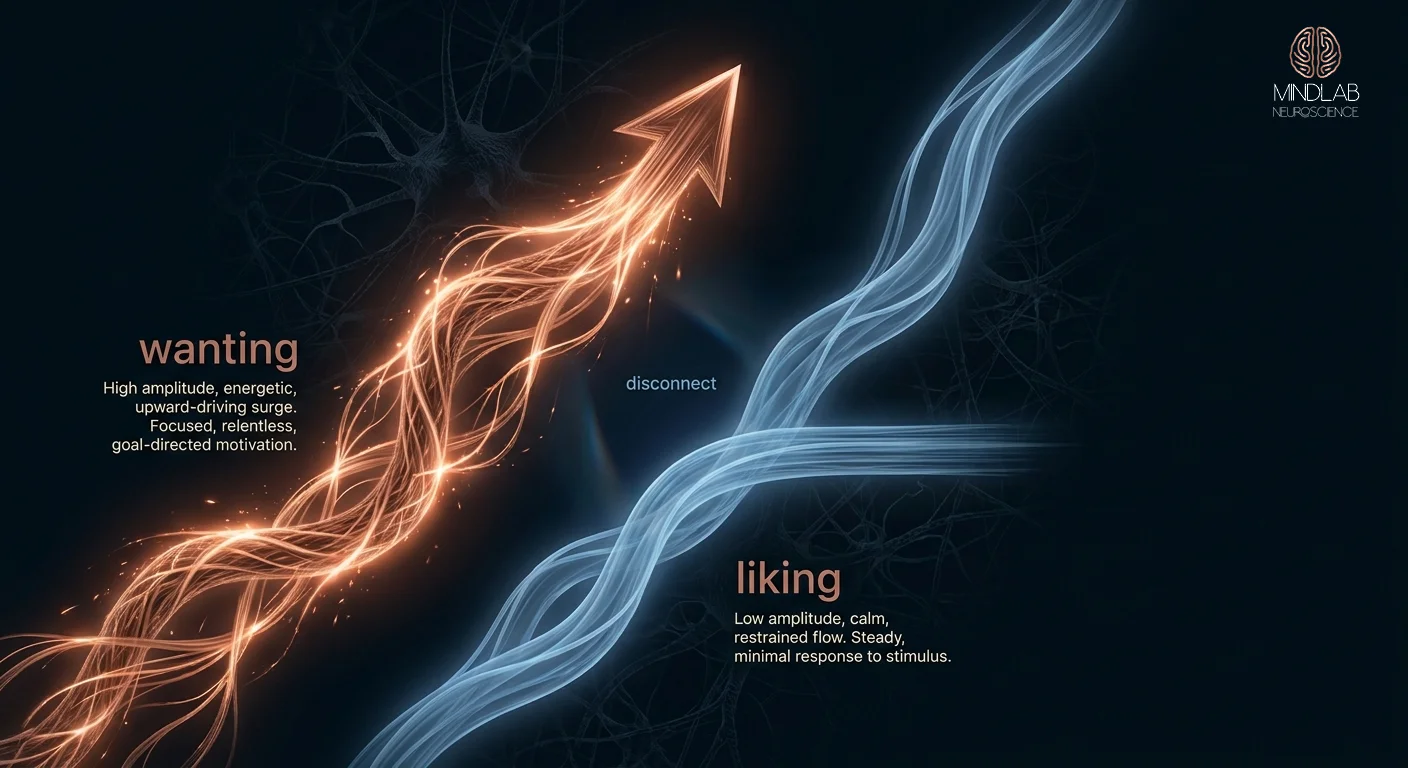
Dopamine drives wanting, not liking. These are two separate systems in the brain, and confusing them is the single most expensive misunderstanding in popular dopamine advice. Dopamine surges when you anticipate a reward and pursue it; a different set of opioid and endocannabinoid circuits produces the actual pleasure of having it. You can crank the first system and barely touch the second, which is exactly what modern life does to high achievers.
The distinction comes from decades of careful work separating the brain’s “wanting” and “liking” systems, most influentially the incentive-sensitization research showing that wanting can be amplified independently of liking (Berridge & Robinson, 2016). The everyday version is familiar to anyone who has refreshed a feed they were not enjoying, finished a bag of something they stopped tasting halfway through, or chased a promotion that felt hollow the week after it arrived. The wanting ran on its own track, disconnected from the liking it was supposed to deliver.
A reward you did not have to earn cannot hold a behavior in place. The architecture is the difference between a feeling and a foundation.
This is what I call the dopamine paradox, and it has a structural consequence. When wanting outruns liking for long enough, the brain recalibrates. The reward system that is constantly aroused by cheap, frequent stimulation raises its own threshold, so the things that used to satisfy now barely register. The research on the dopamine motive system describes precisely this drift: highly stimulating inputs sensitize motivation toward themselves while desensitizing it toward slower, more meaningful rewards (Volkow, Wise & Baler, 2017). Your menu of walks and journaling is not failing because the activities are weak. It is failing because they are competing against a system that has been trained to want faster things. I go deeper into this mechanism in my piece on the dopamine paradox of wanting versus liking.
Why motivation collapses the moment you get what you wanted

Motivation collapses after a win because dopamine encodes prediction error, the difference between the reward you expected and the reward you received, not the reward itself. When an outcome matches your prediction, dopamine neurons barely respond. The signal that felt like drive on the way up goes silent at the summit, and the flatness you feel the morning after a major achievement is not ingratitude. It is your reward system reporting, correctly, that nothing was surprising.
This is one of the most robust findings in reward neuroscience. Dopamine neurons fire in fast bursts to rewards that are better than predicted, stay at baseline for rewards that are exactly as predicted, and dip below baseline for rewards that are worse than predicted, all within a fraction of a second (Schultz, Dayan & Montague, 1997). The circuit is not a pleasure meter. It is a learning signal, built to update expectations and then go quiet once reality and prediction agree.
For the people I work with, this explains a pattern that often arrives disguised as a crisis. They reach a goal they organized years of their lives around, and instead of satisfaction they feel an unsettling emptiness, sometimes severe enough to look like the start of something clinical. It is rarely that. It is the predictable silence of a prediction-error system that has caught up with its own forecast. Understanding the mechanism does not make the feeling pleasant, but it does make it legible, and legible is the first step toward designing around it. I have written about this specific drop in detail in why motivation disappears after a major win.
Why a dopamine detox helps, and then stops helping
A dopamine detox helps because it lowers an overstimulated reward threshold; it stops helping because lowering a threshold is a reset, not a rebuild. Step back from the fastest sources of stimulation for a stretch of time and the system recalibrates downward, so quieter rewards begin to register again. That recalibration is real and useful. What it is not is permanent, because nothing about the reset changes the pathways that drove the overstimulation in the first place.
This is the most common place I watch a well-intentioned plan come apart. Someone does a strict reset, feels the clarity return, declares the problem solved, and then walks straight back into the same environment and the same cues that built the pattern. Within weeks the threshold climbs again. The reset behaved exactly as designed; it bought a window of lowered tolerance. The mistake was treating a temporary state as a structural change. A reset is a tool that opens the window. It is not the work you do once the window is open.
A reset is a tool that opens the window. It is not the work you do once the window is open.
The deeper version of this trap shows up with compulsive scrolling, where the reward loop is engineered to deliver unpredictable, fast hits that are almost perfectly tuned to the prediction-error system described above. I unpack that specific mechanism in how compulsive scrolling hijacks the reward loop, and the structured approach in a neuroscience-based dopamine reset. Both are genuinely useful. Both are doors, not destinations. The destination is an architecture that does not need to be reset because it was built to hold.
How the reward system is actually built: the three-layer architecture
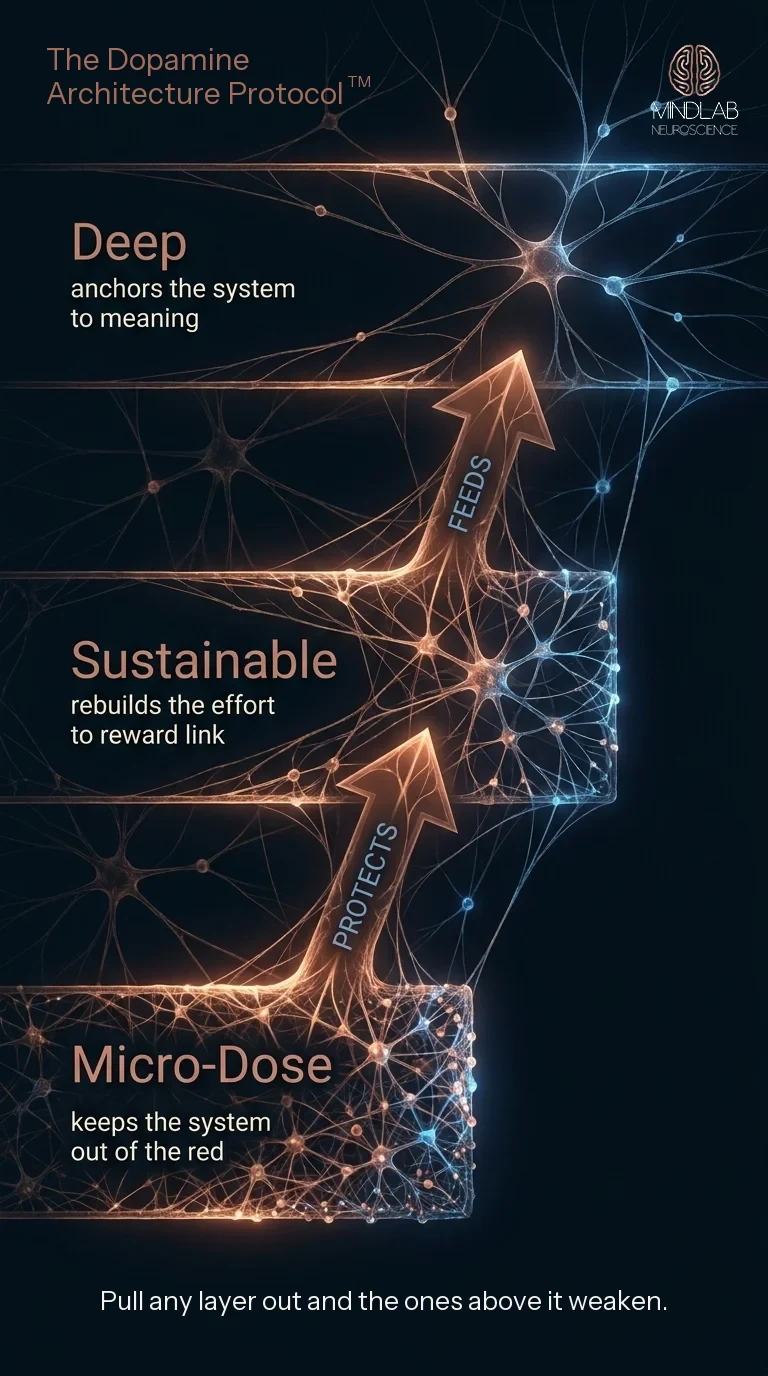
The reward system is built in three layers, and a dopamine menu only holds when all three are populated and kept in balance. Most failed menus over-invest in one layer and starve the other two, which is why they feel busy and produce nothing durable. The three layers are not a ranking of better and worse rewards. They are different functions, and a healthy reward system needs all three working together.
The first layer is the Micro-Dose: brief, two-to-five-minute nervous-system resets that lower arousal without spiking it. A few minutes of breath work, stepping outside, a short walk, a deliberate pause between meetings. These do not feel like much, and that is the point. Their job is to keep the system from running hot, not to deliver a hit. The second layer is the Sustainable layer: ten-to-thirty-minute, effort-linked rewards where the satisfaction is genuinely earned. Focused work that produces something, a real conversation, training a skill, movement that demands attention. This is the layer that rebuilds the link between effort and reward that cheap stimulation erodes. The third layer is the Deep layer: high-meaning, high-return experiences that operate at the level of identity and purpose, the things that make a life feel like yours rather than a series of completed tasks.
What makes the three layers an architecture rather than a list is the relationship between them. The Micro-Dose layer protects the Sustainable layer: a nervous system kept out of the red can actually hold the thirty minutes of focused effort that rebuild the link between effort and reward. The Sustainable layer feeds the Deep layer: the satisfaction of something genuinely earned is what gives meaning a place to attach. Pull any layer out and the ones above it weaken. This is why the person who lives entirely on quick resets feels busy and empty at the same time, and why the person who chases only peak, identity-level experiences eventually burns out. The Deep layer cannot carry a system that has no daily floor beneath it. A reward system, like any architecture, is only as sound as the load path between its levels.
A reward system, like any architecture, is only as sound as the load path between its levels.
The reason a menu usually fails is now clear in structural terms. A menu of feel-good activities is almost always a pile of Micro-Doses with nothing underneath them. It manages arousal for an afternoon and rebuilds nothing, because the Sustainable layer that reconnects effort to reward is empty and the Deep layer that anchors the whole system to meaning was never on the list. Balance is not optional. A reward system weighted entirely toward quick resets stays fragile no matter how many resets you add.
This three-layer architecture is the framework at the center of my book, The Dopamine Code (Simon & Schuster, June 2026), where I lay out the full system for auditing your own reward chemistry and building a menu that populates all three layers in the right proportions. The book is the complete, do-it-yourself version of the architecture described here. What follows on this page is the deeper question the book opens onto, which is why a structure like this so often refuses to hold even after you understand it, and what it actually takes to make a new reward pattern durable.
Real-Time Neuroplasticity™: why a reward pattern has to be rewired in the moment

A reward pattern has to be rewired in the live moment it fires, because that is the only window when the underlying pathway is malleable. The architecture you just read is a map of where the system should end up. It does not, by itself, change anything, for the same reason that knowing the route does not move the car. Insight describes the pathway. It does not rebuild it. Rebuilding happens through the brain’s own machinery of plasticity, and that machinery has a timing.
Every reward pattern lives as a physical pathway, a circuit strengthened by repetition. The brain strengthens and weakens these circuits through long-term potentiation and synaptic pruning, the cellular processes by which a frequently used connection grows stronger and a neglected one is trimmed away (Nicoll, 2017; Lüscher & Malenka, 2012). Those processes are not always available. They open in the brief window between a stimulus and your response, the refractory period, when the circuit is active and deciding which pathway to reinforce. This is the foundation of my proprietary methodology, Real-Time Neuroplasticity™: intervening in that window, while the pathway is still forming, so a new response strengthens and the old one weakens through the brain’s own potentiation and pruning. The principle is precision of timing over volume of effort.
This is why retrospective approaches struggle with reward patterns. Reviewing a craving on Sunday, after a week of giving in to it, works on a pathway that has already closed and reopened a hundred times without you present at the moment of decision. The dopamine circuit, in particular, is a fast-learning system; it updates in the instant a cue fires, well before the reflective mind arrives (Bromberg-Martin, Matsumoto & Hikosaka, 2010). To change it, the intervention has to arrive at the same speed, in the live moment the want appears, which is precisely the moment a list on your refrigerator cannot reach. The architecture tells you what to build. Real-Time Neuroplasticity™ is how the building actually happens, and it sits at the center of the broader neuroscience of dopamine and motivation that runs through everything I do.
The Dopamine Architecture Protocol™: rewiring reward in real time

The Dopamine Architecture Protocol™ is Real-Time Neuroplasticity™ applied to the brain’s reward system. As a framework, it restructures that system into the three layers, Micro-Dose, Sustainable, and Deep, and works with the pathways that keep pulling back toward the cheapest layer in the live moment a reward pattern fires rather than reviewing it afterward. It explains why a dopamine menu works when it does, and it names the difference between knowing what a balanced reward system looks like and actually living inside one.
The distinction from a list or a reset is the whole point. A list tells you what to do. A reset buys you a clean window. The Protocol works on the structure that produced the problem, so a new response can become the automatic default rather than a daily act of willpower. Where a detox lowers the threshold temporarily, the Protocol addresses the pathway itself, so the threshold can hold. Where a menu manages a day, the Protocol speaks to the system that produces every day. This is also why it is not a self-help technique that can be fully captured on a page. The architecture can be described, and the book describes it well. What a page cannot fully carry is the timing at the center of the idea: the principle that a reward pattern is most malleable in the live moment it fires, rather than in the reflection that comes later.
In more than twenty-six years of practice, the pattern I see most reliably is this: the people who finally change their relationship to reward are almost never the ones who found a better list. They are the ones who stopped trying to out-discipline a structure and started rebuilding the structure itself. The first weeks of that work are quieter than people expect. There is no dramatic detox, no white-knuckle abstinence. There is a series of small interventions placed precisely at the moments the old pathway used to fire, and a gradual, almost unnoticeable shift in which response feels automatic. That quietness is the signature of structural change. Patterns that are rewired at the level of architecture do not feel like effort, because the effort has moved upstream, into the design.
Durability is the honest measure of any reward intervention, and it is the one a list and a reset both quietly fail. The question is never whether a change feels good in the first week, because almost anything does. The question is whether it survives the return to ordinary life: the stress, the travel, the bad night of sleep, the cue that always used to win. A pattern rewired at the level of architecture survives those conditions because the architecture, not the willpower, is doing the holding. I am careful about what I promise here, because every nervous system is different, and the timeline and texture of change vary from one person to the next. What does not vary is the principle. You cannot out-list or out-detox a structure. You can only rebuild it.
This is the part that resists a single formula, because which layer has gone quiet varies from one nervous system to the next. The capable professional whose reward system is starved of the Sustainable layer faces something different from the person whose Deep layer collapsed after a major life change, even though both arrive describing the same flatness. The Protocol is a framework, not a fixed program, and the useful first question is always which layer is starved and which pathway keeps pulling hardest. Exploring that for your own reward system is what a strategy call with Dr. Sydney Ceruto is for.
What changes when the architecture holds
When a reward system is rebuilt at the level of structure, the change rarely looks dramatic from the outside. It looks like a person who is no longer at war with their own attention. I have watched the same shift arrive in lives that look nothing alike.
There is the capable professional, early in a career that is going well on paper, who cannot understand why the evenings dissolve into scrolling and the mornings begin already behind. Their Sustainable layer is empty. Every reward in their day is either an obligation or a fast hit, and nothing in between rebuilds the link between effort and genuine satisfaction. When that layer is populated and the live pull toward the phone is rewired in the moment it fires, the scrolling does not require willpower to stop. It simply loses its grip.
There is the person who has reached the top of something they organized years around, a company, a field, a long-held goal, and found the summit strangely silent. Their prediction-error system has caught up with its own forecast, and the Deep layer that anchors a life to meaning beyond the next achievement was never built, because the climb never left room for it. The work there is not motivation. It is architecture.
And there is the person carrying the invisible weight of a complex family system, the household, the relationships, the emotional logistics that hold other people’s lives together, who has been told they are simply overwhelmed and should rest more. They rarely need more rest. They need a reward structure that returns something to them instead of only drawing down, and a Micro-Dose layer that genuinely protects the nervous system through the day rather than becoming one more thing to manage.
Three different lives, one structural truth. The flatness, the compulsion, the depletion are not character flaws. They are architecture, and architecture can be rebuilt.
The flatness, the compulsion, the depletion are not character flaws. They are architecture, and architecture can be rebuilt.
The real work of rebuilding a reward system happens in the quiet weeks between the insights, in the small moments where the old pathway fires and a new response is either reinforced or lost. That steady, unglamorous practice, one usable piece of the neuroscience of reward at a time, is what I write each week in The Intelligence Brief. If you want to keep seeing the architecture underneath your own motivation while you decide what to build, subscribing is the quietest and most useful first step, and it costs you nothing but your attention.
Dr. Sydney Ceruto, PhD, is a Neuroscientist & Author and the founder of MindLAB Neuroscience. She holds a PhD in Behavioral & Cognitive Neuroscience from New York University and is the pioneer of Real-Time Neuroplasticity™, a methodology for rewiring neural pathways in the live moment they form. She is the author of The Dopamine Code (Simon & Schuster, June 2026). For more than twenty-six years she has worked privately with a small number of individuals from offices in New York, Miami, Beverly Hills, and Lisbon.
References
- Berridge, K. C., & Robinson, T. E. (2016). Liking, wanting, and the incentive-sensitization theory of addiction. American Psychologist, 71(8), 670-679. https://pubmed.ncbi.nlm.nih.gov/27977239/
- Volkow, N. D., Wise, R. A., & Baler, R. (2017). The dopamine motive system: implications for drug and food addiction. Nature Reviews Neuroscience, 18(12), 741-752. https://doi.org/10.1038/nrn.2017.130
- Schultz, W., Dayan, P., & Montague, P. R. (1997). A neural substrate of prediction and reward. Science, 275(5306), 1593-1599. https://doi.org/10.1126/science.275.5306.1593
- Nicoll, R. A. (2017). A brief history of long-term potentiation. Neuron, 93(2), 281-290. https://pubmed.ncbi.nlm.nih.gov/28103477/
- Bromberg-Martin, E. S., Matsumoto, M., & Hikosaka, O. (2010). Dopamine in motivational control: rewarding, aversive, and alerting. Neuron, 68(5), 815-834. https://pubmed.ncbi.nlm.nih.gov/21144997/
- Lüscher, C., & Malenka, R. C. (2012). NMDA receptor-dependent long-term potentiation and long-term depression (LTP/LTD). Cold Spring Harbor Perspectives in Biology, 4(6), a005710. https://doi.org/10.1101/cshperspect.a005710
Understanding the architecture is where most reading stops, and it is exactly where the work begins. You cannot out-list or out-detox a structure; you can only rebuild it, and that begins with seeing your own reward system clearly. If the weekly letter is where I work through one piece at a time, The Dopamine Code is the complete field guide to that work: how to tell which layer has gone quiet, why the cheapest one keeps winning, and how to make a new pattern hold once the structure beneath it is sound.
How does the Dopamine Architecture Protocol™ relate to a dopamine menu?
A dopamine menu is a personalized set of activities chosen to manage your reward chemistry through a day. The Dopamine Architecture Protocol™ is the framework I use to build one that holds: three layers of reward (Micro-Dose, Sustainable, Deep), combined with the principle of real-time rewiring, reinforcing a new reward pattern in the live moment it fires rather than reviewing it afterward. A menu built only from quick resets fades within weeks.
Why does my dopamine menu stop working after a week or two?
Most dopamine menus fade because they over-invest in quick resets and starve the two layers that create durability. A menu built almost entirely of two-to-five-minute Micro-Doses manages arousal for an afternoon but never rebuilds the link between effort and reward, and it never anchors to meaning. The reward system also adapts to whatever it is fed most often, so a menu competing against faster, cheaper stimulation gradually loses. Durability comes from balancing all three layers, not from adding more activities.
Is a dopamine detox actually effective?
A dopamine reset is genuinely effective for what it does, which is lower an overstimulated reward threshold so quieter rewards register again. It is not effective as a permanent solution, because lowering a threshold is a temporary state, not a structural change. The pathways that drove the overstimulation are unchanged, so the threshold climbs again once you return to the same cues and environment. A reset is best understood as a window of opportunity, not the work itself.
What does dopamine actually do in the brain?
Dopamine primarily drives the pursuit of reward rather than the enjoyment of it. It encodes prediction error, the gap between the reward you expected and the reward you received, which is why it surges when something is better than predicted and goes quiet when an outcome merely matches your forecast. The actual pleasure of a reward is produced by separate circuits. This is why you can want something intensely and enjoy it very little, and why motivation often collapses the moment a long-pursued goal is reached.
How is this different from advice I can find online or in the book?
The science of the reward system and the three-layer architecture is fully explained in my book, which is the complete framework you can apply yourself. What a book cannot fully capture is the timing at the center of the idea: a reward pattern is most malleable in the live moment it fires, rather than in the hours of reflection afterward. Real-Time Neuroplasticity™ is the name for working in that window. The book teaches the architecture; the framework is about when the change is made.