
Key Takeaways
- Relating is a trained circuit, not a fixed trait: learned predictions fire before deliberate intention.
- Your relational architecture is three systems: attachment circuitry, amygdala social threat-detection, prefrontal-to-amygdala regulation loop.
- The Relational Architecture Protocol maps the wiring, names the pattern, rebuilds it: lens, not checklist.
- Rejection and conflict share physical-threat circuitry: the prefrontal cortex goes offline, old patterns take over.
- Insight rarely rewires; patterns change only in live moments: long-term potentiation, synaptic pruning, Real-Time Neuroplasticity™.
By Dr. Sydney Ceruto, Neuroscientist & Author
You have probably noticed that your relationships rhyme. Different people, different cities, different years, and yet somehow the same argument, the same distance that opens at the same point, the same kind of partner who turns out to be the same kind of wrong. It can feel like a run of bad luck, or a verdict on your character, or proof that the right person simply has not arrived. In more than twenty-six years of practice I have found it is almost never any of those. It is a pattern, and a pattern has a mechanism, and a mechanism can be changed.
That is the first thing to understand, and it reframes everything that follows. The way you get close to people, the way you read closeness and conflict, the move you make when a relationship starts to matter, is not a personality trait carved in stone. It is wiring. Your brain runs a fast, learned prediction about what intimacy means and what it is likely to cost, and it produces the behavior that prediction calls for, a fraction of a second before the part of you that knows better can weigh in. The behavior feels like who you are. Neurologically, it is closer to a reflex. And a reflex, unlike a fate, can be rewired.
The behavior feels like who you are. Neurologically, it is closer to a reflex. And a reflex, unlike a fate, can be rewired.
What is the neuroscience of relationships?
The neuroscience of relationships is the study of the specific brain systems that fire when you get close to another person: how attachment is encoded, how the brain decides whether closeness is safe, and how it regulates itself under the pressure of intimacy and conflict. Put simply, your relationships are produced by circuitry, and that circuitry was built by experience and can be rebuilt the same way.
Most people experience their relational life as a story about other people. He was distant. She was too much. They always leave. The narrative is about the cast, and the plot keeps arriving at the same place with a new cast each time. What that story leaves out is the one constant in every version of it, which is you, or more precisely the wiring you bring into the room before a word is spoken. The brain is a prediction machine before it is anything else. Long before you consciously assess a person, older and faster systems have already read the situation, compared it against everything intimacy has ever meant to you, and begun producing the behavior that history says is safest. You experience the output. You rarely see the computation.
This is not a comfortable idea at first, because it seems to take agency away. In practice it does the opposite. As long as the problem lives in other people, or in some defect of your own worth, there is nothing to work with except better luck and more willpower, and both run out. The moment you can see the pattern as architecture rather than as a sentence about who you are, it becomes something you can actually change. You cannot rewire a character flaw. You can rewire a circuit.
Why do you keep repeating the same relationship pattern?

Because your brain is running a prediction it learned early, and prediction is built on history, so it reaches for the familiar relational outcome even when the familiar one hurts. The pattern is not a preference for pain. It is the brain choosing the known over the unknown, because to a prediction machine, known is a synonym for safe.
Attachment is the earliest and deepest layer of this. In the first relationships of your life, your brain learned a working model of what closeness is: whether it is reliable or unpredictable, whether needing someone is safe or dangerous, whether other people come toward you or pull away when you reach. That model is not a memory you can recite. It is encoded as circuitry, a set of fast expectations that fire automatically when a new relationship starts to carry weight, shaped by the oxytocin-linked bonding systems that carry attachment forward from your earliest relationships into your adult ones (Feldman, 2017). If closeness was once unpredictable, the adult brain may read a calm, available partner as strangely uninteresting and a distant, inconsistent one as electric, because the inconsistent one matches the prediction the circuit is built around. The pull toward the wrong partner is not a failure of taste. It is a match to a template. The fuller anatomy of these templates is worth reading in our guide to understanding your attachment style, which maps how each style behaves under pressure.
The pull toward the wrong partner is rarely a failure of taste. It is a match to a template the brain learned before you could name it.
There is a second reason the pattern repeats, and it is the one people find hardest to forgive in themselves: the brain will often recreate a familiar dynamic in order to try, this time, to win it. If distance once felt like the thing you could never quite close, you may be drawn again and again to people who keep you at exactly that distance, because the circuit is not seeking peace, it is seeking resolution of the original open loop. This is why leaving a relationship can be so much harder than the relationship itself deserves, a pull we examine in why you cannot move on from a relationship. The behavior looks like weakness or bad judgment from the outside. From the inside of the circuit, it is the brain doing exactly what it was trained to do, chasing a completion that the pattern is structurally designed never to deliver.
The Relational Architecture: attachment, threat-detection, and the regulation loop
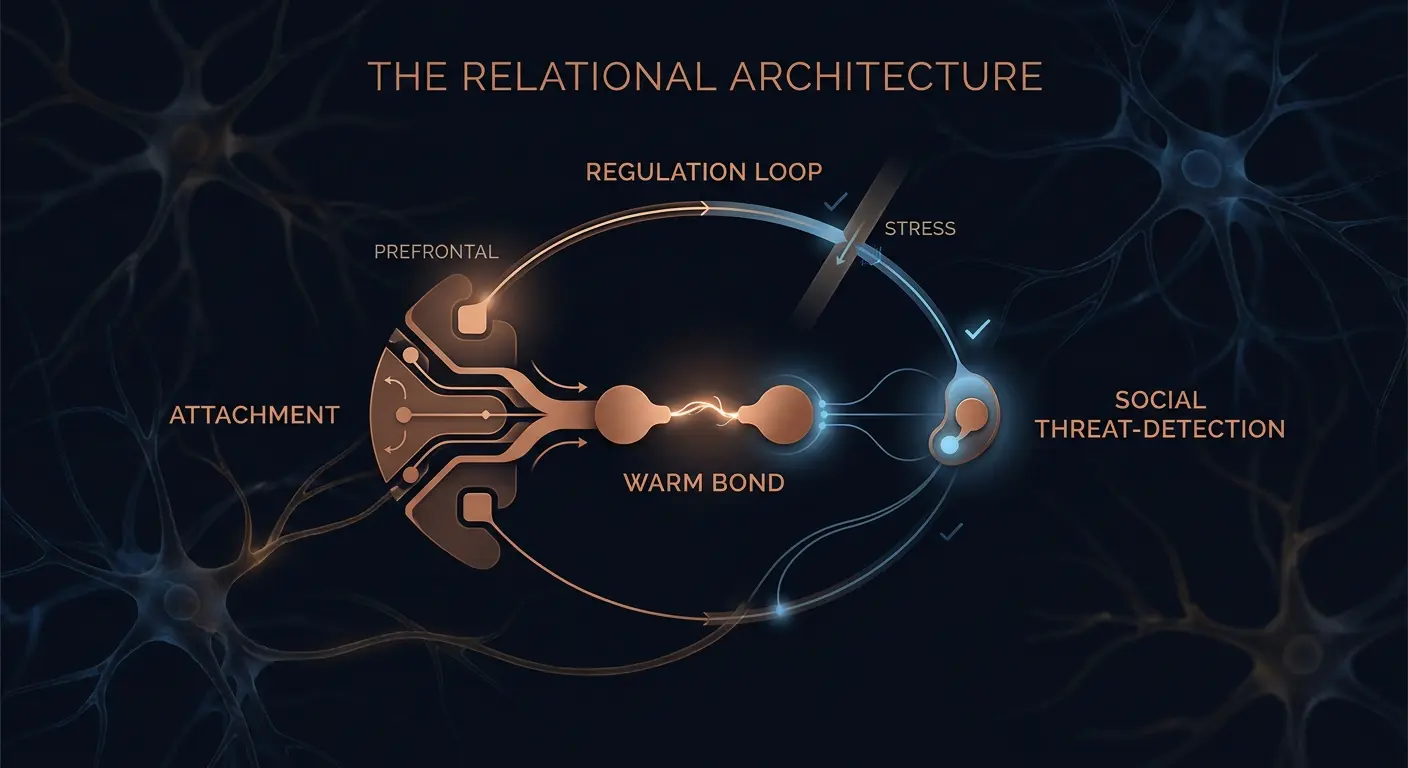
Underneath every repeating relational pattern sits a structure I call your relational architecture: the three brain systems that together decide how you behave when a relationship matters. Attachment circuitry supplies the prediction of what closeness means. Social threat-detection, run largely by the amygdala, decides in milliseconds whether a given moment of closeness or conflict is safe or dangerous. And the regulation loop between the prefrontal cortex and the amygdala determines whether you can stay present and choose, or whether control passes to the faster, older wiring. Map those three, and you can see the mechanism producing the pattern. That map, and the work of rebuilding it, is what I mean by the Relational Architecture Protocol.
It helps to be precise about what that name is and is not. The Relational Architecture Protocol is not a script you run or a set of steps every person performs the same way. It is a lens: a way of looking at your relational life as a system with identifiable parts, so that a pattern which felt like an unchangeable fact about you resolves into a specific, locatable piece of wiring that can be worked on. Naming the architecture is what makes it visible, and visibility is the precondition for change. Everything else in this article is a tour of the three systems the lens brings into focus.
Start with the chemistry of bonding, because it is where most people expect the story to be simple and it is not. We tend to assume that the intensity of early attraction and the depth of a lasting bond are the same signal turned up or down. They are not the same system. The dopamine-driven pursuit that makes early attraction feel electric is built to drive wanting, the motivational chase toward someone, and it runs hottest precisely when a person is uncertain and not yet secured. Bonding, the oxytocin-linked chemistry of actually being held and holding, is a quieter and more durable system that deepens with safety and presence rather than with uncertainty. When the two get confused, a familiar kind of suffering follows: the spark that was really the chemistry of the chase gets mistaken for the measure of the connection, so the relationship that finally feels safe starts to feel flat, and the one that keeps you anxious feels like love. This is the same wanting-versus-having engine I named the Pursuit Paradox™ in the context of self-sabotage, running here in the domain of intimacy. I write about how the pursuit chemistry gets confused with genuine belonging, and how availability gets mistaken for intimacy, in Chapter 6 of my book, The Dopamine Code by Dr. Sydney Ceruto (Simon & Schuster, June 2026), which traces loneliness in a hyperconnected world; you can read more about the book if that thread is the one you recognize. For the neurochemistry of bonding on its own terms, our guide to the neurochemistry of love goes deeper.
The second system is the one that surprises people most, because it does not feel like fear. Your brain treats social connection as a survival matter, which means it treats social threat, rejection, exclusion, the withdrawal of a person who matters, as a genuine danger. This is not a metaphor. When researchers looked at what happens in the brain during social rejection, they found that exclusion activates some of the same circuitry the brain uses to register physical pain (Eisenberger, Lieberman, and Williams, 2003). Rejection does not feel like a stubbed toe, but to the threat-detection system it lives in a neighboring room. This is why a partner going quiet can trigger a response wildly out of proportion to the actual event, and why the behaviors that most damage relationships, the sudden coldness, the preemptive attack, the wall that goes up, are so often defensive maneuvers against a threat the amygdala has flagged before the thinking brain has even caught up.
Why closeness can register as danger, and conflict as threat
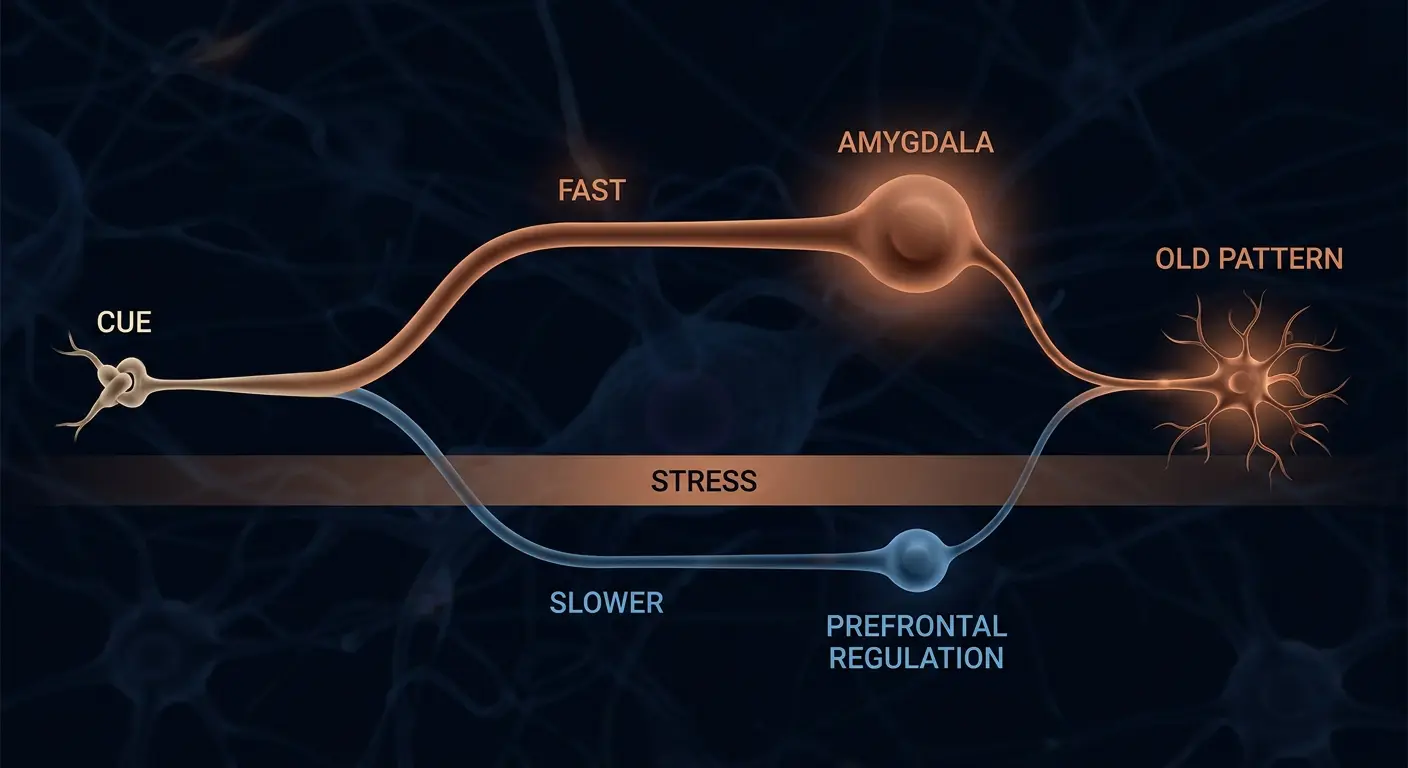
Because to a brain built for survival, the people closest to you hold the most power to hurt you, so the same systems that make connection feel good also make it feel dangerous, and under stress the dangerous reading wins. This is the paradox at the center of most relational pain: the closer a bond, the higher the stakes the threat-detection system assigns to it, and the more easily an ordinary moment tips into a defended one.
The mechanism has a specific and well-documented failure mode. The prefrontal cortex, the region responsible for perspective, impulse control, and staying in a hard conversation without reaching for the worst move, is exquisitely sensitive to stress. Even mild, uncontrollable stress causes a rapid loss of prefrontal function, weakening exactly the circuitry you would need to stay regulated, and shifting control toward older, faster, more reflexive systems (Arnsten, 2009). Read that against the experience of a conflict escalating. The moment the exchange turns threatening, the very part of your brain that could choose a repair goes partly offline, and control passes to the amygdala-driven pattern you have run a thousand times. This is why you can know, with total clarity, that contempt and stonewalling are corrosive, and still watch yourself do them in the heat of the moment. The knowledge lives in the system that just went quiet. The behavior is coming from the one that took over. The specific escalation sequence, and what actually interrupts it, is the subject of the four horsemen of communication, and the neuroscience of de-escalation is in the neuroscience of conflict resolution.
Closeness itself, not just conflict, can trip the same alarm. If early experience taught the circuit that intimacy is where you get hurt, then the moment a relationship deepens past a certain point, the threat-detection system reads the depth as danger and produces the behavior that restores a safer distance. The picked fight, the manufactured doubt, the sudden certainty that this person is wrong for you, arriving precisely when things were going well. These are what I call protest behaviors when they are loud and deactivating behaviors when they are cold, and both are the same architecture defending against the vulnerability of the bond. We trace the loud version in protest behaviors in toxic relationships. It is the interpersonal cousin of the self-sabotage that fires at the threshold of any success, the pattern I examine in the neuroscience of self-sabotage, and when it shows up as a more general dread of closeness, it overlaps with the circuitry of the anxious brain. Different surfaces, one architecture: a threat system doing its job a little too well, on stakes that no longer warrant it.
There is a repair side to this system, and it is one of the most hopeful findings in the whole field. The presence of a safe other person does not just feel comforting; it measurably regulates the threat response. In one well-known study, simply holding a trusted partner’s hand reduced the brain’s neural response to threat, with the effect strongest in the most securely bonded couples (Coan, Schaefer, and Davidson, 2006). Connection is not only where the danger is registered. It is also, when the architecture allows it, the most powerful regulator the brain has. The goal of the work is never to need people less. It is to rebuild the wiring so that closeness can do what it is designed to do, which is to steady you rather than to threaten you.
The goal of the work is never to need people less. It is to rebuild the wiring so that closeness can do what it is designed to do, which is to steady you rather than to threaten you.
Why understanding your pattern does not change it

You can finish this article understanding your relational architecture with real precision. You can name your attachment style, recognize the pursuit chemistry masquerading as love, see the threat-detection system firing when a partner withdraws, and understand exactly why your prefrontal cortex abandons you mid-conflict. And then you can walk into the next relationship, or the next argument, and run the identical pattern you just understood. This is not a failure of comprehension. It is the whole problem, stated precisely.
The reason is structural. A relational pattern is a habit in the exact neurological sense: a response repeated enough times that it has migrated out of deliberate control and into automatic circuitry that fires faster than thought (Graybiel, 2008). Understanding is a product of the slow, deliberate system. The pattern is produced by the fast, automatic one. In the live moment, the fast system moves first, every time, and it moves hardest under exactly the stress that a charged relational moment supplies. So insight arrives a beat too late and in the wrong part of the brain to change what happens. You are not failing to apply what you know. You are discovering that knowing and doing run on different circuitry, and that the circuit you want to change does not answer to the one that understands it.
This is the line where most people get stuck for years, and often where they conclude, wrongly, that they are simply broken in this one domain. They read the books. They can narrate the childhood origin of the pattern in fluent detail. Perhaps they have spent real time in therapy or coaching working on it from the outside, and come away with an accurate and valuable map. And still the pattern fires, because the pattern was not learned through insight and will not be unlearned through insight. It was learned through repetition in live moments, and that is the only place it can be rewired. Most of that rewiring happens not in the dramatic blowups but in the small, ordinary moments where the pattern shows up quietly and is easy to miss.
Can relational patterns actually be rewired? What the neuroscience says
Yes. The same plasticity that built the pattern can rebuild it. Throughout life, the brain changes its physical wiring in response to experience, strengthening the pathways it uses and weakening the ones it stops using, which means a relational circuit that was learned can be unlearned and replaced. This is not motivation talking. It is the mechanism.
The pattern was not learned through insight, and it will not be unlearned through insight. It was learned through repetition in live moments, and that is the only place it can be rebuilt.
At the level of the synapse, repeated coordinated firing between neurons strengthens the connection between them, a process called long-term potentiation, often summarized as cells that fire together wire together, and connections that fall out of use are pruned away (Long-Term Synaptic Potentiation, NCBI Bookshelf). Every relational pattern you run is a circuit that repetition has potentiated. Every time you run it, you reinforce it. That sounds like a life sentence, and it is actually the opening, because the rule that carved the pattern in is the same rule that can carve a new response in over the old one.

The catch is timing, and it is the catch that defeats most attempts to change. A circuit is only malleable in the moment it is firing, in the brief window between the trigger and your response, when the brain is deciding which pathway to strengthen. That window, in a relationship, is not in the calm of the next morning when you can see clearly. It is in the middle of the withdrawal, the flash of jealousy, the urge to go cold, the pull toward the person who is wrong in the familiar way. Conventional approaches work in the calm afterward, reviewing a pattern that only appears when the reviewing part of the brain is offline. The insight is real. It simply arrives in the wrong place to change the wiring.
This is the principle behind Dr. Sydney Ceruto’s Real-Time Neuroplasticity™ methodology, the overarching mechanism this entire body of work rests on. Rather than reviewing relational patterns after they fire, it intervenes in the live moment they are forming, inside that narrow window, while the pathway is still soft, so a new response is strengthened while the old one is allowed to weaken, using the brain’s own long-term potentiation and pruning applied with deliberate timing. The Relational Architecture Protocol is the map of what needs to change; Real-Time Neuroplasticity™ is how the change actually gets made. The principle is precision of timing over volume of effort: one regulated response in the moment the old pattern would have fired does more to rebuild the circuit than a hundred resolutions made in the calm. Seeing the exact shape of your own relational architecture, named precisely and traced to the moment it fires, is the ground any lasting change is built on, and it is the kind of pattern a working strategy conversation is built to map. The rebuilding itself is not a matter of trying harder in your relationships. It is a matter of changing the wiring the relationships run on.
One regulated response in the moment the old pattern would have fired does more to rebuild the circuit than a hundred resolutions made in the calm.
How relational patterns show up
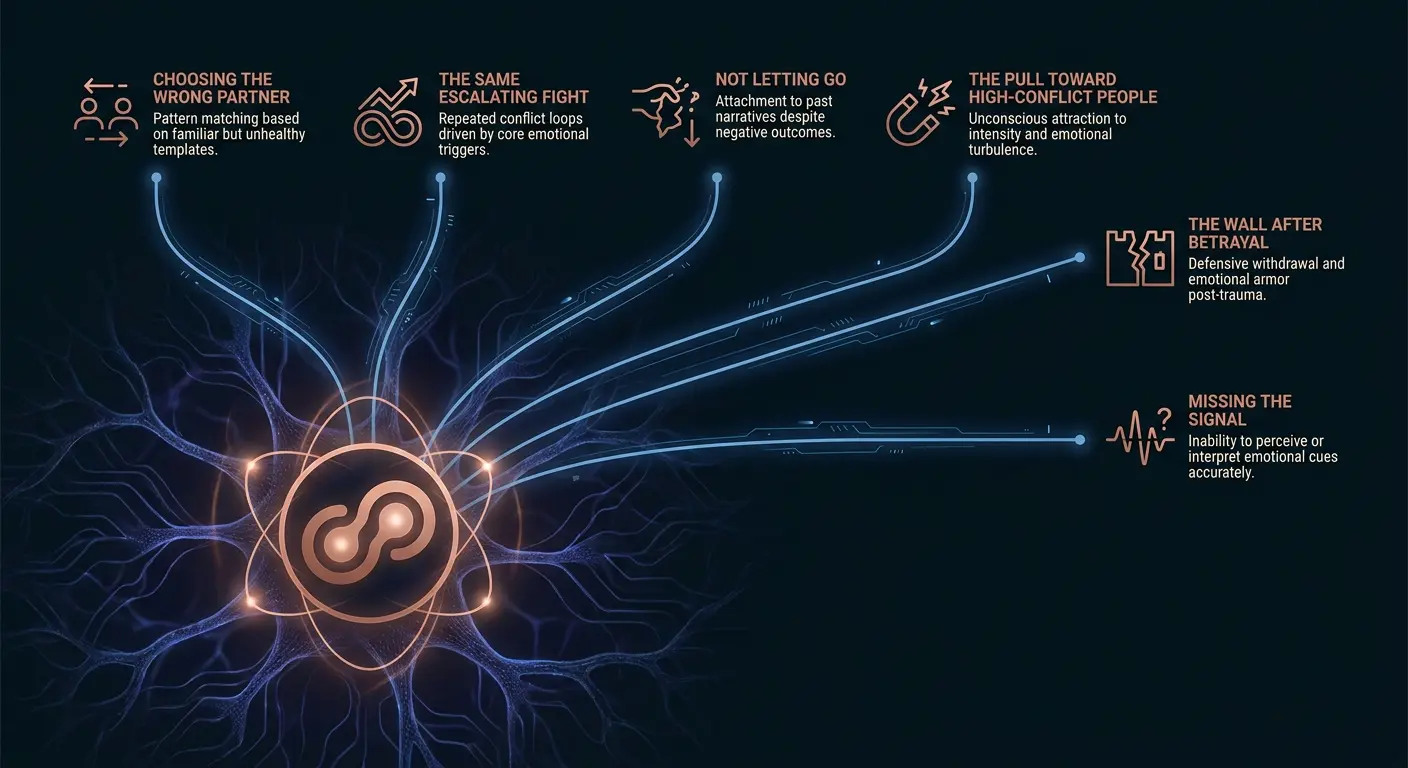
Relational patterns rarely arrive labeled. They wear the ordinary clothes of he, she, and they, and most people spend years working on the cast and the plot without recognizing the shared architecture underneath. The most common forms each have their own deeper anatomy worth reading in full:
- Choosing the same wrong partner. The attachment template pulling you toward the person who matches the prediction rather than the person who is good for you. The anatomy is in understanding your attachment style.
- The same escalating fight. The threat-detection system tipping conflict into contempt and stonewalling as the prefrontal cortex drops offline. The sequence, and what interrupts it, is in the four horsemen of communication.
- Not being able to let go. The circuit chasing the completion of an open loop long after the relationship itself is over. We examine it in why you cannot move on and read the early signals in the five signs a relationship is ending.
- The pull toward high-conflict people. The intensity of the chase mistaken for depth, and the familiar chaos mistaken for home. The fuller picture is in breaking free from a narcissist.
- The wall after betrayal. Trust is a specific neural computation, and once it is broken the brain rebuilds it slowly and on its own terms. The path is in rebuilding after infidelity.
- Missing the signal in others. The capacity to read and regulate emotion, in yourself and across a bond, is itself trainable wiring. The foundation is in emotional intelligence and the neuroscience of effective communication, and the full-connection version is in twelve neuroscience secrets of stronger relationships.
Different surfaces, one architecture. Whichever version you recognize, the place to intervene is the same: not more effort applied to the symptom, and not a better cast of characters, but a change in the wiring that keeps producing the pattern.
References
- Eisenberger NI, Lieberman MD, Williams KD. Does rejection hurt? An fMRI study of social exclusion. Science, 2003. https://pubmed.ncbi.nlm.nih.gov/14551436/
- Coan JA, Schaefer HS, Davidson RJ. Lending a hand: social regulation of the neural response to threat. Psychological Science, 2006. https://pubmed.ncbi.nlm.nih.gov/17201784/
- Feldman R. The neurobiology of human attachments. Trends in Cognitive Sciences, 2017. https://pubmed.ncbi.nlm.nih.gov/28041836/
- Arnsten AFT. Stress signalling pathways that impair prefrontal cortex structure and function. Nature Reviews Neuroscience, 2009. https://www.nature.com/articles/nrn2648
- Graybiel AM. Habits, rituals, and the evaluative brain. Annual Review of Neuroscience, 2008. https://pubmed.ncbi.nlm.nih.gov/18558860/
- Long-Term Synaptic Potentiation. Neuroscience (NCBI Bookshelf), National Center for Biotechnology Information. https://www.ncbi.nlm.nih.gov/books/NBK10878/
The quiet work of catching a relational pattern happens between the dramatic moments, in the ordinary weeks where it shows up small and easy to miss. That steady noticing, one piece of the neuroscience of connection at a time, made usable, is what I write each week in The Intelligence Brief. If you want to understand the architecture underneath your own relationships while you decide what to do about it, subscribing is the quietest and most useful first step, and it costs you nothing but your attention.
What is the neuroscience of relationships?
It is the study of how three brain systems produce your closest relationships: the attachment circuitry that predicts what intimacy will cost, the amygdala that reads a given moment of closeness or conflict as safe or dangerous, and the prefrontal regulation loop that decides whether you stay steady or default to an old pattern. The reason it matters is practical. Because these are trained circuits rather than fixed traits, the way you relate can be rewired rather than only managed.
Why do I keep attracting or choosing the same kind of partner?
Because your brain learned a working model of closeness early in life and encoded it as fast, automatic circuitry, and it reaches for the partner who matches that prediction rather than the one who is good for you. If closeness was once unpredictable, a calm and available person can read as flat while an inconsistent one feels electric, because the inconsistent one matches the template. The pull is not a failure of taste; it is a match to wiring that was built before you could name it, and wiring can be changed.
Why do I lose myself or turn cold in conflict even when I know better?
Because conflict registers as a threat, and even mild uncontrollable stress rapidly weakens the prefrontal cortex, the part of the brain responsible for perspective and impulse control. As it goes partly offline, control passes to older, faster, amygdala-driven circuits that default to the pattern you have run before. The knowledge that contempt or stonewalling is corrosive lives in the system that just went quiet, while the behavior comes from the one that took over. This is a wiring problem under stress, not a character defect.
Is my attachment style permanent?
No. Attachment styles describe deeply learned patterns, not fixed hardware. The brain rewires itself in response to experience throughout life, strengthening used pathways and pruning unused ones. An attachment pattern was carved in through repeated early experience, and a more secure pattern can be carved in the same way. The decisive factor is timing: the circuit is most malleable in the live moments it actually fires, which is why change made in those moments reshapes the wiring while after-the-fact analysis, however accurate, tends not to.
How is this different from relationship advice or the counseling I have already tried?
Most approaches work on the relationship from the outside, after the moment has passed, offering better strategies and a clearer map. That map is genuine and valuable, and it is not the same thing as a rewired circuit. This works on the neural architecture underneath, in the live moment the pattern fires, using the brain’s own mechanisms of long-term potentiation and synaptic pruning through Real-Time Neuroplasticity™. It is structural work on the wiring your relationships run on rather than advice about how to behave, so the aim is not better management of the pattern but a rebuilt pathway, where a response that once felt automatic is replaced by a steadier one that becomes automatic in its place.