Key Takeaways
- Resilience is not a fixed trait or willpower but trainable in the brain’s stress-regulation system.
- Stress responses are healthy; damage comes from one never switching off, registered as allostatic load.
- Resilience rests on three functions: stress inoculation, cognitive reappraisal (circuit-level meaning change), recovery (parasympathetic restoration).
- Recovery, the most neglected function, decides the others: unrecovered stress becomes your baseline, not strength.
- Resilience Operating System™ is Real-Time Neuroplasticity™ for stress regulation, building three functions as stress fires.
By Dr. Sydney Ceruto, Neuroscientist & Author
You keep bouncing back, and it keeps costing more. The crisis at work, the family emergency, the stretch where everything arrived at once: you handled all of it, the way you always do, and from the outside nothing cracked. What no one sees is the slow erosion underneath, the sleep that no longer restores, the patience that runs out earlier each year, the sense that you are managing your life with a reserve that is quietly draining and not refilling. You were told to be more resilient. You have been resilient. That is precisely the problem.
Neural resilience is not toughness, and it is not the will to endure. It is the brain’s trainable capacity to mount a stress response, regulate it, and then fully recover, so that pressure leaves you adapted rather than depleted. Resilience is not a personality trait you were issued at birth and either have or lack. It is built from three functions of the stress-regulation system, and those functions can be developed deliberately. That built capacity has a name, the Resilience Operating System™: resilience as installable neural architecture, assembled from stress inoculation, cognitive reappraisal, and recovery. The difference between a person who is durable and a person who is merely enduring is not character. It is architecture.
What is neural resilience, really?
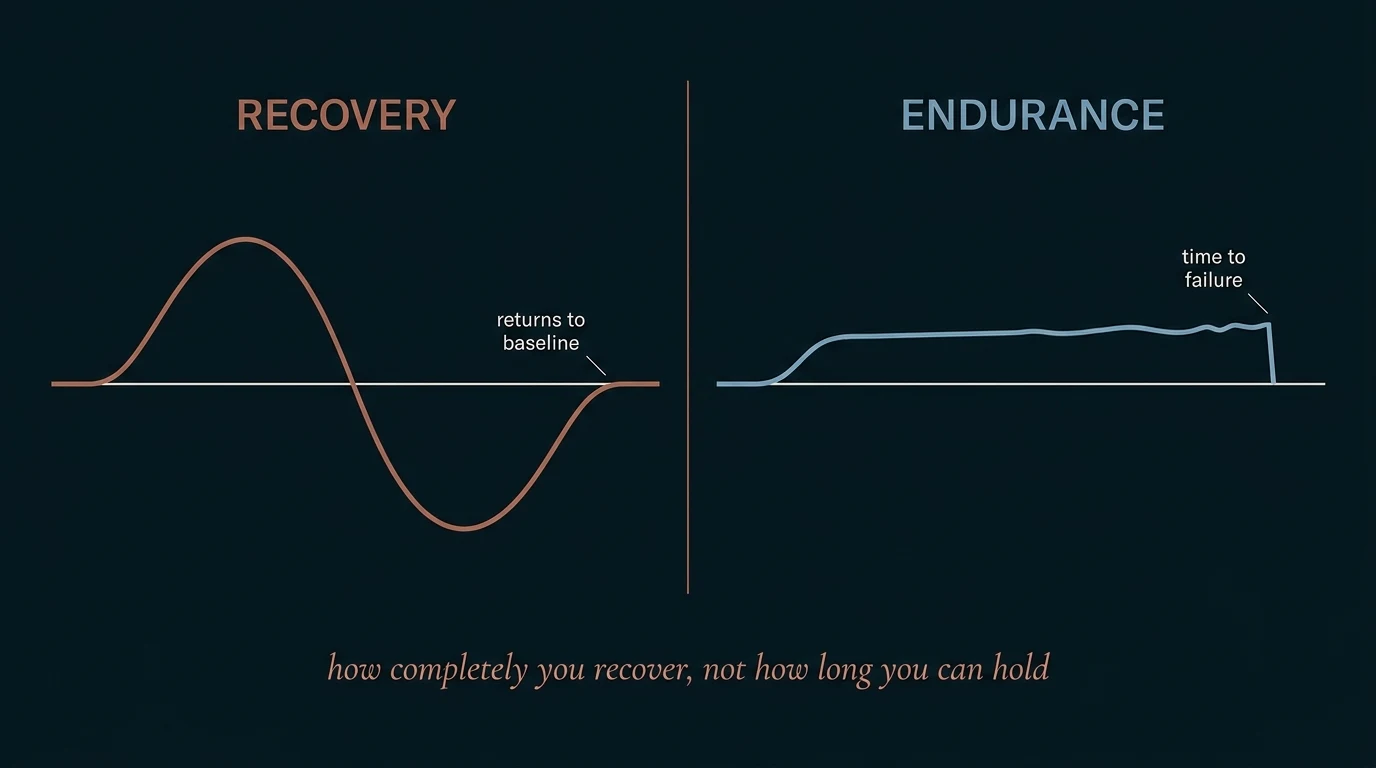
Neural resilience is the brain’s capacity to respond to a stressor, regulate the response while it runs, and return fully to baseline afterward, so that demand produces adaptation instead of accumulating damage. It is a property of circuits, not of character, which is the first thing most people have backwards. Resilience is not how much you can take. It is how completely you recover from what you take.
The popular image is of bouncing back, a ball returning to shape after a hard squeeze, and that image quietly misleads. A ball that bounces back is unchanged by the impact, which is exactly what a resilient nervous system does not do. A resilient system is changed by stress: it adapts, recalibrates, and returns not to the old shape but to a slightly stronger one, the way a muscle returns from a hard session denser than before. The relevant comparison is never endurance, which is how long you can hold a load before you fail. It is recovery, which is how quickly and completely the system resets once the load is removed. Two people can carry identical pressure and have opposite outcomes, and the difference lives almost entirely in what happens after the pressure lifts.
This is also why psychological resilience has proven so resistant to the usual advice. You cannot affirm your way into it, and you cannot will it, because it is not a belief or an attitude. It is the measurable behavior of the systems that govern stress, arousal, and restoration, and like any biological system it responds to training and to neglect, not to instruction. The research on the neurobiology of resilience makes the point plainly: resilience is an active, neurochemically mediated process, a set of adaptations in specific circuits, rather than the simple absence of vulnerability (Russo et al., 2012). It is something the brain does, and therefore something the brain can be taught to do better.
Resilience is not the absence of stress, and it is not the strength to endure it. It is the capacity to recover from it, and recovery is built, not born.
The people who reach me have almost always been running on the endurance model for years, and running out of room. They are capable and high-functioning by every external measure, which is exactly what disguises the problem, because the endurance model works right up until it doesn’t. Understanding what resilience actually is, a recoverable, trainable property of the stress system rather than a finite reserve of grit, is the reframe that makes the rest of this possible. The next question is why the advice they were given made it worse.
Why “just be more resilient” quietly makes it worse

Because the instruction to be more resilient is almost always heard as an instruction to endure more, and endurance without recovery is the precise mechanism by which a resilient system breaks down. Told to toughen up, the capable person does the thing they are good at: they push harder, absorb more, and recover less, which loads the exact system that was already overloaded. The advice does not build resilience. It accelerates its depletion.
This is the most common pattern I see, and it arrives disguised as strength. A person handles a punishing stretch without complaint, takes pride in not needing to recover, and treats the ability to keep functioning under load as evidence of resilience when it is often the opposite. Functioning under sustained load while skipping recovery is not resilience operating. It is resilience being spent. The system keeps producing output because the stress response is doing its job, mobilizing energy and sharpening attention, but each cycle that never fully closes leaves a small residue, and the residue compounds. In more than twenty-six years of practice, the people who arrive most depleted are rarely the ones who took on the least. They are the ones who were best at enduring and therefore never built the half of the system that lets stress leave the body.
The cultural script makes this worse by treating recovery as weakness and endurance as virtue, so the most overloaded people are the ones least willing to do the one thing that would help. They have been rewarded their whole lives for pushing through, and pushing through is the behavior that is now hurting them. The reframe that matters is uncomfortable but freeing: the goal was never to need less recovery. The goal is to recover more completely, more often, so the same pressure stops accumulating. To see why that is not a motivational slogan but a description of biology, you have to look at what stress actually is and what it costs.
The biology of stress, and why recovery is the real variable
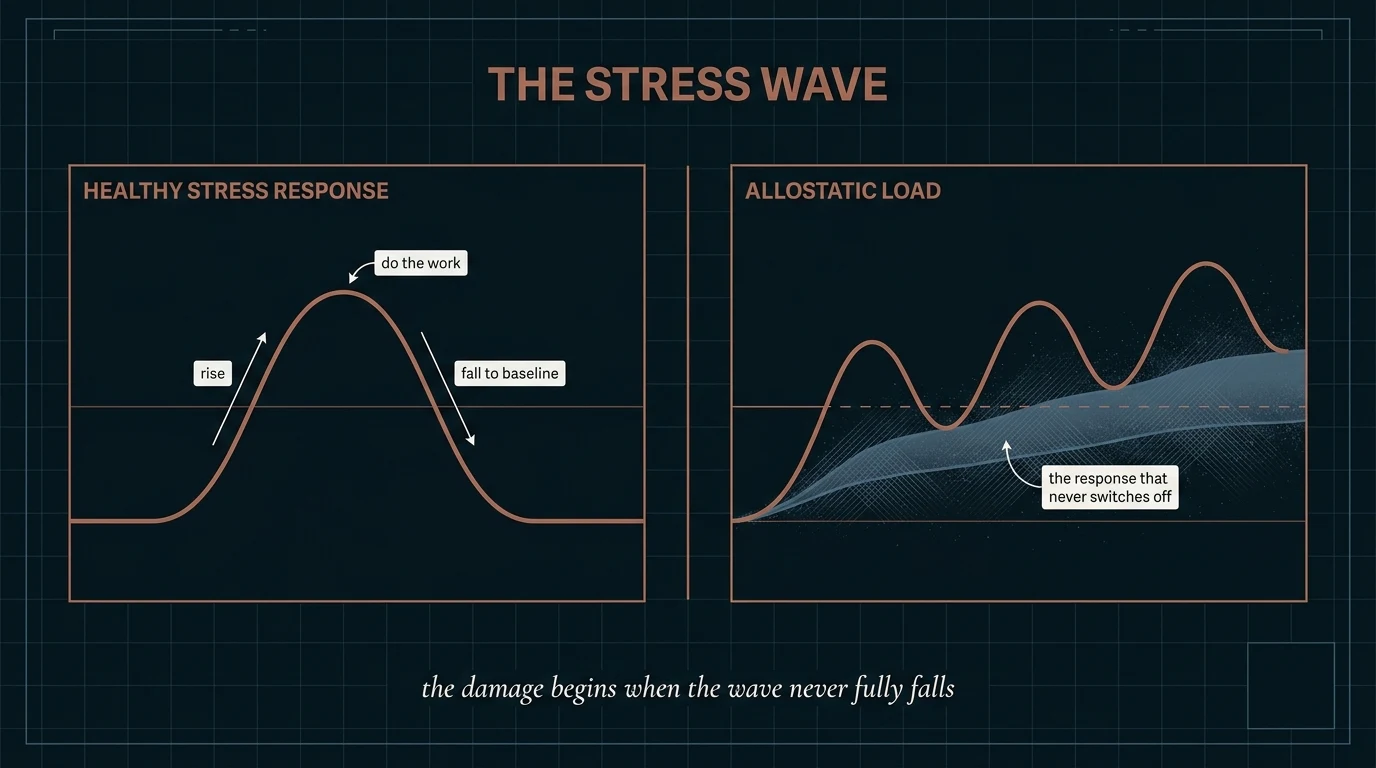
Stress is an adaptive response, not a malfunction. When the brain registers a demand, the hypothalamic-pituitary-adrenal axis releases a cascade of hormones, cortisol chief among them, that mobilizes energy, sharpens focus, and prepares the body to meet a challenge. This response is precise, useful, and self-limiting by design. The system is built to surge and then to stand down, returning hormone levels and arousal to baseline once the demand has passed. A healthy stress response is not a long plateau of tension. It is a wave: it rises, it does its work, and it falls.
The damage begins when the wave never fully falls. When stressors arrive faster than the system can reset, or when the psychological sense of threat persists long after the actual demand is gone, the response stays partially switched on, and the body pays a cumulative cost that the neuroscientist Bruce McEwen named allostatic load: the wear and tear that accumulates when the stress response is activated too often or fails to shut off when it should (McEwen, 1998). Allostatic load is not stress. It is the bill for stress that was never recovered from, and it is paid in the systems most sensitive to chronic stress: sleep architecture, immune function, mood regulation, and the very prefrontal circuits the brain needs to regulate stress in the first place. The overloaded system erodes its own capacity to manage load, which is the quiet, vicious spiral underneath most chronic depletion.
The stress response was never the problem. The failure to complete it is.
This reframes the entire project of resilience. If stress itself were the enemy, the goal would be to avoid it, and a life arranged to avoid all stress would be both impossible and, as it happens, the surest way to weaken the system further, because a stress-response system that is never challenged loses tone the same way an unused muscle does. The real variable is not how much stress you encounter. It is whether each stress response is allowed to complete, to rise and then fully fall, before the next one begins. That single distinction, between a stress that completes and a stress that lingers, is the hinge the entire Resilience Operating System turns on. It is built from three functions, and the first one explains why the right kind of stress is not something to avoid at all.
Stress inoculation: why the right amount of stress builds capacity
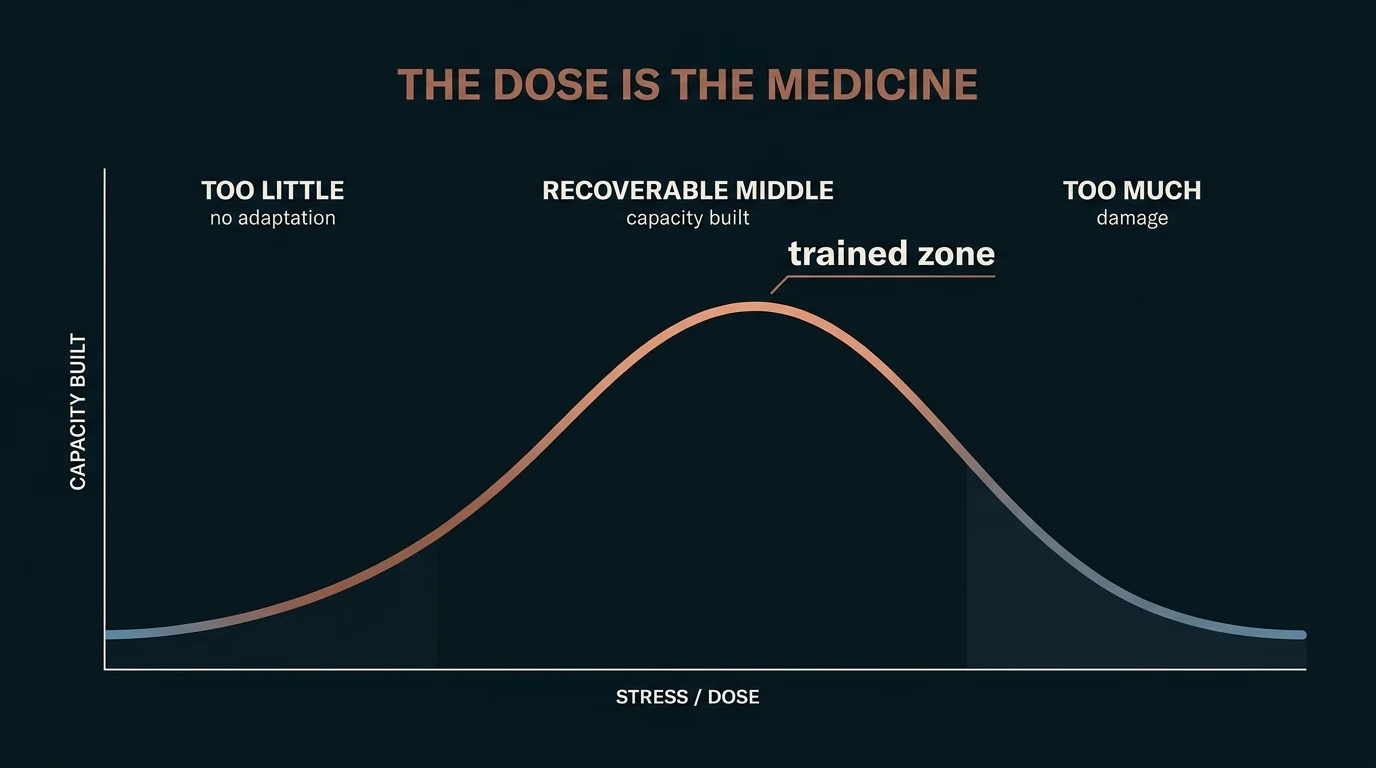
The first function is stress inoculation: controlled, recoverable exposure to manageable stress that trains the system to respond and reset more efficiently, the way a vaccine trains immunity by presenting a survivable version of a threat. Resilience is not built by avoiding stress and it is not built by enduring overwhelming stress. It is built in the specific middle zone where a stressor is challenging enough to demand a response but bounded enough that the system fully recovers afterward. That recovery is not incidental to the training. It is the training.
The principle is hormesis, the biological rule that a controlled, recoverable dose of a stressor produces adaptation and strengthening, while the same stressor in chronic or overwhelming form produces damage. It is the logic of physical exercise applied to the stress-regulation system: a hard workout is a stressor, and it makes you stronger precisely because it is followed by recovery, during which the body rebuilds past its previous capacity. Stress without recovery is injury; stress with recovery is training, and the line between them is recovery itself. The experimental evidence that this applies to the stress-regulation system, not just to muscle, is striking. When researchers exposed young primates to mild, manageable, repeated stress, those animals grew up measurably more resilient: better at regulating arousal, with stronger prefrontal control of the stress response, compared to animals raised with either no stress or unmanageable stress (Lyons and Parker, 2007). The dose was the medicine. Too little did nothing; too much did harm; the recoverable middle built the capacity.
This is why a life engineered for maximum comfort tends to produce fragility, and why the most protected people are often the least resilient. A system that never has to mount and complete a stress response loses the conditioning that keeps it efficient. The practical implication is not to seek out suffering, which only adds uncompleted load, but to stop treating every stressor as a threat to be eliminated and start treating the recoverable ones as the reps that build the system. The challenge that stretches you and is followed by genuine recovery is not the enemy of your resilience. It is how your resilience is manufactured. But exposure alone does not finish the work, because the same external stressor can land as a manageable challenge or as a genuine threat depending entirely on how the brain reads it, which is the second function.
Cognitive reappraisal: how meaning rewrites the stress response

The second function is cognitive reappraisal: deliberately changing the interpretation of a stressor so that the brain mounts a smaller, more appropriate stress response, because the size of the response is set not by the event but by the brain’s appraisal of it. The same deadline, the same difficult conversation, the same uncertainty can trigger a full threat cascade in one nervous system and a focused, manageable arousal in another, and the difference is the meaning assigned in the first fraction of a second. Reappraisal is the trainable skill of revising that meaning before the cascade commits.
This is not positive thinking, and the distinction is everything. Positive thinking tries to feel better about a threat after the threat response has already fired, which is too late and rarely convincing. Reappraisal works upstream, at the level of the appraisal itself, changing the signal the brain sends before the full physiological response is launched. The neuroscience of how this works is well mapped. When a person reappraises an emotional situation, the prefrontal cortex, the brain’s deliberate regulatory center, modulates the activity of the amygdala, the structure that initiates the threat response, turning the alarm down at its source rather than suppressing it after the fact. A large meta-analysis of neuroimaging studies confirms this signature: reappraisal reliably increases prefrontal activity and decreases amygdala activity, a measurable, physical down-regulation of the stress response through reinterpretation (Buhle et al., 2014). The meaning you assign is not a story you tell yourself about the stress. It is an input that changes how much stress the body actually produces.
Reappraisal does not talk you out of the feeling. It changes the signal the brain sends before the feeling arrives.
Of the three functions, reappraisal often carries the most immediate leverage, because so much of the load people carry is self-generated by an appraisal system stuck on threat. The capable professional who reads every setback as a verdict on their worth is running a threat response to events that do not warrant one, and the cost is a stress system that is rarely allowed to stand down. Building emotional resilience is in large part the work of retraining that appraisal, not so that hard things stop being hard, but so that the brain stops issuing a maximum threat response to a manageable challenge. Yet reappraisal, like inoculation, generates a stress response that still has to be completed. Reading a stressor more accurately produces a smaller wave, but a wave nonetheless, and a wave that is never allowed to fall still accumulates. Which returns us, as everything in this system does, to the function that decides all the others.
Recovery: the pillar everyone skips, and the one that decides the rest

The third function is recovery: the active parasympathetic restoration that completes a stress response and returns the system to baseline, and it is the single most neglected and most decisive element of resilience. Inoculation and reappraisal both manage the rising edge of the stress wave, how the response begins and how large it grows. Recovery governs the falling edge, whether the wave actually completes, and a wave that does not complete is the entire mechanism of depletion. You can train your stress exposure and sharpen your reappraisal, and if you never recover, you will still erode.
Recovery is not the absence of activity, which is why rest so often fails to restore. It is the active engagement of the parasympathetic nervous system, the branch of the autonomic system that counterbalances the stress response, slowing the heart, lowering arousal, and signaling to every stressed system that the threat has passed and rebuilding can begin. A reliable physiological window into this capacity is heart rate variability, the moment-to-moment variation in the spacing of heartbeats, which reflects the strength of that parasympathetic, prefrontally regulated brake. Higher variability tracks with better emotional regulation and a more flexible stress response, and a major meta-analysis links it directly to the same prefrontal circuits that govern cognitive control of emotion (Thayer et al., 2012). Recovery, in other words, runs on the same regulatory machinery as reappraisal, which is why a depleted system loses both at once: the person who cannot recover also cannot reappraise, and the spiral tightens.
A stress you never recover from is not making you stronger. It is quietly becoming your baseline.
This is the function the endurance culture actively punishes, treating sleep as negotiable, downtime as laziness, and the inability to switch off as a badge. The cost is precise and biological. Without genuine parasympathetic recovery, cortisol stays elevated, allostatic load accumulates, and the prefrontal circuits that would otherwise regulate the next stressor are themselves degraded by the chronic stress, acting mainly through excessive catecholamine signaling. Rebuilding a recovery system that has been neglected for years is slow, specific work, and it is the part of resilience that benefits most from a structured, day-by-day practice rather than a single insight. The full version of that practice, the daily protocol for restoring a depleted recovery system over the first weeks, is the subject of my book Rewire for Resilience, which works out the recovery side of this architecture in complete, do-it-yourself detail. What the three functions cannot do on their own is assemble themselves into a system, which is the work of the architecture itself.
The Resilience Operating System™: resilience as installable neural architecture
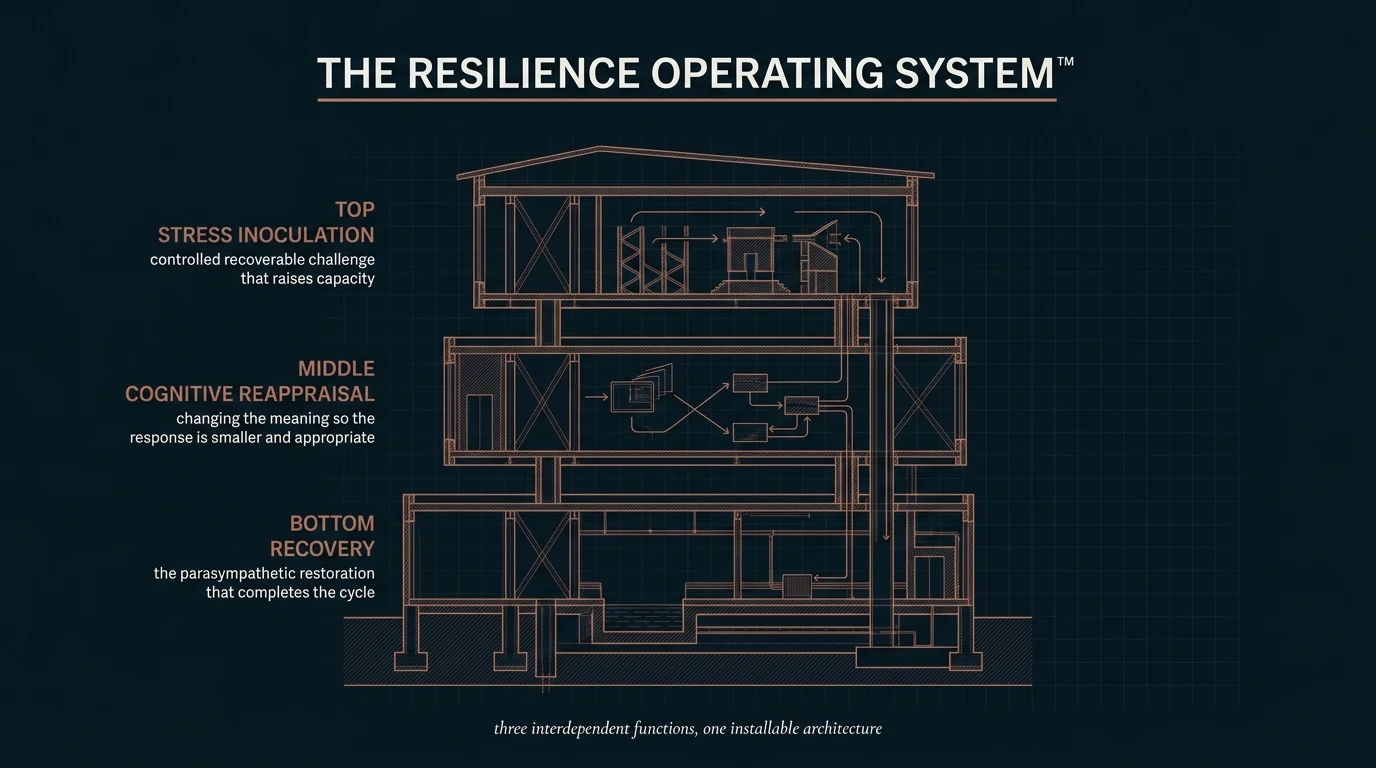
The Resilience Operating System™ is the integration of the three functions, stress inoculation, cognitive reappraisal, and recovery, into a single trainable architecture, built into the stress-regulation system through Real-Time Neuroplasticity™ so that durable response and recovery become the brain’s default rather than a daily act of will. The three functions are not a checklist of separate techniques. They are interdependent layers of one system, and the system holds only when all three are developed together. Inoculation without recovery is injury. Reappraisal without recovery is a smaller wave that still never falls. Recovery without inoculation is a system that rests well and was never conditioned to begin with. The architecture is the relationship between the three, and an architecture is exactly what a list of stress-management tips can never become.
What makes it an operating system rather than a set of practices is that it runs underneath, automatically, governing how every stressor is met before deliberate effort arrives. That is also why it cannot be installed by understanding alone. The functions describe what a resilient system does; building them into the architecture is a matter of Real-Time Neuroplasticity™, the methodology I developed for rewiring a neural pattern in the live moment it fires, when the pathway is briefly malleable. I have written at length elsewhere about how that mechanism works at the level of the synapse, and the point I want to carry here is narrower and more important: resilience, like every other durable pattern, is built in the moment the stress actually arrives, not in the calm planning afterward. The appraisal is retrained in the instant the threat reads as a threat. The recovery is installed in the moments the system would otherwise stay switched on. The inoculation is the recoverable rep itself. This is why a resilience plan written on a calm Sunday so rarely survives a hard Wednesday: the plan addresses a system that is not currently running, and the system only changes while it runs.
Resilience is not a trait you were issued at birth. It is an architecture, and an architecture can be built.
This is the difference between the Resilience Operating System and the advice it is often mistaken for. A resilience plan is a list of intentions. The Operating System is a rebuilt architecture rather than a list, built in the live moments stress fires rather than described in advance, so the durability holds under exactly the conditions, stress, fatigue, the bad week, that make intentions collapse. There is real value in the planning stage, and the work of building your own resilience plan is a genuine first step toward seeing your own system clearly. But a plan describes the destination. The architecture is the road, and the road is built in real time, under load, which is the part that does not reduce to a worksheet. I am careful about what I promise here, because every nervous system is different and the pace of rebuilding varies from one person to the next. What does not vary is the principle. You cannot will a resilient architecture into being, and you cannot plan your way to one on a calm afternoon. You can only build it in the moments it is actually needed, until durability becomes the structure rather than the effort.
What changes when resilience is built as architecture
When resilience is rebuilt at the level of the system rather than applied as willpower, the change rarely looks dramatic from the outside. It looks like a person who is no longer running on a draining reserve. The same pressures arrive, and they land differently, because the system now meets them and then genuinely lets them go. I have watched the same shift arrive in lives that look nothing alike.
There is the senior leader carrying sustained pressure across a whole organization, who has mistaken an unbroken capacity to absorb crisis for strength, and who is quietly eroding underneath it because not one of those crises was ever fully recovered from. The work there is not more endurance, which is the last thing the system needs. It is installing the recovery the role never allowed and retraining an appraisal system that now reads ordinary friction as emergency. When the stress response is allowed to complete, the same load stops accumulating, and the steadiness that used to require constant effort starts to come from the architecture instead.
There is the person carrying a complex family system, the household and the relationships and the emotional logistics that hold other people steady, who has been told they are simply overwhelmed and should rest more. They rarely need more rest in the passive sense. They need active recovery their nervous system can actually use, and they need to stop running a full threat response to the ordinary, recoverable demands of a full life, so that the reserve finally begins to refill instead of only drawing down.
And there is the high performer who has confused being unbreakable with being resilient, who takes pride in needing nothing, and who cannot understand why the things that used to restore them no longer do. Their system has been all inoculation and no recovery for so long that the elevated baseline now feels normal, and the flatness, the shortening fuse, the sleep that no longer repairs are read as personal failings rather than as a recovery system that was never allowed to run. Mapping which of the three functions has gone quiet, in which moments, for one specific nervous system, is the work itself, and it is what a strategy call with Dr. Ceruto is built to begin.
Three different lives, one structural truth. The depletion, the shortening patience, the reserve that will not refill are not character flaws and not a failure of grit. They are an architecture missing one of its three functions, and an architecture can be rebuilt. Most of the work of learning to see your own system clearly happens in the ordinary weeks between the hard ones, which is the terrain I write through each week in The Intelligence Brief, taking one piece of the neuroscience of durable change at a time and making it usable. If you want to keep your own resilience in view while you decide what to do about it, it is a quiet place to begin.
Dr. Sydney Ceruto, PhD, is a Neuroscientist & Author and the founder of MindLAB Neuroscience. She holds a PhD in Behavioral & Cognitive Neuroscience from New York University and is the pioneer of Real-Time Neuroplasticity™, a methodology for rewiring neural pathways in the live moment they form. She is the author of Rewire for Resilience and The Dopamine Code (Simon & Schuster, June 2026). For more than twenty-six years she has worked privately with a small number of individuals from offices in New York, Miami, Beverly Hills, and Lisbon. Read her full bio.
References
- Russo, S. J., Murrough, J. W., Han, M. H., Charney, D. S., & Nestler, E. J. (2012). Neurobiology of resilience. Nature Neuroscience, 15(11), 1475-1484. https://pubmed.ncbi.nlm.nih.gov/23064380/
- McEwen, B. S. (1998). Protective and damaging effects of stress mediators. New England Journal of Medicine, 338(3), 171-179. https://pubmed.ncbi.nlm.nih.gov/9428819/
- Lyons, D. M., & Parker, K. J. (2007). Stress inoculation-induced indications of resilience in monkeys. Journal of Traumatic Stress, 20(4), 423-433. https://pubmed.ncbi.nlm.nih.gov/17721972/
- Buhle, J. T., Silvers, J. A., Wager, T. D., Lopez, R., Onyemekwu, C., Kober, H., Weber, J., & Ochsner, K. N. (2014). Cognitive reappraisal of emotion: a meta-analysis of human neuroimaging studies. Cerebral Cortex, 24(11), 2981-2990. https://pubmed.ncbi.nlm.nih.gov/23765157/
- Thayer, J. F., Åhs, F., Fredrikson, M., Sollers, J. J., & Wager, T. D. (2012). A meta-analysis of heart rate variability and neuroimaging studies: implications for heart rate variability as a marker of stress and health. Neuroscience & Biobehavioral Reviews, 36(2), 747-756. https://pubmed.ncbi.nlm.nih.gov/22178086/
- McEwen, B. S., & Gianaros, P. J. (2011). Stress- and allostasis-induced brain plasticity. Annual Review of Medicine, 62, 431-445. https://pubmed.ncbi.nlm.nih.gov/20707675/
Building resilience is where most reading stops, and it is exactly where the work begins. A resilient nervous system is not the one that takes the most; it is the one that recovers the most completely, and that is built in the ordinary moments stress arrives and is, this time, allowed to complete. That steady practice of seeing your own system in motion, one ordinary week at a time, is what I write through in The Intelligence Brief, where I work through the questions about durable change that do not resolve inside a single essay.
What is neural resilience, and how is it different from just being tough?
Neural resilience is the brain’s trainable capacity to mount a stress response, regulate it, and then fully recover, so that pressure leaves the system adapted rather than depleted. Toughness, in the everyday sense, usually means endurance: how much you can absorb before you fail. Resilience is almost the opposite emphasis. It is about how completely the system resets once the load lifts, not how long it can hold the load. Two people can carry identical stress with opposite outcomes, and the difference lives in recovery, which is a property of circuits that can be trained, not a fixed trait of personality.
Can you actually build resilience, or are some people just born with it?
You can build it. Genetics and early experience set a starting point, but resilience is an active, neurochemically mediated process, a set of adaptations in specific stress-regulation circuits, rather than a fixed inheritance. Those circuits respond to training and to neglect the same way other biological systems do. This is why resilience tracks so poorly with willpower or attitude and so well with whether a person actually trains the underlying functions: controlled, recoverable challenge, accurate reappraisal of stressors, and genuine parasympathetic recovery. The capacity is built, which also means it can be rebuilt after it has been depleted.
Why does pushing through stress leave me more depleted instead of stronger?
Because stress builds capacity only when it is followed by recovery, and pushing through usually skips the recovery. A stress response is designed to rise and then fully fall; when it never completes, the body carries a cumulative cost called allostatic load, the wear that accumulates when the stress response stays switched on too long or too often. Pushing through repeatedly means loading the system without ever letting it reset, which is the precise mechanism of depletion rather than of strength. The same stress, followed by genuine recovery, would build the system; without the recovery, it erodes it.
What is the difference between a resilience plan and the Resilience Operating System™?
A resilience plan is a list of intentions and techniques, usually written in a calm moment, describing what you intend to do under stress. The Resilience Operating System™ is the rebuilt architecture itself: the three functions, stress inoculation, cognitive reappraisal, and recovery, installed into the stress-regulation system so they run automatically when a stressor fires. A plan addresses a system that is not currently running; the architecture is built in the live moments stress actually arrives, using Real-Time Neuroplasticity™, which is why it holds under the exact conditions, fatigue, pressure, the hard week, that make written plans collapse. The plan is the map; the Operating System is the rebuilt road.
Why is recovery treated as the most important of the three functions?
Because recovery governs whether every stress response actually completes, and an incomplete stress response is the underlying mechanism of depletion. Stress inoculation and cognitive reappraisal both shape how a stress response begins and how large it grows, but neither matters if the response never falls back to baseline. Recovery is the active parasympathetic restoration that closes the cycle, and it runs on the same prefrontal regulatory circuits as reappraisal, so a system that cannot recover also loses its ability to reappraise. When recovery is neglected for long enough, the elevated stress state becomes the new baseline and feels normal, which is why so many depleted people no longer recognize how far their system has drifted.