Key Takeaways
- Anxiety is an amygdala threat-detection circuit that learned to fire too easily: practiced, not permanent.
- The amygdala outruns the prefrontal cortex, so reasoning cannot stop an anxious response once started.
- Avoiding or suppressing anxiety confirms the threat, strengthening the circuit’s pattern rather than weakening it.
- Anxious circuits can be retrained only while firing, when briefly malleable: Real-Time Neuroplasticity™.
- PACE Protocol™ restores the brain’s regulatory brake on an overactive amygdala, retraining instead of overriding.
By Dr. Sydney Ceruto, Neuroscientist & Author
The racing thoughts arrive before you have decided to think them. The tight chest, the fast scan for what might go wrong, the 3 a.m. replay of a conversation that actually ended fine. You have tried to reason your way out, and reason does not reach it. That is not a failure of will. It is a threat system doing exactly what it was built to do, faster than thought.
Many high performers arrive here after years of talk therapy; Dr. Ceruto offers a science-based alternative to talk therapy built on real-time neuroplasticity.
You can rewire an anxious brain. Anxiety is not a fixed trait or a flaw of character; it is a pattern of activity in a threat-detection circuit that has learned to fire too easily, and a circuit that is learned can be retrained. The work is not talking yourself out of fear. It is changing the circuit that produces it, in the moment it fires. The framework for that kind of retraining has a name, the PACE Protocol™, an approach aimed at the level of the circuit itself, not the story the circuit tells.
What is anxiety, in the brain?

Anxiety is the activity of a threat-detection system built around the amygdala, the small almond-shaped structure that scans for danger and triggers the body’s alarm. In an anxious brain that system is not broken. It is over-calibrated, flagging ordinary uncertainty as threat and launching a full physiological response to situations that hold no real danger.
That response is not metaphorical. When the amygdala registers a threat, it sets off a cascade through the body within fractions of a second: heart rate climbs, breathing shortens, stress hormones release, attention narrows to the source of the alarm. This is the same machinery that once kept our ancestors alive, and in a genuine emergency it still does. An anxious brain is not a weak one. It is a vigilant one, running an excellent threat-detection system against a world that rarely supplies a real threat. The problem is not that you have it. The problem is the threshold at which yours fires.
What makes anxiety so disorienting for the capable, accomplished people I work with is precisely that the alarm is real while the danger is not. Their judgment is sound everywhere else. They run companies, manage complex families, make high-stakes decisions under pressure, and then find themselves flooded by an alarm they cannot argue with over something they know, intellectually, is fine. The gap between what they know and what they feel is not a sign of weakness. It is a sign that the feeling is being generated below the level where knowing happens. I go deeper into the structure of that system in my work on the neuroscience of anxiety; this page is about why it holds on, and what actually changes it.
Why does a calm, successful life still feel anxious?
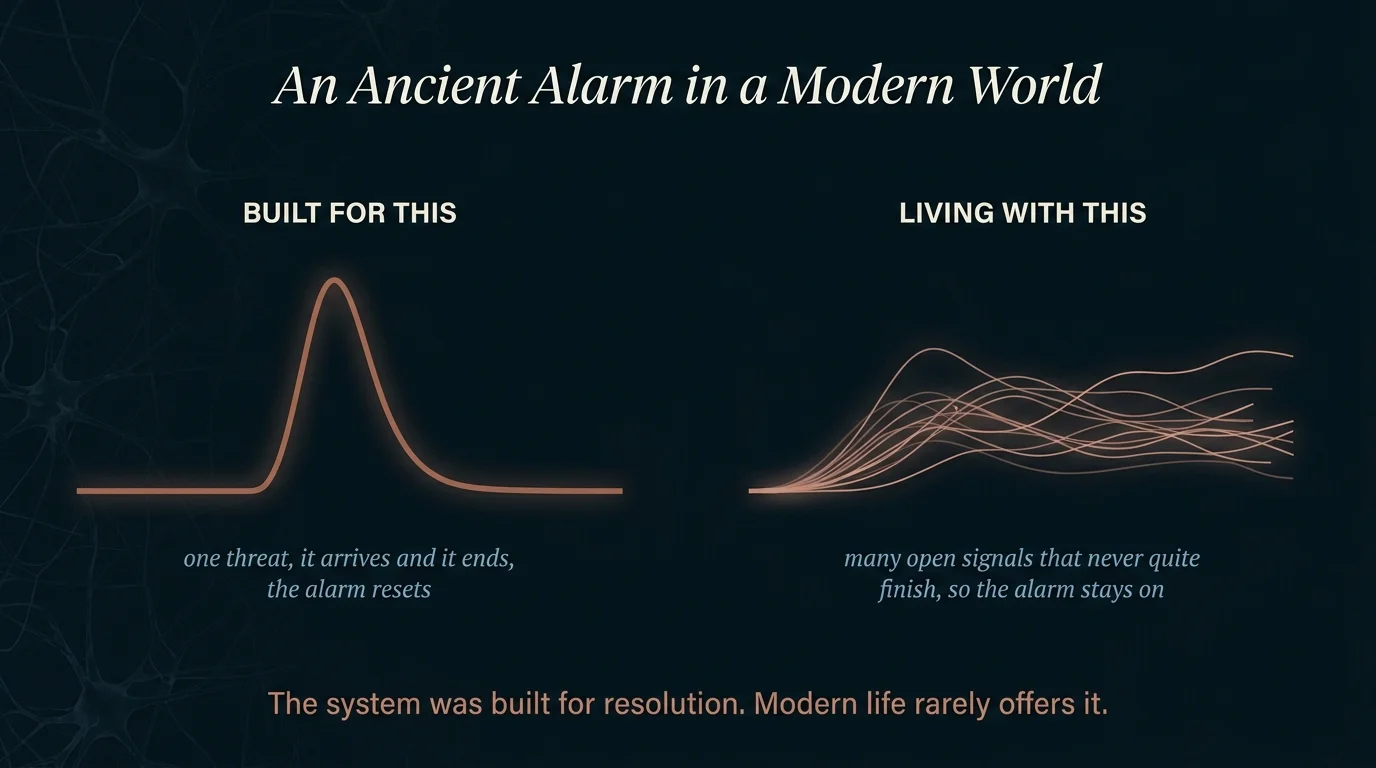
Because the threat system was tuned for physical danger in a world that no longer supplies much of it, and it cannot tell the difference between a predator and an unanswered message. A safe, demanding modern life floods an ancient alarm with abstract, unresolved, never-quite-finished threats, and the circuit stays switched on.
A predator either arrives or it does not, and when it leaves, the alarm resets. The threats of a modern life almost never resolve that cleanly. The email you have not answered, the outcome you cannot control, the relationship that is mostly fine but not certain, the standard you hold yourself to that is never quite met. None of these end. They hum in the background, each one a small, open signal to a system that was designed to switch off once the danger passed. The system was built for resolution, and modern life rarely offers it.
This is why anxiety so often arrives in lives that look, from the outside, like they should be the least anxious of all. The person carrying the invisible weight of a household and the people in it, the founder whose company is succeeding, the professional whose career is ahead of schedule, all describe a version of the same thing: a baseline of alarm that does not match the facts of their life. The facts are not the input. The unresolved signals are, and a sophisticated life generates more of them, not fewer. I unpack this collision between an ancient system and a modern environment in why a modern, safe life keeps the brain on alert.
Why you cannot think your way out of anxiety
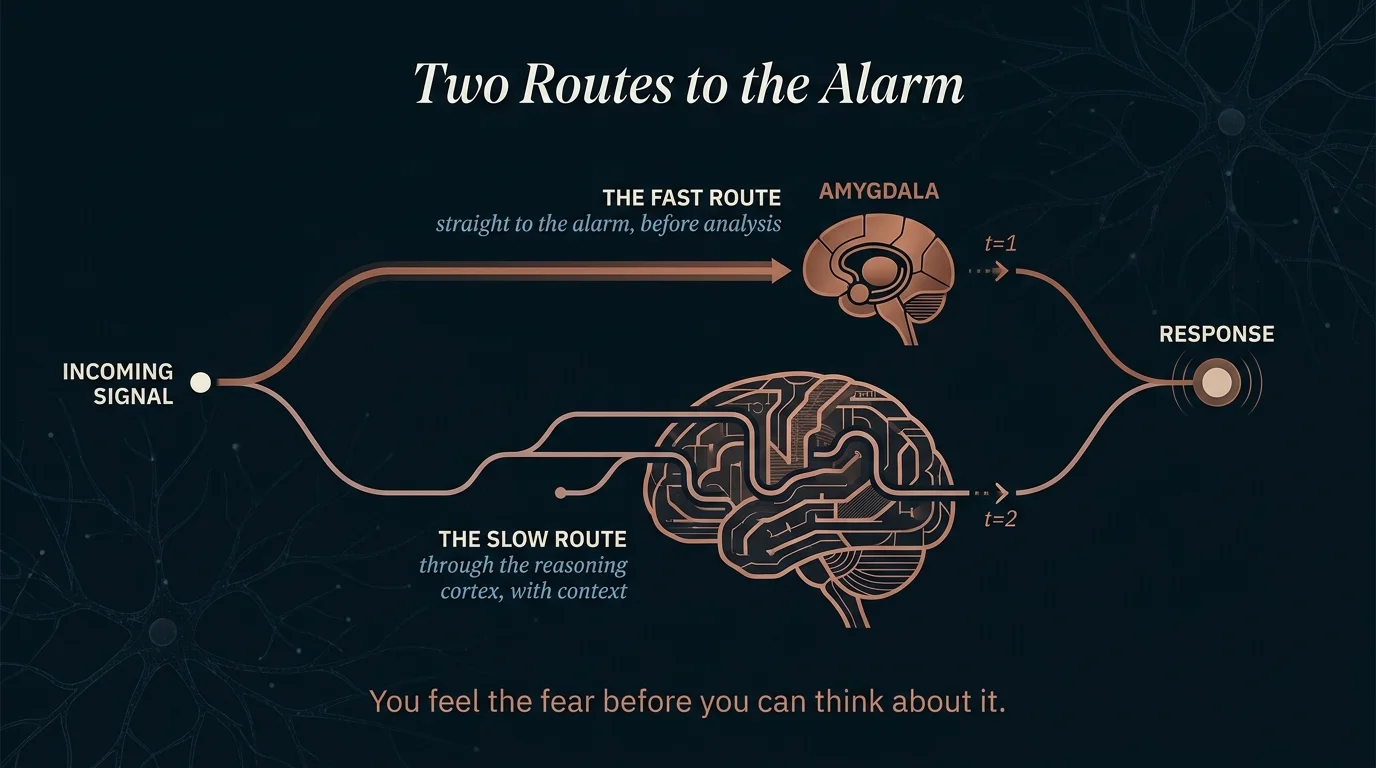
Because the amygdala responds before the prefrontal cortex, the brain’s reasoning center, has finished processing what happened. The threat signal reaches the body in a fraction of a second; deliberate thought arrives later. By the time you are reasoning with your fear, the alarm has already fired, which is why insight and reassurance so rarely switch it off.
The brain processes a potential threat along more than one path. A fast, rough route runs almost directly to the amygdala and triggers the alarm before the information has been fully analyzed, while a slower route travels through the cortex, where it is evaluated with context and judgment (LeDoux, 2000). The fast route exists for a reason: when the shape on the path might be a snake, the brain that reacts first and checks later survives. But it means the alarm is always a step ahead of the analysis. You feel the fear before you can think about it.
The alarm fires before the argument begins. By the time you are reasoning with fear, the body has already decided.
This is also why willpower is the wrong tool. The prefrontal cortex can regulate the amygdala, and a great deal of emotion regulation depends on exactly that top-down influence (Etkin, Büchel & Gross, 2015). But in an anxious brain that regulatory hold is weak relative to the strength of the alarm, so trying harder to think calm thoughts is like pressing a brake that is not connected to the wheel. The answer is not more force on a weak brake. It is rebuilding the connection so the brake actually engages. That distinction is the entire difference between managing anxiety and changing it.
Where an anxious pattern comes from
An anxious pattern is learned. The threat circuit strengthens the associations it rehearses, so a brain that has repeatedly paired ordinary situations with alarm, through temperament, early environment, or a stretch of genuine stress, builds a faster and stronger version of that response over time. The pattern is not a flaw you were born with. It is a pathway you have practiced.
The brain is an association engine. When a situation is paired with a threat signal often enough, the circuit learns to predict the threat from the situation alone, and the prediction itself becomes the alarm. A person who lived through a period of real instability, or who grew up reading a room for danger, or who simply has a temperament that runs sensitive, is not imagining their anxiety. They are running a circuit that learned its lesson well and never received the update that the lesson no longer applies.
This is the part that tends to bring relief when I explain it, because it reframes the whole problem. An anxious pattern that was learned can be unlearned, in the same way and through the same machinery that built it. The circuit is not a verdict on who you are. It is a record of what your brain has rehearsed, and a record can be rewritten.
Why I understand this so deeply
Long before there were degrees or a neuroscience practice, there was a little girl who could not understand why her body felt like it was on fire every day. As a child and teenager, anxiety was not an idea: it was the air I breathed.
I remember running across a highway in panic because I was sure something terrible would happen to my parents if I did not reach them. I remember leaving ballet class in tears, climbing down a fire escape, and breaking my leg because the fear of being abandoned felt worse than any physical pain. As a teenager, I struggled with a persistent knot in my stomach, anxiety before school, and a nervous system that never seemed to calm down.
For years, I was told I would just have to manage it, that this was how my brain was wired. I followed every “standard” path, but nothing created the profound shift I needed. That is what pushed me into the work I do now.
When I discuss rewiring patterns, calming the alarm system, and building a new baseline, I am not speaking solely from theory. I am speaking as someone who has known what it is like to wake up every day with dread and who has also experienced what it feels like when your brain finally learns a new way to live. That is why this work exists, and why I refuse to accept the story that you are “just an anxious person” and always will be.
Why fighting anxiety makes it stronger
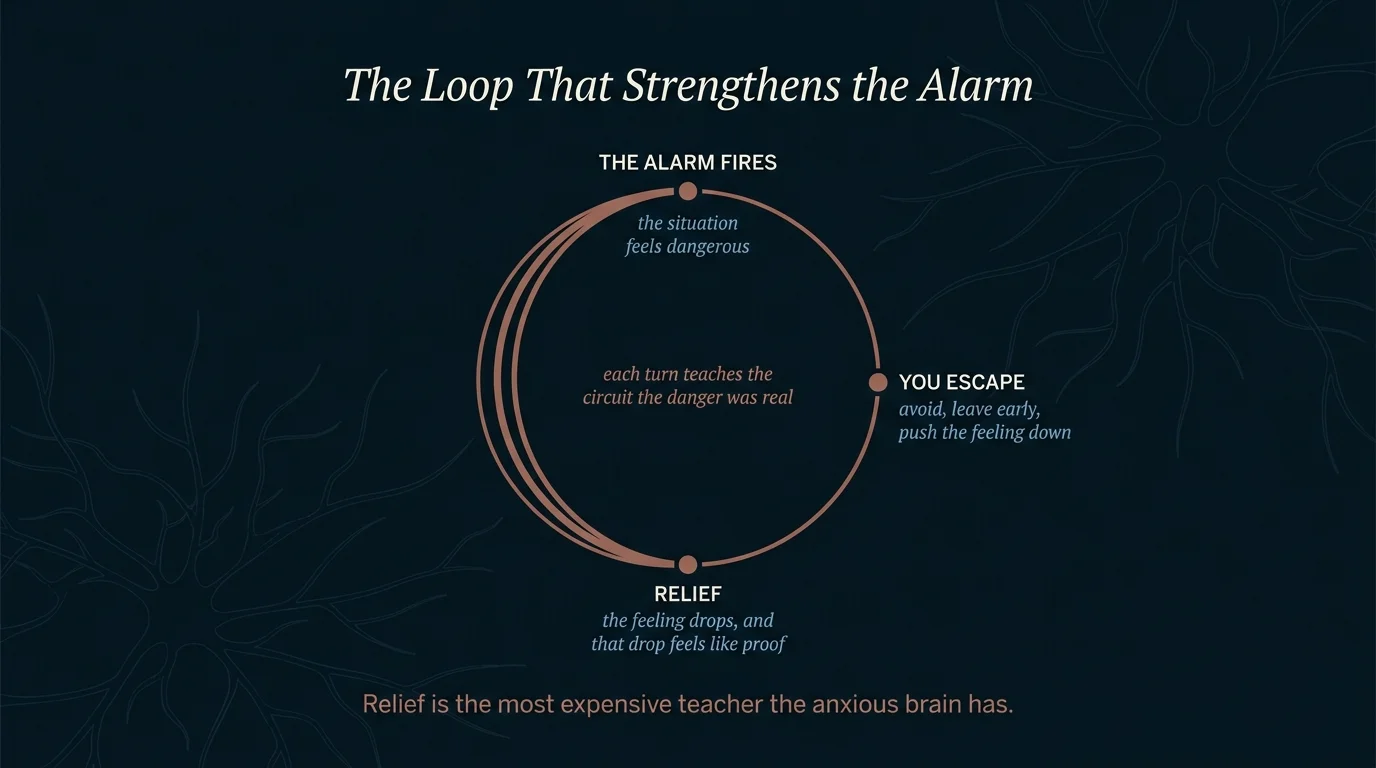
Because avoidance and suppression both teach the circuit that the threat was real. Every time you escape a feared situation and feel the rush of relief, the brain logs the escape as the thing that kept you safe, and the alarm grows more justified. The harder you fight the feeling, the more faithfully you rehearse the pathway that produces it.
Relief is the trap. When you avoid the meeting, leave the party early, or talk yourself out of the trip and feel the anxiety drop, that drop feels like proof that the avoidance worked. To the circuit, it is proof. The brain just learned that the situation was dangerous and that escaping it was the correct response, and it will recommend the same escape, more urgently, next time. Suppression works the same way at a smaller scale: pushing a feeling down hard signals that the feeling was intolerable, which is exactly what an anxious system already believes.
Relief is the most expensive teacher the anxious brain has. Every escape quietly tells the circuit the danger was real.
This is the cruelty of the ordinary advice to just relax or to push through. Both are forms of fighting the alarm, and the alarm reads being fought as confirmation. The way out is not through more force in either direction. It is through a different relationship with the moment the alarm fires, one that lets the circuit learn a new lesson instead of rehearsing the old one. I cover the counterintuitive mechanics of this, and why the instinct to struggle backfires, in the paradox of fighting anxiety.
Real-Time Neuroplasticity™: why an anxious circuit has to be rewired in the moment it fires
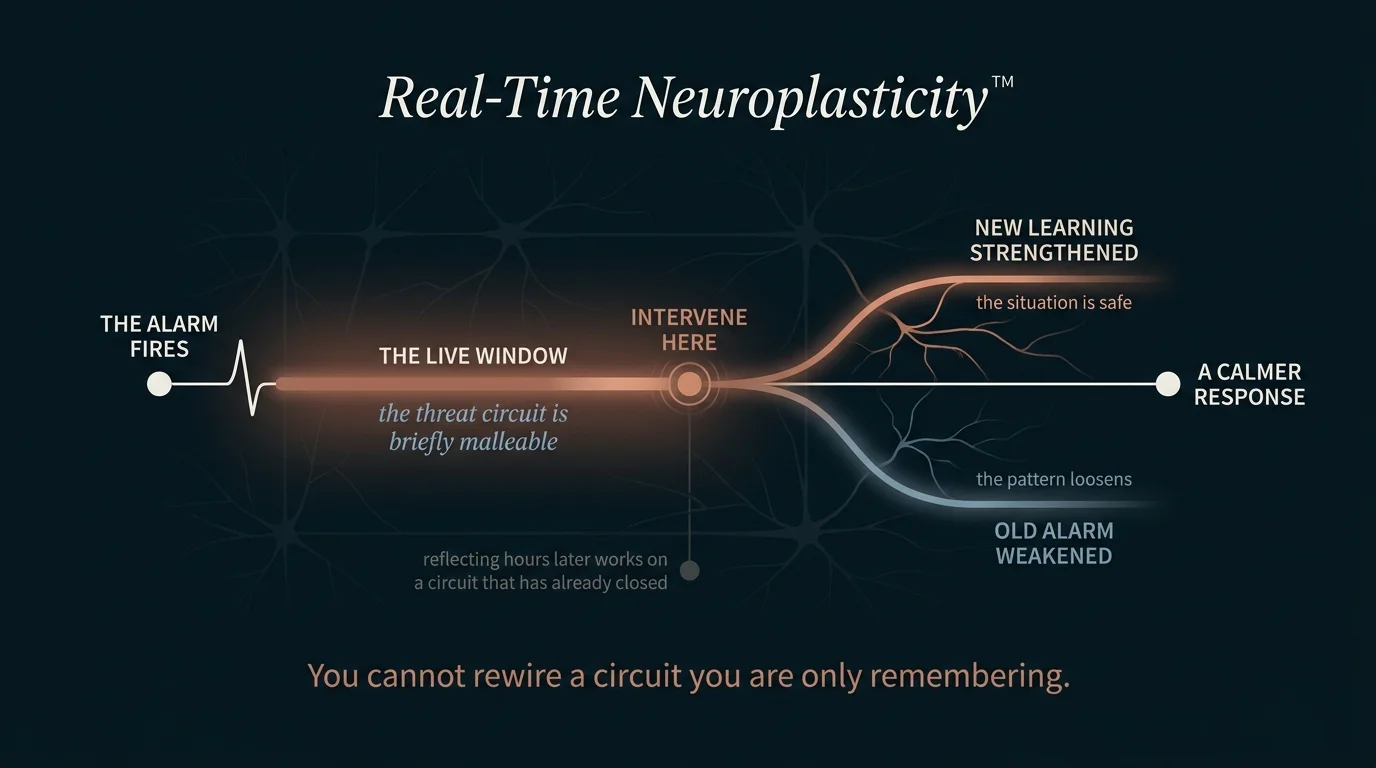
Because the threat circuit is only malleable while it is active. The window in which the brain decides whether to strengthen or loosen a pathway opens in the live moment the alarm fires, not in calm reflection hours later. Reviewing yesterday’s panic works on a circuit that has already closed. The change has to happen at the speed the fear does.
This is the foundation of my methodology, Real-Time Neuroplasticity™: intervening in the live moment a pattern fires, while the pathway is still forming, so a new response strengthens and the old one weakens through the brain’s own machinery. Applied to anxiety, the principle has a precise neuroscience behind it. The fear that an anxious circuit produces is not erased by reasoning; it is overwritten by new learning, a competing memory that the situation is safe, formed through the same process that built the fear in the first place (Milad & Quirk, 2012). And that new learning can only form while the circuit is active, in the moment the alarm is actually firing.
You cannot rewire a circuit you are only remembering. The change has to happen at the speed the fear does.
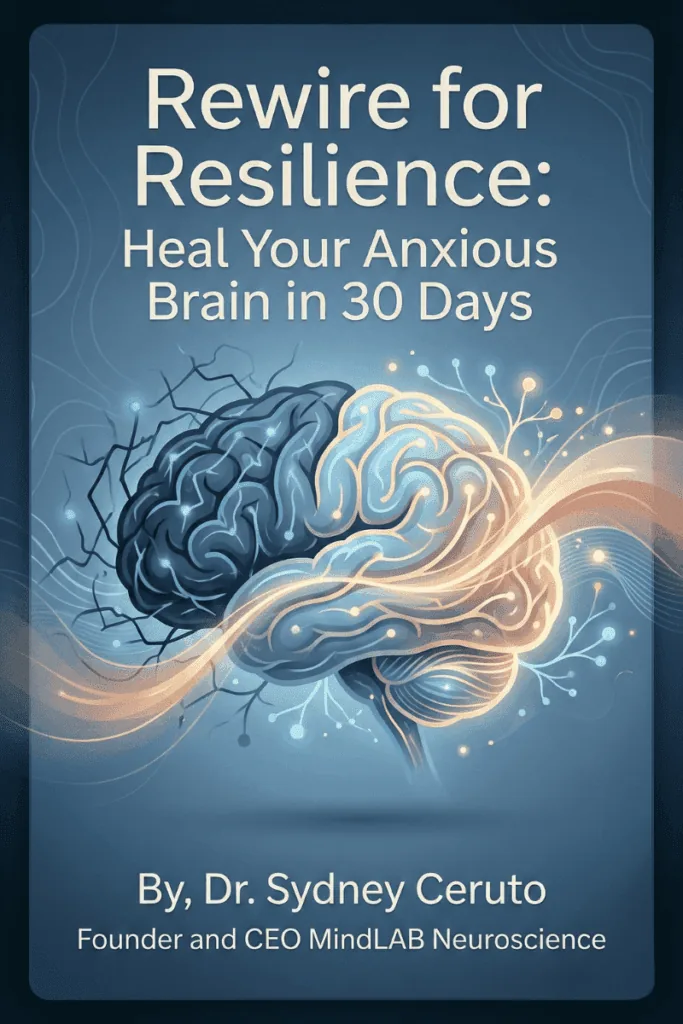
This is why retrospective approaches struggle with anxiety. Talking through last week’s spiral, on a calm afternoon, is working on a pathway that is currently dormant. It can produce insight, and insight matters, but insight is not the same as rewiring. The circuit that needs to change is the one that fires in the elevator, before the presentation, when the phone lights up with a name you did not want to see. To reach it, the intervention has to arrive at the same moment the alarm does. The book version of this work, including what the first 30 days of that practice actually look like, is in Rewire for Resilience: Heal Your Anxious Brain in 30 Days, where I lay out the full framework for retraining the threat circuit in the moments it fires.
The PACE Protocol™: recalibrating an overactive amygdala
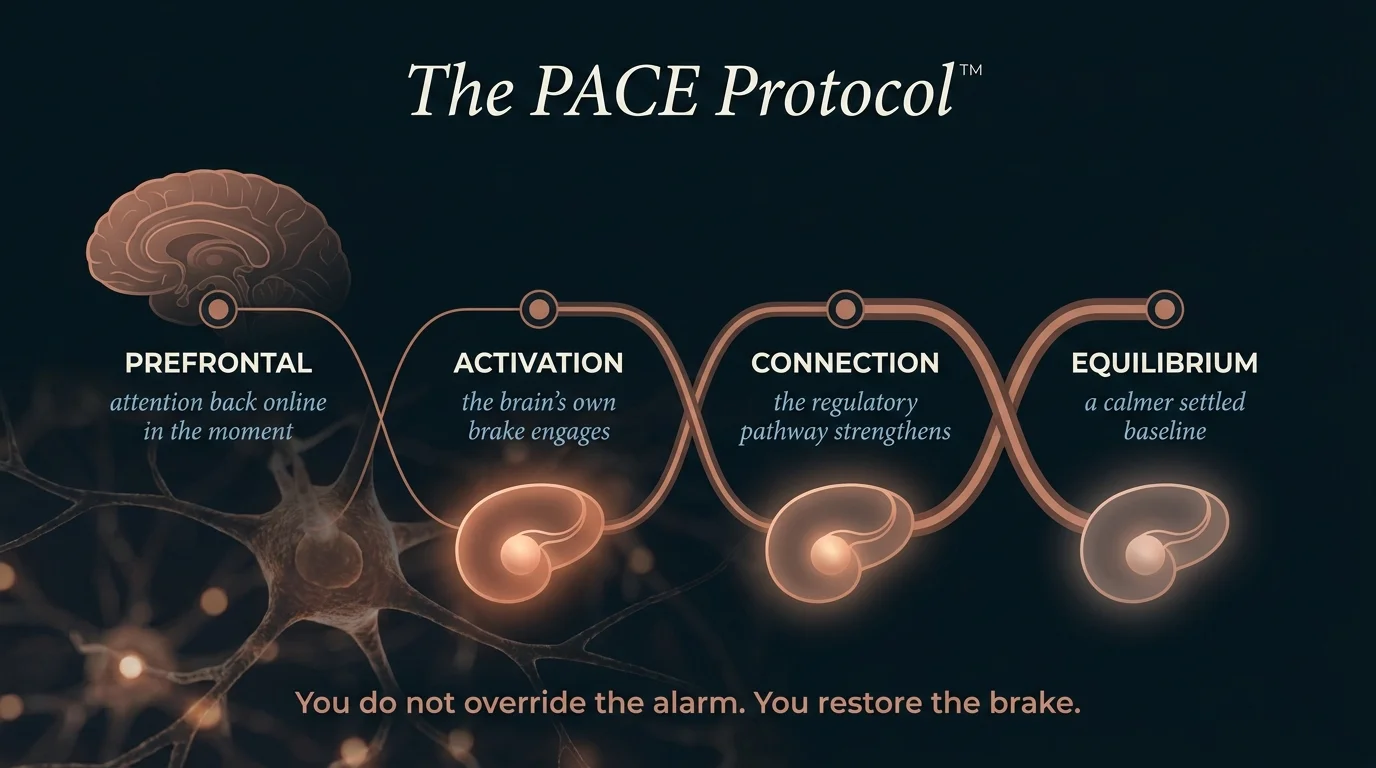
The PACE Protocol™ is Real-Time Neuroplasticity™ applied to the threat system. As a framework, it approaches an overactive amygdala at the circuit level, restoring the prefrontal cortex’s regulatory hold over the alarm instead of trying to override fear with willpower. It is the framework beneath the phrase rewire your anxious brain, and it names the difference between managing an anxious response and changing the circuit that produces it.
What the framework is organized around is the rebuilding of that brake. The broad idea moves through four related aspects, from bringing deliberate prefrontal attention back online in the live moment the alarm fires, to engaging the prefrontal cortex’s own regulatory signal over the amygdala while the circuit is active, to strengthening the connection between the two, to a recalibrated set-point at which the amygdala settles to a calmer baseline and the response that once fired automatically no longer does. It describes how an overactive threat circuit can learn a new baseline, retrained rather than merely overpowered, and it is not a fixed script applied the same way to everyone.
Calm is not the absence of the alarm. It is the return of the brake.
What separates this from the standard advice is the level it works on. Breathing techniques, reframes, and reassurance all operate on the symptom, the felt experience of the alarm, and they can help in the moment. The Protocol operates on the circuit that generates the alarm, so the goal is not a better way to ride out the response but a system that stops producing it at that intensity. Where a calming technique manages a single episode, the Protocol changes the threshold, so fewer episodes fire and the ones that do are quieter. The aim is a recalibrated baseline, not a larger toolkit for emergencies.
I am careful about what I promise here, because every nervous system is different and the timeline and texture of change vary from one person to the next. Which part of the framework matters most varies from one nervous system to the next. The professional whose prefrontal brake is strong everywhere except under social evaluation faces something different from the person whose alarm has been running hot since a genuinely destabilizing year, even when both arrive describing the same racing mind. Exploring where a particular nervous system sits, from the general framework to one specific case, is what a strategy call with Dr. Ceruto is for. What does not vary is the principle. You do not calm an overactive threat system by fighting it harder. You recalibrate it.
What changes when the circuit recalibrates
When a threat system is retrained at the level of the circuit, the change rarely looks dramatic from the outside. It looks like a person who is no longer braced. I have watched the same shift arrive in lives that look nothing alike.
There is the young professional, early in a career that is going well, who has been managing a low hum of dread for so long that it feels like a personality trait rather than a circuit. They have tried the apps and the breathing and the talking, and each helped a little and none of it held, because all of it worked on the feeling and none of it reached the pathway. When the alarm is rewired in the moments it actually fires, the dread does not have to be managed. It stops being generated at the same volume.
Then there is the person who has reached a level of success that was supposed to feel like safety and instead brought a sharper, more constant vigilance, the sense that there is now more to lose and the alarm has noticed. Their threat system is not malfunctioning. It is doing precisely what an over-calibrated system does with higher stakes. The work there is not to think differently about the stakes. It is to restore the regulatory hold that lets them carry the stakes without the alarm running underneath everything.
And there is the person carrying the invisible weight of a complex family system, the household and the relationships and the emotional logistics that hold other people’s lives together, who has been told they are simply stretched thin and should rest more. They rarely need more rest. They need a threat system that is not treating every unresolved thread as a live danger, and a prefrontal brake strong enough to let the unfinished business of a full life stay unfinished without sounding the alarm.
An anxious pattern is not who you are. It is what your brain has practiced, and practice can be changed.
Three different lives, one structural truth. The dread, the vigilance, the bracing are not character flaws. They are a circuit, and a circuit can be recalibrated. The anxious mind is one of the patterns I return to most often in The Intelligence Brief, where I work through the questions that do not resolve inside a single essay.
Dr. Sydney Ceruto, PhD, is a Neuroscientist & Author and the founder of MindLAB Neuroscience. She holds a PhD in Behavioral & Cognitive Neuroscience from New York University and is the pioneer of Real-Time Neuroplasticity™, a methodology for rewiring neural pathways in the live moment they form. She is the author of Rewire for Resilience: Heal Your Anxious Brain in 30 Days (MindLAB Press) and The Dopamine Code (Simon & Schuster, June 2026). For more than twenty-six years she has worked privately with a small number of individuals from offices in New York, Miami, Beverly Hills, and Lisbon.
References
- LeDoux, J. E. (2000). Emotion circuits in the brain. Annual Review of Neuroscience, 23, 155-184. https://pubmed.ncbi.nlm.nih.gov/10845062/
- Etkin, A., Büchel, C., & Gross, J. J. (2015). The neural bases of emotion regulation. Nature Reviews Neuroscience, 16(11), 693-700. https://doi.org/10.1038/nrn4044
- Milad, M. R., & Quirk, G. J. (2012). Fear extinction as a model for translational neuroscience: ten years of progress. Annual Review of Psychology, 63, 129-151. https://pubmed.ncbi.nlm.nih.gov/22129456/
- Phelps, E. A., & LeDoux, J. E. (2005). Contributions of the amygdala to emotion processing: from animal models to human behavior. Neuron, 48(2), 175-187. https://pubmed.ncbi.nlm.nih.gov/16242399/
- Kim, M. J., Loucks, R. A., Palmer, A. L., et al. (2011). The structural and functional connectivity of the amygdala: from normal emotion to pathological anxiety. Behavioural Brain Research, 223(2), 403-410. https://pubmed.ncbi.nlm.nih.gov/21536077/
- Bishop, S. J. (2007). Neurocognitive mechanisms of anxiety: an integrative account. Trends in Cognitive Sciences, 11(7), 307-316. https://doi.org/10.1016/j.tics.2007.05.008
Understanding the mechanism is where most reading stops, and it is exactly where the work begins. You do not calm an overactive threat system by fighting it harder; you recalibrate it, and that begins with seeing your own circuit clearly. Rewire for Resilience is the complete field guide to that work: how the anxious brain learns its pattern, why the ordinary fixes do not hold, and how to retrain the threat circuit, phase by phase, in the moments it fires across the first 30 days.
Rewire for Resilience: Heal Your Anxious Brain in 30 Days
Can you really rewire an anxious brain, or is anxiety permanent?
You can rewire an anxious brain. Anxiety is not a fixed trait; it is a pattern of activity in a threat-detection circuit that has learned to fire too easily, and circuits that are learned can be retrained through the brain’s own plasticity. This does not mean the capacity for fear disappears, which would be neither possible nor desirable. It means the threshold at which the alarm fires can be recalibrated, so the system responds to genuine threat rather than to ordinary uncertainty. The timeline and degree vary from one nervous system to the next.
Why can’t I just think or talk myself out of anxiety?
Because the amygdala, which triggers the alarm, responds faster than the prefrontal cortex, which does your reasoning. The threat signal reaches your body in a fraction of a second, well before deliberate thought arrives, so by the time you are reasoning with the fear the alarm has already fired. Insight and reassurance work on the slow, reflective system; the alarm runs on the fast one. Lasting change comes from rebuilding the regulatory connection between the two, not from applying more willpower to a brake that is not fully engaged.
Why does my anxiety get worse when I try to fight it?
Because avoidance and suppression both teach the circuit that the threat was real. When you escape a feared situation and feel relief, the brain logs the escape as what kept you safe and strengthens the alarm for next time. Suppressing a feeling hard signals that the feeling was intolerable, which an anxious system already believes. Fighting the alarm is read by the circuit as confirmation that the alarm was justified, so the pattern is rehearsed rather than relieved. Changing it requires letting the circuit learn a new lesson in the moment, not overpowering the old one.
What is the PACE Protocol?
The PACE Protocol™ is a framework for restoring the brain’s own regulatory brake on an overactive amygdala at the circuit level. It is Real-Time Neuroplasticity™ applied to the threat system, an approach oriented toward strengthening the prefrontal cortex’s regulatory hold over the alarm rather than overriding fear with willpower. Instead of managing each anxious episode as it arrives, the idea is to change the threshold at which the circuit fires, so the goal is a calmer baseline rather than a larger set of coping techniques.
How is this different from advice I can find online or in the book?
The neuroscience of the anxious brain and the framework are fully explained in my book, which is the complete version you can work through yourself. What a book cannot fully capture is the timing at the center of the idea: a threat pattern is most malleable in the live moment it fires, rather than in later reflection. Real-Time Neuroplasticity™ is the name for working in that window. The book teaches the framework; the framework itself is about when the change is made.