

Key Takeaways
- Conflict addiction is a popular term. It isn’t a recognized diagnosis. The research below helps explain why some people keep getting pulled into fights.
- In a brain-imaging study, people were provoked and then chose how hard to retaliate. Those with more activity in the nucleus accumbens, a brain area tied to reward, retaliated more harshly.
- In mice, blocking dopamine receptors in the nucleus accumbens cut how hard the animals worked for a chance to fight. In another mouse study, about 19% showed addiction-like aggression.
- In lab studies, people who kept replaying an insult were angrier or more aggressive afterward than people who were distracted.
- High-conflict patterns between partners, such as one pressing while the other pulls away, are linked to worse relationship outcomes.
Popular writing uses the term conflict addiction for people who seem drawn to fights. It isn’t a diagnosis. The studies cited here did not test how dopamine traps the brain in addiction cycles on arguments. Research on anger, revenge and reward helps explain the pull. When people feel wronged, striking back can feel good. In one brain-imaging study, people were provoked and then chose how hard to retaliate. The nucleus accumbens is a brain area tied to reward. People who retaliated more harshly had more activity there as they made their choice. Some people keep returning to arguments even when the fights cost them. In 26 years of practice at MindLAB Neuroscience, I observe this pattern consistently: individuals who seek conflict don’t experience relief after resolution. They experience boredom.
Can you actually become addicted to conflict?
Not in the medical sense. The DSM-5 is the manual US clinicians use to diagnose mental disorders. When it came out in 2013, gambling disorder was the only behavior it listed among the addictive disorders. Psychiatrist Marc Potenza noted that internet gaming disorder was added as a condition that needs more study. Conflict isn’t on either list. Some researchers also warn against calling every hard-to-stop habit an addiction. Kardefelt-Winther and colleagues proposed a stricter definition so that common behaviors aren’t labeled as disorders.
Some parts of the pattern do look like addiction in animals. Golden and colleagues trained mice to press a lever for a chance to attack another mouse. The study didn’t include people. The mice worked hard for it and went back to seeking it after a break. About 19% of them showed what the researchers called addiction-like aggression. They were less likely to pick another reward over fighting. They kept working as the cost went up and kept going when they were punished for it. They were also more likely to relapse.
Wolfram Schultz’s research on dopamine reward prediction-error signaling describes how the cells that make dopamine respond to a prediction error, the gap between the reward you expected and the reward you got. The main part of that response tracks how much a reward is worth to the individual. The studies cited here didn’t record this signal during a human argument. For the wider picture of how the brain shapes relationships, see relationship intelligence through neuroscience.
The studies cited here also didn’t ask people when the pull to argue begins. A client I work with described it precisely: the surge begins when the other person says something they can dismantle. Not after they’ve won. Before.
That shifts the question. “Why can’t they stop arguing?” becomes “What does the fight give them?” In every case I’ve mapped in practice, the conflict-seeking individual has learned, through years of reinforcement, to treat interpersonal victory as the highest-value reward available.
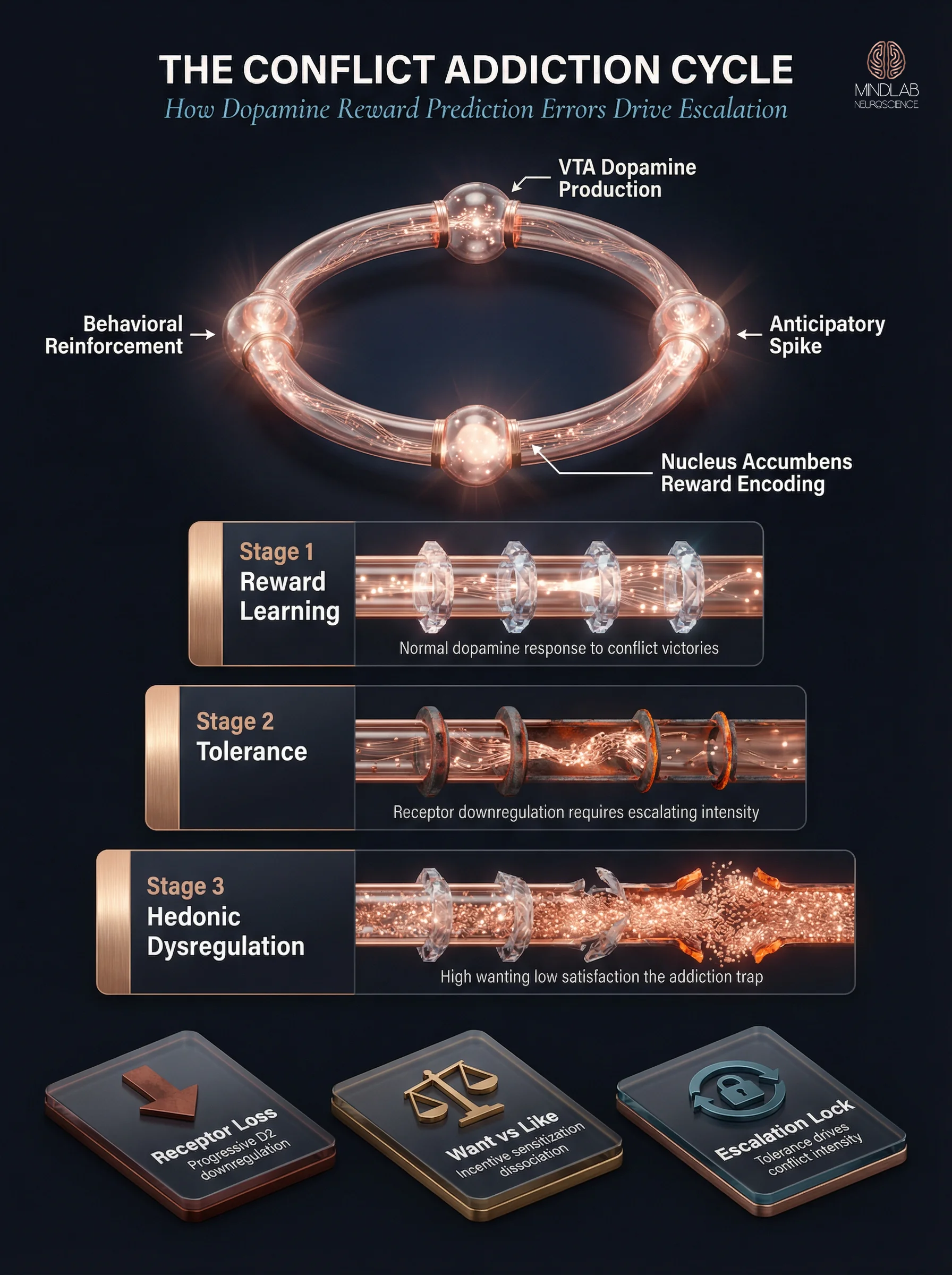
Why does winning an argument feel so good to some people?
In lab studies, striking back lifted the mood of people who had been rejected. Chester and DeWall ran six studies with 1,516 people in total. Rejection hurts mood. In two of the studies, rejected people acted aggressively. Afterward, their mood matched that of people who hadn’t been rejected. The change came from a rise in good feeling. In an earlier experiment by Bushman, Baumeister and Phillips, insulted people who had been led to believe venting would make them feel better acted more aggressively. When they were told a pill had frozen their mood, so lashing out couldn’t lift it, the extra aggression went away.
Brain scans point the same way. de Quervain and colleagues scanned people as they decided how to punish a partner who’d broken their trust in a money game. Some punishments cut the partner’s earnings, and others were only symbolic. The ones that cut earnings activated the dorsal striatum, an area tied to rewards that follow from your own actions. People with stronger activation there were willing to pay more of their own money to punish. The authors read this as the satisfaction people expected from punishing.
What the research doesn’t capture is the specificity I observe in practice. Not all argument “wins” feel equally rewarding. The individuals I work with who exhibit this pattern report that the reward scales with the perceived competence of the opponent. Dismantling a weak argument produces almost nothing. Outmaneuvering someone they respect produces a response they describe as electric.
These findings also suggest why a plain request to “just stop arguing” can fall flat. For someone whose mood lifts when they strike back, stopping means giving up a short-term reward.
What happens in the brain when someone keeps starting fights?
The brain studies cited here looked at single moments of retaliation. They didn’t follow people who start fights over years. In a study by Chester and DeWall, 69 people had brain scans during a game. In the game, they could blast an opponent with loud noise. After being provoked, people with more nucleus accumbens activity as they made their choice picked louder blasts. More activity there also went with a history of real-world violence. Some people’s nucleus accumbens worked more closely than others’ with a part of the prefrontal cortex that helps with self-control. Those people retaliated less.
Animal work ties this reward area to dopamine. Couppis and Kennedy trained mice to respond for the chance to attack an intruder. Drugs that block dopamine receptors in the nucleus accumbens cut how often the mice worked for that chance. The highest doses didn’t change how much the mice moved around in general.
Berridge and Robinson’s incentive-sensitization theory separates wanting a reward from liking it. Wanting is the drive to pursue a reward, and it comes from brain systems that include dopamine. Liking is the pleasure of having it, and it doesn’t depend on dopamine. The theory holds that in drug addiction, dopamine-related systems can change in long-lasting ways. Those changes can make wanting grow much stronger without necessarily making the drug more enjoyable. Its authors say the theory is now being applied to behavioral addictions. The studies cited here didn’t test it on conflict.
In high-conflict individuals, I consistently observe something that resembles this split. They describe the buildup to an argument with language that mirrors craving: restlessness, scanning for provocations, a mounting tension that conflict resolves. But when asked about the aftermath, they rarely describe satisfaction. They describe a brief discharge followed by immediate readiness for the next confrontation.

In a leadership context, this manifests as someone who cannot tolerate a peaceful quarter. The quarterly review goes well, the numbers are strong, and within days they’ve manufactured a crisis: reorganizing a team, challenging a vendor relationship, escalating a minor disagreement into a strategic confrontation.
Does dopamine drive repeated conflict?
In mice, dopamine signaling in the nucleus accumbens helps drive the effort to fight, as the Couppis and Kennedy study showed. In people, the studies cited here didn’t measure dopamine during arguments. They also didn’t show tolerance, the drug effect in which the same dose stops working as well. The human research points to other forces that keep conflict going.
Anger can push people toward a confrontation. In a review of the evidence, Carver and Harmon-Jones concluded that anger is an approach emotion. It’s tied to the same motivational system as seeking a reward, while anxiety and fear are tied to pulling back. People also sometimes choose to stoke their anger. In a study by Tamir, Mitchell and Gross, people who expected a confrontation preferred activities that would make them angrier. Anger also helped them perform better on a confrontational task.
Replaying a provocation in your head can keep aggression up. In studies by Bushman and colleagues, some provoked people ruminated, meaning they kept replaying the provocation. Others were distracted. Later, someone annoyed them in a minor way. The people who’d ruminated were more aggressive toward that person. In a third study, the effect held after an 8-hour rumination period. Thomas Denson describes angry rumination as a risk factor for aggression that briefly lowers self-control.
This is what I see as escalation across engagements. A client’s partner once described it to me this way: the arguments had to keep getting bigger. Minor disagreements stopped producing any visible response. Only threats (to the relationship, to financial stability, to something genuinely consequential) generated the engagement they recognized as their partner being “present.” The partner wasn’t choosing cruelty.

For a complete framework on understanding and resetting your dopamine reward system, I cover the full science in my book The Dopamine Code (Simon & Schuster, June 2026).
Why do high-conflict people never seem satisfied after “winning”?
Research on venting and on couples’ conflict patterns may help explain why fights keep coming back. In an experiment by Brad Bushman, angry people who hit a punching bag while thinking about the person who angered them felt angrier afterward. They were also more aggressive toward that person than people who hit the bag while thinking about getting fit, and than people who skipped the bag.
Fights between partners can also settle into patterns that repeat. In the demand/withdraw pattern, one partner presses with requests, criticism and complaints. The other pulls back through defensiveness or silence, as Christensen and Heavey described it. A review of 74 studies with 14,255 people found a moderate link between this pattern and worse outcomes. The strongest links were for relationship and communication outcomes. Gottman and Levenson studied 73 married couples in 1983 and again in 1987. Couples in the group the researchers called nonregulated showed more negative emotion, more defensiveness, and more stubbornness and withdrawal. They were also more likely to consider separating or to separate.
Some people return to the same kind of fight again and again. In one of the clearest examples I’ve encountered, a family system where one member had this pattern running at full intensity, every holiday gathering followed an identical sequence. The individual would arrive, identify the most contentious topic available, escalate it into a confrontation that consumed the entire room, achieve decisive verbal dominance, and then, within twenty minutes, begin scanning for the next point of friction. Their spouse described it as watching someone eat without ever feeling full.

The studies on this page didn’t test what drives a pattern like this one.
What the First Conversation Looks Like
When someone reaches out to me about a partner, family member, or colleague who cannot seem to stop manufacturing conflict, the first thing I do is map the reward pattern. Not the arguments. Not the triggers. Not the history of who said what. I map the pattern: when the pull begins, what level of conflict currently sets it off, and how quickly it fades after each confrontation.
What surprises most people is that this isn’t about anger management or communication strategies. Those approaches target the surface behavior. Through Real-Time Neuroplasticity™, I work within the live moment when the escalation pattern activates.
What makes someone seem addicted to conflict?
Conflict addiction isn’t a formal diagnosis, and the studies cited here didn’t test a cause. Still, striking back after a provocation can feel rewarding. In a brain-imaging study by Chester and DeWall, people were provoked and then chose how hard to retaliate. Those with more activity in the nucleus accumbens, a reward area, retaliated more harshly. In two later studies by the same team, acting aggressively lifted the mood of people who had been rejected. In lab studies by Brad Bushman, alone and with colleagues, some people kept replaying an insult. They were angrier or more aggressive than people who were distracted.
Is conflict addiction a real neurological condition?
Conflict addiction is a popular term. It isn’t a recognized diagnosis. When the DSM-5 came out in 2013, gambling disorder was the only behavior it listed among the addictive disorders. In animal studies, fighting can act like a reward. In studies by Couppis and Kennedy and by Golden and colleagues, mice worked for a chance to fight. In the Golden study, about 19% showed addiction-like aggression. Those findings come from mice and don’t make conflict a diagnosis in people.
Why do some people seem to enjoy arguments more than others?
People differ in how rewarding they find striking back. In a brain-imaging study by Chester and DeWall, people chose how hard to retaliate with noise blasts. Those who picked louder blasts had more activity in the nucleus accumbens, a reward area, as they chose. More activity there also went with a history of real-world violence. In experiments by Bushman, Baumeister and Phillips, people who tend to vent their anger were more aggressive after an insult, unless they believed a pill had frozen their mood. These studies show links, but they didn’t test what causes the differences between people.
Can a person who thrives on conflict actually change?
Lab studies point to what went with less aggression in the moment. In studies by Brad Bushman, alone and with colleagues, people who were distracted after an insult were less aggressive than people who kept replaying it. In one of Bushman’s studies, doing nothing at all worked better than venting. In Chester and DeWall’s brain-imaging study, some people’s reward area worked more closely than others’ with a self-control region of the prefrontal cortex. They retaliated less. These were short lab studies, and they didn’t follow people over time.
How does conflict addiction affect relationships long-term?
The couples studies cited here didn’t study conflict addiction by that name. They studied repeating conflict patterns. In the demand/withdraw pattern, one partner presses with complaints while the other pulls back. A review of 74 studies by Schrodt, Witt and Shimkowski found a moderate link between this pattern and worse personal and relationship outcomes. Gottman and Levenson studied 73 married couples in 1983 and again in 1987. The couples they called nonregulated showed more negative emotion, defensiveness and withdrawal. They were also less satisfied and more likely to separate.
References
- Berridge, K. C., and Robinson, T. E. (2016). Liking, wanting, and the incentive-sensitization theory of addiction. American Psychologist, 71(8), 670-679. https://doi.org/10.1037/amp0000059
- Bushman, B. J. (2002). Does venting anger feed or extinguish the flame? Catharsis, rumination, distraction, anger, and aggressive responding. Personality and Social Psychology Bulletin, 28(6), 724-731. https://doi.org/10.1177/0146167202289002
- Bushman, B. J., Baumeister, R. F., and Phillips, C. M. (2001). Do people aggress to improve their mood? Catharsis beliefs, affect regulation opportunity, and aggressive responding. Journal of Personality and Social Psychology, 81(1), 17-32. https://doi.org/10.1037/0022-3514.81.1.17
- Bushman, B. J., Bonacci, A. M., Pedersen, W. C., Vasquez, E. A., and Miller, N. (2005). Chewing on it can chew you up: Effects of rumination on triggered displaced aggression. Journal of Personality and Social Psychology, 88(6), 969-983. https://doi.org/10.1037/0022-3514.88.6.969
- Carver, C. S., and Harmon-Jones, E. (2009). Anger is an approach-related affect: Evidence and implications. Psychological Bulletin, 135(2), 183-204. https://doi.org/10.1037/a0013965
- Chester, D. S., and DeWall, C. N. (2016). The pleasure of revenge: Retaliatory aggression arises from a neural imbalance toward reward. Social Cognitive and Affective Neuroscience, 11(7), 1173-1182. https://doi.org/10.1093/scan/nsv082
- Chester, D. S., and DeWall, C. N. (2017). Combating the sting of rejection with the pleasure of revenge: A new look at how emotion shapes aggression. Journal of Personality and Social Psychology, 112(3), 413-430. https://doi.org/10.1037/pspi0000080
- Christensen, A., and Heavey, C. L. (1990). Gender and social structure in the demand/withdraw pattern of marital conflict. Journal of Personality and Social Psychology, 59(1), 73-81. https://doi.org/10.1037/0022-3514.59.1.73
- Couppis, M. H., and Kennedy, C. H. (2008). The rewarding effect of aggression is reduced by nucleus accumbens dopamine receptor antagonism in mice. Psychopharmacology, 197(3), 449-456. https://doi.org/10.1007/s00213-007-1054-y
- de Quervain, D. J.-F., Fischbacher, U., Treyer, V., Schellhammer, M., Schnyder, U., Buck, A., and Fehr, E. (2004). The neural basis of altruistic punishment. Science, 305(5688), 1254-1258. https://doi.org/10.1126/science.1100735
- Denson, T. F. (2013). The multiple systems model of angry rumination. Personality and Social Psychology Review, 17(2), 103-123. https://doi.org/10.1177/1088868312467086
- Golden, S. A., Heins, C., Venniro, M., Caprioli, D., Zhang, M., Epstein, D. H., and Shaham, Y. (2017). Compulsive addiction-like aggressive behavior in mice. Biological Psychiatry, 82(4), 239-248. https://doi.org/10.1016/j.biopsych.2017.03.004
- Gottman, J. M., and Levenson, R. W. (1992). Marital processes predictive of later dissolution: Behavior, physiology, and health. Journal of Personality and Social Psychology, 63(2), 221-233. https://doi.org/10.1037/0022-3514.63.2.221
- Kardefelt-Winther, D., Heeren, A., Schimmenti, A., van Rooij, A., Maurage, P., Carras, M., Edman, J., Blaszczynski, A., Khazaal, Y., and Billieux, J. (2017). How can we conceptualize behavioural addiction without pathologizing common behaviours? Addiction, 112(10), 1709-1715. https://doi.org/10.1111/add.13763
- Potenza, M. N. (2014). Non-substance addictive behaviors in the context of DSM-5. Addictive Behaviors, 39(1), 1-2. https://doi.org/10.1016/j.addbeh.2013.09.004
- Schrodt, P., Witt, P. L., and Shimkowski, J. R. (2014). A meta-analytical review of the demand/withdraw pattern of interaction and its associations with individual, relational, and communicative outcomes. Communication Monographs, 81(1), 28-58. https://doi.org/10.1080/03637751.2013.813632
- Schultz, W. (2016). Dopamine reward prediction-error signalling: A two-component response. Nature Reviews Neuroscience, 17(3), 183-195. https://doi.org/10.1038/nrn.2015.26
- Tamir, M., Mitchell, C., and Gross, J. J. (2008). Hedonic and instrumental motives in anger regulation. Psychological Science, 19(4), 324-328. https://doi.org/10.1111/j.1467-9280.2008.02088.x
Crisis & mental-health support resources
If you are in crisis or thinking about harming yourself, support is available right now.
- 988 Suicide & Crisis Lifeline: call or text 988 (24/7, free, confidential).
- Crisis Text Line: text HOME to 741741.
- If you are in immediate danger, call 911 or go to your nearest emergency room.