How the Brain Encodes Goal Setting in the Prefrontal Cortex
Most frameworks for goal setting treat it as an organizational problem: find the right template, break the objective into steps, track progress against a deadline. What those frameworks miss is the prior question: what does the brain actually do when a goal is formed, and why does the neurological process make or break everything that follows?
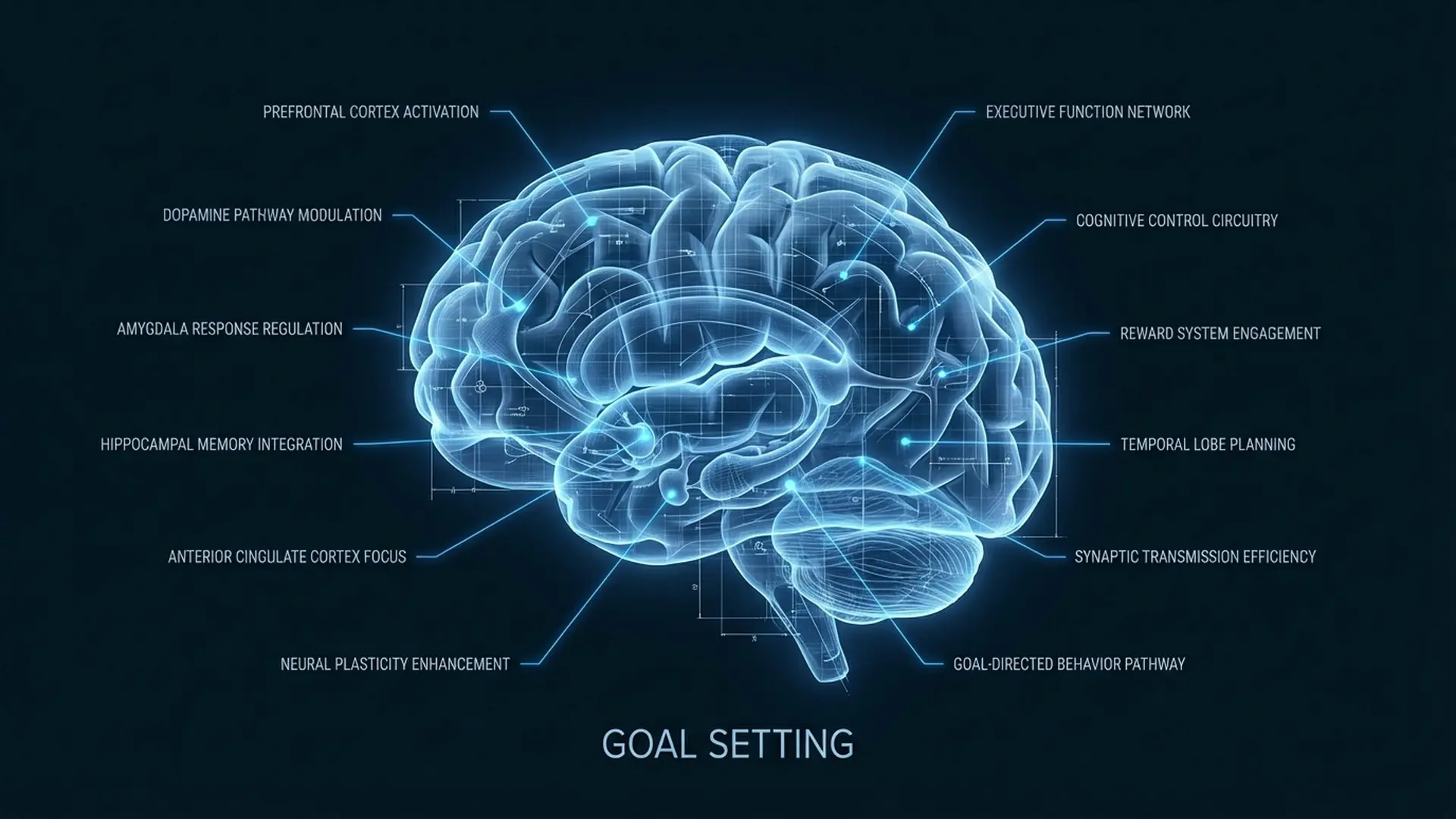
Goal setting is fundamentally a prefrontal cortex operation. The lateral and medial regions of the prefrontal cortex are responsible for encoding future-oriented intentions: translating a desired outcome into a neural representation the brain can hold, compare against current reality, and use to guide behavior across time. This is not metaphorical. Neuroimaging research from the laboratory of Earl Miller at MIT has documented the sustained firing patterns in prefrontal neurons that represent intended goals, even in the absence of immediate sensory input. The brain is literally holding the goal in mind, maintaining it against the constant pull of competing signals.
What determines whether a goal survives that competition? Three factors emerge consistently from the neuroscience. First, the specificity of the neural representation: vague goals produce weak prefrontal encoding, which is why “I want to be healthier” fails to recruit sustained effort while “I will exercise for thirty minutes before 8 AM on Monday, Wednesday, and Friday” creates a more durable neural template. Second, the emotional valence attached to the goal: prefrontal encoding is strengthened by the involvement of the ventromedial prefrontal cortex and its connections to the limbic system, which is why goals anchored in genuine personal meaning persist while externally imposed goals erode. Third, the working memory load the goal demands: the dorsolateral prefrontal cortex has finite capacity, and goals that compete with high cognitive demands tend to drop out of active representation first.
In my practice, I consistently observe a pattern that the encoding research predicts: the individuals who struggle most with goal setting are not lacking motivation or discipline. They are holding goals whose neural representation is too thin to compete. The goal was never properly encoded in the first place. It was stated, not built.
The architecture of genuine goal encoding requires deliberate engagement with the prefrontal systems that create durable representation, not affirmation, not visualization in the casual sense, but the kind of structured, emotionally-grounded, contextually specific mental simulation that activates the same prefrontal circuits that will later have to sustain the effort. This is where the neuroscience of goal setting departs from the productivity industry’s conventional advice.
Dopamine and Goal Pursuit: Why the Reward Signal Fires Before You Arrive
The role of dopamine in goal setting is widely misunderstood, and that misunderstanding has practical consequences for anyone who has ever felt their motivation collapse long before reaching a meaningful objective. The popular account is that dopamine is the reward chemical: it fires when you achieve something and generates the pleasure that reinforces behavior. That account is approximately twenty years out of date.
Contemporary neuroscience, built substantially on the work of Wolfram Schultz and later refined by researchers studying reward prediction error, the same circuitry detailed across the dopamine and motivation architecture, establishes something more precise: dopamine fires in anticipation of reward, not upon its receipt. The dopamine system is a goal-pursuit system. It is activated by the prediction of reward, by the approach toward a desired outcome, by the cues that signal that a valued goal is within reach. This is the mechanism that generates the motivational energy for sustained goal-directed behavior, not the satisfaction of completion, but the dopaminergic charge of the chase.
This has an important implication for goal setting architecture. Goals that feel exciting when first set are producing dopamine from the novelty of the anticipation: the prediction is vivid and the reward feels close. As time passes and the goal recedes from its initial vividness, the prediction signal weakens, the dopaminergic charge falls, and effort feels increasingly costly. This is not a motivation deficiency. It is a reward prediction problem. The brain needs fresh anticipation signals to sustain goal pursuit across extended time horizons.
The neuroscience points toward a specific structural solution: breaking large goals into sub-goals that generate their own prediction cycles. Each proximate milestone creates a new near-term reward prediction, a new dopamine signal, a new motivational charge. The goal architecture that works is not a single destination with a long runway: it is a sequence of nested reward predictions that keep the dopamine system engaged throughout the process. Goal setting done well is, among other things, a dopamine engineering problem.
I see the failure of this principle regularly in high-capacity clients. A founder sets an ambitious two-year goal with significant personal meaning, builds a detailed plan, and then finds themselves disengaged by month four. The plan is sound. The goal is genuine. But the dopamine architecture is broken: there is no proximate prediction cycle generating the neurochemical fuel the brain needs to sustain long-horizon effort. Rebuilding the goal framework with proper sub-goal sequencing restores the motivational signal within weeks.
Why SMART Goals Fail Neurologically
The SMART framework (Specific, Measurable, Achievable, Relevant, Time-bound) has been standard in corporate and personal development contexts for decades. It is not wrong, exactly. But it is incomplete in ways that the neuroscience of goal setting makes visible, and that incompleteness explains a great deal of the gap between goal-setting and goal-achieving that its adherents consistently report.
The first problem is that SMART goals address the cognitive representation of a goal, its clarity and structure, without addressing its emotional encoding. The ventromedial prefrontal cortex integrates value signals from the limbic system into goal representations. Goals that lack personal emotional relevance may be perfectly SMART and still fail to generate the sustained prefrontal engagement required for execution. Achievable and time-bound matter less than whether the brain assigns the goal sufficient reward weight to compete against the immediate demands that will constantly contest it.
The second problem is the “Achievable” criterion itself. From a neuroscience perspective, goals calibrated to feel safe and achievable are calibrated to avoid threat, and the threat-avoidance circuits they engage are metabolically cheap, producing minimal dopaminergic activation. Goals that sit at the upper edge of perceived capability (what Mihaly Csikszentmihalyi’s flow research describes as challenge-skill balance, a principle central to peak performance and flow state optimization) recruit the dopamine system more intensely, generate stronger neural encoding, and sustain motivation more durably. SMART’s emphasis on achievability inadvertently trains people to set goals that the brain doesn’t find compelling.
The third problem is that SMART goal setting treats goal formation as a single event rather than an ongoing neural process. The prefrontal representation of a goal degrades over time as competing demands occupy working memory and as the emotional valence of the initial intention fades. Goals require regular re-encoding (deliberate, emotionally engaged contact with the intention and its meaning) to maintain the neural substrate that executive function depends on. A goal set once in January and reviewed quarterly is not a goal the brain is holding. It is a file the brain has archived.
What goal setting requires, from a neurological standpoint, is not a smarter template. It requires an understanding of the encoding process, the dopamine architecture, and the ongoing maintenance work that keeps prefrontal representation sharp. That is a neuroscience problem, not a productivity problem.
Implementation Intentions: The If-Then Mechanism That Bridges Goal and Action
One of the most robust findings in the psychology and neuroscience of goal setting is the implementation intention effect, documented extensively by Peter Gollwitzer at New York University. The effect is straightforward but its neural mechanism is significant: people who translate goals into specific if-then plans (“If situation X occurs, I will perform response Y”) achieve their goals at substantially higher rates than people who form only outcome intentions.
The neuroscience behind this effect sits at the intersection of prefrontal goal encoding and cue-triggered automaticity. An implementation intention essentially pre-loads a stimulus-response association into working memory, so that when the specified situation is detected, the intended action fires automatically without requiring deliberate executive oversight. The prefrontal cortex has off-loaded the execution decision to a lower-bandwidth process, which matters enormously because the situations in which goals are hardest to pursue are typically the same situations in which prefrontal resources are most depleted.
Willpower, from a neuroscience standpoint, is a prefrontal resource with finite capacity. Every decision, every self-regulation demand, every cognitive conflict consumes it. Goal pursuit that depends entirely on moment-to-moment executive function will fail when that function is depleted, which is precisely the pattern most people recognize in themselves. The implementation intention mechanism routes around this problem by converting deliberate choices into situationally-triggered habits before the prefrontal cortex is under load.
The practical architecture of implementation intentions requires identifying not only what you intend to do but the specific environmental cues and internal states that will be present when you need to do it. “I will exercise more” is an outcome intention. “If it is 7 AM and I have had coffee, I will put on my running shoes immediately” is an implementation intention. The specificity of the if-clause is what creates the cue-detection pattern that fires the automatic response.
In my work with clients on goal setting, implementation intentions are one of the most immediately practical tools available because they produce measurable behavioral change without requiring the client to develop more willpower, a task that is neurologically analogous to asking someone to grow more RAM. The brain’s architecture is being used intelligently rather than fought against.
Goal Conflict and the Anterior Cingulate Cortex
The experience of feeling pulled in two directions, committed to a goal and yet persistently failing to act on it, is not a character problem. It is an anterior cingulate cortex problem, rooted in the same conflict-monitoring circuitry that governs strategic thinking and decision-making under uncertainty. Understanding the neural basis of goal conflict transforms how that experience is interpreted and, critically, what can be done about it.
The anterior cingulate cortex (ACC) is the brain’s conflict detection system. It monitors for discrepancies between competing behavioral options, between intentions and actual behavior, and between predicted and actual outcomes. When two goals demand incompatible actions (when pursuing professional ambition conflicts with relational presence, when financial discipline conflicts with the immediate relief of spending) the ACC registers that conflict as a signal requiring resolution. The discomfort of goal conflict is, in part, the ACC’s conflict monitoring signal entering conscious awareness.
The neuroscience of goal conflict identifies two types of resolution that the prefrontal-ACC circuit can produce. The first is goal prioritization: the prefrontal cortex assigning relative value to competing goals and suppressing the lower-priority option. This is the resolution people are trying to force when they “decide” to prioritize one goal over another. It works when the value differential is clear and stable. It fails when both goals have significant emotional weight and the value comparison is genuinely contested.
The second resolution is goal integration: restructuring the goal architecture so that what appeared to be conflicting goals can be pursued in ways that are mutually supportive rather than competitive. This is a more sophisticated cognitive operation, requiring the prefrontal cortex to hold both goals simultaneously and find a higher-order frame that accommodates both. It is also more durable, because it removes the ACC conflict signal entirely rather than suppressing one goal while the conflict persists.
What I observe consistently in my practice is that unexamined goal conflict is one of the most reliable predictors of behavioral stagnation. The individual is not lazy and not uncommitted. They are running two incompatible neural programs simultaneously, and the ACC conflict signal is producing the psychological resistance that looks, from the outside, like failure of will. Mapping the conflict and resolving it at the level of goal architecture reliably breaks the stagnation.
The Neuroscience of Goal Commitment: Why You Abandon Goals Before They Fail
There is a pattern in goal-setting behavior that is rarely discussed: most goals are not abandoned when they become difficult. They are abandoned before they become difficult, during the pre-commitment phase when the brain is evaluating whether the investment of effort is worth the anticipated reward. Understanding this through neuroscience reframes the problem of goal follow-through entirely.
The ventromedial prefrontal cortex and the striatum are jointly responsible for value-based decision-making: the neural computation that assigns a value to a potential action and compares it against the cost. When a goal is new, the anticipated reward is salient and the cost of initial effort is relatively low. The value computation favors commitment. As time passes and the effort cost accumulates while the reward remains distant, the value computation can shift, particularly if the individual encounters early obstacles that update the brain’s estimate of how difficult the goal will actually be.
Goal abandonment often looks like a decision, but the neuroscience suggests it is frequently a value computation that updated without conscious awareness. The striatum downgraded the anticipated reward, the vmPFC recalculated the cost-benefit ratio, and the prefrontal representation of the goal quietly lost the competition with other, more immediately rewarding alternatives. The person experiences this as “losing motivation” or “realizing this goal wasn’t really for me.” Both interpretations are usually wrong. What happened was a neurochemical accounting shift.
Protecting goal commitment across the long arc of pursuit requires understanding this process and intervening at the right points: refreshing the reward salience before the value computation degrades, restructuring the cost perception by making early progress visible, and ensuring that the goal remains emotionally live rather than cognitively archived. This is maintenance work for the prefrontal encoding that goal pursuit depends on.
Dr. Ceruto’s Goal Architecture Methodology
Over more than two decades of working with high-capacity individuals navigating genuinely complex professional and personal demands, I have developed what I refer to as a goal architecture methodology: an approach to goal setting that begins with the brain’s actual operating conditions rather than a productivity framework imposed on top of them.
The methodology operates in three phases. The first is neural mapping: identifying what goals the individual is currently holding at a neural level, which include goals they are aware of and goals that are driving behavior without conscious recognition. Goal conflict cannot be resolved until all relevant goals are on the table, including the implicit goals the brain has been pursuing in service of threat avoidance, identity maintenance, or attachment security. These implicit goals are often the ones that sabotage the explicit ones. A C-suite client I worked with had spent three years “trying to delegate more” while simultaneously holding an implicit goal of remaining indispensable, a goal that had been protecting him against the fear of obsolescence since his earliest professional experiences. The explicit goal had no chance until the implicit one was identified and addressed.
The second phase is encoding optimization: rebuilding the goal representation in the prefrontal cortex with sufficient specificity, emotional grounding, and implementation architecture to compete against the daily demands that will contest it. This includes designing the dopamine sequencing: the sub-goal progression that keeps the reward prediction system engaged across the full pursuit horizon. It includes translating intentions into implementation intentions that route around depleted executive function. And it includes the emotional engagement work that connects the goal to the individual’s deepest values, because that connection is what generates the vmPFC’s value signal that sustains prefrontal commitment.
The third phase is real-time integration: working with clients during the actual moments when goal-directed behavior is most under threat. When the conflict arises, when the value computation is about to tip, when the implementation intention needs to fire and the cue is ambiguous. This is where Real-Time Neuroplasticity™ becomes most consequential for goal-setting work: the neural patterns that drive goal abandonment are most available for restructuring precisely when they are active, not when they are being discussed in a retrospective session.
The goal setting literature is rich with frameworks that describe what goals should look like. The neuroscience I work with every day describes what the brain needs to build, maintain, and execute them. Those are different questions with different answers, and the gap between them is where most goal-directed effort gets lost.
If the goals you have set for years continue to dissolve before they are achieved, the problem is almost certainly not your commitment. It is the neural architecture those goals were built on. That architecture can be rebuilt. The science makes this possible, and working with someone who understands the mechanisms makes it practical.
If you are ready to approach your goals differently, with a methodology grounded in how the brain actually works, schedule a strategy call with Dr. Ceruto to explore what that work looks like for your specific situation.