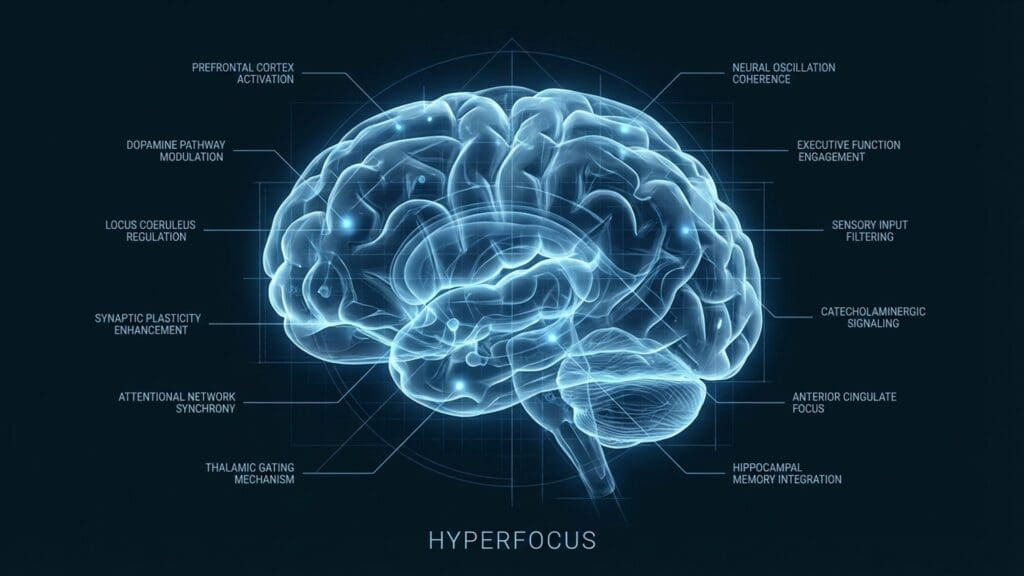
A paradoxical state of intense fixation common in neurodivergent brains. We explore the dopamine dynamics that lock attention and protocols to harness this surge for creative breakthroughs.
Executive Neuro-Brief
The Evolutionary Design
Nature built your brain to hunt. You needed to track prey for hours without losing the trail. You could not get distracted by a rustling leaf or a changing wind. This deep focus meant food for the tribe. It is a survival state. Your brain floods with chemicals to lock you in. It ignores hunger and fatigue to reach the goal. This was not an accident. It was a necessity for staying alive.
The Modern Analogy
Hyperfocus is like having a spotlight so bright that once it locks onto one thing, everything else in the room disappears. The beam is intense. It reveals every detail of your target. But the rest of the room goes pitch black. You cannot see the clock. You cannot see your other tasks. You might even miss signals from your own body. The light is powerful, but it makes you blind to the environment. You get stuck on one point while the world moves on without you.
The Upgrade Protocol
You must learn to control the beam. Do not let the spotlight get stuck in one position. You need to install a dimmer switch and a swivel. Practice widening the light to check your surroundings. Set external alarms to break the trance. This turns the spotlight off for a moment. Then you can aim it again with purpose. You become the operator, not just the bulb. Use the intensity when you need it, but turn it down when you are done.
ADHD, focus, and executive function problems are not character flaws. They live in your brain’s control networks. This guide shows how to understand and rewire them using neuroscience.
While ADHD is often defined by a “deficit” of attention, hyperfocus proves it is actually a regulation issue. Neurodivergent brains operate on an Interest-Based Nervous System (rather than importance-based). When a task is perceived as urgent, novel, or fascinating, the brain dumps massive amounts of dopamine into the striatum. This doesn’t just “turn on” attention; it locks it, creating a tunnel vision where the external world disappears and cognitive processing speed accelerates significantly.
Hyperfocus vs. Flow
Though they feel similar, Hyperfocus and Flow differ in their control mechanisms.
The Entrance: Flow is usually entered through a balance of skill and challenge. Hyperfocus is often triggered by an emotional spike—either excitement or panic (urgency).
The Exit: In Flow, you maintain enough executive function to stop when necessary. In Hyperfocus, the “switching” mechanism (the Anterior Cingulate Cortex) is effectively jammed. You may forget to eat, sleep, or track time because the brain prioritizes the dopamine stream over physiological signals.
Operationalizing the Surge
To turn hyperfocus from a liability (spending 6 hours on the wrong task) into a superpower, you must engineer the entry and exit points.
The Launchpad: Since you cannot force hyperfocus, you must lower the barrier to entry. “Strewing”—leaving the tools of your creative work visible and open—can trigger the interest response without the friction of setup.
External Brakes: Because internal time-blindness is a hallmark of this state, you must offload the executive function. Using external “hard” interruptions (like smart lights changing color or a timed playlist ending) breaks the loop without relying on willpower, preventing the inevitable crash of exhaustion.
The Intelligence Brief
Neuroscience-backed analysis on how your brain drives what you feel, what you choose, and what you can’t seem to change — direct from Dr. Ceruto.