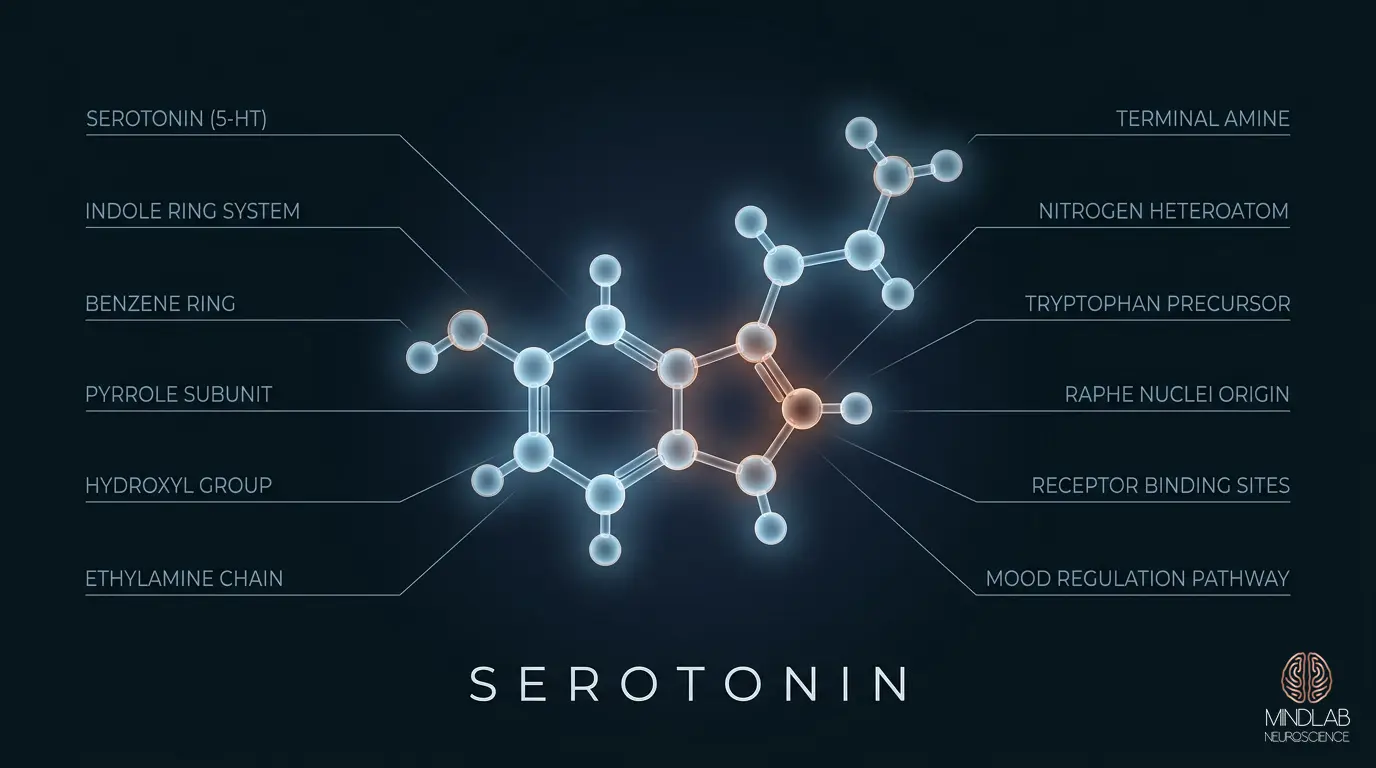
Most people have been told that serotonin is the brain’s “happiness chemical”: a single molecule responsible for good moods, calm feelings, and general well-being. In 26 years of working with individuals navigating complex emotional and cognitive landscapes, I have found this narrative to be not just incomplete but actively misleading. Serotonin is one of the most widely distributed neuromodulators in the human nervous system, influencing everything from impulse control and social behavior to gut motility and sleep-wake cycling. Reducing it to a feel-good molecule obscures the intricate architecture that actually governs how we think, decide, and regulate ourselves under pressure. What follows is a deeper look at what serotonin really does, why it goes wrong, and how the brain can be guided back toward serotonergic equilibrium.
Beyond the Happiness Myth: What Serotonin Actually Does
The popular framing of serotonin as a simple mood elevator emerged from early pharmacological research: specifically the observation that increasing serotonin availability in the synaptic cleft often reduced depressive symptoms. But correlation was mistaken for mechanism. Serotonin does not produce happiness the way a light switch produces illumination. Instead, it modulates the gain on dozens of neural circuits simultaneously, adjusting how strongly signals propagate through networks involved in emotion, cognition, appetite, pain perception, and motor control.
What I consistently observe in my practice is that individuals with serotonergic imbalances rarely present with a single complaint. They describe a constellation: disrupted sleep, heightened irritability, difficulty disengaging from negative thought loops, impulsive decision-making under stress, and a generalized sense that their internal calibration is off. This pattern makes perfect sense once you understand that serotonin operates across at least 14 distinct receptor subtypes, each with different distributions, signaling mechanisms, and functional consequences. The 5-HT1A receptor, concentrated in the prefrontal cortex and hippocampus, plays a central role in anxiety modulation and memory consolidation. The 5-HT2A receptor, densely expressed across cortical regions, influences perception, cognitive flexibility, and the capacity to update mental models. The 5-HT3 receptor, unique among the family as a ligand-gated ion channel rather than a G-protein-coupled receptor, mediates rapid signaling in the gut and brainstem, directly linking nausea, visceral sensation, and emotional processing.
This is not a single system with a single function. It is a sprawling regulatory network, and when it destabilizes, the effects cascade across every domain of functioning.
The Prefrontal Gate: Serotonin, Impulse Control, and Social Architecture
One of serotonin’s most consequential roles, and one of the least discussed outside of neuroscience literature, is its governance of prefrontal impulse control. The prefrontal cortex serves as the brain’s executive gatekeeper, evaluating potential actions against long-term goals and social consequences before allowing them to proceed. Serotonin is the primary neuromodulator that sets the threshold on this gate. When serotonergic tone in the prefrontal cortex drops, impulsive responses become more likely, not because the individual lacks intelligence or willpower, but because the neurochemical infrastructure that supports deliberation has been compromised.
In my practice, I see this play out with striking regularity among high-performing executives and entrepreneurs. These are individuals with extraordinary cognitive capacity who nonetheless find themselves making decisions they later recognize as impulsive, reactive, or socially costly. The external narrative (stress, poor judgment, character flaw) misses the underlying mechanism entirely. Their serotonergic tone has been eroded by chronic demand, and the prefrontal gate no longer holds under pressure.
There is also a fascinating body of research on serotonin’s role in social dominance hierarchies. Studies across primate species, including humans, demonstrate that serotonin levels are both a consequence and a determinant of social rank. Higher serotonergic tone is associated with greater social confidence, more stable leadership behavior, and reduced reactive aggression. Lower serotonergic tone correlates with status anxiety, defensive hostility, and erratic social signaling. This is not about personality: it is about neurochemistry shaping social behavior at the circuit level, which is directly relevant to those exploring depression and motivational drive as interconnected systems.
The Tryptophan Pathway: Where Serotonin Synthesis Begins, and Where It Breaks Down
Serotonin cannot cross the blood-brain barrier, which means every molecule of serotonin the brain uses must be synthesized locally from the essential amino acid tryptophan. The synthesis pathway is straightforward in principle: tryptophan is converted to 5-hydroxytryptophan (5-HTP) by the enzyme tryptophan hydroxylase, and 5-HTP is then converted to serotonin by aromatic L-amino acid decarboxylase. But in practice, this pathway is extraordinarily vulnerable to disruption.
The first vulnerability is competition. Tryptophan must compete with other large neutral amino acids (leucine, isoleucine, valine, tyrosine, and phenylalanine) for transport across the blood-brain barrier. A high-protein meal, counterintuitively, can actually reduce brain tryptophan availability because the competing amino acids are present in greater relative concentration. This is one reason why the relationship between diet and mood is far more complex than popular nutrition advice suggests.
The second vulnerability, and the one I encounter most frequently in my work, is cortisol-mediated tryptophan diversion. Under chronic stress, elevated cortisol activates the enzyme indoleamine 2,3-dioxygenase (IDO) and its hepatic counterpart tryptophan 2,3-dioxygenase (TDO). These enzymes shunt tryptophan away from serotonin synthesis and down the kynurenine pathway, producing metabolites that are, in some cases, neurotoxic. The result is a double hit: less serotonin production and increased neural inflammation. This mechanism explains why individuals under sustained pressure do not simply feel “stressed”: they experience a progressive erosion of the neurochemical substrate required for emotional regulation, cognitive flexibility, and restorative sleep.
The Gut-Brain Axis: Ninety Percent of the Story Lives Below the Neck
Perhaps the most paradigm-shifting finding in modern neuroscience is that approximately 90 percent of the body’s serotonin is produced not in the brain but in the enterochromaffin cells of the gastrointestinal tract. This gut-derived serotonin regulates intestinal motility, secretion, and visceral sensation, but its influence does not stop at the gut wall. Through the vagus nerve, the primary communication highway between the gut and the brain, peripheral serotonin signaling directly modulates central nervous system function, influencing mood, stress reactivity, and even cognitive processing.
The gut microbiome plays a central role in this dynamic. Specific bacterial strains, particularly within the Lactobacillus and Bifidobacterium genera, influence tryptophan metabolism and serotonin production in the gut. Dysbiosis, or microbial imbalance, can alter the availability of tryptophan precursors, shift the balance between serotonin synthesis and kynurenine pathway activation, and modulate vagal afferent signaling in ways that directly affect brain function.
What I find particularly relevant for the individuals I work with is how profoundly lifestyle disruptions (irregular eating patterns, frequent travel across time zones, high alcohol consumption, chronic sleep deprivation) destabilize the gut microbiome and, by extension, serotonergic signaling. Many of the cognitive and emotional complaints that high-performers attribute to “burnout” or “mental fatigue” have a significant gut-brain axis component that is entirely addressable once the mechanism is understood.
Serotonin and Dopamine: The Interplay That Governs Motivation and Restraint
Serotonin and dopamine and reward signaling are often discussed as if they operate independently: serotonin for mood, dopamine for motivation. This separation is artificial and misleading. In reality, these two neuromodulatory systems are in constant dynamic interaction, and the balance between them determines much of our behavioral output.
At the circuit level, serotonin generally functions as a behavioral brake while dopamine functions as a behavioral accelerator. Serotonin promotes patience, risk aversion, and the capacity to wait for delayed rewards. Dopamine promotes action, novelty-seeking, and the pursuit of immediate reinforcement. Neither system is inherently superior: adaptive behavior requires both. The problem arises when the balance tilts persistently in one direction.
In many of the high-performers I work with, I observe a characteristic pattern: dopaminergic overdrive paired with serotonergic depletion. These individuals are extraordinarily driven: they pursue goals relentlessly, thrive on novelty, and maintain punishing schedules. But their capacity for restraint, reflection, and sustained contentment has eroded. They achieve but do not feel satisfied. They win but cannot rest. This is not a motivation problem. It is a serotonin-dopamine ratio problem, and it requires recalibration at the neural level rather than further acceleration of the dopaminergic drive that created the imbalance in the first place.
The dorsal raphe nucleus, the brain’s primary serotonin production center, has extensive reciprocal connections with the ventral tegmental area, the primary dopamine production center. When serotonin output from the dorsal raphe drops, dopaminergic circuits lose a critical modulatory input and begin to operate in a more impulsive, reward-seeking mode. Understanding this interplay is essential for anyone experiencing the paradox of external success accompanied by internal dysregulation: a pattern closely connected to depression and neural architecture.
Circadian Regulation: The Serotonin-Melatonin Conversion That Governs Sleep
Serotonin is the direct biochemical precursor to melatonin, the hormone that regulates the sleep-wake cycle. In the pineal gland, serotonin is converted to melatonin through a two-step enzymatic process involving N-acetyltransferase (NAT) and hydroxyindole-O-methyltransferase (HIOMT). This conversion is regulated by light exposure: specifically, it is suppressed by light and activated by darkness, creating the circadian rhythm that governs sleep onset and sleep architecture.
The clinical implication is direct: if daytime serotonin production is insufficient, the substrate available for nighttime melatonin conversion is also insufficient. This creates a vicious cycle in which serotonin depletion leads to poor sleep, poor sleep further impairs serotonin synthesis (which is itself dependent on adequate sleep for precursor replenishment and receptor resensitization), and the downward spiral accelerates. Many individuals pursuing sleep and circadian optimization discover that their sleep difficulties are not primarily a sleep problem at all: they are a serotonin problem that manifests most visibly at night.
In my practice, I have found that addressing the upstream serotonergic deficit is often the single most impactful intervention for individuals with chronic sleep disruption. Rather than targeting sleep in isolation, the focus shifts to restoring the neurochemical conditions that allow healthy sleep to emerge naturally: adequate tryptophan availability, managed cortisol rhythms, stabilized gut-brain signaling, and appropriate light exposure patterns that support the serotonin-melatonin conversion cycle.
Why High-Performers Are Especially Vulnerable, and What Neural Recalibration Offers
There is a paradox I encounter repeatedly: the individuals with the greatest external accomplishments often present with the most pronounced serotonergic imbalances. The explanation lies in the neurochemical cost of sustained high performance. Chronic cognitive demand, compressed recovery windows, frequent high-stakes decision-making, and the social isolation that often accompanies leadership positions all converge on the same endpoint: progressive depletion of the serotonergic system through the cortisol-kynurenine mechanism described above.
What makes this particularly insidious is that the early stages of serotonin depletion can actually feel productive. The reduction in serotonergic braking means faster decisions, less hesitation, more willingness to take risks. The individual interprets these changes as sharpness or competitive edge. It is only when the depletion reaches a critical threshold (when sleep collapses, emotional reactivity spikes, and the capacity for strategic thinking gives way to pattern-rigid rumination) that the underlying deficit becomes impossible to ignore.
My approach through Real-Time Neuroplasticity™ (RTN™) addresses serotonergic imbalance not as a chemical deficiency to be corrected pharmacologically but as a systems-level recalibration challenge. The serotonergic system does not exist in isolation: it is embedded within a web of neural, metabolic, endocrine, and circadian processes that must be addressed as an integrated architecture. This means identifying the specific points of vulnerability in each individual’s neurochemical profile, understanding how their particular combination of cognitive demands, lifestyle patterns, and stress exposure is driving depletion, and designing a recalibration protocol that restores serotonergic function within the context of their actual life.
The neural recalibration framework recognizes that optimizing serotonergic tone is not about increasing serotonin indiscriminately. It is about restoring the dynamic range of the system, ensuring that serotonin levels rise and fall appropriately in response to environmental demands, that receptor sensitivity is calibrated for accurate signal transduction, and that the downstream conversion to melatonin proceeds on a rhythm aligned with the individual’s circadian needs.
Recalibrating the Serotonergic System: A Conversation Worth Having
If what you have read here resonates (if you recognize the pattern of external achievement paired with internal erosion, of sleep that never quite restores, of decisions that feel increasingly reactive rather than deliberate) then the serotonergic dimension of your neural architecture deserves serious attention. This is not about labeling what is wrong. It is about understanding, with precision, how a specific neurochemical system has been pushed beyond its adaptive range and mapping the path back to functional equilibrium.
I invite you to schedule a strategy call with Dr. Ceruto to explore whether serotonergic recalibration is relevant to the challenges you are navigating. In that conversation, we will examine the specific patterns in your cognitive performance, emotional regulation, sleep architecture, and stress exposure that point toward serotonergic involvement, and discuss what a targeted neural recalibration protocol would look like for your particular situation.