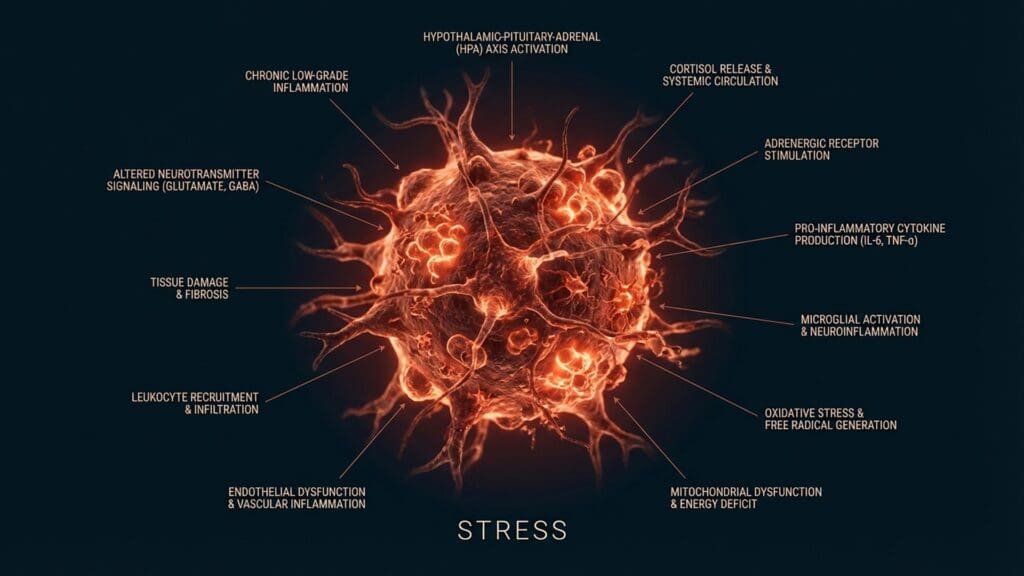
The body’s mobilization for action. We deconstruct the HPA axis and the autonomic nervous system, providing protocols to manage “allostatic load” and toggle between alert and recovery states.
Executive Neuro-Brief
The Evolutionary Design
Your brain has a built-in alarm system. It is designed to save your life. When you sense danger, your body releases powerful chemicals. Your heart beats faster. Your focus sharpens. This is the fight-or-flight response. Nature built this for short bursts of action. You see a threat, you react, and you survive. Once the danger passes, your system is supposed to cool down and recover.
The Modern Analogy
Stress is like carrying a backpack that slowly fills with bricks; one or two are fine, but if you never set it down, every step becomes painful. Today, we treat every email and deadline like a life-or-death threat. We add a brick for traffic. We add another for a missed meeting. We never stop to rest. The load gets heavier every hour. Your body breaks down under the constant weight. You become slow, tired, and weak.
The Upgrade Protocol
You must learn to take the backpack off. You cannot run at top speed with a heavy load. Schedule time to empty the bag every day. Deep breathing stops new bricks from piling up. Good sleep dumps the load out completely. Exercise makes your back stronger. Do not carry yesterday’s stress into today. Set the weight down often so you stay fast and agile.
Childhood experiences play a significant role in an individual's vulnerability to depression. Research shows that experiencing traumatic events or neglect during childhood can increase the risk of developing...
The amygdala is responsible for states such as anxiety or the sensation of threat. However, it’s possible to modulate its hyperactivity so that it offers us more harmonious and relaxed states. I...
When your nervous system has been primed by trauma, you can overreact to perceived “dangers” that aren’t life-threatening, like when your boss questions you or someone cuts in line in front of you. When...
At one time or another, everyone gets stuck in uncertainty. It’s a scary place to be, and can leave us feeling out of control, hopeless, and helpless.
Although each of us differs in coping with ambiguity...
Before reading my suggestions below, please understand that anything you’re feeling right now is completely normal. We are all facing the same external situation, but each of us will have different reactions...
Your brain is a rebel waiting to be unleashed. Neuroplasticity isn't just scientific jargon—it's your ticket to a mental revolution. Imagine rewiring your mind like a mad scientist, sculpting neural pathways...
In 'Understanding Mental Health Help Avoidance: Why Don't People Seek the Care They Need?', we delve into the complex reasons why individuals don't seek mental health help. Learn about the societal and...
In our latest article, 'Am I Depressed or Just Sad? Depression Symptoms You Might Not Know and the Promise of Brain-Based Treatment for Depression,' we delve into the often misunderstood signs of depression...
Discover the power of Psychology First Aid in restoring balance and resilience to your mental well-being. Dive into this insightful article from MindLab Neuroscience and explore effective strategies to...
Unravel the neuroscientific mysteries behind psychological needs. Discover their role in neural connections, brain functions, and emotional regulation.
Stress is not inherently “bad”; it is a generic system for energy mobilization. Mechanistically, it is the activation of the Sympathetic Nervous System, designed to liberate energy (glucose) and narrow focus to handle immediate demands. The problem arises not from the stress response itself, but from the inability to turn it off. The brain treats email notifications with the same neurochemical urgency as a physical threat, keeping the system stuck in high-RPM “fight” mode without the release of physical action.
Allostatic Load
While acute stress is performance-enhancing, chronic stress leads to “Allostatic Load”—the cumulative wear and tear on the body.
The Cortisol Tax: Chronic activation of the HPA Axis (Hypothalamus-Pituitary-Adrenal) keeps cortisol levels elevated. While cortisol is necessary for alertness, constantly high levels degrade synaptic connections in the prefrontal cortex (loss of emotional regulation) and suppress the immune system.
State Rigidity: A healthy nervous system is flexible, oscillating easily between alertness and rest. A stressed system is rigid, unable to downshift even when the demand has passed.
The Off-Switch Protocols
You cannot “think” your way out of a stress response; you must use physiological levers to signal safety to the autonomic nervous system.
The Decompression: Most people carry stress from work into the home because they lack a “boundary event.” A dedicated 20-minute Non-Sleep Deep Rest (NSDR) or Yoga Nidra session acts as a manual reset for the nervous system, forcing the brain into a parasympathetic state.
The Mindset Shift: Neuroscience shows that the belief that stress is harmful is a stronger predictor of health decline than the stress itself. Viewing the stress response as “body mobilization” rather than “damage” alters the ratio of DHEA (growth hormone) to cortisol, turning a threat response into a challenge response.
The Intelligence Brief
Neuroscience-backed analysis on how your brain drives what you feel, what you choose, and what you can’t seem to change — direct from Dr. Ceruto.