Trauma is not a psychological abstraction. It is a neural reorganization event. When the brain encounters an experience that overwhelms its capacity to process and integrate, whether acute or cumulative, it encodes a set of survival responses as permanent operating instructions. The amygdala stores the threat signature. The hippocampus, impaired by cortisol flooding during the event, fails to properly timestamp the memory. The result is a nervous system that responds to present-tense triggers as though the original danger is still occurring, because at the neural level, the brain has not registered that the event ended.
Van der Kolk’s extensive clinical research demonstrated that traumatic memory is stored not primarily as narrative (which would be accessible to verbal processing) but as sensory fragments, motor patterns, and autonomic states distributed across the body and brainstem. This explains why talk-based approaches often fail to resolve trauma: they engage the wrong neural systems. The prefrontal cortex can construct a coherent story about what happened, but the subcortical and autonomic circuits that hold the threat response operate independently of narrative understanding. Knowing what happened and why does not, by itself, change what the nervous system does when it encounters a trigger.
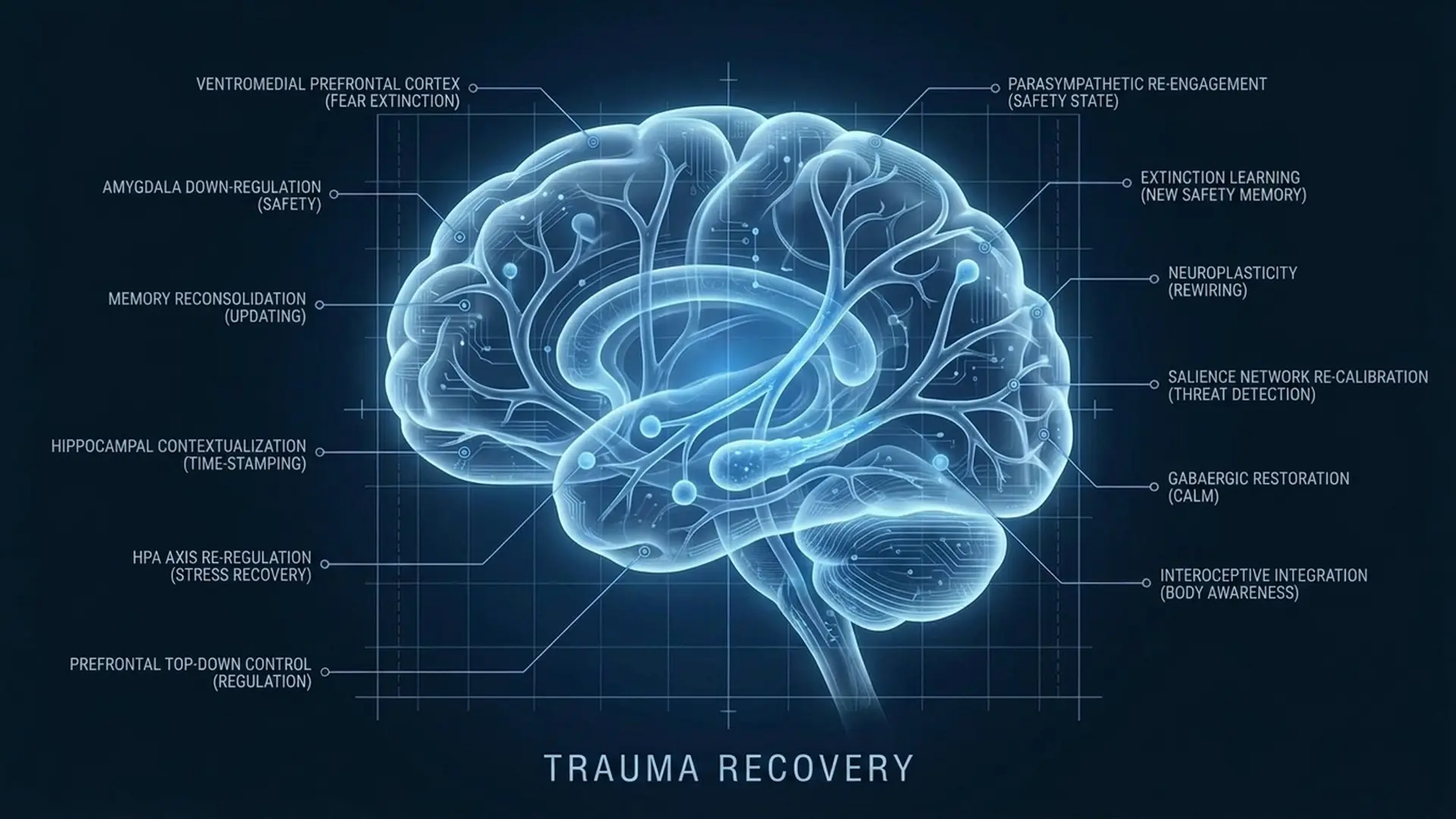
LeDoux’s work on fear conditioning at NYU established that the amygdala’s threat associations, once formed, are not erased by new learning: they are suppressed by competing circuits in the ventromedial prefrontal cortex. This means that recovery is not about deleting the trauma. It is about building new neural pathways strong enough to override the old ones and restoring the hippocampus’s capacity to contextualize the threat as past rather than present. Functional recovery requires the brain to learn, at the level of the circuit, that the conditions which necessitated the survival response no longer exist.
At MindLAB Neuroscience, Dr. Sydney Ceruto’s approach to trauma recovery reflects this neuroscience directly. Rather than processing the narrative of what happened in a removed setting, she works within the real-time conditions where traumatic patterns activate, because that is when the relevant circuitry is online and available for reorganization. Her 26 years of applied neuroscience practice have consistently demonstrated that circuit-level intervention during live activation produces more durable results than retrospective processing. A strategy call is the starting point for understanding how trauma has reorganized your neural architecture and what targeted intervention looks like.
The articles below explore the neuroscience of traumatic encoding, memory reconsolidation, nervous system recovery, and the mechanisms through which the brain can reorganize after overwhelming experience.