
When clients come to me exhausted, scattered, and unable to concentrate, I often ask a simple question: “How much time do you spend on short-form content?” More often than not, the answer is staggering. YouTube Shorts alone now commands trillions of views every year, a testament to the compelling nature of these short, fast-paced videos. But the very design that makes them impossible to resist is also reshaping your brain.
Key Takeaways
- YouTube Shorts leverage variable reward loops, exploiting unpredictability to maximize dopamine release.
- Neuroscience reveals that dopamine drives anticipation, not lasting satisfaction, leaving users restless and unfocused.
- Prolonged exposure fragments attention and memory, conditioning the brain to crave novelty over depth.
- Reward loops exploit evolutionary survival wiring in a modern environment of endless novelty.
- Rewiring is possible through awareness, replacement, ritual, and alignment with values.
The endless scroll of Shorts isn’t just harmless entertainment—it’s a direct manipulation of your brain’s reward loops. These loops, powered by deeply embedded survival mechanisms, are optimized for novelty, unpredictability, and anticipation. And while neuroscience explains why they feel so magnetic, it also reveals why prolonged exposure leaves you restless, unfocused, and unsatisfied.
Let me walk you through the neuroscience of how YouTube Shorts hijack your brain, why these reward loops affect your memory, focus, and productivity, and what you can do to reclaim your attention.
The Secret Weapon of Shorts: Variable Reward Loops
At the core of YouTube Shorts’ addictive power lies a principle well-known to neuroscience: variable reward loops . Research from Stanford University demonstrated that unlike predictable rewards , which the brain quickly adapts to, unpredictable outcomes produce the most substantial dopamine spikes. This is the exact mechanism that makes slot machines so irresistible.
Each swipe brings the possibility of encountering something hilarious, shocking, heartwarming, or informative. The uncertainty itself is what drives the craving. When you do get a hit of novelty or affective stimulation, your dopamine system learns: swipe again, the next one could be even better.
In my practice, I often explain it this way: your brain doesn’t release dopamine because you found something you like; it releases dopamine because you might find something you like. That “maybe” factor fuels relentless seeking. Hours vanish, attention fragments, and you walk away not refreshed, but depleted.
People often refer to this phenomenon as Doom Scrolling – the compulsive behavior of endlessly scrolling through negative or distressing news, social media posts, or online content. It is driven by the brain’s reward system, which reinforces the habit despite its emotional toll.
The Neuroscience of Anticipation vs. Satisfaction
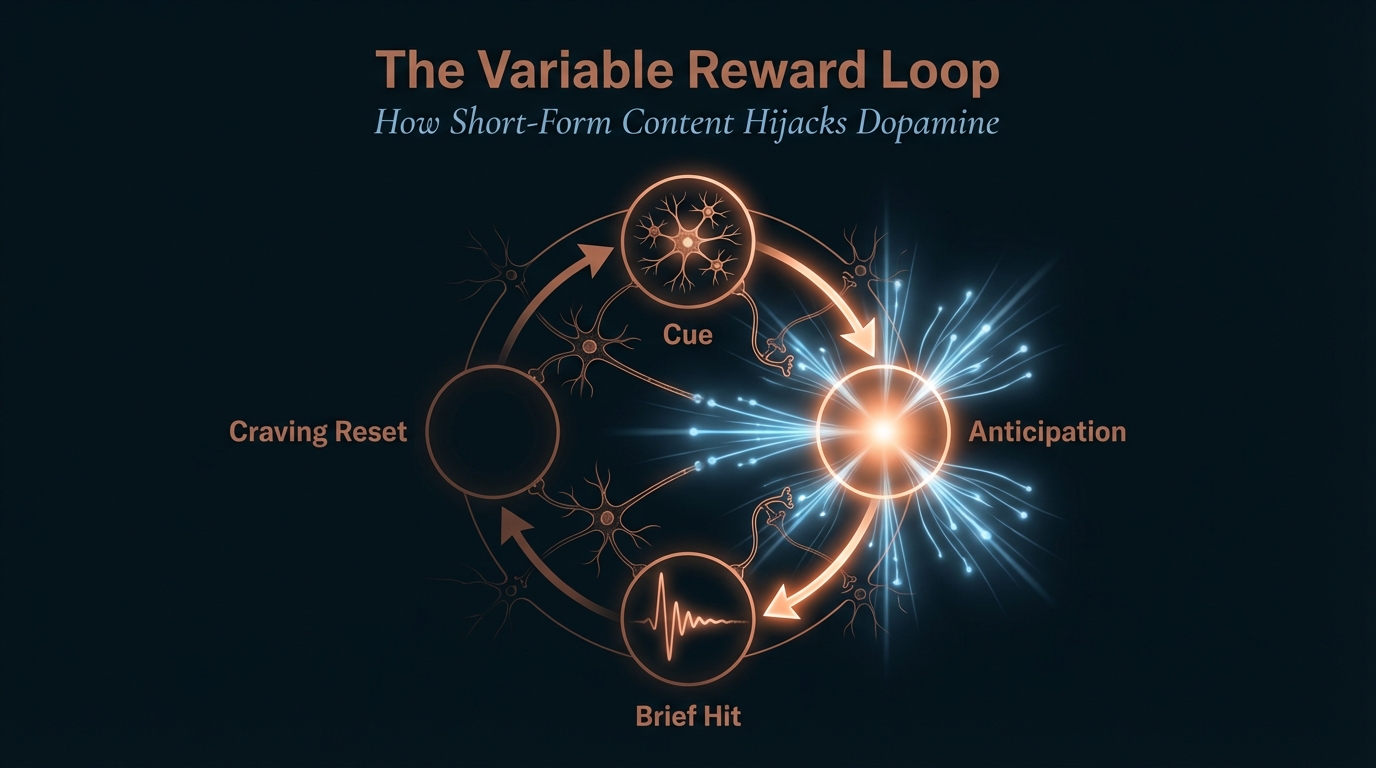
Neuroscience reveals that dopamine primarily drives anticipation rather than lasting enjoyment. Damasio (2022) demonstrates that the act of seeking creates surges of expectation mediated by somatic markers, while the satisfaction of each video remains fleeting. Within seconds, the brain recalibrates and prepares for the next anticipated reward, perpetuating the cycle without delivering genuine fulfillment.
| Reward Loop Stage | Brain Region | Neurochemical | Subjective Experience | Digital Equivalent |
|---|---|---|---|---|
| Anticipation | Ventral tegmental area → Nucleus accumbens | Dopamine surge | Excitement, craving, “one more swipe” | Thumb hovering over next video |
| Consumption | Orbitofrontal cortex | Brief opioid release | Fleeting satisfaction (2-5 seconds) | Watching the video |
| Habituation | Dorsal striatum | Dopamine baseline drops | Diminishing returns, restlessness | Videos feel less satisfying over time |
| Seeking | Anterior cingulate cortex | Dopamine prediction error | Compulsive pursuit, inability to stop | Scrolling past bedtime |
| Withdrawal | Prefrontal cortex (deactivated) | Cortisol elevation | Irritability, brain fog, attention deficit | Closing the app and feeling worse |
Over time, this constant cycle conditions your nervous system to prefer anticipation over presence. You become wired for pursuit, not enjoyment. This research explains why people often describe binge-watching Shorts as both exhilarating and strangely empty. The reward loops are firing perfectly, but the satisfaction system—the quieter interplay of serotonin, oxytocin, and endorphins—barely gets a chance to activate.
This imbalance reshapes how you approach work, relationships, and even self-worth. Tasks that require patience feel unbearable. Conversations lose depth. Achievements feel anticlimactic. You live in a perpetual state of craving, never truly arriving.
Attention Hijacked: The Cost to Focus and Memory

Every second spent in the grip of reward loops trains your brain to expect rapid novelty. Long-form tasks—such as reading a book, writing a report, or engaging in a meaningful conversation—become neurologically more challenging. Research by Siegel and Cozolino (2023) confirms that sustained attention networks weaken under conditions of chronic novelty-seeking, while your tolerance for.
Memory consolidation requires sustained attention. Neuroscience reveals that when distraction prevails, experiences fail to transition from short-term to long-term memory. That’s why you can watch dozens of Shorts in a row and barely recall details later. The system is optimized for the chase, not for retention.
Many clients describe this as “brain fog” or “mental clutter.” In reality, it’s the predictable outcome of running reward loops on repeat. Networks that once supported deep focus are being overtaken by those trained for novelty.
Evolutionary Roots: Why We’re Wired to Chase
To understand why reward loops are so powerful, we must step back into evolutionary history. For our ancestors, unpredictability was critical. A patch of berries might be sweet today and gone tomorrow. A hunting ground might yield a feast or nothing at all. The brain evolved to reward persistence in the face of uncertainty.
That wiring kept our species alive. But in today’s digital world, where novelty is infinite and risk nonexistent, the same circuitry turns against us. YouTube Shorts, TikTok, and Instagram Reels exploit this ancient bias, offering endless variability with zero consequence. The result is a brain stuck in perpetual pursuit mode, chasing stimulation without resolution.
Understanding the Habit Loop Cue
To understand how Shorts become compulsive, it helps to explore the habit loop. Habits are formed around three key components: the cue, the routine, and the reward. The cue might be boredom, fatigue, or stress. The routine is opening YouTube Shorts. The reward is the dopamine spike from novelty.
Over time, the brain begins to associate the cue directly with craving. That finding means you don’t just watch Shorts because you want entertainment—you watch them because your brain has learned to fire the craving at the very hint of boredom. This is the neuroscience of compulsive checking. In neuroscience, the cycle of habit loop cue routine reward explains exactly why YouTube Shorts feel automatic, and why the craving to swipe can fire before you even realize it. When you understand the habit loop cue, you gain the power to break it.
Case Study: Daniel—Productivity Crushed by Reward Loops
Daniel, a 34-year-old cybersecurity consultant, came to me overwhelmed and on the brink of burnout. Despite working multiple jobs from home, he confessed that hours of his day were disappearing into YouTube Shorts. “It’s my way of taking a break,” he said, “but I end up feeling more drained.”
When we mapped his behavior, the pattern was clear. His brain had become reliant on reward loops for microbursts of energy and distraction. However, these hits came at the expense of deep work, leaving him scrambling to meet deadlines and perpetually behind schedule.
Through targeted neurological work, we created a plan to retrain his brain. We installed intentional pauses that replaced reward loops with brief grounding exercises. We structured his day so genuine breaks—walks outside, short phone calls with friends, simple stretches—gave his nervous system satisfaction instead of just stimulation. Within two months, his focus improved dramatically, and the urge to escape into endless Shorts diminished.
Daniel didn’t need more discipline. He needed to understand the neuroscience of reward loops—and to rewire them.
The clients who break free from compulsive scrolling are not the ones with more willpower. They are the ones who understand what their nervous system is actually searching for — and build a legitimate source for it.
How Reward Loops Reshape Identity and Motivation

Prolonged engagement with digital reward loops does more than distract—it gradually erodes a person’s sense of identity and intrinsic purpose. Each loop reinforces a pattern of seeking external stimulation over internal meaning, shifting how individuals define their time and value. Barrett (2023) describes this as constructed emotional conditioning that reshapes motivational architecture over time.
In neuroscience terms, this creates a bias toward extrinsic motivation. You feel driven only when rewards are immediate, flashy, and uncertain. Intrinsic motivation—working for growth, meaning, or connection—atrophies. This is why so many people describe feeling unmotivated in daily life, yet can spend hours locked into digital reward loops.
Cultural and Social Dimensions of Reward Loops
Reward loops don’t operate in isolation; they are amplified by culture and society. Social validation—the ping of a like, the thrill of a share, the anticipation of comments—adds another layer of unpredictability. The neuroscience is clear: social cues activate the same reward systems as food and shelter.
YouTube Shorts are designed not just to entertain but to trigger comparison, aspiration, and competition. This compounds the craving, making it harder to disengage. Clients often report that the pull of “what others are doing” is stronger than their own original interests. This reveals how reward loops reshape cultural norms, narrowing focus toward the fleeting instead of the fulfilling.
Psychology of Variable Rewards
Variable reward schedules exert powerful control over behavior because the dopamine system responds most strongly to unpredictable outcomes. When rewards are uncertain, the brain’s anticipatory circuitry activates more intensely than when outcomes are guaranteed—a process rooted in reward prediction error, which is the gap between what the nervous system expects and what it receives.
Psychologically, this dynamic means that every swipe holds the possibility of surprise—a funny clip, a shocking fact, a moving story. That possibility, not the actual content, is what reinforces the behavior. In fact, studies in behavioral neuroscience show that variable rewards can make habits form up to four times faster than predictable ones.
This is why casinos thrive, why social media platforms dominate, and why YouTube Shorts feels so irresistible. You are not addicted to the videos themselves—you’re addicted to the anticipation of what might come next. That psychological loop, once activated, can override logical reasoning and keep you swiping even when you consciously want to stop.
The more you understand the psychology of variable rewards, the easier it becomes to step outside the loop and reclaim your agency. Recognizing that your craving is not for the video itself, but for the unpredictability, helps you reframe the experience and build healthier digital habits.
Reclaiming Your Brain: Expanded Strategies
The good news is that your brain is plastic. Reward loops can be rewired, and sustained focus can be rebuilt. Here are deeper strategies I share with my clients:. Multiple brain regions contribute to this process through synchronized neural firing patterns that emerge during both resting and active.
Track Your Cues
Notice the cues that trigger your behavior. Is it boredom, stress, or loneliness? Awareness of cues interrupts the autopilot of reward loops. Try keeping a small log for one week: write down what you were feeling right before you opened YouTube Shorts. Patterns will emerge quickly, and once you see them, you can intervene.
Replace with Enrichment
Instead of reaching for Shorts, replace the habit loop cue with a routine reward cycle that incorporates enriching novelty. Read a short essay, learn a new word, sketch a quick idea, or even step outside for a two-minute walk. You still get stimulation, but in a form that builds rather than depletes.

Harness Dopamine Wisely
You cannot eliminate dopamine—it is essential to motivation. But you can harness it strategically —pair effort with mild, intentional rewards. A favorite playlist during deep work, a special tea when you start writing, or a short walk after finishing a project all use dopamine to reinforce healthy routines.
Ritualize Completion
Our brains are biased toward starting, not finishing. That’s why closure often feels anticlimactic. To counteract this, create completion rituals, such as taking a deep breath, jotting down what you accomplished, or even standing up and stretching. Label the win, share it, or reflect in writing.
Create Attention Anchors
Use tools like timers, focus playlists, or environmental cues to guide attention back to meaningful work. An anchor can be as simple as a candle you only light when working, or a specific chair reserved only for deep tasks. Neuroscience reveals that physical and sensory anchors enhance consistency by tying focus to a ritual.
Practice White Space Daily
Neuroscience reveals that the brain recalibrates during downtime. Protect daily windows free from devices—no screens, no stimulation. Even just ten minutes of white space can lower cortisol, strengthen executive function, and restore your ability to focus. This practice is not laziness; it is maintenance for your prefrontal cortex, the part of your brain responsible for self-control.
Reconnect with Values
One of the most potent antidotes to digital distraction is meaning. Refocus goals on what matters most. Ask yourself: Does this activity align with my long-term values, or is it just a short-term craving? When your energy is invested in pursuits that reflect your values—whether learning, connection, or creativity—your brain experiences intrinsic motivation.
Why This Matters for the Future
We’re entering an era where short-form, variable content will only expand. Platforms have every incentive to exploit reward loops because attention is their currency. However, neuroscience reveals that the cost is high: fragmented attention, weakened memory, and diminished fulfillment. The underlying neural mechanisms involve coordinated activity across cortical.
The clients I work with who break free from compulsive digital consumption share one characteristic: they stopped trying to fight the loop with willpower and started rebuilding the neural architecture underneath it. Real-Time Neuroplasticity™ provides the mechanism — intervening in the live moment when the craving fires, before the hand reaches for the phone, building new evidence that the nervous system can self-regulate without external stimulation as the delivery mechanism.
The choice isn’t between abandoning technology and surrendering to it. The choice is whether you allow reward loops to dictate your brain—or you reclaim agency. By understanding the neuroscience beneath the scroll, and by understanding the habit loop, you can build a life where novelty excites you but doesn’t own you.

Key Takeaways from This Article
- YouTube Shorts leverage variable reward loops, exploiting unpredictability to maximize dopamine release.
- Neuroscience reveals that dopamine drives anticipation, not lasting satisfaction, leaving users restless and unfocused.
- Prolonged exposure fragments attention and memory, conditioning the brain to crave novelty over depth.
- Reward loops exploit evolutionary survival wiring in a modern environment of endless novelty.
- Understanding the habit loop is critical to breaking compulsive digital behavior.
- Rewiring is possible through awareness, replacement, ritual, and alignment with values.
Panksepp, J. (2021). Affective neuroscience: The foundations of human and animal emotions. Oxford University Press. Current neuroscience research suggests that this phenomenon emerges from coordinated activity across multiple brain networks, involving regions responsible for emotional processing, memory consolidation, attention regulation, and the integration of sensory information with.
Damasio, A. (2022). Somatic markers, consciousness, and the construction of emotion. Annual Review of Neuroscience, 45, 1-24.
Barrett, L. F. (2023). Constructed emotion theory and the architecture of affective experience. Psychological Review, 130(2), 211-238.
Frequently Asked Questions
The following questions address common concerns about the neuroscience concepts discussed in this article. Each answer draws on current research findings to provide practical, evidence-informed perspectives that can support your understanding of how the brain shapes behavior, emotion, and everyday experience across different life contexts.
How long does it take to rewire reward loops from short-form video?
Most clients begin noticing measurable changes in focus and craving patterns within 2-4 weeks of consistent intervention. The dopamine system recalibrates relatively quickly once the variable reward signal is interrupted — but the habit loop cue (boredom, stress, loneliness) requires separate attention. Full rewiring of the compulsive seeking pattern typically takes 60-90 days of deliberate replacement behavior, though the sharpest improvements occur in the first 3 weeks.
Are YouTube Shorts more addictive than TikTok or Instagram Reels?
The neurological mechanism is identical across all short-form platforms — variable reward loops exploiting dopamine prediction error. The differences are algorithmic, not neurochemical. YouTube Shorts may feel stickier for some users because YouTube’s recommendation engine draws on years of watch history data, making predictions more personalized and therefore more neurochemically compelling. The brain does not distinguish between platforms; it responds to the unpredictability pattern itself.
Can short-form video cause permanent attention damage?
Neuroplasticity works in both directions. Prolonged exposure to variable reward loops can weaken sustained attention networks, but these networks rebuild when exercised. The damage is functional, not structural — attention circuits are suppressed, not destroyed. Clients who implement structured deep-focus practices consistently recover their concentration capacity, though the timeline depends on how long and how intensely the reward loop pattern was reinforced.
Why do I feel worse after scrolling even though it felt good in the moment?
Dopamine drives the pursuit — the swiping, the seeking, the “one more” impulse — but it does not deliver lasting satisfaction. The satisfaction system (serotonin, oxytocin, endorphins) barely activates during rapid-fire content consumption. When you stop scrolling, the dopamine drops but the satisfaction system was never engaged, leaving you in a neurochemical deficit: depleted without having been fulfilled. The feeling of emptiness afterward reflects the gap between pursuit energy spent and actual reward received.
Is there a safe amount of short-form video consumption?
There is no universal threshold because individual dopamine sensitivity varies significantly. However, the pattern matters more than the duration. Intentional viewing — choosing specific content, watching it, and closing the app — is neurologically different from open-ended scrolling. The reward loop activates primarily during the seeking phase, not during deliberate consumption. In practice, clients who cap sessions at 10-15 minutes with a defined endpoint and no open-ended scrolling report minimal cognitive impact.
From Reading to Rewiring
Understand the neuroscience. Apply it to your life. Work directly with Dr. Ceruto to build a personalized strategy.
Book a Strategy CallReferences
- Schultz, W. (2016). Dopamine reward prediction error signalling: A two-component response. Nature Reviews Neuroscience, 17(3), 183-195. DOI: 10.1038/nrn.2015.26
- Lembke, A. (2021). Dopamine Nation: Finding Balance in the Age of Indulgence. Dutton/Penguin Random House.
- Montag, C., et al. (2019). Addictive features of social media/messenger platforms and freemium games against the background of psychological and economic theories. International Journal of Environmental Research and Public Health, 16(14), 2612. DOI: 10.3390/ijerph16142612
The following peer-reviewed sources informed the research and clinical insights presented in this article on YouTube Shorts and reward loop neuroscience. Citations include work on variable reward scheduling, dopaminergic habituation, attentional capture research, and neuroscience findings on compulsive media consumption and its circuit-level drivers.