Key Takeaways
- The brain stores no fuel, so cerebral blood flow must supply oxygen and glucose continuously.
- Neurovascular coupling routes extra blood to the hardest-working regions, matching supply to demand within seconds.
- Aerobic movement raises cerebral blood flow, grows new vessels, and protects perfusion with age.
- Declining blood flow and vascular health take cognition with them; vascular injury drives age-related dementia.
- Blood flow powers the brain’s overnight cleaning system, protecting daytime function and nightly waste clearance.
Cerebral blood flow is the brain’s lifeline. Your brain is about two percent of your body weight, yet it consumes roughly a fifth of the oxygen and fuel your heart pumps, and it stores almost none of it in reserve. That means cognition depends, minute by minute, on a steady, well-aimed blood supply. Movement and vascular health are how you protect it.
Why Does the Brain Depend So Heavily on Blood Flow?
The brain is the most metabolically expensive organ you own, and it runs almost entirely on what arrives in the blood. It makes up roughly two percent of body mass but draws close to twenty percent of the body’s oxygen and glucose at rest. Crucially, it keeps barely any of that fuel in storage. Where muscle and liver bank glycogen for later, the brain lives hand to mouth, which is why even a brief interruption in blood supply produces symptoms within seconds and lasting damage within minutes.
This is the simple, under-appreciated fact behind a great deal of cognitive performance: thinking is a delivery problem before it is anything else. Every act of attention, recall, and decision is paid for in oxygen and glucose that has to arrive on time, in the right place, through a dense network of vessels. The brain protects this supply fiercely. It holds its own blood flow remarkably stable across swings in blood pressure, and it sits behind a specialized barrier, the blood-brain barrier, that controls with great precision what is allowed to cross from the bloodstream into neural tissue. The vasculature is not plumbing bolted onto the brain. It is part of the brain’s working machinery.
That reframing matters because it changes what counts as brain care. If the brain is, in a real sense, a vascular organ, then everything that protects your blood vessels also protects your mind. This is the thread that runs through our hub on brain health and optimization, part of the wider architecture of how the brain attends, decides, and learns, where sleep, movement, and blood flow keep neural networks resilient. It is the specific leg this article takes up: how the flow of blood itself protects cognition.
How Does the Brain Send Blood Exactly Where It Is Working?
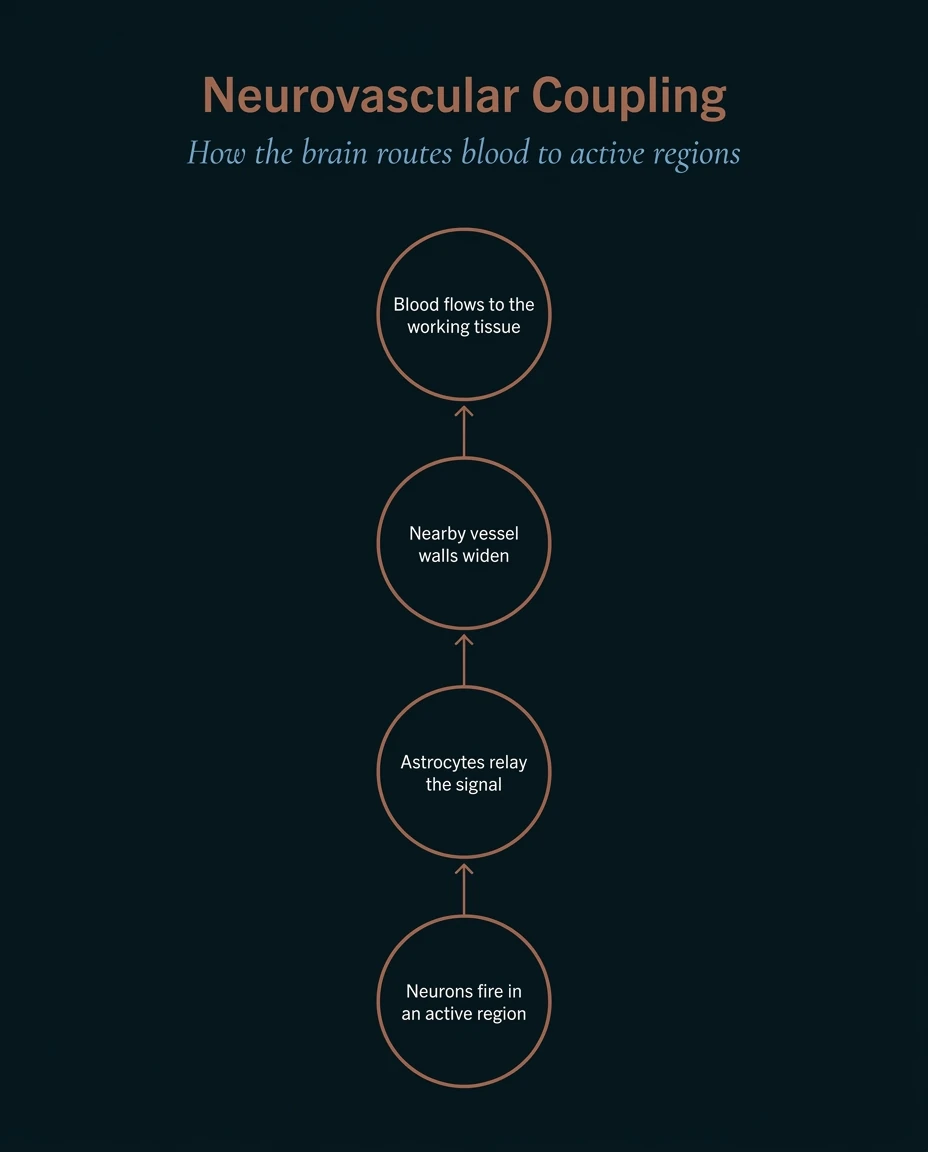
The brain cannot flood every region with blood at once, so it does something far more elegant: it sends extra blood, on demand, to whichever circuits are active in the moment. Start reading and the language regions draw more flow. Solve a problem and the supply shifts toward the networks doing the work. This matching of blood supply to local neural demand, second by second, is called neurovascular coupling, and it is one of the quiet marvels of how the brain stays fed.
The mechanism is genuinely collaborative. When a population of neurons fires, it does not simply wait for more blood to show up. Together with astrocytes, the star-shaped support cells that wrap around both synapses and vessels, active neurons release chemical signals that relax the nearby vessel walls and widen them, pulling more blood into exactly the patch of tissue that needs it. As David Attwell and colleagues detailed in their account of how glia and neurons control brain blood flow, much of this fine control happens not only at the larger arterioles but right down at the capillaries, the smallest vessels woven through the tissue. The system is precise enough to track thought as it moves.
Neuroscientists now describe the neurons, astrocytes, and vascular cells that pull this off as a single functional team, the neurovascular unit, and treat it as a unit of brain health in its own right. In his integrative review of the neurovascular unit, Costantino Iadecola makes the case that the partnership between brain cells and blood vessels is so tight that when the coupling falters, cognition suffers, well before any single neuron dies. It is also the basis of brain imaging: when an fMRI study lights up a region, what it is actually detecting is the blood-flow response that coupling produces. We read the mind, in practice, by reading its circulation.
How Does Movement Increase and Protect Cerebral Blood Flow?
Aerobic movement is the most reliable lever most people have over their own cerebral blood flow. Fit adults carry measurably higher flow through the brain than sedentary ones, and the gap is not small. In a study tracking cerebral blood flow velocity across healthy adult aging, Philip Ainslie and colleagues found that the most aerobically fit men had brain blood-flow velocity that amounted to being roughly a decade younger, a striking offset to the slow decline in perfusion that otherwise comes with age. You can read their report on elevated cerebral blood flow velocity with aerobic fitness in The Journal of Physiology. Higher fitness, in other words, is associated with markedly younger patterns of cerebral blood flow.

Movement does more than push more blood through existing vessels. Over time, it changes the vessels themselves. When Ana Pereira, Scott Small, and their colleagues had people complete a three-month aerobic exercise program, MRI showed a selective rise in blood volume in the dentate gyrus, the hippocampal subregion most central to forming new memories, and that rise tracked with measurable gains in both aerobic fitness and memory. In the animal arm of the same work, the increase in blood volume corresponded to the growth of new neurons. Their study, an in vivo correlate of exercise-induced neurogenesis, exploited a deep biological fact: the brain tends to grow new blood vessels and new neurons together, so a richer blood supply and a more plastic brain arrive as a pair.
That vessel growth has a name, angiogenesis, the formation of new capillaries, and it is how a frequently used brain region expands its own supply line. I hold the precise human dose loosely here, because much of the direct evidence that exercise builds new capillaries comes from animal models, where sustained activity reliably raises both capillary density and blood volume in the regions the movement recruits. But the principle is consistent across species and methods: a brain that moves is a brain that perfuses itself better, both right now and structurally over months. This is the same exercise signal that drives the growth factor I discuss in our explainer on BDNF, the brain’s growth signal you can influence. Movement protects the brain through several doors at once, and blood flow is one of the most direct.
What Happens to Cognition When Blood Flow Falters?
When perfusion drops or the vessels themselves are damaged, cognition pays the bill. Chronically reduced cerebral blood flow and small-vessel injury starve neurons of the steady delivery they cannot do without, and the effect accumulates quietly over years before it announces itself. This is not a fringe contributor to cognitive decline. In their scientific statement on vascular contributions to cognitive impairment and dementia, Philip Gorelick and colleagues, writing for the American Heart Association and American Stroke Association, concluded that vascular brain injury is one of the most important and most preventable contributors to later cognitive decline. The conditions that damage the heart and the arteries, untreated high blood pressure, diabetes, smoking, and a sedentary life, are the same ones that quietly erode the brain’s blood supply.
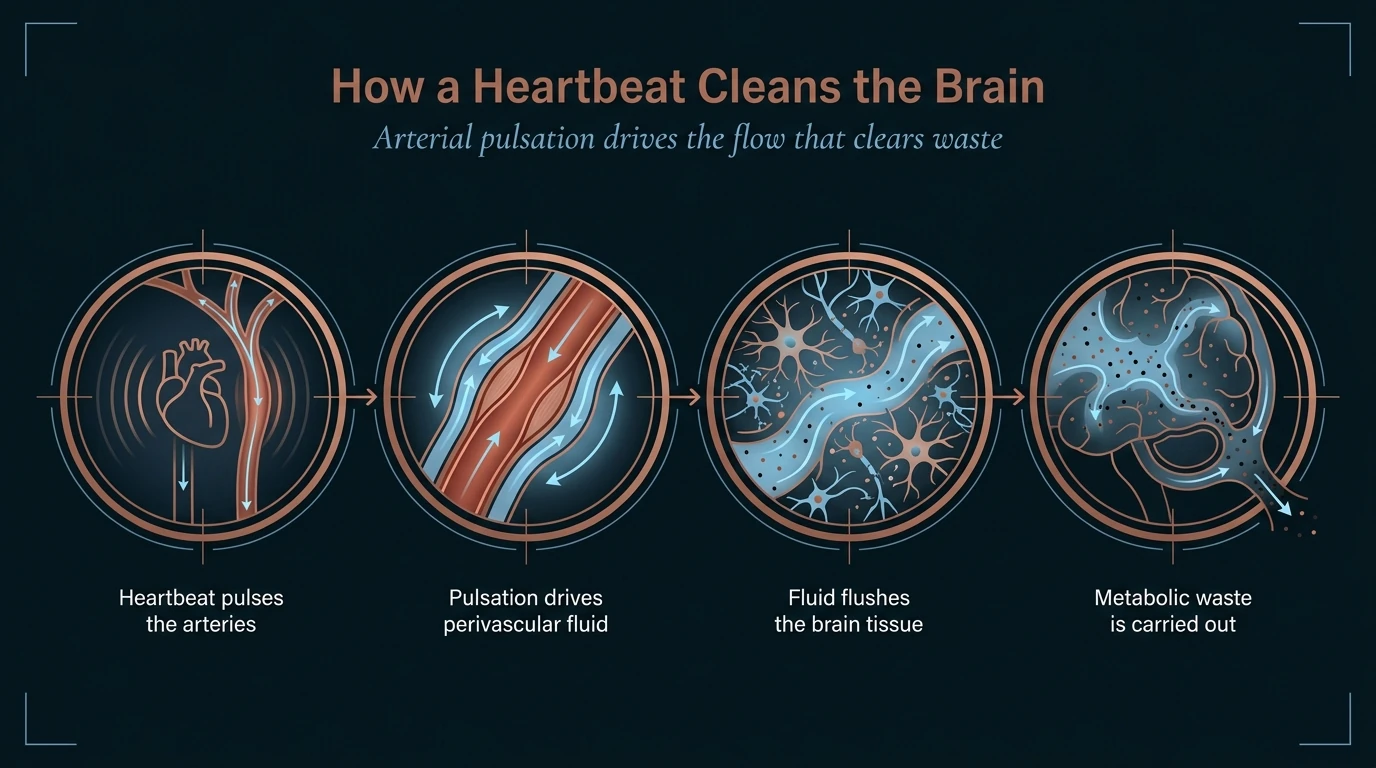
There is a second, subtler cost. Blood flow does not only feed the brain; it helps clean it. The brain clears metabolic waste through fluid that moves along the spaces surrounding its blood vessels, and that flow appears to be driven, in large part, by the pulsing of the arteries themselves with each heartbeat. Humberto Mestre and colleagues showed that these arterial pulsations are a principal pump for the perivascular fluid flow behind waste clearance, and that in hypertension the altered pulsation reduces the net flow that does the cleaning. Stiff, poorly regulated vessels do not just deliver less; they wash less. This links circulation directly to the overnight clearance I cover in our piece on the glymphatic system and how the brain cleans itself during sleep, which is why the same vascular health protects both how well you think by day and how well you clear waste by night.
The encouraging side of this is that the brain’s vasculature stays responsive to how you live. The capacity to protect and even improve perfusion does not vanish with age, which is part of the larger story I tell in what the science actually shows about neuroplasticity after forty. Vessels, like circuits, respond to use.
The brain is a vascular organ. Every thought you have is delivered through blood vessels, which means the care you give your circulation is care you give your mind.
Why the People Who Train Their Minds but Neglect Their Circulation Pay for It
In more than twenty-six years of working with people in demanding, high-stakes roles, I have watched a particular blind spot play out again and again. It is not confined to any one kind of person. I see it just as often in someone who has every resource and the discipline to use it, yet treats the brain as pure software, something to be optimized with the right thinking, the right routines, the right inputs, while quietly neglecting the hardware that runs it. They will overhaul their calendar and their focus rituals and never once consider that their resting blood pressure, their sedentary days, and their never-quite-addressed cardiovascular risk are slowly throttling the very organ they are trying to sharpen.
The pattern is consistent. The cognitive symptoms they eventually bring me, the afternoon fog, the words that arrive a beat late, the sense that recall is not what it was, get attributed to stress or age or workload. Sometimes that is right. But often enough the missing variable is circulatory: a brain being asked to perform at a high level on a blood supply that has been allowed to decline. I treat cerebral blood flow as a foundation precisely because it sits underneath everything else. You can train attention and memory all you like, but you are training them on whatever perfusion you provide.
The practical upshot is unglamorous and powerful. The aerobic movement that protects your heart is, by the same mechanisms, protecting your mind, and it compounds with the other brain-health levers rather than competing with them. A well-perfused brain ages more slowly in the ways that matter, which connects directly to why some brains age better than others. The single most reliable thing most people can do for their long-term cognition is also the thing they are most likely to skip: move enough, often enough, to keep the blood flowing.
| Dimension | The under-perfused brain | The well-perfused brain |
|---|---|---|
| Fuel delivery | Oxygen and glucose arrive unevenly, so demanding tasks tire the brain faster | Steady, well-matched delivery supports sustained attention and recall |
| Neurovascular coupling | The supply-to-demand match grows sluggish, blunting performance before neurons are lost | Blood reaches active regions quickly and precisely as thought shifts |
| Vessel health over time | Stiff, damaged vessels lower perfusion and raise the risk of vascular cognitive decline | Movement-driven vessel growth and flexibility preserve supply with age |
| Waste clearance | Weakened arterial pulsation slows the perivascular flow that washes out waste | Healthy pulsation helps power the brain’s overnight cleaning |
Understanding that blood flow protects cognition is the first step. Building the specific movement and vascular habits that actually keep your brain well-supplied, in a way that fits a demanding life rather than fighting it, is where steadier focus and sharper recall begin.
If you are investing heavily in how you think but have never looked at how well your brain is being supplied, that may be the missing variable. Book a Strategy Call with Dr. Ceruto to map where your brain health has room to grow and design a neuroscience-based plan around how your brain, and its circulation, actually work.
What is cerebral blood flow, and why does it matter for thinking?
Cerebral blood flow is the supply of blood that delivers oxygen and glucose to the brain. It matters because the brain has almost no stored fuel and uses close to a fifth of the body’s energy, so it depends on a constant, well-aimed blood supply to function. Attention, memory, and decision-making are all paid for in oxygen and glucose that has to arrive on time, which is why protecting blood flow is one of the most direct ways to protect cognition.
Does exercise really increase blood flow to the brain?
Yes. Aerobically fit adults show measurably higher cerebral blood flow than sedentary peers, and in one study of healthy aging the fittest men had brain blood-flow velocity equivalent to being about a decade younger. Beyond moving more blood through existing vessels, sustained exercise also encourages the brain to grow new capillaries in the regions it uses, so movement improves perfusion both immediately and structurally over time.
What is neurovascular coupling?
Neurovascular coupling is the brain’s ability to send extra blood to whichever regions are most active at a given moment. When a group of neurons fires, those neurons and nearby support cells called astrocytes signal the local blood vessels to widen, drawing more blood into exactly the tissue that needs it, within seconds. It is how the brain matches its blood supply to changing demand, and it is also what brain-imaging methods like fMRI actually measure.
How does poor blood flow contribute to cognitive decline?
When cerebral blood flow drops or the small vessels in the brain are damaged, neurons receive less of the steady oxygen and glucose they require, and the effect accumulates over years. Major health organizations identify vascular brain injury as one of the largest and most preventable contributors to cognitive impairment and dementia. The conditions that harm the heart and arteries, such as untreated high blood pressure, diabetes, and inactivity, are the same ones that gradually erode the brain’s blood supply.
What is the best way to protect cerebral blood flow as I age?
Regular aerobic movement is the most reliable lever most people have, because it raises blood flow, encourages new vessel growth, and helps keep arteries flexible. Managing cardiovascular risk factors, including blood pressure, blood sugar, and smoking, protects the same vessels that supply the brain. These are general, research-supported principles rather than personal medical advice, and anyone with specific health conditions should work them out with their own physician, but the broad direction is clear: what is good for your heart is good for your brain.
References
- Ainslie, P. N., Cotter, J. D., George, K. P., Lucas, S., Murrell, C., Shave, R., Thomas, K. N., Williams, M. J. A., & Atkinson, G. (2008). Elevation in cerebral blood flow velocity with aerobic fitness throughout healthy human ageing. The Journal of Physiology, 586(16), 4005-4010. https://doi.org/10.1113/jphysiol.2008.158279
- Pereira, A. C., Huddleston, D. E., Brickman, A. M., Sosunov, A. A., Hen, R., McKhann, G. M., Sloan, R., Gage, F. H., Brown, T. R., & Small, S. A. (2007). An in vivo correlate of exercise-induced neurogenesis in the adult dentate gyrus. Proceedings of the National Academy of Sciences, 104(13), 5638-5643. https://doi.org/10.1073/pnas.0611721104
- Swain, R. A., Harris, A. B., Wiener, E. C., Dutka, M. V., Morris, H. D., Theien, B. E., Konda, S., Engberg, K., Lauterbur, P. C., & Greenough, W. T. (2003). Prolonged exercise induces angiogenesis and increases cerebral blood volume in primary motor cortex of the rat. Neuroscience, 117(4), 1037-1046. https://doi.org/10.1016/S0306-4522(02)00664-4
- Attwell, D., Buchan, A. M., Charpak, S., Lauritzen, M., MacVicar, B. A., & Newman, E. A. (2010). Glial and neuronal control of brain blood flow. Nature, 468(7321), 232-243. https://doi.org/10.1038/nature09613
- Iadecola, C. (2017). The neurovascular unit coming of age: A journey through neurovascular coupling in health and disease. Neuron, 96(1), 17-42. https://doi.org/10.1016/j.neuron.2017.07.030
- Gorelick, P. B., Scuteri, A., Black, S. E., DeCarli, C., Greenberg, S. M., Iadecola, C., Launer, L. J., Laurent, S., Lopez, O. L., Nyenhuis, D., Petersen, R. C., Schneider, J. A., Tzourio, C., Arnett, D. K., Bennett, D. A., Chui, H. C., Higashida, R. T., Lindquist, R., Nilsson, P. M., … Seshadri, S. (2011). Vascular contributions to cognitive impairment and dementia: A statement for healthcare professionals from the American Heart Association/American Stroke Association. Stroke, 42(9), 2672-2713. https://doi.org/10.1161/STR.0b013e3182299496
- Mestre, H., Tithof, J., Du, T., Song, W., Peng, W., Sweeney, A. M., Olveda, G., Thomas, J. H., Nedergaard, M., & Kelley, D. H. (2018). Flow of cerebrospinal fluid is driven by arterial pulsations and is reduced in hypertension. Nature Communications, 9(1), 4878. https://doi.org/10.1038/s41467-018-07318-3