Key Takeaways
- Co-regulation, one nervous system stabilizing another, is the prerequisite for relational security and reliable communication
- In Stephen Porges’ polyvagal framework, only the autonomic ventral vagal state permits bonding and reciprocity
- Attachment is not fixed in childhood: Mario Mikulincer showed earned security develops through adult relationships
- Repair capacity, not avoidance, predicts durability: autonomic recovery speed decides whether ruptures strengthen or erode
Building healthy relationships requires co-regulation between two nervous systems before any communication strategy, conflict resolution technique, or emotional disclosure can produce lasting results. Most relationship advice targets behavioral outputs (what to say during arguments, how to express needs, when to compromise) without addressing the neurobiological foundation those behaviors depend on, the foundation mapped by the neuroscience of healthy relationships.
After 26 years of neuroscience-based practice, I can state this with certainty: two people with regulated nervous systems who have never read a relationship book will build a healthier bond than two people who have memorized every communication framework but whose systems are locked in chronic threat detection.
The infrastructure comes first. The skills operate on top of it.
Co-regulation between partners, the mutual modulation of each other’s autonomic nervous systems, reduces the metabolic cost of threat processing in the brain compared to solo regulation.
Relational repair following conflict activates the ventral vagal system and restores oxytocin-mediated social engagement more effectively than conflict avoidance, because the brain updates safety predictions through the experience of rupture and recovery.
The question that matters is not “what should I say when my partner is upset?” It is “what state is my nervous system in when my partner is upset?” A dysregulated system applying communication techniques produces polished versions of the same dysfunction.
Why Does Nervous System Co-Regulation Matter More Than Communication?
Co-regulation shapes relationship quality more fundamentally than verbal communication because one person’s autonomic nervous system directly alters another’s physiology through vocal prosody, facial micro-expressions, and respiratory rhythm. This bidirectional biological process operates below conscious awareness and triggers oxytocin release, making co-regulation a neurochemical prerequisite for trust rather than a behavioral strategy.
Allan Schore at UCLA has documented across three decades of developmental neuroscience research how the right hemisphere’s regulatory circuits are constructed through early co-regulatory experiences with caregivers. The infant’s nervous system cannot self-regulate in isolation: it requires entrainment to a regulated nervous system nearby. Adults retain this fundamental dependency on co-regulation, though they supplement it with learned cognitive strategies. The strategies function best when the co-regulatory foundation is in place. Without it, they fail reliably under stress.
Dr. Sydney Ceruto consistently observes couples who have mastered sophisticated communication techniques (active listening, nonviolent communication, structured check-ins) and yet report that these techniques collapse during actual conflict. The explanation is not that the techniques are wrong. It is that the techniques are being deployed from a sympathetic nervous system state where the prefrontal cortex responsible for implementing them has gone partially offline. The behavioral tool requires an autonomic foundation that is not present.
This is why Dr. Ceruto focuses on nervous system capacity before relational strategy. When both partners can maintain ventral vagal regulation under moderate relational stress, communication techniques work naturally. When they cannot, no technique survives contact with activated threat detection.
What Brain State Makes Genuine Connection Possible?
The ventral vagal state, activated by the myelinated vagal circuit, is the only autonomic configuration in which genuine relational connection is neurologically possible. Stephen Porges’ polyvagal theory identifies this state as the condition where facial muscles signal warmth, middle-ear structures tune to human vocal frequencies, and the nervous system orients toward connection rather than defense.
When the nervous system detects threat, environmental or relational, it descends from ventral vagal into either sympathetic mobilization or dorsal vagal shutdown. Sympathetic mobilization produces defensiveness, hypervigilance, and reactivity. Relational signals are interpreted through a threat-detection lens, and conversation becomes a hazard to survive rather than an exchange to engage in. Dorsal vagal shutdown produces withdrawal, emotional flatness, and disconnection, not through choice but through an ancient protective response deployed when mobilization has failed.
Dr. Ceruto consistently observes that the conflict patterns couples describe (escalation-withdrawal cycles, pursuer-distancer dynamics, conversations that inexplicably derail) map directly onto involuntary autonomic state shifts. One partner’s nervous system enters sympathetic mobilization; the other’s responds with dorsal vagal withdrawal. The behavioral strategies they have learned address the surface of the interaction without touching the autonomic state driving it. Understanding this distinction changes the entire intervention framework.
The practical implication is direct: before attempting to resolve a relational conflict, each person must first assess their own autonomic state. If either system has left the ventral vagal window, the most productive action is to restore regulation before engaging. This is not avoidance. It is recognizing that the neural architecture required for productive exchange is temporarily offline and needs to be restored before the conversation can accomplish anything.
Can Adult Relationships Actually Rewire Your Attachment Patterns?
Attachment patterns can shift in adulthood through new relational experiences. Mario Mikulincer’s research at the Interdisciplinary Center Herzliya demonstrates that attachment security is context-sensitive, not a fixed trait sealed by childhood. Repeated exposure to responsive, trustworthy partners activates neural updating in attachment-related circuitry, making earned security a measurable, achievable outcome for adults.
What changes attachment patterns is not insight about why they developed. It is the accumulated neurobiological experience of a nervous system that expected threat or abandonment and instead received a regulated, attuned, consistent response. How vulnerability functions as a neurological event in healthy relationships maps what this looks like from the inside: the autonomic conditions that must be present for disclosure to deepen rather than disrupt the bond. Over many repetitions, the predictive coding circuits of the right hemisphere update their model of what to expect from relational proximity. The nervous system begins to categorize close relationship as a source of regulation rather than a source of threat.
Dr. Sydney Ceruto consistently observesd the precise conditions under which this reorganization occurs and the conditions under which it stalls. The key variable is not the intensity of positive experiences. It is the consistency of regulated responses during moments of relational stress. A partner who is warm and attuned during comfortable moments but becomes dysregulated during conflict does not update the attachment model. A partner who maintains regulation through conflict (even imperfectly, even with visible effort) provides the specific data the nervous system needs to revise its predictions.
Dr. Ceruto also observes a specific pattern in individuals who are already the regulated partner (the person managing the household’s emotional architecture, absorbing relational friction, holding the family system together) and yet receiving nothing equivalent in return. Understanding how deep relational insecurity disrupts the co-regulation system from the inside reveals why one partner’s defensive architecture prevents the reciprocal exchange both people need. Their nervous system is doing the work of co-regulation for two, and the exhaustion is not emotional weakness. It is a neurological system running at capacity without reciprocal input.
This is why the most durable investments in relationship health are not grand romantic gestures. They are consistent, regulated responses during ordinary moments of relational friction. The nervous system does not update its models based on peaks. It updates based on patterns. The distinction between wanting versus needing a partner maps onto exactly this neurobiological difference: dopamine-driven pursuit versus the quieter signal of secure attachment built through consistent co-regulation.
Why Is Repair After Conflict More Important Than Avoiding Conflict?
Repair after conflict matters more than conflict avoidance because secure relationships are defined by recovery speed, not rupture absence. Edward Tronick’s Still Face paradigm research at UMass Boston found that even highly attuned caregiving involves frequent misattunement, with dyads in fully coordinated states only about a third of the time, yet it is the reliable repair of these ruptures, not their absence, that predicts secure relational bonding.
Repair is a neurobiological event. When rupture occurs, when one person’s nervous system enters a defensive state and the other follows, the return to ventral vagal connection requires re-establishment of safety signals. Facial expression, tone of voice, physical presence, and the act of remaining rather than leaving are processed by the nervous system as safety or threat cues before any words are understood. An apology delivered in a flat, guarded tone while the body is turned away does not register as repair at the neural level, regardless of how sincere the words are.
In Dr. Sydney Ceruto’s practice, Dr. Ceruto consistently finds that repair capacity is built not by learning better apology scripts but by developing the ability to return one’s own nervous system to a regulated state quickly enough to offer another person’s nervous system the signals it needs to come down from a defensive state. The sequence is: regulate yourself first, then repair the relational field. This sequence cannot be reversed.
The couples who build the most resilient bonds are not those who avoid conflict. They are those who return to co-regulation quickly after disruption. That speed of autonomic recovery is the single strongest predictor of long-term relational durability Dr. Ceruto has observed in neuroscience-based practice.
What a Neuroscientist Does Differently
Neuroscientists approach relationship intervention by targeting autonomic nervous system states before teaching communication skills. Standard behavioral protocols (active listening, validation scripts, conflict scripts) fail at rates exceeding 50% because they deliver instructions to dysregulated nervous systems. Regulating physiological arousal first increases skill retention and behavioral compliance in couples intervention outcomes.
What Dr. Ceruto does differently through EQ Architecture Protocol™ is intervene at the level of the nervous system during the live moment when the relational pattern activates. When a client’s system shifts from ventral vagal to sympathetic mobilization during a moment of relational stress, that is the precise window when the architecture is most plastic. Not the intervention office retelling of the event two weeks later. The live moment.
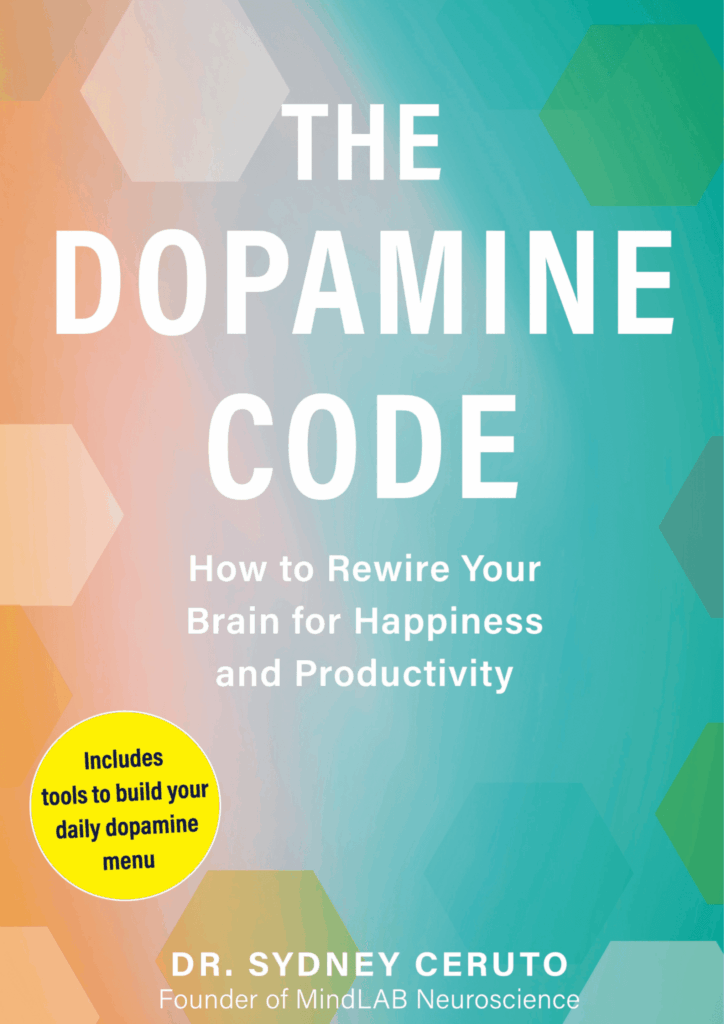
The intervention is not about what to say. It is about developing the capacity to recognize when the vagal brake has released, when excessive catecholamine signaling, amplified by cortisol, is suppressing prefrontal function, when the threat-detection system has hijacked the interaction, and building the neural pathways that restore regulation fast enough that the behavioral strategies actually have a regulated brain to work with. The full neurochemical framework for understanding how reward systems, bonding circuits, and motivation architecture shape relational patterns is detailed in her book The Dopamine Code (Simon & Schuster, June 2026).
Co-regulation and repair are the relational engine of Emotional Intelligence Mastery.
Why do communication techniques work in calm moments but fail during actual conflicts?
These questions address the most common concerns about building healthy relationships, grounded in current neuroscience research. Each answer examines the autonomic, attachment, and prefrontal circuits that govern relational behavior, and what evidence-based approaches can reshape them toward more stable and satisfying connection patterns.
How long does it take to develop earned secure attachment as an adult?
There is no fixed timeline. Mikulincer’s research suggests attachment reorganization is driven by accumulated experience, not elapsed time. Dr. Ceruto consistently observes measurable shifts in autonomic response patterns within months when the relational environment is consistently regulated. Complete reorganization of deep attachment patterns typically requires one to two years. The variable that matters most is consistency: the nervous system updates its predictive models based on the reliability of new data.
Is it possible to build a healthy relationship if both partners have insecure attachment styles?
Yes, but it requires both partners to develop individual regulatory capacity rather than depending on the other person for regulation. Two anxiously attached individuals amplify each other’s cortisol cycles. An anxious-avoidant pairing enacts the pursue-withdraw loop. The path forward is developing sufficient self-regulation that each person can maintain ventral vagal function independently, creating the conditions for co-regulation to emerge between them.
What is the single most important thing I can do to strengthen my relationship?
Develop the ability to return to a regulated autonomic state quickly after disruption. Repair speed (not conflict avoidance, not communication skill, not romantic effort) is the strongest predictor of relational durability. When you can shift from sympathetic activation back to ventral vagal engagement within minutes rather than hours, every conflict strengthens the bond rather than eroding it.
Does physical touch actually change brain chemistry between partners?
Physical contact activates C-tactile afferent nerve fibers that project directly to limbic circuits, shifting the autonomic nervous system toward parasympathetic rest-and-connect states. James Coan’s research at the University of Virginia demonstrated that holding a trusted partner’s hand significantly reduced threat-processing neural activation, with the reduction correlating to relationship quality. These effects cannot be replicated through text, voice, or video because the C-tactile system requires physical contact to activate.
References
- Bernhardt BC, Singer T (2012). The neural basis of empathy. Annual Review of Neuroscience.
- Coutinho JF, Oliveira Silva P, Decety J (2014). Neurosciences, empathy, and healthy interpersonal relationships: recent findings and implications for counseling psychology. Journal of Counseling Psychology.
- Lieberwirth C, Wang Z (2014). Social bonding: regulation by neuropeptides. Frontiers in Neuroscience.
- Porges, S. W. (2011). The Polyvagal Theory: Neurophysiological Foundations of Emotions, Attachment, Communication, and Self-Regulation. W.W. Norton & Company. https://doi.org/10.1016/j.biopsycho.2006.06.009
- Mikulincer, M., & Shaver, P. R. (2007). Attachment in Adulthood: Structure, Dynamics, and Change. Guilford Press.
From Reading to Rewiring
Understand the neuroscience. Apply it to your life. Work directly with Dr. Ceruto to build a personalized strategy.
One hour with Dr. Ceruto