Every meaningful human connection depends on a single neural calculation: one that most people never consciously recognize. Deep within the brain’s limbic architecture, a rapid-fire evaluation occurs each time we encounter another person: safe or dangerous. This determination unfolds in milliseconds, driven by circuits that evolved long before language, long before logic, and long before the concept of a relationship ever entered human awareness. When those circuits have been damaged by betrayal, abandonment, or chronic unreliability, the result is a persistent recalibration of the brain’s social threat detection system: a shift that touches every interaction, every partnership, and every attempt at genuine intimacy. In 26 years of working with individuals navigating trust impairment, I have mapped the specific neural signatures that distinguish protective wariness from deeply embedded mistrust, and more importantly, I have developed precise methods to recalibrate those signatures.
The Amygdala’s Role in Trust Calibration
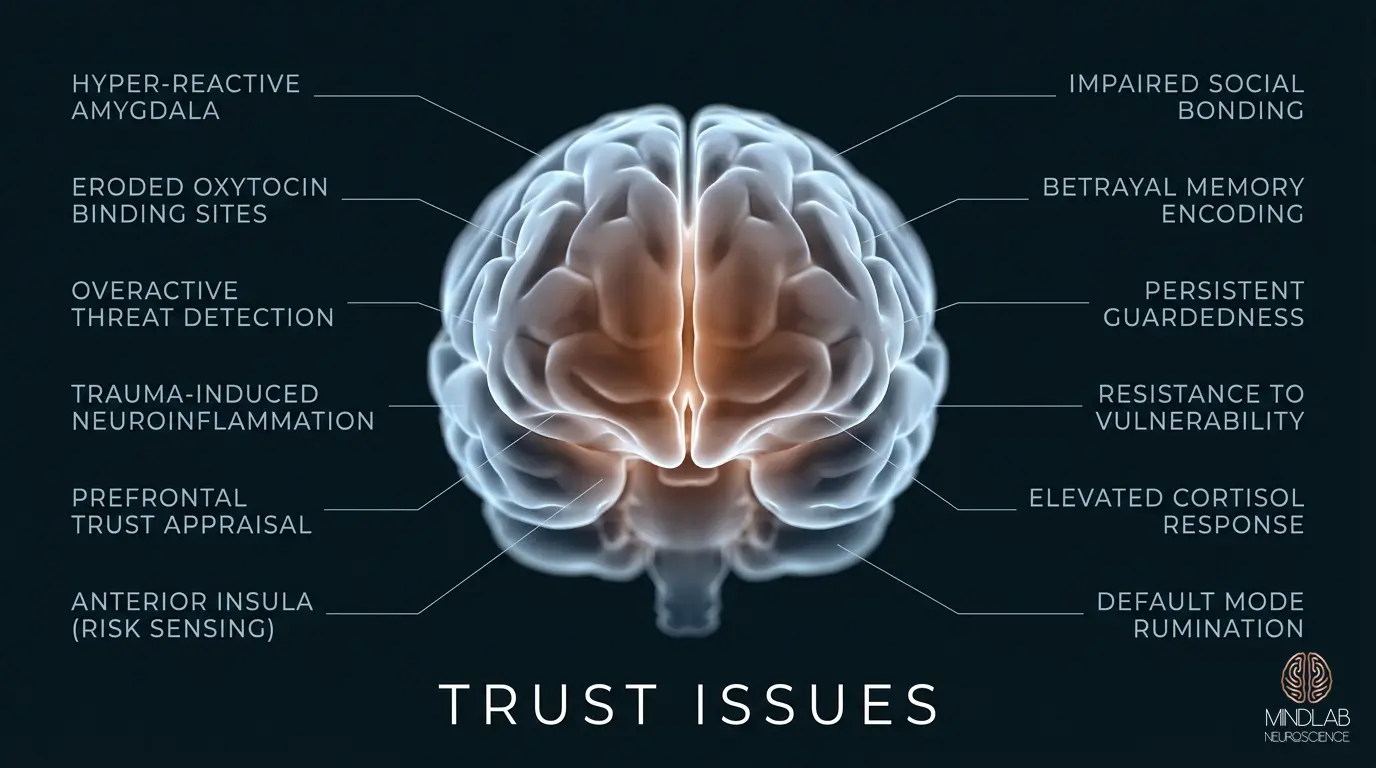
Trust is not a feeling. It is a computational output generated by the amygdala in coordination with the prefrontal cortex, the anterior insula, and a distributed network of regions responsible for social cognition. The amygdala functions as the brain’s primary threat detection hub, scanning faces, vocal tones, body language, and contextual cues for anything that resembles a previously encoded danger signal. In individuals with intact trust architecture, this scanning process is balanced. The amygdala flags potential threats, and the prefrontal cortex evaluates them rationally before triggering a behavioral response.
In individuals who have experienced significant trust violations, however, this balance collapses. The amygdala becomes hyper-sensitized, encoding a broader range of social cues as threatening. A partner’s delayed text message, a colleague’s ambiguous comment, a friend’s shift in tone, each of these gets routed through the same neural alarm system that processed the original betrayal. What I consistently observe in my practice is that the individual experiencing this is rarely aware of the mechanism. They feel the anxiety, the suspicion, the impulse to withdraw, but they attribute it to the other person’s behavior rather than to their own recalibrated circuitry.
Oxytocin-Vasopressin Dysfunction and Impaired Bonding
The neurochemistry of trust extends well beyond simple threat detection. Two neuropeptides, oxytocin and vasopressin, serve as the primary chemical mediators of social bonding, pair attachment, and interpersonal reward. Oxytocin, often oversimplified in popular media, does far more than promote warm feelings. It modulates the amygdala’s threat response during social interaction, effectively reducing the neural cost of vulnerability. When oxytocin signaling functions properly, proximity to a trusted individual dampens the stress response and reinforces the neural reward pathways associated with connection.
In trust-impaired individuals, this system operates in reverse. Chronic social stress dysregulates oxytocin signaling in the circuits that carry it, particularly the ventromedial prefrontal cortex and the nucleus accumbens. The result is a measurable reduction in the brain’s capacity to derive reward from closeness. Simultaneously, vasopressin, which drives vigilance and territorial behavior, often becomes upregulated, creating a neurochemical environment that favors monitoring over bonding. In my practice, I see this pattern most strikingly in high-performers who maintain exceptional professional relationships but find themselves unable to sustain intimate partnerships. Their social cognition is not globally impaired: it is selectively disrupted in contexts that require genuine vulnerability.
The Anterior Insula and Interoceptive Prediction Errors
One of the most underappreciated mechanisms in trust impairment involves the anterior insula: a region responsible for interoception, the brain’s ability to sense and interpret its own internal states. The anterior insula generates continuous predictions about how social interactions should feel based on prior experience. When those predictions are violated, when someone who was expected to be safe becomes dangerous, the insula registers what neuroscientists call a prediction error.
Repeated prediction errors in social contexts create a specific and measurable consequence: the anterior insula begins generating threat predictions even in objectively safe environments. The individual reports a persistent “gut feeling” that something is wrong, an inability to relax in the presence of people who have given them no rational reason for concern. This is not intuition in any mystical sense. It is a computational artifact: the insula running outdated prediction models that no longer match current reality. What makes this particularly challenging is that interoceptive signals carry enormous subjective authority. People trust their gut, and when that gut has been neurologically rewired by betrayal, it becomes an unreliable narrator that nonetheless feels absolutely certain.
Understanding the interoceptive dimension of trust impairment is essential for anyone navigating relationship intelligence and neural bonding, because the body’s internal signals are often the first barrier to forming new connections, even when the conscious mind is ready.
Betrayal Trauma and Neural Rewiring
The neural architecture of betrayal trauma differs substantially from other forms of psychological injury. When trust is violated by someone within the individual’s attachment system (a partner, a parent, a close collaborator) the brain faces a unique computational dilemma. The source of danger and the source of safety are the same person. This creates what researchers describe as a dual-coding conflict in the hippocampus and amygdala: the same face, the same voice, the same contextual cues are simultaneously tagged as both rewarding and threatening.
The downstream effects are profound. The hippocampus, which normally consolidates experiences into coherent narratives, struggles to integrate contradictory information. Memories of the betrayal become fragmented, vivid in emotional intensity but disorganized in sequence and detail. Meanwhile, the amygdala encodes a generalized threat signature that extends far beyond the original violator. Sensory cues only tangentially related to the betrayal (a particular cologne, a restaurant, a time of day) can trigger full activation of the hypothalamic-pituitary-adrenal axis, flooding the body with cortisol and stress signaling that feels indistinguishable from the original event.
In my work with individuals recovering from infidelity and trust architecture collapse, I have observed that this generalized threat encoding is one of the most significant obstacles to rebuilding connection. The brain does not distinguish between the person who caused the harm and the new person standing in a similar relational position. Until the underlying neural signatures are addressed at the circuit level, the same protective responses will continue to deploy regardless of the new partner’s actual behavior.
Hypervigilance: The Prefrontal-Amygdala Feedback Loop
Hypervigilance is perhaps the most recognizable behavioral expression of trust impairment, and it operates through a specific and self-reinforcing neural mechanism. Under normal conditions, the dorsolateral prefrontal cortex exerts top-down regulatory control over the amygdala, modulating threat responses and allowing flexible social engagement. In trust-impaired individuals, this regulatory relationship inverts. The amygdala’s heightened activation overwhelms prefrontal control, and the prefrontal cortex, rather than calming the alarm, begins actively scanning for evidence that confirms the threat.
This creates a closed feedback loop: the amygdala signals danger, the prefrontal cortex searches for confirmation, and any ambiguous social cue is interpreted as validating the original alarm. The individual experiences this as relentless mental scanning, checking a partner’s phone, analyzing micro-expressions, replaying conversations for hidden meanings. What appears from the outside as controlling or paranoid behavior is, at the neural level, a prefrontal cortex operating in service of an overactive amygdala rather than in opposition to it.
I find that high-achievers are particularly vulnerable to this loop because their prefrontal networks are exceptionally strong. The same executive capacity that makes them effective strategists in professional domains becomes weaponized in personal relationships, deployed not for creative problem-solving but for threat surveillance. They develop remarkably sophisticated compensatory control strategies: structuring relationships to minimize vulnerability, maintaining emotional distance disguised as independence, and building contingency plans for abandonment that they update continuously and unconsciously. These strategies may preserve a sense of safety in the short term, but they systematically prevent the neural conditions necessary for genuine attachment.
Protective Caution Versus Pathological Mistrust
Not all wariness is dysfunction. The brain’s social threat detection system exists for legitimate reasons, and a degree of evaluative caution in new relationships represents healthy neural functioning. The critical distinction, one that I assess carefully in every individual I work with, lies at the circuit level.
Protective caution is characterized by prefrontal engagement that remains proportional and flexible. The individual evaluates new information, updates their assessment of another person based on evidence, and gradually extends trust as safety is confirmed. The amygdala is active but regulated. Cortisol levels rise modestly during ambiguous social encounters and return to baseline once the situation resolves. The anterior insula generates predictions that are updated by new experience rather than locked into historical patterns.
Pathological mistrust, by contrast, shows a distinctly different neural profile. Prefrontal evaluation becomes rigid and confirmation-biased. The amygdala operates at elevated baseline activation regardless of context. Cortisol remains chronically elevated, impairing hippocampal function and further degrading the brain’s ability to form accurate new social memories. The default mode network, which supports self-referential thinking, becomes hyperactive, generating ruminative narratives about others’ intentions that consume enormous cognitive resources.
Understanding this distinction matters enormously because individuals experiencing pathological mistrust almost always believe they are exercising reasonable caution. The subjective experience is identical. Only the underlying neural dynamics differ, and those dynamics determine whether the individual is capable of building new trust or permanently locked into a defensive posture shaped by previous experience. Recognizing where one falls on this spectrum often requires the kind of precise neural assessment that attachment style patterns alone cannot provide.
Real-Time Neuroplasticity™ and Trust Recalibration
The question that brings most individuals to my practice is deceptively simple: can a brain that has learned to default to mistrust actually learn to trust again? The neuroscience is unequivocal: yes. The same neuroplasticity that allowed the brain to rewire toward threat after betrayal can be leveraged to recalibrate those circuits toward accurate social assessment.
My approach, Real-Time Neuroplasticity™ (RTN™), targets the specific circuits described above rather than relying on generalized cognitive strategies. When the anterior insula is generating inaccurate threat predictions, the intervention addresses interoceptive recalibration directly. When the prefrontal-amygdala feedback loop has inverted, the work focuses on restoring top-down regulatory control through precise neural exercises that rebuild the inhibitory pathways between these structures. When chronic social stress has blunted oxytocin signaling, the protocol includes structured exposure to social reward conditions that gradually restore neurochemical responsiveness.
What distinguishes this approach from conventional models is specificity. Trust impairment is not a single condition: it is a constellation of circuit-level disruptions that manifest differently in each individual. The executive who cannot delegate without micromanaging has a different neural profile than the individual who sabotages romantic relationships at the point of deepening commitment. Both are experiencing trust impairment, but the underlying architecture requires different points of intervention. In my practice, I map these specific disruptions before designing any recalibration protocol, because precision at the neural level is what produces lasting change rather than temporary behavioral compliance.
Rebuilding the Neural Architecture of Trust
Trust recalibration is not about convincing yourself that people are safe. It is about restoring your brain’s capacity to accurately distinguish safety from danger in real time: a capacity that betrayal disrupts but does not permanently destroy. The individuals I work with often arrive believing they are fundamentally broken in their ability to connect. What the neuroscience consistently reveals is something different: their social threat detection systems are functioning exactly as designed for the environments that shaped them. The problem is not malfunction: it is miscalibration. And miscalibration, unlike structural damage, is addressable.
The path forward requires understanding your specific neural profile: which circuits are disrupted, which compensatory strategies have formed, and which conditions will allow genuine recalibration rather than superficial behavioral change. This is the work I engage in daily, and it begins with a precise assessment of where your brain’s trust architecture stands right now.
If you recognize these patterns in your own experience (the persistent scanning, the inability to rest in connection, the gap between what you know intellectually and what your nervous system will allow) I invite you to schedule a strategy call with Dr. Ceruto. Together, we will identify the specific neural signatures driving your trust impairment and outline the recalibration pathway that matches your unique circuitry.