
Key Takeaways
- Flow is not motivation: dopamine, norepinephrine, endorphins, anandamide co-release, producing effortless concentration and time distortion.
- Challenge-skill ratio is the top trigger: stretch enough for norepinephrine and dopamine, not amygdala override.
- Transient hypofrontality, reduced prefrontal cortex activity during flow, makes flow effortless: self-monitoring and self-criticism drop.
- Flow is not accidental: it has identifiable triggers and structural conditions that can be cultivated.
- Flow neurochemistry depletes over a session; forcing flow afterward produces frustration. Recovery is not optional.
For more than a decade, “flow state” has been treated as a pop-psychology buzzword. It shows up in social media posts, productivity hacks, and motivational speeches. Yet neuroscientists like me have been studying the brain mechanisms behind flow states for more than thirty years. Long before it became trendy, we knew this state was not magic at all. It is a particular pattern in your brain and nervous system that you can learn to create on purpose. Mastering it is the essence of peak performance and flow.
In this piece, I want to do three things for you. First, I want to define what a flow state really is from both psychological and neuroscientific perspectives. Second, I want to show you the opposite of a flow state, the patterns that keep you stuck in friction, self-doubt, and scattered attention. Third, I want to walk you through how to use neuroscience and neuroscience-based practice principles to move from your old state into a reliable, repeatable flow state across every part of your life.
We will explore how flow state shows up at work, in your personal life, in high-level performance, and even in your relationships. I will also share a very personal story from my PhD years, when I lost my flow state entirely and had to rebuild it from the ground up. Finally, we will look at the role of dopamine in flow state and how my latest book, The Dopamine Code, helps you design a dopamine menu that supports flow in every sector of your life.
By the time you finish reading, my goal is simple: you will not only understand what a flow state is, but also know what it feels like in your own body, why it matters so much to your brain, and how to begin building more flow states every single day.
What Is a Flow State, Really?
Most people often define a flow state as simply “entering the zone.” That phrase is not wrong, but it is incomplete. A real flow state is a specific experience with a few key features that recur across people, cultures, and situations.
Psychologically, a flow state feels like this:
You are fully absorbed in what you are doing. Distractions fade into the background.
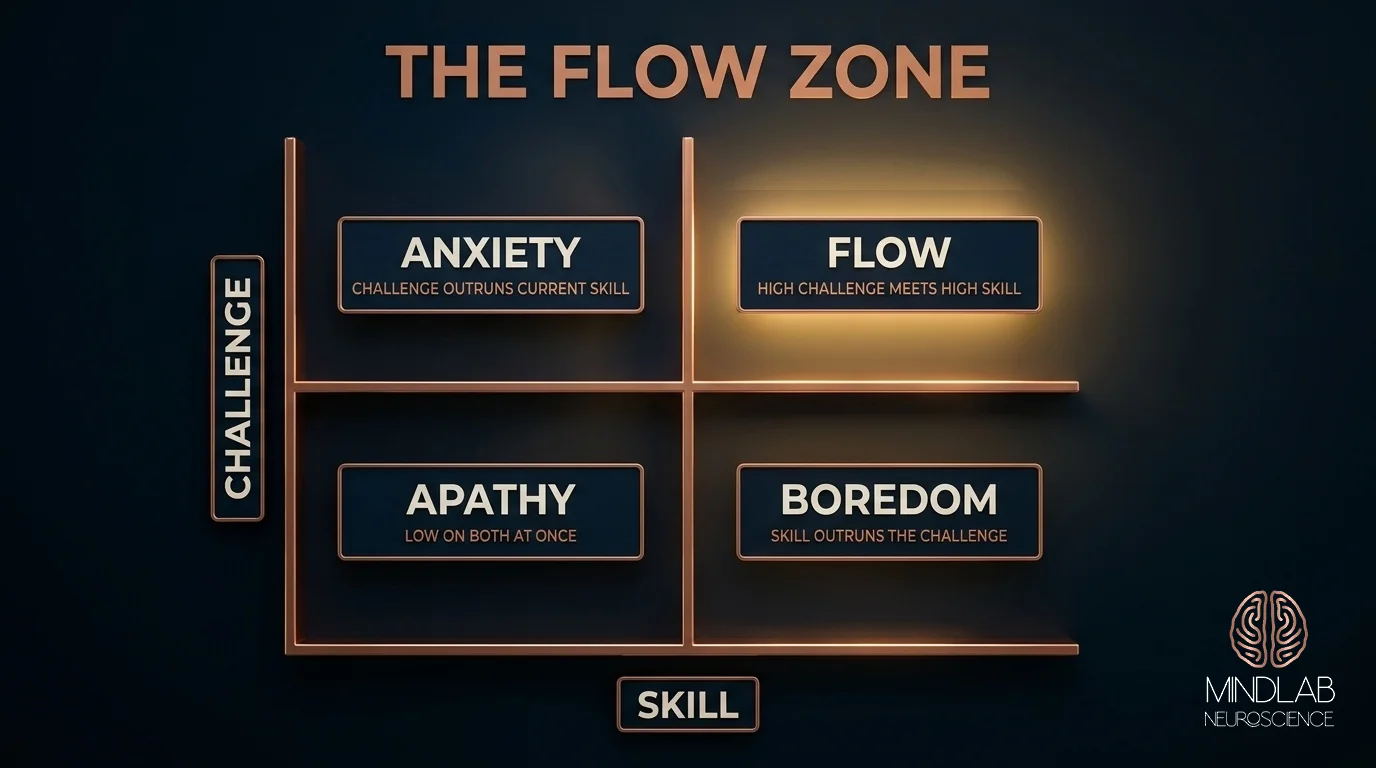
The challenge in front of you is neither too easy nor too difficult. It stretches you just enough to keep you engaged.
Time changes. Occasionally, it seems to accelerate; at other times, it appears to slow down, but it never gives the impression of requiring constant time monitoring.
Self-consciousness drops away. You are not focused on what you look like, how you sound, or how others are judging you.
There is a quiet sense of control. You are not thinking, “Can I do this?” You are simply doing it.
In short, a flow state is deep focus without strain. It is intense engagement without panic. It is an effort that feels almost effortless.
Neuroscientifically, a flow state is your brain shifting into a highly efficient mode. Different regions of your brain begin to work together more efficiently. The networks that handle focus, movement, planning, and reward come into alignment. Instead of fighting each other, they form a clear channel.
In an actual flow state, your nervous system is alert but not overloaded. You are focused, alert, and responsive, not threatened, numb, checked out, or scattered. Your brain is sending a simple, powerful signal: “This matters right now. Stay here.”
When you understand the flow state this way, it stops being mysterious. It becomes something you can observe, describe, and most importantly, shape.
The Neuroscience of Flow State in Your Brain
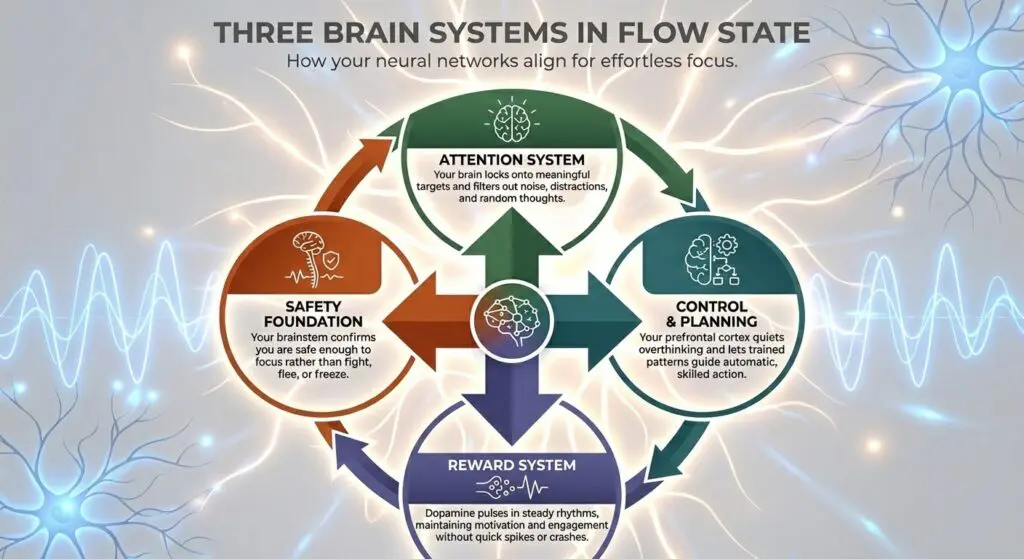
Understanding the neuroscience of flow state begins with mapping what your brain is actually doing when you enter this kind of experience. Three interconnected systems coordinate during flow, and knowing each one gives you practical leverage to build and sustain this state more deliberately in your daily life.
Think of three big systems in your brain working together during a flow state:
Synchronizing those three systems on purpose, rather than waiting for flow to arrive, is what Dr. Sydney Ceruto built her ATTUNE Protocol™ around, a way to reach durable focus without stimulants or forced suppression.
Your attention system
This is the network that helps you decide what to focus on and what to ignore. In a flow state, your attention system locks onto one meaningful target. Noise, pings, and random thoughts are still there, but they do not win. Your brain filters them out.
Your control and planning system
This system lives mainly in the front of your brain, in the prefrontal cortex. It helps you plan, organize, and monitor yourself. In a flow state, the prefrontal cortex of your brain engages in unique activities. Parts of it quiet down. You are not overthinking every move, nor are you running endless self-critiques. Instead, your brain relies more on trained patterns and automatic skills. It is like your conscious mind steps back a little so your well-practiced wiring can do its job.
Your reward and motivation system
This system runs mainly through your dopamine pathways. When you enter a flow state, dopamine pulses in a steady, rhythmic way, keeping you motivated, curious, and engaged. You are not chasing a quick spike, like you might from social media or a sugary snack. Instead, you are riding a smooth wave of satisfaction as you move deeper into the task.
These three systems sit atop your basic survival wiring. Your brainstem and deeper structures are constantly scanning for danger. If your brain perceives a threat, the survival system will take control of all your cognitive functions. You will not enter a flow state if your brain thinks you need to fight, flee, or freeze.
So, in a flow state, your nervous system is telling a specific story:
Your nervous system is broadcasting a safety signal, a state in which your autonomic baseline allows higher-order engagement rather than defensive shutdown. Your brain enters flow precisely when three internal messages align: “I am safe enough to focus,” “This challenge is meaningful and worth my energy,” and “I have enough.”
Your brain enters a state of flow when those conditions are satisfied. Your neurons fire in smoother patterns. Your brain waves move toward a rhythm that supports focused, flexible thinking. Learning, memory, and pattern recognition become more efficient.
This is why a flow state feels so different from your everyday, distracted mode. It is not just a mood. It is a full-body, whole-brain state that changes how you process information, move, and feel.
The Opposite of the Flow State: When Your Brain Blocks Flow
Recognizing the opposite of a flow state is just as important as understanding flow itself. Most people assume the opposite is simple laziness or boredom, but neuroscience reveals something far more precise and actionable. Chronic low-grade stress keeps the brain locked in a defensive mode that actively prevents the neural coordination flow requires.
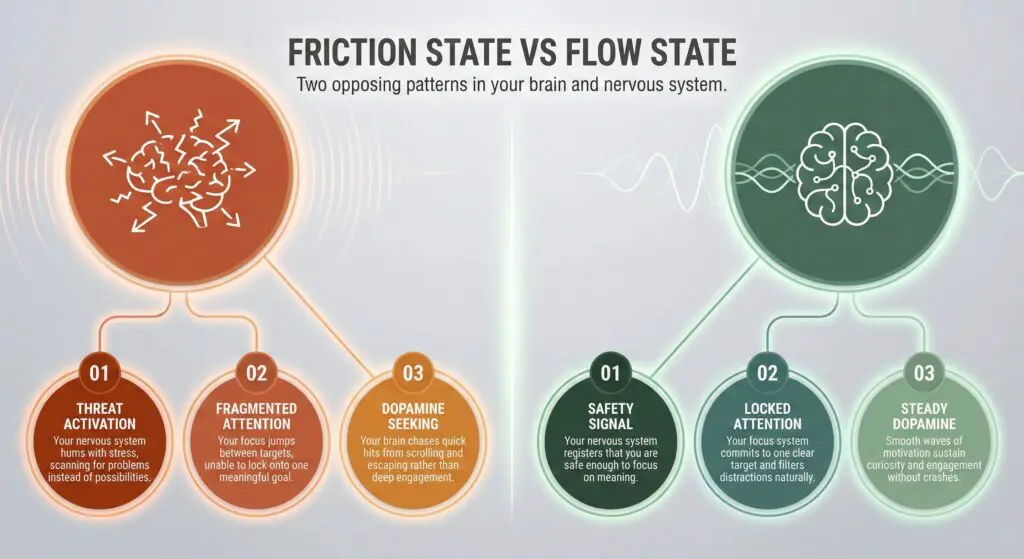
The opposite of a flow state is a friction state. In a state of friction, your brain and body are sending mixed, conflicting signals. You might recognize some of these patterns:
You settle in to work, yet your thoughts persistently drift to your inbox, social media, or unrelated concerns.
You start a task, then feel a flood of self-doubt: “What if this is not good enough?”
You feel wired and worn out at the same time. Your body is restless, but your thinking feels foggy.
You bounce between tasks without finishing anything and end the day feeling busy but ineffective.
In a friction state, several things happen in your nervous system:
State of friction: Your threat system is slightly or fully activated. You might not feel panic, but there is a steady hum of stress. Your brain is scanning for problems, not possibilities. Your attention system is fragmented. It keeps shifting targets rather than locking onto a meaningful goal.
Emotionally, the opposite of a flow state feels like this:
You are either overwhelmed or under-stimulated.
You are hyper-aware of yourself in a critical, harsh way.
You feel disconnected from meaning and purpose in the moment.
This friction state is not proof that you are weak or lazy. It is simply your brain trying to protect you with old wiring. The problem is that this old wiring blocks the doorway into a healthy flow state.
When you can name the friction state as the opposite of a flow state, you gain power. You stop taking it so personally. Instead, you can approach it like data from your nervous system and begin to change the conditions that keep your brain stuck.
My PhD Story: Losing and Regaining My Flow State
Despite my extensive knowledge of science, my relationship with the flow state has not always been smooth. Indeed, a significant awakening occurred during my PhD pursuit. Research across multiple neuroscience disciplines has demonstrated that the brain continuously adapts its structural and functional connections in response to repeated experiences.
On paper, I was thriving. I was at a top university, working with brilliant mentors, designing research on how emotion and cognition shape each other in real time. I was the person people turned to for answers about the brain. From the outside, it appeared as though I was constantly in a state of flow.
Inside, it was a very different story.
During one stretch of my PhD, my flow state disappeared almost overnight. I could spend an hour examining a single paragraph of my dissertation without producing a single sentence. I would walk into the lab and feel my chest tighten, my breathing become shallow, and my mind spin with thoughts like, “What if my data is wrong?” or “What if I am not as smart as they think?”
I started doing what many high achievers do when their flow state collapses. I tried to push harder. I stayed up later. I drank more coffee. I opened my laptop earlier in the morning and closed it later at night. The more I pushed, the worse it got. My brain was not entering a flow state. It was stuck in a chronic threat state.
One night around 2 a.m., sitting under the harsh light of my desk lamp, I realized something that changed everything. I was applying neuroscience to everyone except myself. I was expecting my brain to perform in a flow state while I was feeding it the exact conditions that block flow: constant stress, no recovery, no clear boundaries, and a nonstop stream of self-criticism.
So I made a decision. I was going to apply the same principles to myself as I would one of my own future clients. I planned to construct a laboratory within my mind, aiming to restore my flow state from the core.
I started small. I carved out a 90-minute block every morning where my only goal was to enter a flow state with my writing. I eliminated all distractions such as emails, phones, editing, and judgment. I focused on answering a single, straightforward question or drafting a single subsection.
I used simple tools to help my nervous system trust that it was safe. I began with a brief breathing exercise. I also used a physical cue, such as the same mug of tea, to signal my start. After the practice, I took a short walk to allow my brain to process the information I had just experienced.
It was not instant. In the first week, my flow state lasted 10 minutes at a time. But those ten minutes felt like a miracle. Slowly, ten minutes became thirty. Thirty became sixty. My brain began to remember what a flow state felt like and, more importantly, how to arrive there.
That season of my PhD did more than help me finish a dissertation. It taught me that a flow state is not something reserved for ideal conditions or for “special” people. It is a trainable state. It is something you can design, protect, and rebuild, even when you feel like you have lost it completely.
Why Flow State Is So Beneficial for Your Brain and Life
Once you have tasted an actual flow state, you understand why people chase it. But this is not only about feeling good. A flow state changes how your brain functions in ways that carry over into every part of your life.
Here is why a flow state is so beneficial:
Flow state boosts learning and memory.
Your brain deeply engages with specific patterns when you are in a flow state. Neurons that fire together wire together. Because you are focused, your brain strengthens the exact circuits you are using. This makes it easier to repeat that skill, decision process, or emotional pattern later.
Flow state builds self-trust.
Every time you enter a flow state and complete something meaningful, you send yourself a powerful message: “When it matters, I can show up.” Over time, this attitude builds a quiet confidence that does not depend on external praise.
Flow state reduces mental noise.
In a flow state, worrying and self-criticism move to the background. You practice being in the present moment without needing everything to be perfect. This trains your brain to spend less time in rumination and more time in engaged action.
The steady-focus mode supports emotional regulation.
A flow state maintains a balance between boredom and panic in your nervous system. You learn what it feels like to be alert without being overwhelmed. That experience becomes a template you can return to when life gets stressful.
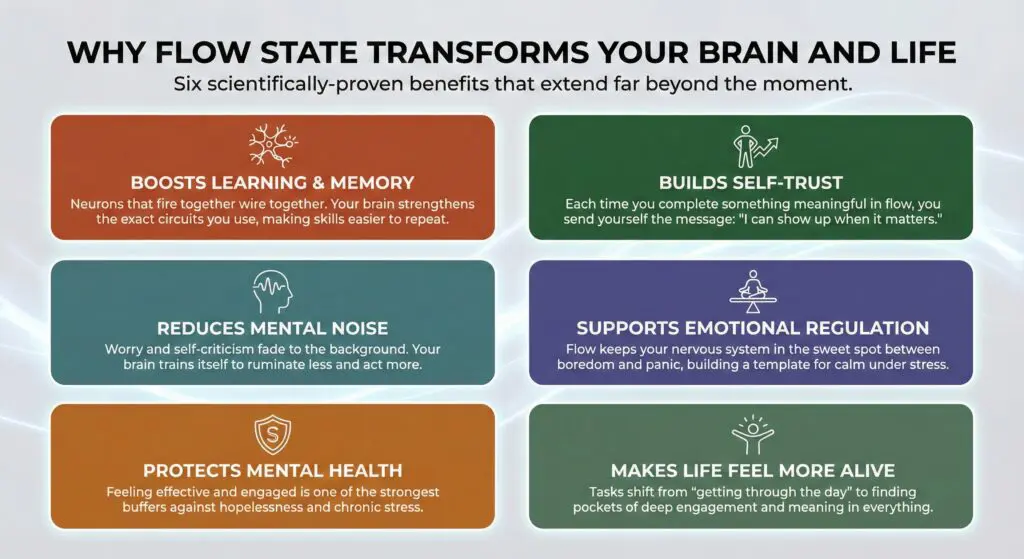
Flow state supports long-term mental health.
While a flow state is not a solution for clinical conditions, it is deeply protective. Feeling effective, engaged, and connected to meaningful challenges is one of the best buffers against hopelessness and chronic stress.
A deep-focus state makes daily life feel more alive. Perhaps most importantly, a flow state changes your relationship with everyday life. Tasks become less about “getting through” the day and more about finding pockets of profound engagement. Work, hobbies, and even small routines start to feel richer and more rewarding.
When you bring all of these elements together, a deep-focus state is not just a performance trick. It is a way of relating to your brain that aligns with it, makes everything you do more efficient, and makes it more satisfying.
Flow State at Work and in Your Career
Work is one of the most potent places to cultivate a deep-focus state, especially if you are a high performer, a leader, or an entrepreneur. Yet most workplaces are designed to destroy deep-focus states rather than support them.
Think about a typical workday:
A constant stream of messages, meetings, and interruptions.
An overflowing task list with unclear priorities is a common feature of a typical workday.
An open office or a noisy environment can divide your attention.
Under these conditions, your brain has very little chance of entering a deep-focus state. It is bouncing in and out of micro-threat responses all day long.
To bring a deep-focus state into your career, you need to reverse this pattern and give your brain what it actually needs:
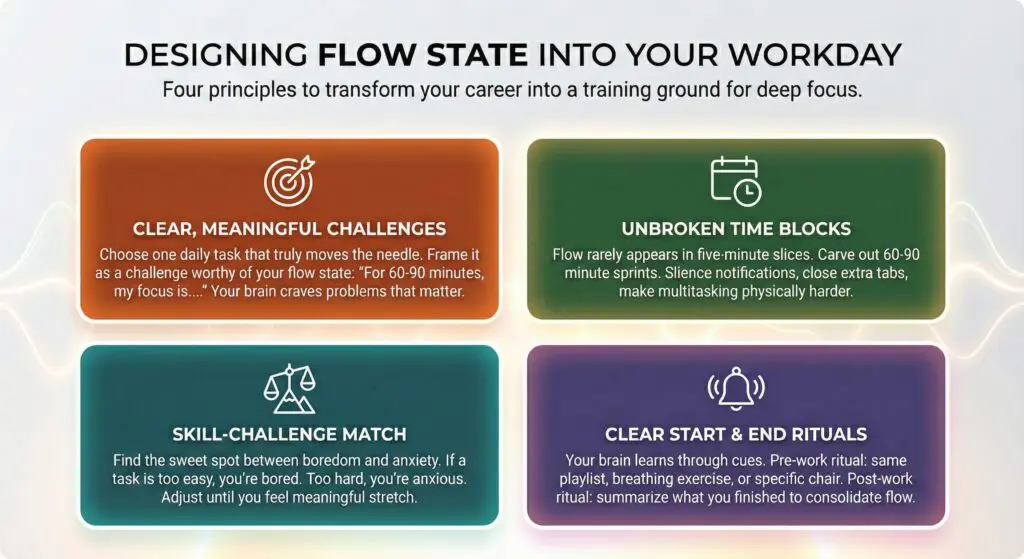
Clear, meaningful challenges
Your brain is attracted to problems that hold significance. Choose a daily task that significantly contributes to your work. Frame it as a challenge that deserves a steady-focus mode: “For the next 60–90 minutes, my only job is to design this proposal,” or “My focus is to map the strategy for the next quarter.”
Unbroken time blocks
A mental focus zone usually requires more than five minutes. You may not always have hours, but you can often carve out 60–90-minute sprints. During that time, silence notifications, close extra tabs, and make it physically more challenging to multitask.
Skill-challenge match
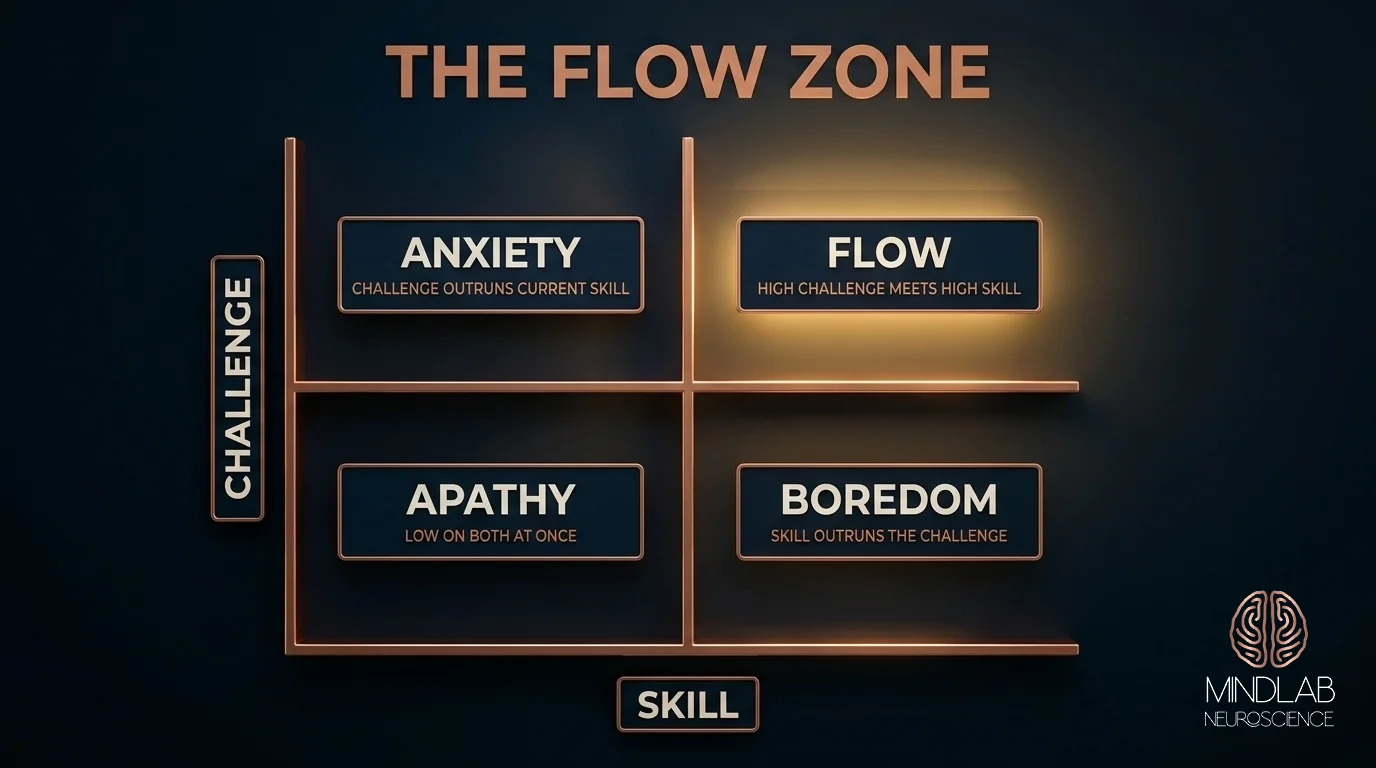
Achieving peak performance at work requires balancing your current capabilities with tasks that challenge you. If a task is far below your skill level, you feel bored. If it is far above, you feel anxious. Adjust the challenge until you feel a sense of meaningful stretch.
Clear start and end rituals
Your brain learns through cues. A simple pre-work ritual can signal that you are entering a fully engaged mode: the same playlist, a short breathing exercise, or even moving to a specific chair. A closing ritual, like summarizing what you finished, helps your brain consolidate the experience and carry the benefits forward.
When you design your workday around these principles, your career becomes a training ground for a deep-focus state rather than a constant drain on your attention and energy.
Flow State in Your Personal Life and Daily Routines
Many people think a flow state is only for big, important projects. The truth is that some of the richest deep work mode experiences happen in ordinary moments. Your brain does not only want flow at work; it also craves a high-focus state in your personal life.
You can enter a focused state of mind while cooking a meal, gardening, playing with your children, organizing a space, or even taking a long walk. The conditions are the same: an apparent, meaningful activity, enough challenge to keep you engaged, and a feeling of safety.
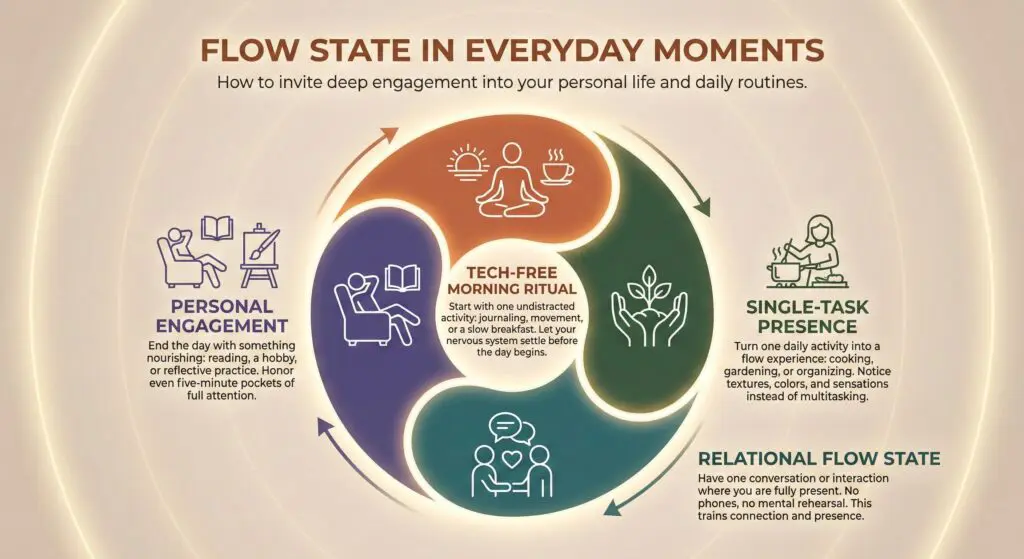
Here are some simple ways to invite a steady-focus zone into your daily routines:
Choose one daily task to do in pure focus
Select an activity you already engage in and transform it into a focus-rich mode practice. For example, instead of scrolling your phone while you cook, consider the meal as a single-task ritual. Notice textures, colors, and smells. Let your mind rest inside the process.
Create tech-free pockets
Your nervous system cannot enter a strong mental focus zone if it is being yanked out of the moment every few seconds. Try small windows of time, 20 or 30 minutes, where your devices are in another room. Use that time for a hobby, reading, or any activity that feels nourishing.
Connect flow state to values
A deep-focus state deepens when it is connected to something that matters to you. If spending time with your family is a core value, consider moments of play or conversation as a chance to enter a shared, fully engaged mode. You are not just “hanging out.” You are wiring your brain for connection and presence.
Honor micro-moments of immersed attention
Not every steady-focus mode will be intense or dramatic. Sometimes it is five minutes of full attention on your pet or ten minutes of writing in a journal. These brief focus-rich mode experiences still train your brain. They remind your nervous system that safety, engagement, and pleasure can exist in the exact moment.
When you bring a deep work mode into your personal life, your days feel less like a blur and more like a series of meaningful, grounded experiences. You stop waiting for retreats, vacations, or perfect conditions to feel alive.
Flow State in Performance and High-Stakes Moments
If you are an athlete, a surgeon, a trader, a trial attorney, or any performer, you already know the power of a flow state. In high-stakes moments, a flow state can distinguish between a scattered reaction and a calm, precise action.
In performance settings, a flow state is not a luxury. It is a necessity. Your brain must integrate complex information, move your body or voice with accuracy, and adapt in real time under pressure.
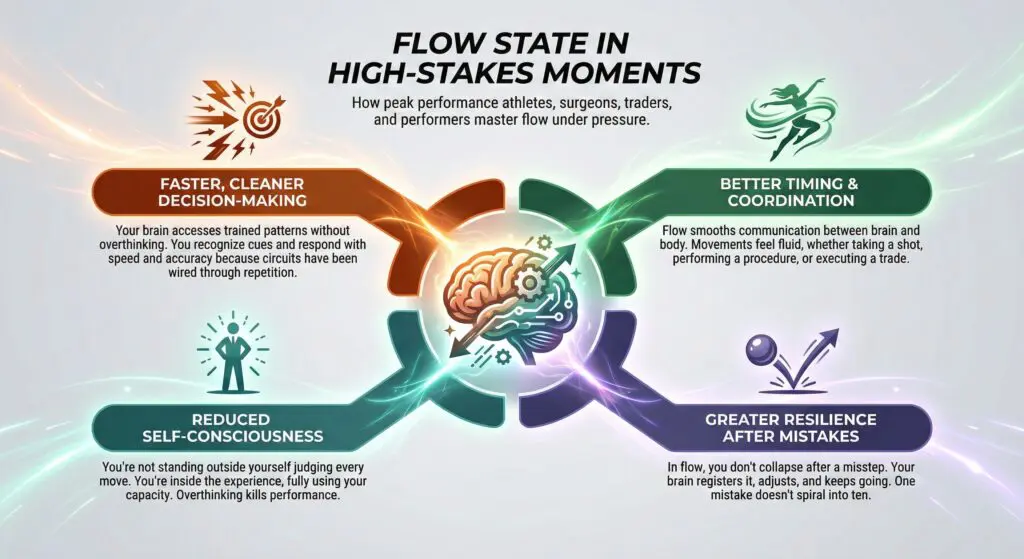
Here is what a steady-focus mode offers in performance:
Faster, cleaner decision-making
In a deep-focus state, your brain can access trained patterns without overthinking. You recognize cues and respond quickly and accurately because your circuits have been wired through repetition.
Better timing and coordination
A high-focus state smooths the communication between the brain and body. Movements feel more fluid, whether you are taking a shot, performing a procedure, or making a trade.
Reduced self-consciousness
Overthinking kills performance. In a mental focus zone, you are not standing outside yourself, judging every move. You are inside the experience, using your full capacity.
Greater resilience after mistakes
In a peak-performance zone, you do not collapse after a misstep. Your brain registers it, adjusts, and keeps going. This is the opposite of the spiral that occurs when you are out of flow, and one mistake becomes ten.
To create a focused brain state in high-stakes moments, you need to train two things: your skills and your nervous system. Repetition builds the patterns your brain can rely on. Nervous system training (through breath, body awareness, and clear routines) teaches your brain that, even under pressure, it can stay in a deep work mode rather than slip into panic.
When you master this, your daily performance becomes a lab where you continuously refine your focus-rich mode. High stakes no longer mean high chaos. They become very clear.
Flow States in Intimate Relationships
It may sound strange to discuss a flow state in the context of intimate relationships, but your brain does not have separate rules for love. The flow state in a relationship is real and one of the most nourishing experiences you can give each other.
In an intimate relationship, a flow state feels like this:
You are fully present with the other person. You are not mentally checking your phone or rehearsing your next response.
Conversation feels natural. You are not forcing it, but you are also not holding back thoughts or emotions that matter.
Time changes. An hour can pass in what feels like a few minutes when both of you are in a shared deep-focus state.
There is a feeling of safety and curiosity. You can delve into deeper subjects or emotions without feeling unease.
Neuroscientifically, a relational high-focus state involves coordinated nervous systems. Your brain and your partner’s brain are reading each other’s cues (tone of voice, facial expression, posture) and responding in a way that maintains connection. Oxytocin, the bonding chemical, and steady waves of dopamine support this shared mental focus zone.
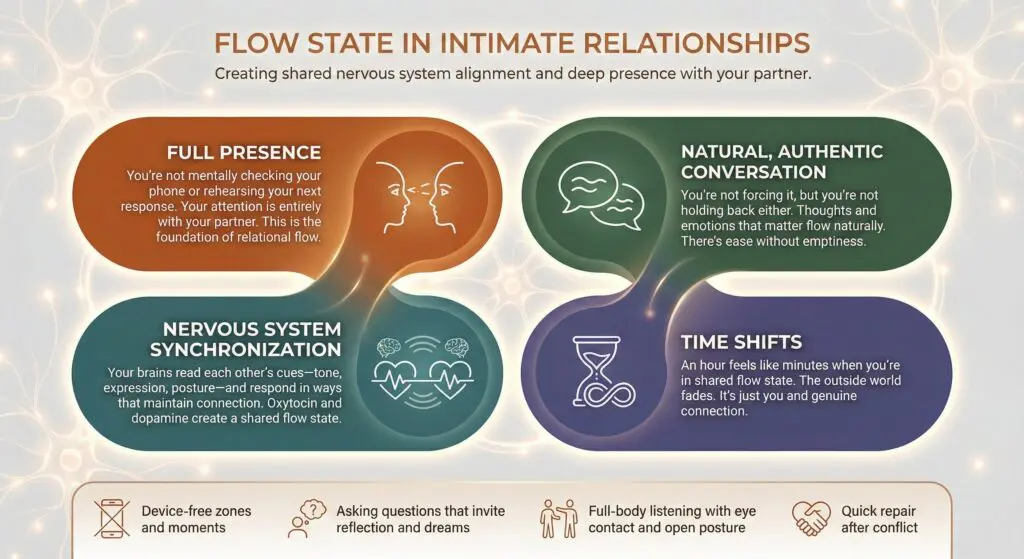
To build a deep work mode in intimate relationships, consider the following:
Creating device-free zones
Agree on moments (meals, walks, bedtime) when both of you prioritize a relationship focus-rich mode. Current neuroscience research suggests that this phenomenon emerges from coordinated activity across multiple brain networks, involving regions responsible for emotional processing, memory consolidation, attention regulation, and the integration of sensory information with.
Asking better questions
A steady-focus mode in conversation grows when you move past surface updates and ask questions that invite reflection, dreams, or even fears.
Practicing full-body listening
Your nervous system responds to how you listen, not just what you say. Eye contact, open posture, and a calm tone help create the safety needed for a relational deep-focus state.
Repairing quickly after a rupture
No relationship can live in a deep work mode all the time. Conflict will happen. What matters is how quickly you repair. Naming your own nervous system state, “I am triggered and not in a high-focus state right now”, can be a decisive first step toward reconnection.
When you learn to create and sustain a focused brain state in your intimate life, relationships stop feeling like a constant problem to manage and become a living, breathing source of energy and support.
Dopamine, Reward, and Your Flow State
You cannot discuss a flow state without mentioning dopamine. Dopamine is often sold as the “pleasure chemical,” but that is misleading. In reality, dopamine is your brain’s prediction and motivation signal. It tells you, “Move toward this. The outcome matters. Keep going.”
In a healthy flow state, dopamine behaves very differently than it does when you are chasing quick hits from scrolling, gambling, or other impulsive behaviors. Instead of sharp spikes and crashes, a flow state creates smoother, more stable waves of dopamine. You get a steady sense of reward as you move through the challenge, not only at the end.
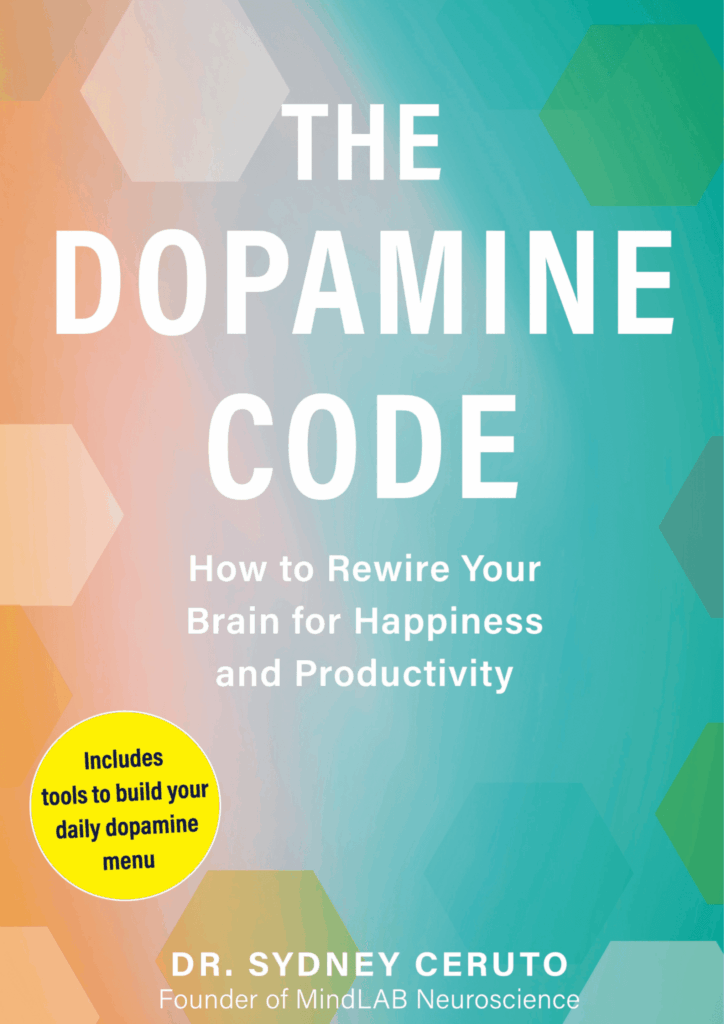
This is where my latest book, The Dopamine Code, comes in. In that book, I teach readers how to design a dopamine menu: a structured way to choose daily actions that feed your brain the dopamine it actually needs.
On a dopamine menu, you organize your life into three layers:
Fast, micro-rewards that help regulate your nervous system in the moment
Sustainable habits that keep your brain healthy over time
Profound, high-meaning experiences that often produce the richest flow state.
When you line up these layers with intention, you stop letting random apps and stressors control your dopamine. Instead, you use dopamine to build more frequent and more reliable flow state experiences across work, home, performance, and relationships.
A simple example:
Instead of “I want to be in a flow state more often,” you design a dopamine menu that might say:
Micro: a five-minute breathing practice before a focus block and a short walk after.
Sustainable: 7–8 hours of sleep most nights, regular movement, and consistent nutrition.
Deep: 90-minute writing sessions three times a week, or weekly sessions where you fully engage in a creative or strategic project.
Every time you follow this menu, you train your dopamine system to link effort with reward in a healthy way. That makes it easier to enter and sustain a flow state.
How to Shift into a Flow State Using Neuroscience
Now, let us get practical. How do you move from your current state (maybe scattered, stressed, or numb) into a flow state using only neuroscience and neuroscience-based practice principles?. Multiple brain regions contribute to this process through synchronized neural firing patterns that emerge during both resting and active cognitive states.
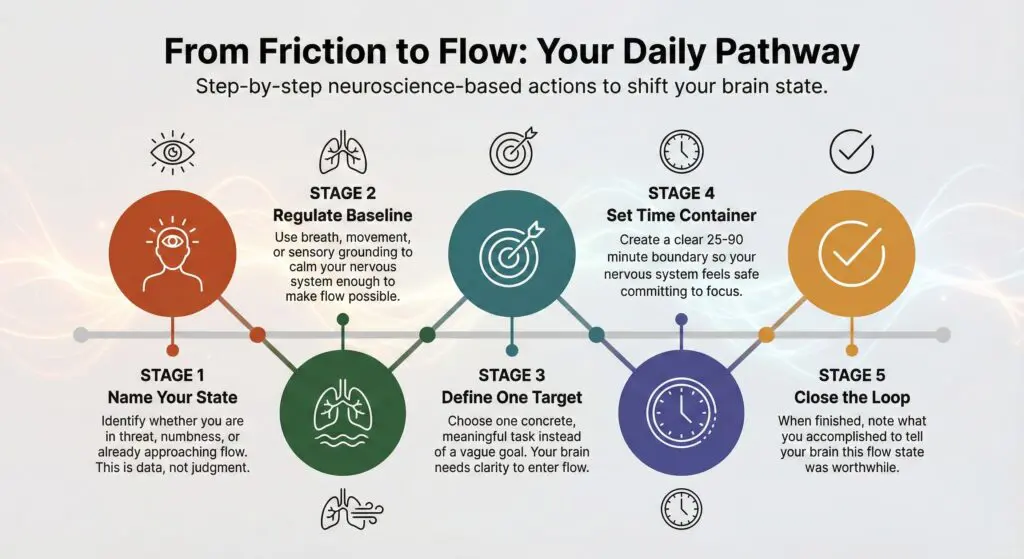
Here is a step-by-step map you can start using today:
Name your current state
You cannot move into a flow state if you are not honest about where you are. Ask yourself, “Am I in a threat state, a numb state, or already close to a deep-focus state?” Your answer is data, not a verdict.
Regulate your baseline
If you are in a clear threat or overload state, your first task is not to force a flow state. It is to calm your nervous system enough to make focus possible. Simple, evidence-based tools include:
Slow, extended exhale breathing
Gentle movement or stretching
Grounding your senses (noticing sounds, textures, temperature)
Think of this as clearing static before tuning into a mental focus zone.
Define one meaningful, specific target
Your brain cannot enter a strong flow state around a vague goal like “get my life together.” Choose one concrete target: “Draft the opening section.” “Review these five trades.” “Plan next week’s schedule.” “Have one honest conversation.”
Set a clear time container
Your nervous system feels safer entering a high-focus state when it knows there is a boundary. Try a 25, 45, or 90-minute block. During that time, you commit to one thing: staying with the target.
Remove obvious friction
Before you start, clear the most predictable distractions. Silence unnecessary notifications. Close extra tabs. Put your phone out of reach. If you are working on something emotional, let someone know you are unavailable for a short while.
Use a simple pre-flow ritual
A basic, repeatable ritual helps your brain associate specific cues with a state of flow. It could be:
Three slow breaths
Putting on the same instrumental playlist
Sitting in a specific chair
Opening your notebook to a blank page
Do not underestimate how much these small rituals prime your nervous system for a deep work mode.
Enter with curiosity, not perfection
Once you begin, your goal is not to produce something flawless. Your goal is to stay engaged. When your mind wanders, you gently bring it back. You recognize self-criticism when it arises and get back to work. You are training your brain to live in a deep-focus state, not to perform a trick.
Close the loop
When the time block ends, stop, even if you feel you could keep going. Take one minute to note what you accomplished. This signal tells your brain, “That focus-rich mode was worth it.” Over time, this closing loop strengthens the circuits that make flow more accessible.
With repetition, these steps become familiar. Your brain begins to recognize the pattern: “When we do these things, we enter a high-focus state. This is safe. This is rewarding.” That is how you turn scattered, reactive days into deliberate, flow-based days.
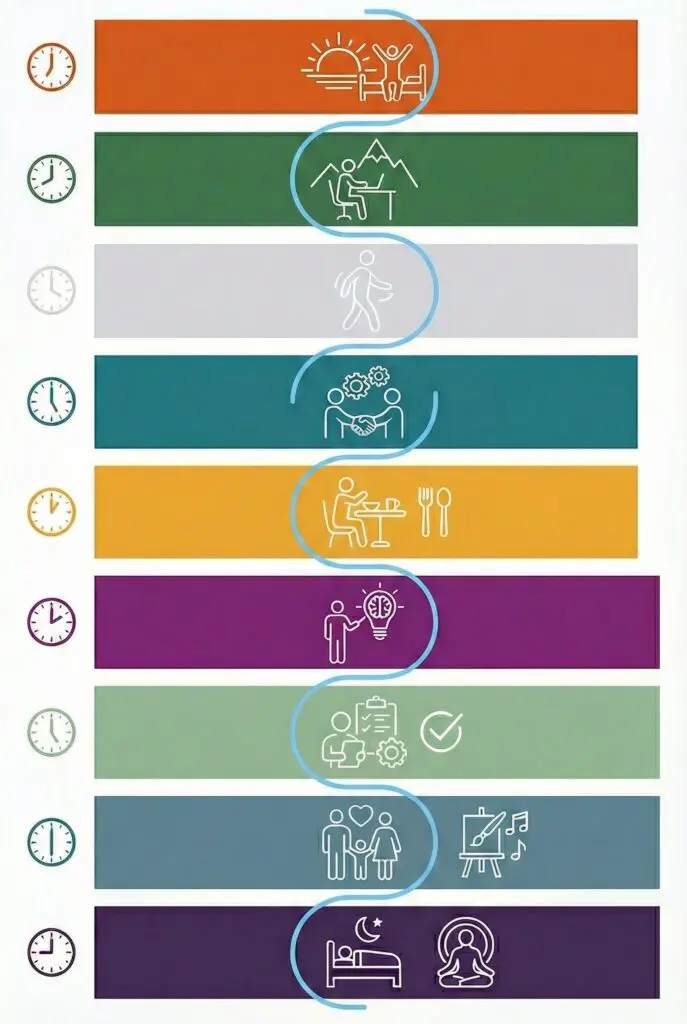
Designing a Daily Flow State Blueprint
A single flow state session is powerful, but the fundamental transformation happens when you build a daily flow state blueprint. This is where neuroscience-based practice becomes a strategic tool rather than a one-time fix.
A daily flow state blueprint is a simple plan that answers three questions:
When will I enter a flow state?
Around what activities will I build that deep-focus state?
What conditions does my brain need to support that steady-focus mode?
Here is an example of how a daily flow state blueprint might look:
In the morning, spend 15 minutes regulating your nervous system through breathing exercises, light movement, or journaling.
Spend 60–90 minutes working intensely on your most important project during a flow state block.
Midday:
Take a short walk or movement break to reset your nervous system.
Spend 20–30 minutes in a focused brain state with a colleague or partner: actual presence in a conversation or collaboration.
Afternoon:
Another 45–60-minute deep work mode block for a different task, such as strategy, creative work, or problem-solving.
Evening:
Tech-free time with family, a hobby, or reflective practice to cultivate a softer, steadier focus zone and let your brain process the day.
This is not about living in a flow state every minute. That is neither realistic nor desirable. Your brain needs rest, play, and even mild boredom. The goal is to have regular, predictable pockets where a focus-rich mode is likely to appear.
Over weeks and months, a daily immersed focus blueprint rewires your brain. Flow stops being a rare, accidental event and becomes a familiar, trustworthy friend.
Neuroplasticity, Habits, and Long-Term Flow
There is one more layer to this story that people rarely discuss when they talk about flow. Your ability to drop into deep engagement is not fixed at birth. It is shaped by neuroplasticity, your brain’s ability to rewire itself based on what you do, feel, and pay attention to over time.
Every time you move from distraction into full focus, you are teaching your nervous system something important. You are saying, “This is the kind of state I want to live in.” The brain responds by strengthening the pathways that support clarity, calm intensity, and follow-through. When you repeat those patterns, the wires that carry them become thicker and faster. What felt hard at first begins to feel natural.
The same thing happens in the opposite direction. If most of your day is spent half-checking emails, scrolling, multitasking, and worrying about other people’s reactions, your brain becomes excellent at that pattern. It learns to expect interruption. It learns to live on the edge of threat. That is why it can feel so awkward at first to sit still, breathe, and stay with one meaningful task. You are not just changing a habit. You are asking your brain to build an entirely new set of circuits.
The good news is that neuroplasticity never really shuts off. As long as you are alive, your brain is capable of learning a new way to operate. The key is to be intentional about the habits that feed this more focused, engaged mode. Some of the most powerful habits are very small:
Choosing one anchor activity each day that deserves your best attention
Starting that activity after a brief calming practice, so your nervous system feels safe
Protecting a short window of time where you agree not to abandon yourself to distraction
Ending the block by writing down one thing that went well and one thing you want to improve next time
None of these steps looks dramatic from the outside. But together, they send a steady signal through your brain: “This is how we do things now.” Over weeks and months, that signal reshapes the pathways that govern motivation, memory, and emotional regulation.
This is the deeper promise of a life built around intentional focus. You are not just chasing a better afternoon or a productive week. You are turning your whole brain into a place where clarity, courage, and creative problem-solving are easier to access. Instead of hoping you will stumble into a good day, you are building a nervous system that knows how to create one on demand.
Think of this like strength training for your mind. At first, the weight feels heavy, and your movements are shaky. With practice, your muscles adapt, and what used to feel impossible becomes your warm-up. Your brain works the same way. The more often you guide it back into steady, present-moment engagement, the more natural that engagement feels. Over time, you are not forcing yourself to focus; you are simply stepping into a pattern your nervous system now recognizes as home.
Myths About Flow State You Can Let Go Of
To fully claim your flow state, you need to release some common myths that keep people stuck:
Myth 1: You have to feel inspired first
In reality, a flow state often appears after you start, not before. Action generates the signals your brain needs to enter a state of flow. Waiting for a perfect mood is one of the fastest ways to avoid a steady focus mode altogether.
Myth 2: Flow state requires giant blocks of time
While extended blocks can deepen a high-focus state, even 20–30 minute pockets can train your brain. Short, high-quality deep work mode sessions are far more powerful than long, distracted marathons.
Myth 3: Only “creative” or “elite” people get a flow state
Flow is about how your brain engages with a challenge, not about your job title. Parents, teachers, managers, students, and retirees can all live in a focus-rich mode more often when they design the right conditions.
Myth 4: A flow state is always calm and quiet
Occasionally, a flow state feels calm. Other times it feels intense and electric, especially in performance or high-pressure situations. The common thread is focused engagement, not a specific emotional tone.
Myth 5: You should be in an immersive focus all the time
Your brain is not built for permanent intensity. The nervous system needs cycles: activation and rest, challenge and recovery. The goal is not nonstop flow but regular, intentional deep-focus state experiences that support a healthy rhythm.
Letting go of these myths frees you to experiment. You stop trying to match some idealized image and start paying attention to what your own brain and body need.
Neuroscience-Based Practice to Support Your Flow State
You can practice everything we have discussed so far on your own. At the same time, there are limits to how far you can go without expert guidance, especially if you are a high performer carrying heavy responsibility and complex emotional patterns.
This is where neuroscience-based practice becomes invaluable for building and sustaining a flow state.
In my work with clients, I do not use generic tips or motivational slogans. Instead, I help you map your unique nervous system:
Where does your brain naturally enter a flow state?
Where does it consistently shut down or become a threat?
What patterns of thought, emotion, and behavior are wiring you away from a high-focus state instead of toward it?. This process engages multiple interconnected neural pathways that work together.
We then design precise, real-time neuroplasticity exercises that fit your actual life. These are not abstract theories. They are specific practices you use in meetings, negotiations, creative work, parenting, and relationships to shift your state from friction into a reliable, deep-focus state.
Having dedicated decades to studying and practice brain-based change, I can help you identify internal blind spots. That might mean spotting the moment your self-criticism spikes, the instant your nervous system slides from curiosity into shame, or the way your dopamine habits quietly pull you out of a focus-rich mode all day long.
With the proper structure, support, and accountability, you learn not only how to enter a flow state more often but also how to live from that state in a way that is sustainable, ethical, and aligned with who you actually are.

Choosing Flow State as Your New Default
Flow state is not a buzzword. It is a deeply grounded, repeatable brain state that can change how you work, love, perform, and live. Psychologically, it feels like full engagement without strain. Neuroscientifically, it reflects a powerful alignment between your attention system, your control system, and your dopamine-driven reward system.
The opposite of a flow state is not simply laziness or lack of discipline. It is a friction state, driven by threat, distraction, and old wiring that no longer serves you. During my PhD years, I lost my flow state and had to rebuild it using the very science I had been studying.
You now have a clear blueprint:
Understand what a flow state is in your own body.
Notice when you are in its opposite state and view that as data, not failure.
Work with your dopamine system using tools like the dopamine menu I teach in The Dopamine Code to create better conditions for flow.
Use neuroscience-based steps to regulate your nervous system, set clear targets, reduce friction, and create simple rituals that invite a deep-focus state in.
Design daily flow state blueprints across work, personal life, performance, and relationships so that flow becomes a familiar rhythm, not a rare event.
Most importantly, you can stop waiting for the perfect moment, the perfect job, or the perfect mood. You can choose to cultivate a flow state deliberately, with the brain you have right now, in the life you are living today.
Your brain is plastic. It is listening. It is ready to learn a new way of being. When you understand and apply the neuroscience of flow state, you are no longer at the mercy of distraction, fear, and old patterns. You are building a life where deep focus, ease, and meaningful momentum are not accidents. They are your new default.
| Flow Trigger | Neurochemical Mechanism | How to Activate | What Blocks It |
|---|---|---|---|
| Challenge-skill balance | Dopamine + norepinephrine from perceived meaningful challenge | Set tasks at approximately 4% above current skill level; avoid both routine and overwhelm | Tasks too easy (boredom = low arousal) or too hard (anxiety = threat activation) |
| Clear goals and feedback | Dopamine prediction signal: brain needs to know what success looks like | Define specific output, progress markers visible in real time | Ambiguous goals; delayed or absent feedback loops |
| Deep focus environment | Norepinephrine-sustained attention requires minimal context-switching | Remove notifications; single-task blocks of 90+ minutes; environmental control | Interruptions, multitasking, background social media |
| Intrinsic motivation | Dopamine release from activity value, not external reward | Work that holds genuine interest; connect task to meaningful goal | Pure extrinsic motivation (deadline-driven, reward-only framing) |
| Physical and neural readiness | All flow neurochemicals require adequate baseline; depleted systems cannot produce the cocktail | Sleep, movement, adequate recovery before deep work sessions | Fatigue, cortisol load from stress, stimulant dependency |
Flow is not something that happens to you on a good day. It is a neurochemical state with known conditions and specific triggers, and once you understand the architecture, you stop waiting for flow and start building the conditions that make it reliable.
The Dark Side of Flow: Addiction and Dopamine Dysregulation
Most flow writing skips the part I think matters most once you learn to reach the state reliably: flow carries a genuine addiction potential. The same neurochemical mix that makes flow so productive, dopamine, norepinephrine, endorphins, and anandamide firing together, is one of the most potent natural rewards the brain can generate. In my practice I have watched this tip into what I call flow dependency, a compulsive pull toward flow-inducing activity even when it costs you elsewhere: the climber escalating to riskier routes, the trader chasing the zone into real financial harm, the gamer losing days at a time.
The Neurological Warning Signs
Flow dependency follows the same neuroadaptation pattern as substance addiction. Tolerance creeps in, so what once triggered flow now needs more intensity or more time. Withdrawal shows up as restlessness, irritability, and a flat, joyless mood when the activity is not available. The clearest signal is structural: a life quietly rearranged around flow access at the expense of relationships, health, and responsibilities. Underneath it sits dopamine receptor downregulation in the nucleus accumbens, the reward hub recalibrating until ordinary pleasures stop landing. Flow is healthy in moderation; it becomes a problem when the chase for the state replaces the meaning behind it, which is why honest self-monitoring belongs in any serious flow practice.
Group Flow: The Social Neuroscience of Collective Peak States
Individual flow is powerful, but group flow is a different order of experience, the shared peak state that emerges when a whole team locks into collective focus at once. When I work with leadership teams and creative collaboratives, group flow is often the real target, because what it unlocks reaches well past any single person’s performance.
Group flow depends on neural synchrony, the alignment of brainwave patterns across several people at the same time. This is not mystical; it is measurable through coherence analysis of brain activity, and when a team reaches it their combined processing genuinely exceeds the sum of the individuals. Mirror neuron systems in the premotor cortex and inferior parietal lobule begin firing in step across members, producing the unconscious coordination that makes a group feel as though it is reading its own mind. At the same time, oxytocin release strengthens social bonds and lowers the ego defensiveness that normally gets in the way, so cooperation, shared risk-taking, and innovation all come more easily than they ever do alone.
What neurochemicals are released during flow state?
Flow involves co-release of at least four neurochemicals working synergistically. Dopamine drives reward-seeking engagement and motivation to continue. Norepinephrine creates heightened arousal and sharpened focus. Endorphins reduce the discomfort of sustained effort, allowing longer engagement without fatigue. Anandamide, the endogenous cannabinoid, supports the lateral thinking and creative connection characteristic of deep flow. The precise combination produces a cognitive state qualitatively different from either focused work or relaxed creativity alone.
What is transient hypofrontality?
Transient hypofrontality refers to the temporary reduction in prefrontal cortex activity during sustained cognitive peak performance states, including flow. The prefrontal cortex normally mediates self-monitoring, self-criticism, and time awareness: functions that can interfere with full absorption in a demanding task. During deep flow, metabolic resources redirect toward task-relevant circuits, reducing prefrontal activity. The result is reduced self-consciousness, diminished time perception, absence of self-critical interruption, and the quality of simply doing without deliberate management.
How long do flow states typically last?
Flow sessions most commonly last between 90 minutes and 4 hours, with the quality of the state typically peaking in the first 90-120 minutes before the neurochemical substrate begins depleting. The dopamine and norepinephrine systems that sustain flow have physiological limits on sustained activation: beyond a point, the reward signal that drives continued engagement begins to diminish and the effort-quality ratio deteriorates.
What happens in the brain during a flow state?
During flow, the prefrontal cortex undergoes a process called transient hypofrontality, where self-monitoring and inner-critic regions temporarily quiet down while task-relevant circuits become hyperactivated. This neurological shift produces a potent cocktail of norepinephrine, dopamine, endorphins, anandamide, and serotonin that dramatically amplifies focus, pattern recognition, and creative problem-solving. The result is a state where performance increases measurably while the subjective experience of effort decreases.
How do you trigger a flow state on demand?
Triggering flow requires calibrating the challenge-skill ratio so that the task is approximately four percent beyond your current ability level, which is enough to engage the brain’s attention systems without activating stress responses. Eliminating external distractions and establishing clear goals with immediate feedback are essential preconditions that allow the brain to consolidate its resources onto a single neural task network. Consistent pre-flow rituals also train the brain to recognize environmental cues that prime the transition into this high-performance state.
Why do some people experience flow state more easily than others?
Individual differences in flow proneness relate to variations in dopamine receptor density and baseline prefrontal cortex activity, which influence how readily the brain shifts from analytical processing to the absorbed state that characterizes flow. People with higher intrinsic motivation and stronger autotelic personality traits show neural patterns that facilitate this transition more readily. However, the brain’s neuroplastic capacity means that anyone can train their flow architecture through progressive practice and environmental design.
What is the difference between flow state and hyperfocus?
Flow state involves a harmonious balance between challenge and skill that produces optimal neurochemistry, while hyperfocus is often driven by anxiety or urgency that floods the brain with cortisol alongside dopamine. In flow, the default mode network quiets gracefully and performance feels effortless, whereas hyperfocus typically involves a rigid attentional lock that leaves people drained afterward. The neurochemical signature of true flow includes a broader range of performance-enhancing compounds that sustain both creativity and well-being simultaneously.
How does distraction prevent the brain from entering flow?
Each distraction forces the prefrontal cortex to perform a costly attentional reset, and neuroscience research shows it takes an average of 23 minutes for the brain to fully re-engage deep task-relevant circuits after an interruption. Distractions also spike cortisol levels, which directly antagonizes the neurochemical environment required for the transient hypofrontality that defines flow. This is why protecting uninterrupted blocks of time is not a productivity preference but a neurobiological requirement for peak performance.
References
- Csikszentmihalyi, M. (1990). Flow: The Psychology of Optimal Experience. Harper & Row.
- Kotler, S. (2014). The Rise of Superman: Decoding the Science of Ultimate Human Performance. New Harvest/Houghton Mifflin Harcourt.
- Dietrich, A. (2004). Neurocognitive mechanisms underlying the experience of flow. Consciousness and Cognition, 13(4), 746-761. DOI
- Damasio, A. (2021). Feeling and knowing: Making minds conscious. Pantheon Books.
- Porges, S. W. (2021). Polyvagal theory: A biobehavioral journey to sociality. Comprehensive Psychoneuroendocrinology, 7, 100069.
- Sapolsky, R. M. (2023). Determined: A science of life without free will. Penguin Press.
From Reading to Rewiring
Understand the neuroscience. Apply it to your life. Work directly with Dr. Sydney Ceruto to build a personalized strategy.
One hour with Dr. Ceruto
If flow is occasional rather than reliable, available on good days but not on demand, the attentional and emotional patterns blocking its onset are identifiable. A strategy call with Dr. Ceruto maps what’s interfering with the conditions flow requires.