🎧 Audio Version
The fastest way to change behavior that actually sticks isn’t more willpower. It’s learning how to work with your dopamine system instead of fighting it every single day. A dopamine menu is a deliberate, personalized set of choices that gives you healthy, sustainable reward instead of the chaotic spikes and crashes that leave you exhausted, anxious, and chasing the next hit.
Key Takeaways
Berke (2018) established that dopamine functions primarily as a learning and anticipation signal rather than a pleasure signal, meaning that sustainable reward requires sequential novelty and meaningful challenge rather than repeated identical stimuli.
Volkow and Koob (2015) demonstrated that habitual overconsumption of high-intensity reward sources progressively desensitizes D2 dopamine receptors, raising the threshold required for any activity to register as rewarding and producing the hedonic blunting associated with burnout.
Lembke (2021) showed that deliberately introducing periods of low-stimulation rest between reward experiences allows dopamine baseline levels to recover, restoring normal sensitivity and making moderate pleasures genuinely rewarding again.
Kringelbach and Berridge (2010) found that the wanting system and the liking system operate through distinct but interacting neural circuits, explaining why individuals can compulsively pursue rewards that deliver diminishing satisfaction and why curated reward menus can break this cycle.
Niv and Rivlin-Etzion (2024) reported that structured reward diversification across temporal scales — immediate, medium, and extended — optimizes dopaminergic tone and predicts sustained behavioral engagement better than high-intensity single-reward approaches.
Berke (2018) established that dopamine functions primarily as a learning and anticipation signal rather than a pleasure signal, meaning that sustainable reward requires sequential novelty and meaningful challenge rather than repeated identical stimuli.
Volkow and Koob (2015) demonstrated that habitual overconsumption of high-intensity reward sources progressively desensitizes D2 dopamine receptors, raising the threshold required for any activity to register as rewarding and producing the hedonic blunting associated with burnout.
Lembke (2021) showed that deliberately introducing periods of low-stimulation rest between reward experiences allows dopamine baseline levels to recover, restoring normal sensitivity and making moderate pleasures genuinely rewarding again.
Kringelbach and Berridge (2010) found that the wanting system and the liking system operate through distinct but interacting neural circuits, explaining why individuals can compulsively pursue rewards that deliver diminishing satisfaction and why curated reward menus can break this cycle.
Niv and Rivlin-Etzion (2024) reported that structured reward diversification across temporal scales — immediate, medium, and extended — optimizes dopaminergic tone and predicts sustained behavioral engagement better than high-intensity single-reward approaches.
- Dopamine functions as a motivational anticipation signal — not a pleasure chemical. It encodes the prediction that a behavior is worth repeating, which is why high-intensity, low-substance stimulation recalibrates the baseline upward and makes naturally rewarding activities feel unrewarding by comparison.
- Chronic overexposure to rapid-spike dopamine sources (social media, compulsive achievement cycles, ultra-processed stimuli) downregulates receptor sensitivity, producing a functional state that mimics ADHD, anxiety, or depression without a primary pathological cause.
- Effort-linked dopamine release — produced by sustained, meaningful, goal-directed work — builds rather than depletes receptor sensitivity, increasing the brain’s capacity for focus, discomfort tolerance, and intrinsic motivation over time.
- The three-layer dopamine menu framework (micro-doses, sustainable layer, deep layer) maps directly to different magnitudes of dopamine release, training the reward system to calibrate responses proportionally to effort rather than to novelty or stimulation intensity.
- Intentional restructuring of the reward environment is neurologically necessary because the prefrontal cortex requires reduced ambient dopamine load to reassert regulatory control over the limbic system’s impulsive reward-seeking circuitry.
Over the past 25 years, I’ve worked with hundreds of high-performing executives, entrepreneurs, and athletes who’ve discovered that their brains were wired for constant stimulation and quick dopamine fixes. Most of them were unaware that technology, work culture, and perfectionist patterns had hijacked their reward systems. They were caught in a loop where everything felt unsatisfactory and slow, and they were constantly searching for the next achievement, the next rush, and the subsequent validation.
Then we built dopamine menus. Real ones. Personalized ones. And everything shifted.
This guide walks you through exactly what a dopamine menu is, how it works in your brain, and how to design one for your real life as someone who actually has ambitions, responsibilities, and a nervous system that’s tired of the chaos. You’ll also see how this concept connects to the deeper framework in The Dopamine Code, which dives into the full neuroscience and strategy behind rewiring your reward system for life.
Why This Matters Now
I’ve dedicated over 25 years to researching how our experiences, environment, and daily choices shape the brain’s reward circuitry. What I’ve watched happen in real time, especially in the last decade, is a silent epidemic of dopamine dysregulation among high-achievers.
The people I work with aren’t lazy. They’re not lacking ambition. If anything, they’ve been too successful at chasing reward. They’ve been trained by achievement culture, by smartphones, by social media algorithms, and by work environments that reward constant reactivity. Their dopamine systems have learned to expect novelty, speed, and stimulation. When the pace slows down, when a task requires sustained focus without constant feedback, when there’s a quiet evening at home, their nervous systems start to malfunction.
They feel anxious for no apparent reason. They can’t focus on meaningful work without checking their phone seventeen times. They immediately reach for alcohol, sugar, or other sources of dopamine as soon as they feel stressed. They may exhibit indicators that resemble depression, ADHD, or anxiety; however, the underlying issue is that their reward systems have been recalibrated to expect high levels of intensity, making anything less feel inadequate.
I started working specifically with dopamine menus because I needed a practical tool that would help people take their nervous systems back without requiring them to move to a cabin in the woods and give up their careers. A dopamine menu becomes a lifeline for thriving when you understand that your nervous system isn’t broken—it’s just been trained by your environment to expect the wrong kind of reward. This menu does that. It’s neuroscience-based practice at its most practical.
The Dopamine Code is where I’ve poured in the whole framework, the research, and a deeper understanding of how your past, your environment, and your choices have shaped your current dopamine circuitry. But a dopamine menu is the first, most powerful step. It’s where the rewiring begins.

What a Dopamine Menu Actually Is
A dopamine menu is a curated list of behaviors and experiences you choose in advance to regulate motivation, focus, and pleasure in ways that actually serve your life. Rather than leaving reward selection to impulse or environment, the dopamine menu provides a structured framework your nervous system can rely on daily. It’s not complicated, but it’s specific.
Dopamine functions primarily as an anticipation signal, meaning effort-linked rewards generate deeper neural satisfaction than consumption-based rewards once receptor sensitivity is properly recalibrated.
Think of walking into a restaurant. You don’t sit down and say, “Give me whatever.” You look at a menu. The menu is curated. It has options that fit different needs and goals. If you want something light, there are options. If you want something hearty, there are options. If you want something quick, there are options. Your nervous system needs the same thing.
Currently, most people are living on a default dopamine menu built for them by tech companies, food manufacturers, work culture, and whatever stimulus is most readily available. Notifications, scrolling, ultra-processed snacks, endless email, binge-watching, alcohol, shopping, and validation from followers are stimuli most people are accustomed to. People continue to order these “house specials” because they are convenient, readily available, and provide a quick boost. You know they leave you more drained, anxious, and empty, but you still reach for them.
A conscious dopamine menu is about reclaiming that choice. It’s about saying, “I’m going to decide what goes on my reward menu intentionally, and I’m going to structure my day so those choices are easier to make than the default ones.”
This is where dopamine regulation meets real behavioral change. This is where you stop fighting your brain and start working with it.
The Neuroscience: Why Your Brain Needs a Dopamine Menu
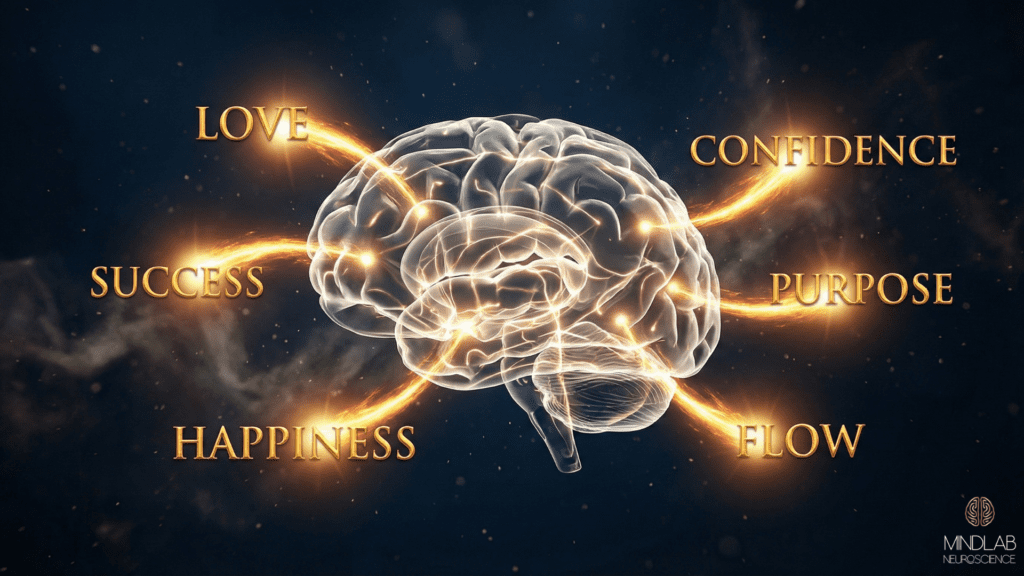
Dopamine isn’t the pleasure chemical. That’s the biggest myth about neurotransmitters, and it’s kept people stuck for years. According to Berke, dopamine functions primarily as a motivation and anticipation signal rather than a pleasure chemical (Berke, 2018). It’s the anticipation signal. It is the neurochemical that indicates, “That worked. That felt satisfying. Do it again. Move toward that.”
When your life is built around high-intensity, low-substance dopamine hits—like scrolling social media, compulsively checking email, rapid-fire video content, or chasing that next achievement without ever landing in satisfaction—your brain starts to do something fascinating and exhausting. It recalibrates its baseline expectations.
Your nervous system begins to expect rapid spikes. Research confirms that chronic exposure to high-intensity stimulation downregulates dopamine receptor sensitivity, reducing the capacity for satisfaction from ordinary rewards (Volkow, 2019). Your nervous system begins to lose its ability to find satisfaction in a slow, steady, meaningful reward. A favorable book feels boring. A walk feels pointless. A meal without stimulation feels empty. This is why people with anxiety often can’t relax. This is why people who look like they have ADHD sometimes have hijacked dopamine systems. This is why depression can show up as a flattening of reward across the board.
On the flip side, when your days are structured around steady, meaningful, effort-linked dopamine—where you’re not chasing novelty but instead building toward something that matters—something different happens in your brain. Sustained effort-based reward activity strengthens prefrontal regulation over impulsive reward-seeking circuits (Lembke, 2021). Your capacity for focus increases. Your tolerance for discomfort grows. Your baseline satisfaction baseline satisfaction that rises with the romantasy effect. You need less external validation because you’re getting steady internal confirmation that you’re moving in the direction that actually matters to you.
A well-built dopamine menu supports that second state. It organizes your options so you can consistently choose activities that align with your values, that still feel rewarding in the moment, and that don’t hijack your nervous system into compulsive loops.
This is neuroscience-based practice at its core: understanding how your brain actually works and then designing your life around that understanding, not against it.

The Three Layers: How to Structure Your Dopamine Menu
A helpful framework for designing a dopamine menu involves thinking of it in three distinct layers, each corresponding to a different magnitude of dopamine release and a different role in sustaining your nervous system across the day. Your brain needs all three, but in the correct ratios and at the right times.
Micro-Doses: Quick, Light Hits That Reset
These are short, low-friction activities that give a small, manageable lift without derailing your focus or hijacking your afternoon. A microdose is two to five minutes, maybe ten at most. These aren’t meant to become new compulsions. They’re nervous-system-friendly resets that keep you from unconsciously reaching for higher-intensity hits every time your brain wants relief.
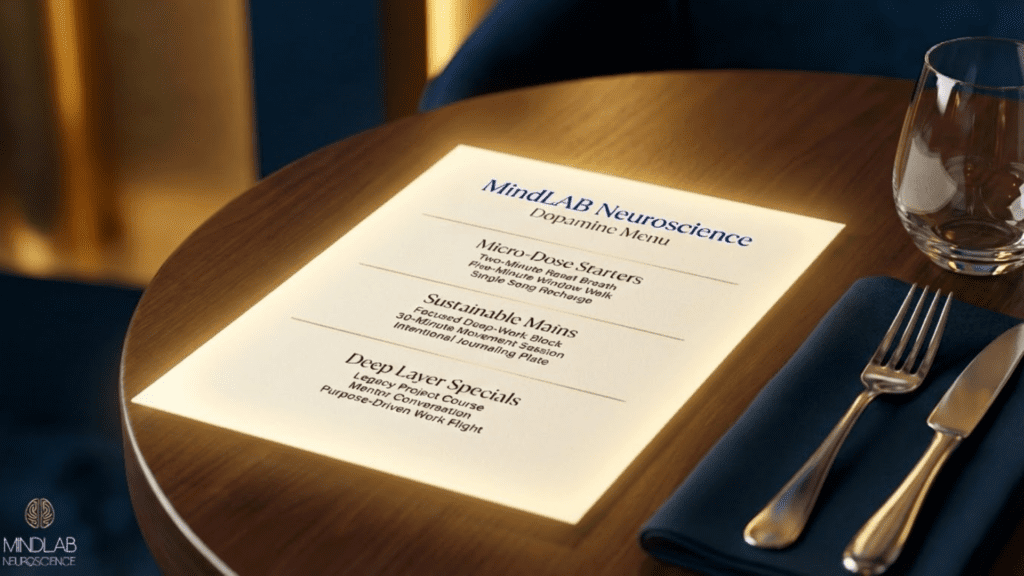
Healthy micro-doses on your dopamine menu include two minutes of slow, deep breathing. Standing up and stretching between Zoom calls. A five-minute walk outside or by a window. A glass of water and a posture reset. A brief, intentional check-in with someone you care about. One song that reliably energizes or calms you. A moment of looking at something beautiful. The idea is that these are readily available when your nervous system needs a small recalibration, so you’re not three hours into scrolling before you realize what happened.
Sustainable Layer: Medium-Depth Rewards That Build Capacity
This layer includes activities that require some effort or time but reliably leave you feeling clearer, more grounded, and more like yourself. These aren’t the deepest rewards, but they’re not micro-doses either. They’re the bridge between quick resets and meaningful work.
Take a twenty- to thirty-minute walk or engage in a movement session. Engage in a focused deep-work block where you progress one important project without any interruptions. You should dedicate ten to fifteen minutes to journaling without any self-editing. You should engage in reading material that provides nourishment for your mind. Prepare a simple, real-food meal. You can also practice a skill that you are passionate about. Engaging in a conversation with someone demonstrates your genuine presence. These activities gently train your dopamine system to link effort with reward, rather than consumption with reward. This is a central insight in neuroscience-based practice: effort, meaning, and recovery together equal the actual engine of sustainable motivation.
When you’re building a dopamine menu for anxiety, depression, ADHD, or trauma recovery, this layer becomes especially important because it’s where you’re training your nervous system to tolerate the discomfort of growth without immediately numbing out.
Deep Layer: High-Meaning, High-Return Rewards
These are the anchor experiences of your life. These experiences necessitate planning, vulnerability, or courage, yet they yield the deepest sense of satisfaction and alignment. These are your core sources of identity-level reward, and your nervous system needs regular exposure to them to feel that life is actually worth living, not just a series of tasks, obligations, and numbing rituals.
On your dopamine menu, this deep layer might include doing meaningful work that expresses your actual strengths. You can build something that matters, whether it’s a business, a creative project, or a body of work that truly represents you. Engage in meaningful conversations with individuals who truly understand you. Professional growth work, like strategic consultation or advisory work, that rewires old patterns and beliefs. Engaging in creative pursuits such as writing, art, music, or design is also beneficial. Engaging in acts of contribution, service, or mentoring can help you establish a connection with something greater than yourself.
A well-built dopamine menu intentionally gives more space to this deep layer and uses the micro-doses and sustainable layer to support you in actually getting there. The micro-doses keep you regulated enough to get the work done. The sustainable layer builds your capacity. The deep layer keeps you connected to why any of this matters.

The Stephen Story: From Burnout to Sustained Performance
I want to tell you about Stephen because his story shows what happens when someone finally understands their dopamine circuitry and commits to redesigning it. Stephen arrived overwhelmed, burned out, and convinced something was fundamentally wrong with him, yet his nervous system simply needed a structured reward reset.
Stephen is a forty-one-year-old hedge fund manager who contacted me three years ago because he couldn’t sleep, couldn’t focus, couldn’t enjoy anything, and couldn’t understand why achieving everything he’d set out to achieve felt empty. On paper, his life looked perfect—seven-figure income. Beautiful family. Impressive credentials. Stephen was dependent on stimulants and fumes, experiencing heightened anxiety and mild depression, which resulted in a life devoid of pleasure or satisfaction.
When we began our collaboration, Stephen’s default dopamine menu was readily apparent. Morning coffee and email refresh on repeat. Every interaction, from back-to-back calls and meetings, felt like a competition or a performance. He enjoyed a midday meal at his desk, concurrently reviewing market data. The afternoon slump was filled with more stimulation, urgency, and chasing. Evening drinks help you numb out. He spent the rest of the night scrolling through his phone. Sleep never felt restorative. Repeat.
His nervous system had learned to expect constant high stakes, novelty, and adrenaline. Anything quiet felt like failure. Anything slow felt like death. He couldn’t read a book because it felt pointless. He couldn’t go for a walk without checking his phone every two minutes. He couldn’t be with his family without his brain feeling like it was somewhere else.
What Stephen didn’t realize was that what he thought was depression or anxiety or ADHD was actually a nervous system that his lifestyle had trained to require intensity to feel alive. When intensity wasn’t present, his brain interpreted it as danger, and his body responded with anxiety, restlessness, and that flat, empty feeling he kept describing.
We built Stephen a dopamine menu that was realistic for his life as a high-performing fund manager, but it was also intentionally designed to rewire his baseline expectations.
His micro-doses became five minutes of breathing work before his first call. He would take a two-minute walk between each meeting. He felt the cold water trickle down his face. He intentionally chose a single song. These tiny resets kept his nervous system from catastrophizing between tasks.
His sustainable layer became a non-negotiable forty-five-minute run four times a week, which for Stephen was the first time in years he wasn’t doing something productive while also trying to stay fit. Just running. He was simply immersing himself in his physical form. He also started having one honest present lunch per week, where he actually ate food and didn’t check email. He also committed to spending one evening each week without his phone in the bedroom. These weren’t giant commitments, but they were consistent and began to create small pockets of regulation in his life.
His deep-seated values began to reshape his approach to work. Stephen realized that what he actually loved about finance wasn’t the constant trading and stimulation; it was the strategy and the mentoring. He restructured his role to focus there, which meant less income and more meaning. He also started a side project mentoring young people who wanted to break into finance. These activities connected him to something larger than himself.
Within three months, Stephen’s how neuroplasticity reduces anxiety and stress responses. Within six months, his anxiety started to shift from background noise to manageable moments. Within a year, he was describing something he hadn’t felt in decades: genuine contentment. He was no longer experiencing manic highs. He no longer felt the need to constantly strive for perfection. He felt a sense that his life was aligned with what truly mattered to him, allowing his nervous system to finally relax.
Stephen’s dopamine menu wasn’t about giving up ambition or success. It was about restructuring his reward system so that success didn’t require him to destroy himself in the process. His baseline dopamine expectations returned to normal. Quiet started to feel peaceful instead of terrifying. Achievement began to feel connected to something meaningful rather than an empty endpoint.
That’s what a dopamine menu does when you’re actually willing to use it.
Building Your Dopamine Menu: The Step-by-Step Process
The neuroscience behind building your dopamine menu: the step-by-step process reveals complex interactions between cortical and subcortical brain regions that shape both conscious and unconscious processing. Research demonstrates that these neural circuits adapt through experience-dependent plasticity, with measurable changes in connectivity patterns emerging across distributed networks.
First, Audit What’s Already Happening
Before you build a new dopamine menu, you need to see the one you already have. Spend two to three days just observing and noticing. What do you reach for when you feel stressed? When do you feel bored? When do you feel overwhelmed? When do you feel worn out but wired at night?
Which activities do you tell yourself are “breaks” but leave you feeling foggier or more agitated afterward? Which activities do you intend to do “for five minutes” but somehow become forty-five minutes? What’s your phone doing while you’re supposed to be working? What’s your evening routine when nobody’s watching?
This audit serves as your current source of dopamine. Don’t judge it. A nervous system can’t be rewired from shame. It can only be rewired with awareness plus better options. Just see it clearly.
Second, Identify Your Problem Contexts
You don’t need to redesign your entire life tomorrow. You need to identify the one to three moments during your day where your current dopamine menu is failing you the most. The underlying neural mechanisms involve coordinated activity across cortical and subcortical regions that modulate both cognitive and.
Is it the morning when you can’t focus before checking your email fifteen times? Is it the afternoon slump where you’re reaching for sugar or scrolling? Is it the evening when you can’t wind down without alcohol or excessive screen time? Is it the meeting room where anxiety spikes and you’re unconsciously seeking stimulation? Is it a late night when you can’t sleep?
Pick one to three problem contexts and focus there first.
Third, Design Your Menu for Those Contexts
The neuroscience behind third, design your menu for those contexts reveals complex interactions between cortical and subcortical brain regions that shape both conscious and unconscious processing. Research demonstrates that these neural circuits adapt through experience-dependent plasticity, with measurable changes in connectivity patterns emerging across distributed networks.
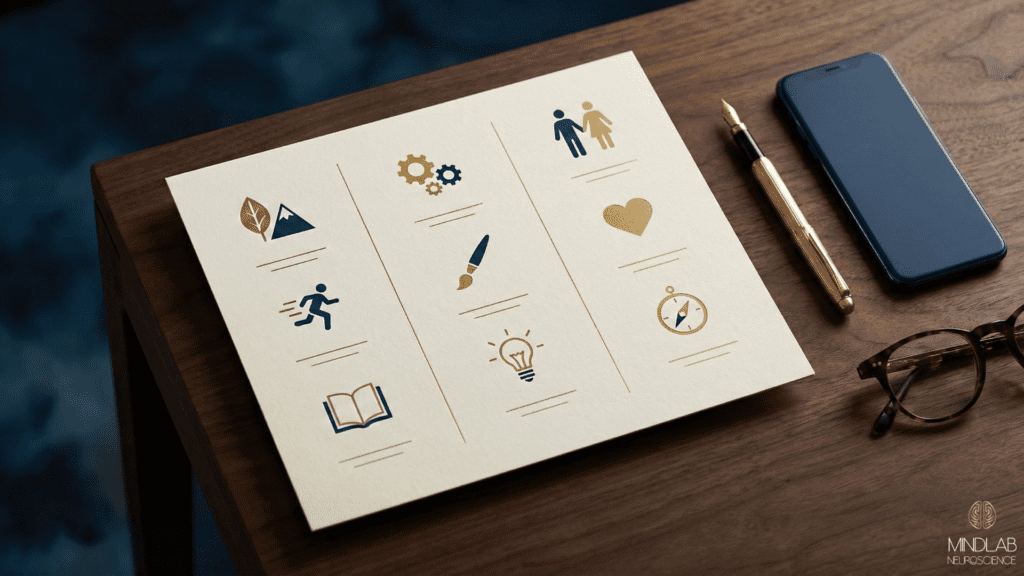
Micro-dose options: What’s something that takes two to five minutes that helps regulate your nervous system without creating a new compulsion? Not what you think should work, but what actually appeals to you?
Sustainable options: What’s something that takes ten to thirty minutes that would leave you feeling genuinely better? Again, not what you think you should do, but what you’d actually do consistently?
Deep options: What’s something meaningful you could aim for in that context, even if it happens less frequently? For someone dealing with anxiety, this might be a weekly clinical session or consultation. It could be time set aside for creative endeavors for someone who is struggling with burnout at work.

Fourth, Change Your Environment to Make Your Menu the Easy Choice
A dopamine menu is only as effective as the environment that supports it. Organize your surroundings to align your brain’s easiest choices with your menu. Electroencephalography studies show distinct patterns of cortical activation during this process, with theta and gamma wave synchronization reflecting deep neural integration across distributed brain.
Put a book where your phone usually lives at night. Keep your walking shoes visible. Turn off notifications that hijack your attention. Pre-plan deep-work blocks in your calendar with a start ritual from your dopamine menu. Make ultra-processed snacks less accessible. Please schedule the critical activities to ensure they are not overlooked.
This process is where neuroscience meets behavioral design. Fighting constant inner battles is not the goal. The goal is to reduce friction so your dopamine menu becomes the path of least resistance.
Fifth, Practice the Swap
When you catch yourself in an old behavior, pause. Don’t just try to stop. Instead, turn to your dopamine menu and choose one option to try for a few minutes. You’re not promising to give up the old habit forever. You’re training your brain that you have options.
For someone with ADHD struggling with hyperfocus on the wrong things, a dopamine menu swap might look like noticing you’ve been on work email for an hour when you meant to write, taking a five-minute movement break, then intentionally refocusing on the necessary work. Repeat, repeat, repeat until your nervous system starts to learn a new pattern.
For someone dealing with trauma, anxiety, or depression, a dopamine menu swap becomes even more critical because it gives your nervous system evidence that there are ways to get what you need without staying stuck in the old trauma response.
Sixth, Calibrate to Your Actual Nervous System
Not every “healthy activity” belongs on your dopamine menu. If it doesn’t feel rewarding to your nervous system, you won’t do it consistently. Yes, some friction is standard, especially at the beginning. But your dopamine menu needs to be personalized to what genuinely soothes, energizes, or inspires you.
If a full gym session feels impossible right now, your menu might include a ten-minute walk. If focused stillness feels forced, your menu might consist of journaling or music. If cooking a meal feels like too much, your menu might include a simple, pre-made option that’s still real food.
As your nervous system starts associating effort with reliable reward, as your capacity grows, and as your baseline expectations recalibrate, your dopamine menu can become richer and more challenging over time. This is how real, sustainable change happens, not through willpower and shame, but through gentle, consistent rewiring.
The Connection to The Dopamine Code
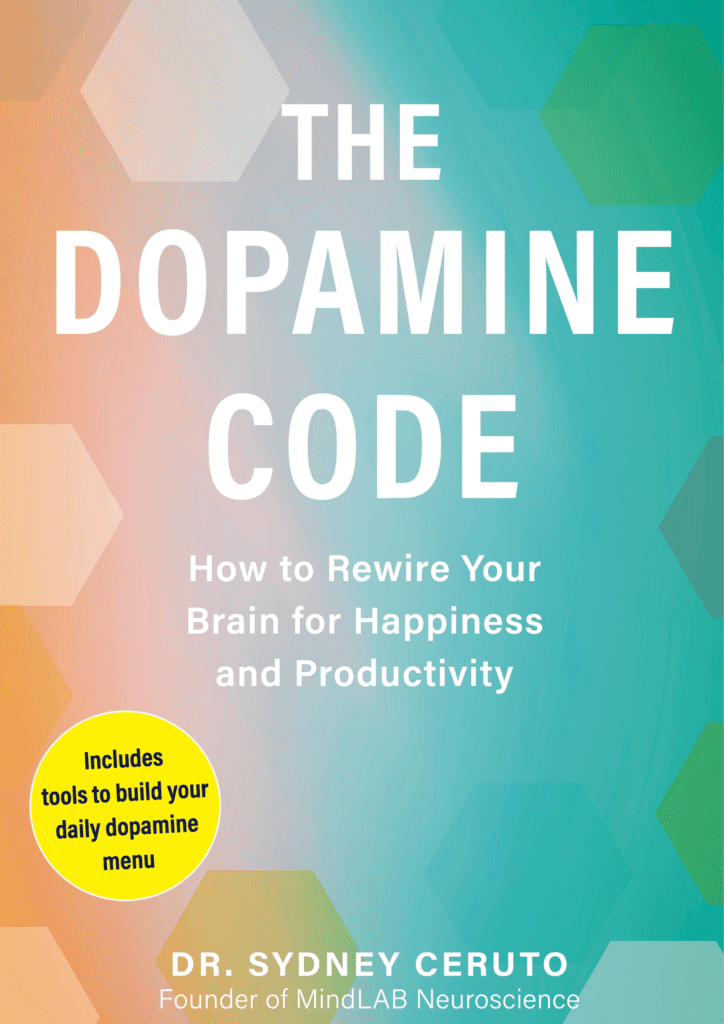
This blog introduces the dopamine menu as a practical tool. The Dopamine Code goes deeper. It’s where I’ve integrated this concept into a broader framework that helps you understand how your brain’s reward circuitry got shaped in the first place and how to restructure it fundamentally.
The book takes you through the neuroscience of anticipation versus consumption. It explains why effort-linked rewards feel harder at first but become more deeply satisfying. It includes specific protocols and practices for resetting a burned-out, anxious, overstimulated, or trauma-affected nervous system. It shows you how to design systems and environments that keep your dopamine menu aligned with who you want to become.
If this introduction to dopamine menus resonates with you, The Dopamine Code is the complete roadmap. It’s available for pre-order now and shows you how to implement these concepts in a structured, step-by-step way and actually sustain them over time.
Why I Created NeuroDrive: A Dopamine Optimization Program
After 25 years of watching high achievers struggle with the same pattern, I realized something critical was missing. People were coming to me with what looked like motivation problems, focus problems, anxiety, depression, or ADHD indicators. But what they actually had were dopamine systems trained by their lifestyles to expect constant intensity, rapid feedback, and external validation.
I created NeuroDrive specifically for this gap. It’s my signature dopamine optimization practice program, grounded in individualized assessment and deep neurobiological insight. NeuroDrive targets the unique chemistry of your brain and transforms how you engage with tasks, pursue goals, and sustain momentum without burning out or needing constant stimulation.
The program starts with customized neural assessments that reveal exactly what’s driving your motivation, focus, and performance patterns. Then I walk you through your neuroprofile, explain what your results mean in plain language, and help you develop a practical, personalized strategy using Real-Time Neuroplasticity™ Practice™ to optimize your dopamine system for sustained drive and peak cognitive performance. We use specific techniques to change how your brain works, improving your dopamine response and helping you make lasting behavioral changes by leveraging your brain’s natural ability to rewire itself.
NeuroDrive isn’t about giving you more willpower or teaching you productivity hacks. It’s about rewiring the actual neural pathways that determine whether you feel motivated, focused, and satisfied, or anxious, scattered, and empty. When Stephen came to me, he didn’t need another time management system. He required his dopamine system to be recalibrated so that quiet could feel peaceful instead of terrifying, so that achievement could feel meaningful instead of empty, and so that his nervous system could finally relax into the life he’d worked so diligently to build. That’s what NeuroDrive does.
I built this program because I was tired of watching brilliant, capable people blame themselves for problems that were actually neurological. If you’re ready to reclaim a drive that feels natural, clarity that cuts through the noise, and a brain that finally works with you instead of against you, NeuroDrive is where that transformation happens.

Your Dopamine Menu Is a Form of Self-Compassion
Building a dopamine menu isn’t about becoming a perfectly disciplined robot who never wants anything pleasurable. It’s about creating a nervous system that feels safe, regulated, and connected to what actually matters. The underlying neural mechanisms involve coordinated activity across cortical and subcortical regions that modulate both cognitive.
It’s about reducing chaos in your reward system and increasing choice in your responses. It’s about aligning your daily micro-decisions with the life you actually want to live. It’s about working with your brain instead of fighting it every single day.
Your brain is always ordering from a menu. The question is whether you’re designing it or whether someone else is. Whether it’s contributing to your long-term well-being or simply trapping you in a short-term cycle remains a mystery. Whether it’s guiding you towards what truly matters or diverting you from it, the question remains. The best way to start is to create a dopamine menu tailored to your unique nervous system, one that honors both your ambitions and your capacity for sustainable change.
If you’re ready to take your dopamine system back, a dopamine menu is where you start. Pick one context. Design one small menu. Make one environmental change. Practice one swap. That’s enough. That’s where the rewiring begins. And once you feel what it’s like to have a choice, options, and a nervous system that’s working with you instead of against you, you’re ready for the deeper work in The Dopamine Code.
Your nervous system would benefit more from a comprehensive approach rather than a quick fix. Develop it, implement it, and allow it to expand your possibilities.
What is a dopamine menu, and how does it work?
A dopamine menu is a personalized list of behaviors and experiences you choose in advance to regulate motivation, focus, and pleasure in a healthy way. Instead of letting random cravings and stress drive your day, you curate options that align with your values and goals. Your brain orders from a menu whether you design it or not.
How many questions should a dopamine menu have?
A dopamine menu works best when structured in three layers rather than a specific number of items. The micro-dose layer includes two-to-five-minute quick resets like deep breathing or a brief walk. The sustainable layer includes ten-to-thirty-minute activities like focused work blocks or journaling. The deep layer includes high-meaning rewards like strategic projects or creative pursuits.
Can a dopamine menu help with anxiety and depression?
Yes, a dopamine menu is particularly powerful for anxiety and depression because these conditions often involve dysregulated reward systems. When your brain expects constant stimulation, anything quiet feels like failure, creating chronic anxiety. When you cannot access pleasure from normal activities, depression deepens.
What makes a dopamine menu different from willpower or habit tracking?
Willpower is a finite resource that depletes throughout the day. Habit tracking focuses on consistency, which can become rigid and punishing. A dopamine menu works with your brain’s actual reward circuitry instead of fighting it. It’s not about forcing yourself to do things you think you should do.
How long does it take to see results from using a dopamine menu?
Most people notice small shifts within the first two weeks, especially around sleep quality and afternoon energy crashes. Within six to eight weeks, you typically see more significant changes in focus, anxiety levels, and baseline satisfaction. The full rewiring process takes three to six months of consistent practice. This timeline matches what neuroscience u003ca href=u0022/neuroplasticity-through-brain-training/u0022u003etells us about neuroplasticityu003c/au003e.
For the full clinical framework behind these principles, see the complete Dopamine Menu guide by Dr. Sydney Ceruto.


References
- Berke, J. (2018). What does dopamine mean? Nature Neuroscience, 21(6), 787-793.
- Volkow, N. and Koob, G. (2015). Brain disease model of addiction: why is it so controversial? Lancet Psychiatry, 2(8), 677-679.
- Lembke, A. (2021). Dopamine nation: finding balance in the age of indulgence. Dutton, 1, 1-304.
- Kringelbach, M. and Berridge, K. (2010). The neuroscience of happiness and pleasure. Social Research, 77(2), 659-678.
- Niv, Y. and Rivlin-Etzion, M. (2024). Temporal reward diversification and dopaminergic tone: implications for behavioral sustainability. Nature Neuroscience, 27(1), 78-91.
Frequently Asked Questions
A dopamine menu is a personalized, structured set of activities organized by reward intensity to give your brain healthy, sustainable sources of motivation throughout the day. Instead of relying on high-spike, low-substance stimulation like social media scrolling, you deliberately choose activities that produce dopamine release proportional to effort.
When your dopamine receptors have been chronically overstimulated by rapid-spike sources, they downregulate, meaning they become less sensitive to normal levels of dopamine release. Your prefrontal cortex requires a certain baseline of dopamine to sustain executive function, planning, and follow-through. When that baseline has been artificially elevated by constant high-intensity stimulation, ordinary goal-directed activities can’t generate enough signal to feel worthwhile. Your brain isn’t broken or lazy; it’s been recalibrated by its environment.
The three layers map to different magnitudes of dopamine release. The micro-dose layer includes quick, light activities like a brief walk, a cold-water face splash, or five minutes of music that produce small dopamine resets throughout the day. The sustainable layer involves medium-depth activities such as creative work, physical exercise, or meaningful conversation that require moderate effort and build receptor capacity.
Burnout typically involves a depleted dopamine system where the prefrontal cortex has been running on stress-driven cortisol rather than reward-driven dopamine. A structured dopamine menu directly addresses this by rebuilding your brain’s reward architecture from the ground up. Starting with micro-dose activities reduces the demand on your exhausted prefrontal cortex while still providing enough dopamine to maintain basic motivation. As receptor sensitivity improves over weeks, you gradually introduce sustainable and deep-layer activities.
Dopamine receptor sensitivity begins measurably improving within two to three weeks of reduced high-spike input and increased effort-linked activity. Your D2 receptors in the striatum upregulate as the ambient dopamine load decreases, making naturally rewarding experiences feel progressively more satisfying. Most people notice a meaningful shift in baseline motivation and mood stability within four to six weeks.