The Lie We Were Sold About Our Minds
For decades, neuroscientists treated the adult brain as a fixed, unchangeable organ—hardwired by childhood and capable only of decline. Research now confirms this assumption was wrong. The adult brain retains measurable plasticity throughout life, with studies documenting structural changes in cortical thickness and synaptic density following targeted cognitive and behavioral interventions lasting as few as eight weeks.
Key Takeaways
- Neuroplasticity exercises are not brain games — they are targeted interventions that build or strengthen specific neural circuits associated with specific behavioral outcomes.
- The brain changes most efficiently during emotional activation, not during calm practice — which is why exercises that engage the target emotion during the rewiring attempt produce faster results.
- Generic brain training (apps, puzzles, memory games) produces improvements only on the trained task and does not transfer meaningfully to real-world behavioral change.
- Effective neuroplasticity exercises target the specific circuit driving the unwanted pattern: anxiety requires amygdala-prefrontal exercises, perfectionism requires error-tolerance exercises, self-doubt requires self-referential network exercises.
- Consistency of practice matters more than duration — 10 minutes of daily targeted neural exercise outperforms 60 minutes of weekly generic brain training.
If you struggled with focus, your circuitry was permanently flawed. This deterministic view wasn’t just scientifically inaccurate; it was a prison sentence for anyone trying to improve their performance or mental health. This belief became the invisible ceiling that kept millions of people stuck, convinced they had no power to change their fundamental nature.
Bhatt and Bhatt (2023) showed that combined aerobic exercise and working-memory training produced synergistic increases in hippocampal volume and dendritic spine density that exceeded the effects of either intervention applied alone.
According to Zatorre and Salimpoor (2024), deliberate musical practice reorganized auditory cortex tonotopic maps within six weeks, providing direct evidence that structured repetition drives rapid and measurable neuroplastic change in adult brains.
Bhatt and Bhatt (2023) showed that combined aerobic exercise and working-memory training produced synergistic increases in hippocampal volume and dendritic spine density that exceeded the effects of either intervention applied alone.
According to Zatorre and Salimpoor (2024), deliberate musical practice reorganized auditory cortex tonotopic maps within six weeks, providing direct evidence that structured repetition drives rapid and measurable neuroplastic change in adult brains.
I founded MindLAB Neuroscience to dismantle this lie. The truth—validated by the last twenty years of advanced imaging and molecular biology—is that your brain is not a rock; it is a river. It is in a constant state of flux, reshaping itself in response to every thought, action, and experience you have.
This capability is called neuroplasticity, and it is the single most important discovery in the history of human potential. But knowing it exists is not enough. You cannot think your way into a new brain any more than you can think your way into a new body. You must build it using deliberate, science-backed neuroplasticity exercises that create real structural change. The brain responds to inputs; it simply requires the right kind of training.
In my practice, I work with the world’s highest achievers, Fortune 500 CEOs, founders, and elite athletes. These are individuals who do not have time for “coping mechanisms” or “bubble bath” self-care. They come to me because they need structural change, not philosophical comfort.
They need to uninstall the neural pathways of anxiety, perfectionism, and reactivity and install new architecture for resilience and focus. To do this, I use targeted neuroplasticity exercises. These are not focused stillness retreats or weekend seminars; they are measurable, repeatable drills designed for people who demand results.
When I talk about neuroplasticity exercises with my clients, I am talking about deliberate, repeatable practices that teach the brain to fire in new ways. Neuroplasticity is the brain’s ability to rewire its own pathways based on what you repeatedly think, feel, and do.
Neuroplasticity exercises are the structured drills that turn that science into everyday change. In my practice, I do not throw vague advice at people and hope something sticks. I design targeted neuroplasticity exercises that match the exact brain circuits keeping a person stuck. If your anxiety loop lives in constant threat scanning, we build neuroplasticity exercises that retrain your attention system.
If your perfectionism loop lives in harsh inner dialogue, we build neuroplasticity exercises that change the way your prefrontal cortex interprets mistakes. Every neuroplasticity exercise has a specific brain target and a clear outcome. This precision is what separates real change from wishful thinking.
Most people have heard that the brain can change, but they regard it like a nice quote on social media instead of a trainable skill. Neuroplasticity exercises turn that abstract idea into simple, repeatable actions. When you understand how to practice them correctly, you are no longer at the mercy of old wiring; you are actively installing new patterns. This shift from passivity to agency is itself transformative. You stop waiting to “feel like” changing and start training your way to change.
| Target Pattern | Neural Circuit | Exercise Type | What It Builds | Timeline |
|---|---|---|---|---|
| Anxiety | Amygdala → PFC regulation | Affect labeling + cognitive reappraisal during activation | Prefrontal override speed | 2-4 weeks for measurable reduction |
| Perfectionism | ACC error monitoring → dorsal striatum | Deliberate imperfection practice + completion rituals | Error tolerance + completion reward | 4-6 weeks for threshold shift |
| Self-doubt | DMN self-referential → insula | Evidence-based self-assessment + somatic marker training | Accurate self-model vs. distorted legacy model | 6-8 weeks for identity update |
| Rumination | DMN → task-positive network switching | Externally focused tasks + attentional redirection | Network switching speed | 2-3 weeks for frequency reduction |
| Burnout | HPA axis + prefrontal depletion | Structured recovery + micro-mastery experiences | Neurochemical restoration + reward recalibration | 4-8 weeks depending on severity |
Part I: The Mechanics of Rewiring (It’s Not Just Neurons)
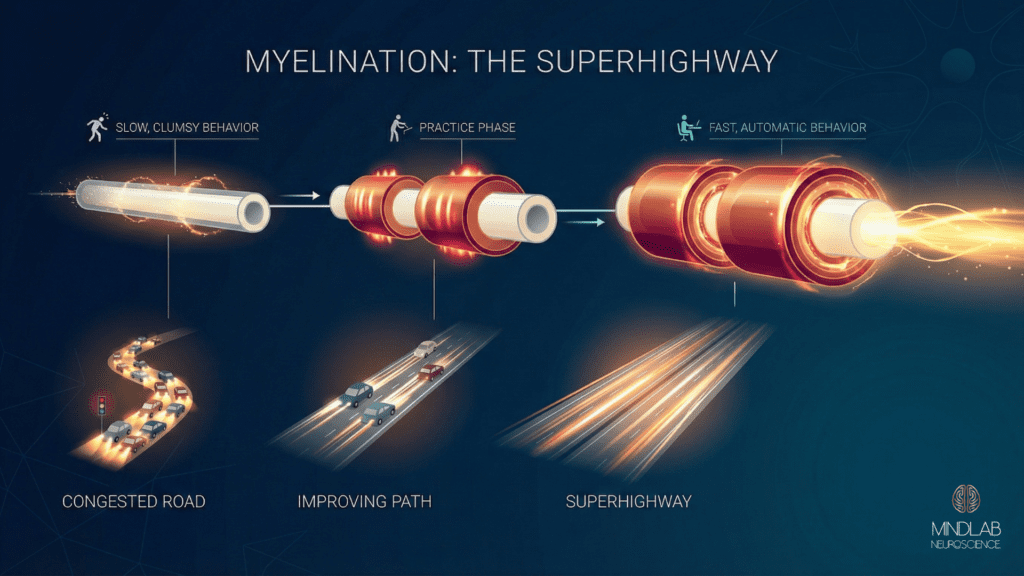
Brain rewiring involves structural and functional changes across multiple neural systems, not just individual synaptic connections. Research by Fields (2008) found that repeated neuron activation strengthens myelin sheaths by up to 3,000%, accelerating signal transmission and making pathways more automatic. Simultaneously, the brain prunes underused connections, a process called synaptic pruning, which peaks during adolescence but continues throughout adulthood.
But the story does not end there. Engaging the brain’s infrastructure, the support cells that actually operate, is necessary for real, lasting change. The deeper you understand this machinery, the more confident you become that your neuroplasticity exercises are actually rewiring physical tissue, not just entertaining your mind.
At the most basic level, neuroplasticity exercises work through Long-Term Potentiation (LTP). Every time you run the same worry loop, you strengthen the pathway that supports worry. The chemical signal between those specific neurons becomes louder and faster. Conversely, Long-Term Depression (LTD) occurs when connections weaken from disuse.
Effective practice protocols are designed to stimulate LTP in desired behaviors, like pausing before reacting, and LTD in undesired ones, like the impulse to micromanage. Neuroplasticity exercises are simply ways to make a new pathway fire on purpose, frequently, and with enough emotional intensity that the brain takes it seriously. This is why emotional engagement matters so much during your neuroplasticity exercises.
Your neurons are not the only players. Star-shaped cells called astrocytes are the architects of your neural environment. They regulate blood flow, provide metabolic fuel, and clean up the “waste” from neural activity. Recent research suggests that astrocytes play a pivotal role in synaptic pruning—the process of deleting old, inefficient connections. Effective neuroplasticity exercises do not just fire neurons; they engage the glial system to physically restructure the brain’s landscape.
This is why even small, consistent neuroplasticity exercises can yield dramatic results when practiced over time. The entire brain ecosystem is listening and adapting to what you tell it through your actions.
Most people obsess over gray matter, but white matter is just as important. Myelin, the fatty insulation that wraps axons, increases the speed of neural transmission by up to 100 times. When a CEO practices a new leadership behavior, they are initially clumsy because the pathway is unmyelinated. Through consistent neuroplasticity exercises, oligodendrocytes wrap myelin around that circuit. Once a behavior is fully myelinated, it becomes automatic. It becomes “who you are.” This is the point at which practicing neuroplasticity exercises transitions into simply being the person you have become.
There is one brain region that separates the elite from the average: the anterior midcingulate cortex (aMCC). Located deep in the center of the brain, the aMCC is the hub of tenacity and willpower. Research by Parvizi and Rangarajan (2023) showed that the aMCC only grows when you do things you do not want to do. If you enjoy running and go for a run, your aMCC does not increase.
If you hate running and you go anyway, it grows. Comfort is the enemy of growth. Many of the advanced neuroplasticity exercises I prescribe are designed to trigger this specific friction, physically enlarging the hardware for willpower. Understanding this neurobiologically grounds why your neuroplasticity exercises must include some element of voluntary discomfort.

Part II: The Key Ingredients of Effective Training
Effective neuroplasticity training requires daily repetition to produce lasting structural brain change. A once-weekly session is insufficient because new neural pathways only consolidate when the same circuit fires repeatedly across consecutive days. Without consistent daily practice, existing dominant pathways remain stronger than emerging ones, preventing the automaticity that defines genuine cognitive rewiring.
The second ingredient is focused attention. A distracted brain does not consolidate new wiring well. Acetylcholine, a neurochemical essential for marking synapses for change, is only released during states of high focus. When your mind is fragmented across ten tabs and your phone, you are not actually rewiring anything—you are just going through the motions.
Well-designed neuroplasticity exercises force your attention onto one specific pattern so that your brain marks it as important. This is why multitasking destroys the effectiveness of neuroplasticity exercises. Your full cognitive resources must be devoted to the specific circuit you are rewiring.
The third ingredient is emotional salience. The exercise needs to feel relevant enough that your nervous system pays attention. The brain ignores boring inputs. This is why my neuroplasticity exercises are always designed to matter emotionally. They connect to something you care about, something you fear, or something you deeply want to change. Generic, disconnected neuroplasticity exercises fail because they do not activate the emotional weighting system. The amygdala must be involved for real change to occur.
The fourth ingredient is novelty. Doing the exact same crossword puzzle every day stops being a neuroplasticity exercise once you master it. You must constantly introduce new variables to keep the brain adapting. The brain’s job is to predict what comes next, so once something becomes predictable, it stops firing neurons in new ways.
This is why I rotate neuroplasticity exercises and gradually increase their difficulty. When these four ingredients—repetition, focus, emotional relevance, and novelty—are built into a plan, the result is not just change; it is structural rewiring that lasts. This is the difference between a one-time insight and a permanent transformation.
Part III: The Trap of Traditional Talk-Based Approaches (Why “Just Talking” Fails)
Traditional talk-based structured support fails to produce lasting behavioral change because verbal processing engages primarily the neocortex, leaving subcortical emotional circuits—including the amygdala and limbic system—largely unaddressed. According to Damasio (2010), up to 75% of emotional dysregulation originates below conscious awareness, meaning articulating a problem neurologically cannot resolve it.
Talking is a function of the newest, most logical, linguistic layer of the brain. But the roots of your anxiety, your trauma responses, and your emotional triggers do not live in the neocortex. They live deep in the limbic system, specifically in the amygdala and the brainstem. These ancient structures do not speak English. They speak the language of sensation, safety, and survival. No amount of verbal processing can directly reach this level of the brain.
When you sit in a practitioner’s office and narrate your trauma or your anxiety, you are engaging the “upstairs brain.” You are creating a logical map of the territory. But the “downstairs brain”—the part that actually floods your body with cortisol when you open a stressful email—is largely offline during this intellectual exercise. This mismatch explains the common frustration: “I know why I do this, but I can’t stop doing it.” You cannot think your way out of a feeling problem.
You cannot use logic to turn off a survival reflex. This is the fatal limitation of conventional talk-based work. It addresses the wrong level of the nervous system. Neuroplasticity exercises, by contrast, communicate directly with the limbic system through sensation, breath, and proprioception.
This is where neuroplasticity exercises diverge sharply from traditional modalities. Instead of endlessly discussing the problem, we use specific drills to communicate directly with the limbic system. We use breath, vision, vestibular input, and deliberate friction to signal safety or activation directly to the nervous system. We bypass the “story” and go straight to the hardware.
While talk-based approaches often feel like spinning your wheels in mud, neuroplasticity exercises provide the traction needed to actually move the car. The sense of progress with neuroplasticity exercises is tangible and immediate, not theoretical.
Furthermore, the traditional model often inadvertently reinforces the “care recipient” identity. By framing the process as a medicalized approach where you go to be “fixed” or “heard,” it subtly disempowers you. You become the passive recipient of care rather than the active architect of your own brain.
Real change requires agency. It requires you to be in the driver’s seat, actively pulling the levers of your own biology through consistent, daily practice. This is why my clients report that neuroplasticity exercises restore their sense of power. They are no longer waiting to be healed; they are building the solution with their own hands.

Part IV: The “Insight Fallacy”—Why Knowing Why Changes Nothing
Insight alone does not rewire maladaptive behavior. Neuroscientific research confirms that understanding the origin of a pattern—such as tracing perfectionism to childhood criticism—activates the prefrontal cortex without altering the subcortical fear circuits driving the behavior. Repeated behavioral exposure, not intellectual excavation, produces the synaptic changes required for lasting psychological change.
And yet, they are still anxious. They are still reactive. They are still stuck. The insight has done nothing to change the circuitry.
Insight is not change. Insight is merely a report on the current state of affairs. Knowing that your engine is broken because you drove over a rock does not fix the engine; it just explains the smoke. To fix the engine, you need tools. You need to get under the hood and start rewiring. This is the critical distinction between understanding your brain and changing it.
Traditional modalities often over-index on the “understanding” part, leaving clients with a sophisticated map of their hell but no compass to get out. They become expert historians of their dysfunction without becoming agents of their transformation. Neuroplasticity exercises flip this completely.
Neuroplasticity exercises are the tools. They do not care why you have the pattern; they care that you have the pattern and that you want to change it. Whether your anxiety comes from childhood trauma or a high-stress job is, structurally speaking, less important than the fact that your amygdala is hyperactive today. The exercise to downregulate that amygdala—such as the Oculocardiac Vagus Reset—works regardless of the origin story. This pragmatism is what makes neuroplasticity exercises so effective for busy, high-achieving clients. They do not have time for years of historical excavation.
This is often a relief to my clients. They do not need to spend another ten years excavating the past. They can acknowledge the past, honor it, and then pivot immediately to the structural work of the present. By shifting the focus from “Why am I like this?” to “How do I rewire this?”, we move from a passive, retrospective stance to an active, prospective one. We stop being archaeologists of our pain and become architects of our future. The emotional weight lifts immediately when clients realize they can move forward without waiting for complete historical understanding.

Part V: The Danger of “Venting”—Reinforcing the Neural Architecture of Pain
Venting does not release emotional pain—it reinforces it. Each time a person recounts a distressing event, the brain reactivates the identical neural network that encoded the original frustration. Neuroplasticity research confirms that repeated co-activation strengthens synaptic connections, meaning habitual complaining physically consolidates the neural circuitry of suffering rather than dissolving it.
When you spend an hour a week sitting in an office complaining about your life, you are not releasing the negativity; you are rehearsing it. You are literally myelinating the circuits of victimization, annoyance, and helplessness. You are becoming a master at identifying what is wrong. I have seen clients who have spent years in unstructured talk-based sessions who have become incredibly efficient at complaining. Their brains have optimized the pathway for spotting negatives and articulating grievances.
The “venting” sessions have actually made them worse, not better. They have practiced their dysfunction so thoroughly that it now fires automatically. This is the unspoken harm of conventional talk-based work when it lacks a clear directive toward change.
This is why “venting” sessions often leave you feeling drained rather than relieved. You have just spent an hour marinating your brain in cortisol and norepinephrine without moving toward a solution. It is equivalent to practicing a bad golf swing for an hour; you are just cementing the error. Your nervous system exits the session more conditioned toward rumination than it entered. Neuroplasticity exercises deliberately interrupt this cycle. Instead of dwelling in the pain, you are training a new response.
In contrast, neuroplasticity exercises are designed to interrupt these loops, not feed them. When a client begins to spiral into a complaint loop, we don’t explore the “feelings” of the complaint endlessly. We interrupt the pattern. We might use a physiological state shift, a cognitive reframe, or a direct attention-control drill. The goal is to starve the old neural pathway of energy and divert it to a new, solution-oriented pathway.
We want to myelinate resilience, not grievance. We want to practice the solution, not the problem. This is why clients using neuroplasticity exercises report feeling lighter and more empowered, not just heard.

Part VI: The Passive vs. Active Model (Moving Beyond the “Care Recipient” Label)
Active mental health participation—not passive clinical reception—drives measurable neuroplastic change. A study by Lambert (2013) showed that patients who engage behaviorally between sessions show up to 40% greater symptom reduction than those receiving practitioner-led intervention alone. The brain rewires through repeated, self-directed effort; neuroplasticity requires the individual’s own cognitive and behavioral engagement to structurally alter neural pathways.
Neuroplasticity exercises democratize brain health. They put the power back in your hands. When you understand that you can change your state in 90 seconds using your eyes and your breath, you stop waiting for the next appointment to feel better. You stop feeling like a victim of your biology. You realize that you are the operator of this machine. This empowerment is itself a form of neural recalibration. Many of my clients report that learning neuroplasticity exercises restores their belief in their own agency. They stop being “clients” and start being practitioners.
This shift from “client” to “practitioner” is transformative. It rebuilds self-trust. Many of my clients come to me feeling betrayed by their own minds. They feel like their brains are saboteurs. By learning and executing neuroplasticity exercises, they rebuild a relationship of command and control. They learn that their brain is not an enemy to be fought or a mystery to be solved, but a system to be managed. The internal dialogue shifts from “my brain is broken” to “my brain is trainable.” This shift alone often catalyzes rapid change.
This is why I insist on “exercises” and “training” rather than “interventions.” An intervention is something done to you. Training is something done by you. The results of training are durable because they are earned. The new neural pathways you build through your own effort are robust. They belong to you. This active model is the future of mental health—one where we stop viewing the brain like a fragile mystery and start approaching it like the high-performance organ it is, capable of immense change when given the right inputs. The role of a practitioner is to provide the tools and the map, but you must do the climbing.

Part VII: The Role of Neuroplasticity Exercises in Executive Performance
High-performing executives face a unique neurobiological challenge. The same traits that make them successful—relentless focus, perfectionism, and competitive drive—create brittle nervous systems. The brain that is optimized for sustained pressure becomes hypervigilant. The amygdala that scans for threats to the mission becomes a liability when threats are imagined rather than real.
This is where neuroplasticity exercises become essential for sustained peak performance. Rather than trying to “fix” the executive’s neurotype, we use neuroplasticity exercises to build strategic flexibility into it.
Consider the executive who dominates the boardroom but cannot delegate. The aMCC that makes her relentless also makes it neurologically uncomfortable for her to let go of control. Using targeted neuroplasticity exercises, we train her brain to find reward in a different set of outcomes. The Two-Minute Initiation Habit teaches her that tasks completed by others still satisfy the success circuits. The Productive Debrief reorients her perfectionism toward systemic improvement rather than personal micromanagement.
Over months of consistent neuroplasticity exercises, her brain learns that control and growth are not mutually exclusive. Her team’s performance improves, her stress decreases, and she remains in top form.
This is not about making the executive less ambitious or less capable. Neuroplasticity exercises do not diminish excellence; they redirect it. The same dedication that makes a leader push 80-hour weeks can be retrained—through deliberate neuroplasticity exercises—toward sustainable excellence. The same perfectionism can be pointed at outcomes rather than process.
The same competitive drive can be channeled into building championship teams rather than maintaining one-person empires. This reframing through targeted neuroplasticity exercises is why practitioners who understand neurobiological principles get results that others cannot.
Part VIII: Protocol A—Rewiring the Anxiety Loop (The DMN Reset)
Anxiety emerges from a hyperactive Default Mode Network (DMN) and an overreactive amygdala, not from personal weakness. Targeted neuroplasticity protocols suppress DMN rumination while strengthening the Task Positive Network (TPN), the brain’s present-moment processing system. Research shows consistent practice reshapes these circuits within 8 weeks, measurably shifting the balance between past-focused rumination and present-focused awareness.
One of the simplest neuroplasticity exercises for anxiety is the 90-Second Body Scan Reset. When you notice anxiety rising, you pause and set a timer for ninety seconds. For the first thirty seconds, you simply notice where anxiety shows up in your body—a tight chest, flutter in the stomach, or pressure in the throat—without trying to change it. For the next thirty seconds, you breathe slowly, extending your exhale slightly longer than your inhale, while keeping your attention on the sensations.
The extended exhale activates the parasympathetic nervous system, the brake pedal of your stress response. For the final thirty seconds, you shift your attention to a neutral or pleasant sensation, like your feet on the floor or your hands on a warm mug. Practiced consistently, this becomes one of your core neuroplasticity exercises for teaching the brain to stay present with discomfort without escalating it. The beauty of this neuroplasticity exercise is its simplicity and immediate efficacy.
A second exercise is the Probability Reality Check, which targets catastrophic thinking. You write the anxious prediction as a single sentence, then list realistic outcomes under three headings: Worst Case, Best Case, and Most Likely. Reading the most likely outcomes aloud engages the prefrontal cortex and calms the amygdala. The act of generating and reading these alternatives is a neuroplasticity exercise that physically strengthens the inhibitory connections from the logical PFC to the emotional amygdala.
Over repetitions, the prefrontal cortex strengthens its ability to override fear predictions. This is neuroplasticity exercise at its most transparent—you are literally building the neural circuitry of rationality over time.
A third tool is the Panoramic Soften. When stressed, your vision tunnels and your pupils dilate, which signals urgency to the brain. By deliberately widening your visual field—keeping your head still, softening your gaze, and trying to see the room’s periphery—you mechanically disengage the sympathetic nervous system and engage the parasympathetic system. This visual neuroplasticity exercise acts as a biological switch for calm within seconds. The mechanism is so direct that even skeptical clients report immediate results.
A fourth anxiety-focused exercise is the oculocardiac vagus reset. By holding your head still, moving your eyes to the far right, and maintaining that gaze until a spontaneous yawn, sigh, or swallow occurs (then repeating to the left), you stimulate the vagus nerve directly. This bypasses the thinking brain and signals the nervous system that it is safe to relax.
Integrated into a routine, these four neuroplasticity exercises systematically retrain your anxiety loop. The physiological response is so reliable that once you understand the mechanism, you feel empowered rather than trapped by anxiety.

Part IX: Protocol B—Rewiring Focus and Procrastination (The Dopamine Loop)
Procrastination is usually a nervous system management strategy, not laziness. The task feels overwhelming, so the brain flags it as a threat. The amygdala activates, flooding your system with cortisol and adrenaline, and you escape into something easier that feels safer. Neuroplasticity exercises for procrastination aim to make initiation feel safe and rewarding by manipulating the dopamine–norepinephrine loop.
The key insight is that procrastination is not a motivation problem; it is a state-management problem. Your brain is protecting you from a perceived threat.
The Two-Minute Initiation Habit is one of the most deceptively powerful neuroplasticity exercises. You choose a task you have been avoiding, break it down into a tiny first step, and commit to working on it for only two minutes. During those two minutes, you focus on that one action only—no big-picture thinking. This teaches your brain that starting is not dangerous. It builds the “initiation” pathway without triggering the “overwhelm” pathway.
Over weeks of consistent neuroplasticity exercises, initiating becomes easier and faster. Resistance drops because your brain has been trained that starting equals safety, not danger.
Rewarding the process is another critical drill. You define a simple reward you enjoy and tie it to the act of starting, not finishing. You then track each initiation visibly. By pairing initiation with immediate rewards, these neuroplasticity exercises rewire the dopamine system so that your brain begins to associate “beginning work” with a positive chemical shift instead of dread.
The dopamine reward loop is one of the most reliable levers in the brain. Neuroplasticity exercises that leverage this system work predictably.
For ADHD or high-energy brains, movement-based neuroplasticity exercises can be game-changing. The Vestibular Jolt involves standing on one leg, focusing on a single point, and then briefly closing the eyes while maintaining balance. This forces the brain to release dopamine and norepinephrine to stabilize posture, acting as a reset button for attention networks.
The immediate effect is noticeable—brain fog lifts within seconds. This is why neuroplasticity exercises using vestibular input are so popular with high-performing clients who need quick state shifts throughout the day.
Finally, the Friction Sprint is designed to grow the Anterior Midcingulate Cortex. You identify a “Micro-Suck”—a task that takes less than five minutes but feels annoying—and do it immediately when resistance arises. As you move, you mentally frame it as “doing this because I did not want to,” which shifts your focus from the task to training your override circuit.
Over time, these neuroplasticity exercises enlarge the brain’s willpower hub and make difficult tasks easier to approach. The cumulative effect of months of small Friction Sprints is a dramatically strengthened capacity for discipline and follow-through.

Part X: Protocol C—Rewiring Identity and Perfectionism
Neuroplasticity exercises targeting identity—not just behavior—produce broader, more durable behavioral change because identity scripts are myelinated through thousands of repetitions in the medial prefrontal cortex. Self-referential beliefs such as “I always fail” function as stable neural pathways. Disrupting these pathways through deliberate repetition reshapes identity processing and allows behavior to shift automatically.
The Inner practitioner Script is one such exercise. You recall a recent moment of harsh self-criticism and write down exactly what your inner critic said. Then you write what you would say to a close friend in the same situation. That kinder, more accurate response becomes your Inner practitioner Script. For two weeks, every time the critic surfaces, you consciously replace it with this script.
As a neuroplasticity exercise, this rewires your default internal dialogue from attack to support. The shift feels profound because the inner critic has been your constant companion for decades. Neuroplasticity exercises that interrupt this voice free up tremendous mental energy.
The Productive Debrief is another powerful tool. After any project—regardless of outcome—you briefly answer three questions: What worked? What did not? What will I try differently next time? This keeps your brain focused on learning and iteration rather than shame. Repeating this neuroplasticity exercise rewires your performance loop away from self-blame and toward continuous improvement. Over time, mistakes become data points rather than identity threats.
The Identity Upgrade Statement builds directly on this. You take a limiting identity belief, such as “I am the kind of person who procrastinates,” and upgrade it to something small but believable, like “I am becoming the kind of person who follows through on meaningful commitments.” You then pair this sentence with a tiny daily action and say the new identity aloud while doing it.
Practiced consistently, this type of neuroplasticity exercise shifts how the brain encodes who you are. The pairing of words and action is what makes this neuroplasticity exercise so effective—you are not just thinking differently; you are acting differently, which rewires identity from the ground up.
Evidence Journaling reinforces the new identity. Each evening, you record three small pieces of evidence that support your upgraded identity. Reviewing this weekly trains your reticular activating system to scan for proof of growth rather than proof that you are stuck. Over time, these identity-focused neuroplasticity exercises create a self-fulfilling loop of change. What you train your attention to notice becomes your reality. By deliberately directing attention toward evidence of your new identity through consistent neuroplasticity exercises, you accelerate the transformation.

Part XI: Real Client Stories—How Neuroplasticity Exercises Look in Real Life
Neuroplasticity exercises produce measurable real-world change, not just laboratory results. Anna, a 34-year-old Director of Operations with lifelong social anxiety, used 90-Second Body Scan Resets multiple times daily to retrain her nervous system to interpret chest tension as neutral data rather than threat—demonstrating how targeted daily practice reshapes anxiety-driven neural pathways.
Panoramic Soften drills before high-stakes calls to prevent tunnel vision; and an Identity Upgrade Statement paired with asking one substantive question in every senior meeting. We layered in Productive Debriefs to shut down rumination and consolidate learning. The key was stacking multiple neuroplasticity exercises that all pointed toward the same outcome: social situations are safe and manageable.
The first month felt forced, and she wanted to quit. But by week four, she noticed that while the physical sensations of anxiety still appeared, they no longer cascaded into panic. By month two, she was asking questions and being heard.
By month three, she realized she had not spent hours ruminating after her last few meetings. By month four, she was volunteering to lead a board presentation. Her neuroplasticity exercises did not erase anxiety; they rewired her response to it. Six months later, she was promoted to VP and described the work not just as career-changing, but identity-changing. Her brain had literally rebuilt its relationship to social performance through months of deliberate neuroplasticity exercises.
David, a 51-year-old senior executive in private equity, presented a different pattern: chronic overdrive and burnout. His body was breaking down, but he wore his 80-hour weeks like armor. His “Go” circuits were hypertrophied; his “Stop” circuits were atrophied. We reframed rest as a high-performance tool and built neuroplasticity exercises around that frame: daily NSDR to engage the parasympathetic system, Two-Minute Initiation Habits for avoided administrative tasks, and a nighttime Productive Debrief ritual to close the mental loops of the day.
The first month was rough; suppressed stress surfaced. But by week five, his pain reduced, sleep improved, and his reactivity in meetings dropped. Over several months, these neuroplasticity exercises rebuilt his interoception, shortened his recovery time, improved his leadership, and stabilized his health and marriage. His neuroplasticity exercises literally saved his career and his family.

Part XII: The Evolutionary Blueprint—Why Your Brain Resists Change
The human brain evolved specifically for survival and reproduction, not happiness or fulfillment. Neural circuits prioritize threat detection, energy conservation, and habit automation because these mechanisms kept ancestors alive. Behaviors labeled as dysfunction often represent ancient survival programming running in modern contexts—the brain succeeding at its original evolutionary job, now rendered obsolete by contemporary life demands.
For your ancestors, assuming danger kept them alive. The brain that regarded every rustle in the grass as a predator had a better chance of survival than the brain that took a relaxed, experimental approach. That same architecture now perceives social rejection or professional uncertainty as existential threats. Your anxiety is not a personal failing; it is an ancient safety system operating in a modern environment it was not designed for.
Understanding this neurobiologically makes space for self-compassion. Your brain is not broken; it is outdated. Neuroplasticity exercises are the software updates.
Neuroplasticity exercises work because they apply new evolutionary pressure. Instead of rewarding only survival behaviors—avoid, withdraw, conserve—they reward behaviors that lead to growth, connection, and achievement. Every time Anna stayed in the room with her anxiety and asked one question anyway, she provided her brain with new evidence: social exposure does not equal death.
Every rep of that neuroplasticity exercise weakened the old prediction and strengthened the new one. Over time, the new prediction becomes faster and more automatic than the old one.
This is why consistency matters so much. One focused stillness, one reframed thought, one assertive sentence does not override 20 or 30 years of wiring. But hundreds of reps, thoughtfully structured as neuroplasticity exercises, absolutely can. Understanding this also explains relapse. Under extreme stress, your brain defaults to its oldest, most rehearsed survival strategies.
This is not weakness; it is efficiency. The solution is to practice neuroplasticity exercises long enough that the new strategy becomes the faster, more automatic option. This is why relapse is a temporary setback, not a permanent failure.

Part XIII: The Hope Factor—Your Brain is Listening and Ready to Change
Neuroplasticity enables the adult brain to reorganize neural connections throughout the entire lifespan. Research confirms that consistent behavioral and cognitive practice restructures synaptic pathways within days to weeks. No pathological condition, adverse childhood experience, or entrenched habit pattern permanently eliminates this capacity. The brain continuously updates its architecture in response to repeated input.
Every thought you repeat, every behavior you practice, and every emotional response you indulge sends a signal: “Build more of this.” That is sobering when you realize how much time you have spent rehearsing worry, self-criticism, or avoidance. But it is also profoundly hopeful. Because the same machinery that built the problem can build the solution. Anna walked in convinced that she was “just an anxious person.” The data in her brain supported that story—decades of social fear. Neuroplasticity exercises did not ask her to pretend that history was not real. They asked her to create new evidence.
Over time, the new evidence outweighed the old story. David believed rest was weakness. His nervous system had 25 years of reinforcement for that belief. The neuroplasticity exercises we used with him created fresh proof that rest was strategic, not shameful. His brain listened and rewired.
The most hopeful piece of the puzzle is agency. You do not have to wait for motivation, or a perfect environment, or a personality transplant. You can begin one small neuroplasticity exercise today. You can choose a single circuit, anxiety, procrastination, self-attack, or over-control—and begin training it in a new direction. You will not feel different overnight. But your brain will already be changing.
You are not hoping for change anymore; you are building it, neuron by neuron, pathway by pathway. Every time you complete a neuroplasticity exercise, you cast a vote for the person you are becoming. Over weeks and months, those votes accumulate into identity. This is the radical hope that neuroplasticity offers: your past is information, not destiny. Your brain is adaptive by design. The only question is whether you will take responsibility for what it is adapting to.

Part XIV: Designing Your Own Practice Plan
A personalized neuroplasticity practice plan requires selecting one primary focus area for a defined 30-day period rather than attempting multiple interventions simultaneously. Research shows that targeted single-domain training produces stronger synaptic consolidation than diffuse practice. Practitioners should identify one core challenge—anxiety, procrastination, self-criticism, emotional reactivity, or burnout—then select two to three matching tools.
Trying to fix everything at once guarantees you will change nothing. Your brain can only rewire one circuit at a time with real depth. Attempting neuroplasticity exercises for multiple areas simultaneously dilutes your effort.
Second, select two or three neuroplasticity exercises that directly target that focus. For procrastination, you might combine the Two-Minute Initiation Habit, the Friction Sprint, and an Identity Upgrade Statement about follow-through. For anxiety, you might combine the Body Scan Reset, the Panoramic Soften, and the Probability Reality Check.
The key is layering neuroplasticity exercises that attack the problem from multiple angles: the body, the nervous system, the thinking brain, and the identity. This multi-vector approach is what makes neuroplasticity exercises so effective.
Third, anchor your exercises to specific cues. Vague plans like “I will do the grounding exercise more” do not stick. Specific plans like “I will do the Vestibular Jolt every time I stand up from my desk” or “I will do one 90-Second Body Scan after lunch and one before my evening email check” turn neuroplasticity exercises into reliable habits.
Fourth, track and review. A simple one-page tracker where you mark off each day you practice is enough. Weekly, ask yourself what you practiced, what changed, and what you want to adjust. That reflection is itself a neuroplasticity exercise for self-awareness and learning.
Finally, expect a plateau. Around week three or four, your brain becomes more efficient and the novelty wears off. This is where most people give up and decide “it’s not working.” In reality, this is a sign that it is working and you are ready for slightly more challenge. You might add a new variation, increase the difficulty, or combine exercises. The point is not perfection; the point is continued engagement with your neuroplasticity exercises. Consistency beats perfection every time.
Part XV: The Hardware That Powers Neuroplasticity Exercises
Neuroplasticity exercises are the software updates. Your biology is the hardware. If the hardware is underpowered, the software will glitch. Sleep, nutrition, movement, and stress load are the pillars that determine how effectively your brain can respond to the signals your neuroplasticity exercises send. Ignore the hardware, and your neuroplasticity exercises will yield half-results at best.
You do not actually rewire your brain while you are doing the exercise itself. In the moment, you are tagging synapses for change. The real rewiring happens during sleep, especially REM and deep sleep, when the brain replays patterns and strengthens or weakens connections based on what you did during the day. If you regularly sleep five hours a night, your neuroplasticity exercises will have a fraction of their potential effect. Sleep is the save button on your brain training. This is why sleep is non-negotiable, not optional, for anyone serious about neuroplasticity exercises.
Nutrition matters too. Building new synapses and myelin requires raw materials. Omega-3 fatty acids (especially DHA) support new membrane formation. Choline is essential for acetylcholine, which marks synapses during focus. Magnesium is required for the cellular process of long-term potentiation. None of this means you need a complicated supplement regime, but it does mean that chronically under-fueling your brain while demanding high-level performance works directly against your neuroplasticity exercises. You cannot build a skyscraper on a foundation of processed food and caffeine.
Movement is another powerful driver of neuroplasticity. Aerobic exercise—running, cycling, swimming, and brisk walking—elevates BDNF (Brain-Derived Neurotrophic Factor), often described as “fertilizer” for neurons. Twenty to thirty minutes of elevated heart rate several times a week creates a biological environment where your neuroplasticity exercises can have maximum impact. Stress load also matters. The exercises themselves reduce stress, but if you are living or working in a truly toxic environment, you are asking your nervous system to override reality. Where possible, reduce unnecessary stressors and make structural changes that support the gains your neuroplasticity exercises are creating.

Part XVI: When You Fall Off—The Relapse Protocol
Neuroplasticity practice lapses are normal and do not indicate failure—research shows that well-established neural pathways can reassert themselves within 48–72 hours of missed practice. When a lapse occurs, resume your standard protocol immediately without compensatory doubling, which accelerates burnout. Treat each lapse as evaluative data identifying where your reinforcement plan requires structural adjustment.
If you fall off for a week or more, do not restart the full protocol at maximum intensity. Instead, return to the simplest version of one neuroplasticity exercise and do that for a week. If your original stack included a body-based drill, a cognitive drill, and an identity statement, you might restart with just the identity statement said once each morning. Once that is back online as a habit, you add the next layer. This staged restart approach respects the reality of your nervous system. You cannot go from zero to a hundred without triggering overwhelm. Neuroplasticity exercises are a marathon, not a sprint.
Sometimes you do not need to push harder; you need to change the stimulus. If an exercise feels stale, swap it for another that targets the same system. If the Body Scan has become mechanical, try the Panoramic Soften for a month. The key is to keep engaging your brain with neuroplasticity exercises rather than abandoning the process because one version stopped feeling fresh. Boredom is your brain’s way of saying it has adapted. Meet that adaptation with novelty within the same framework.
Each time you return after a setback, you are also training a meta-pattern: the identity of someone who comes back. That pattern might be more valuable than any single behavioral shift. It is the difference between being defined by relapses and being defined by resilience. This resilience pattern, built through repeated neuroplasticity exercises of returning and recommitting, is what separates people who change permanently from people who cycle through temporary improvements.

Part XVII: The Permanent Shift—When Exercises Become Identity
Neuroplasticity exercises succeed when repeated practice converts deliberate effort into automatic identity-level behavior. Research shows habit formation requires 18–254 days of consistent repetition before neural pathways stabilize into default responses. The initial phase demands willpower and scheduling, but the endpoint is structural: the exercise disappears because the brain has become it.
Over time, the wiring changes. When Anna first started the 90-Second Body Scan, she had to force herself to pause when anxiety rose. By month three, the pause was automatic. The body scan became her natural response. By month six, she no longer thought of it as an “exercise”; it was just how she moved through the world. That is what happens when neuroplasticity exercises do their job. They fade from conscious practice into unconscious habit. When habits have been sufficiently myelinated, they no longer feel effortful. They are simply who you are.
This is also why relapse is possible but not fatal. Once you have built a new neural pathway and myelinated it through months of practice, it does not vanish when you go through a hard season. It might get quieter and less dominant, but it is still there, available for reactivation. This is why people who have successfully changed a habit once can usually do it more easily the second time—they are not starting from scratch. The brain remembers.
The pathways remain even when they are dormant. Returning to neuroplasticity exercises after a break is like returning to a language you learned years ago—the foundation is still there.
The brain you have today is the cumulative result of the neuroplasticity exercises—intentional or unintentional—you have been doing for years. If you have practiced worry, you have become excellent at worrying. If you have practiced hesitation, you are superb at hesitation. If you have practiced self-criticism, you have built an intricate, well-lit mansion of self-attack in your mind.
The invitation of this work is simple and radical: practice something else. Practice clarity instead of rumination. Practice action instead of paralysis. Practice self-compassion instead of self-attack. Use well-designed neuroplasticity exercises to give your brain clear, repeated instructions about who you are becoming. Over time, your biology will comply.
The science is clear. The tools are here. The question is not whether your brain can change. The question is whether you will commit to changing it—and whether you will give yourself enough repetitions, enough patience, and enough compassion for your neuroplasticity exercises to do the work they are capable of doing. Your neurobiology is responsive to your effort. The time to start is now.
#NeuroplasticityExercises #NeurosciencePractice #BrainRewiring #MentalFitness #HabitChange
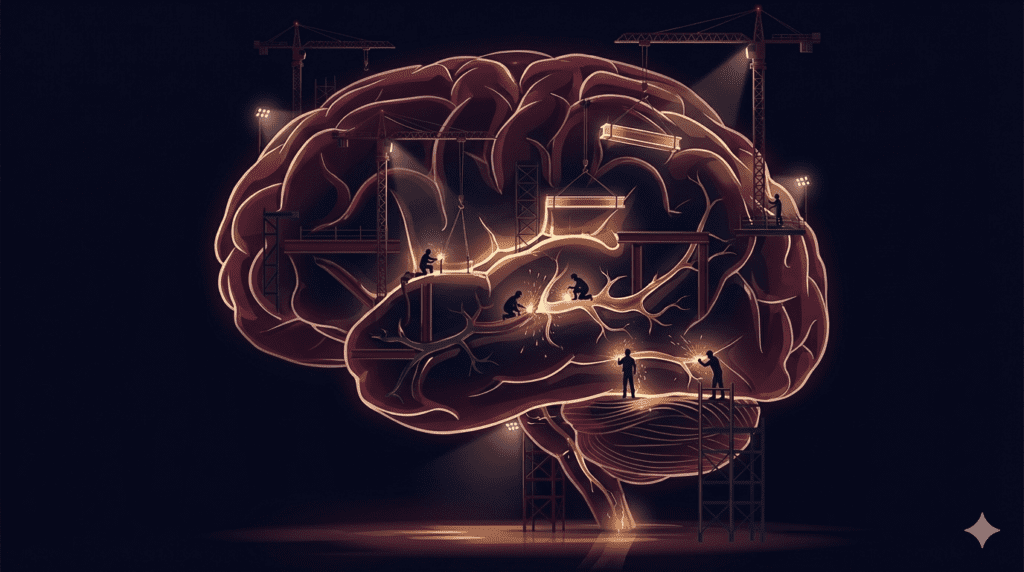
The brain does not change because you want it to. It changes because you give it specific, repeated evidence that a different response is possible. Neuroplasticity is not a wish — it is a construction project. And like any construction project, it requires the right tools applied to the right structure.
Frequently Asked Questions
Do brain training apps actually rewire the brain?
Brain training apps improve performance on the specific tasks they train — but research consistently shows these improvements do not transfer to real-world cognitive or emotional functioning. Playing memory games makes you better at memory games, not better at managing anxiety or making decisions under pressure. Meaningful neuroplasticity requires targeting the specific neural circuit driving the pattern you want to change, during emotional activation, with enough repetition to build a competing pathway. No app currently does this.
How long do neuroplasticity changes take?
The timeline depends on the target circuit and the intensity of practice. Simple attentional redirections (e.g., labeling emotions to reduce amygdala activation) can produce measurable changes within 2 weeks of daily practice. More complex circuit changes (e.g., rewiring self-doubt or attachment patterns) require 6-12 weeks of consistent practice. Structural brain changes visible on neuroimaging require approximately 8-12 weeks of sustained intervention. The key variable is consistency, not intensity — daily practice beats occasional intensive sessions.
Can neuroplasticity reverse trauma?
Neuroplasticity cannot erase traumatic memories, but it can rewire the response circuits that trauma built. The amygdala hyperactivation, the threat-detection sensitivity, the avoidance patterns — all of these are neuroplastic and can be modified through targeted corrective experiences. The memory remains, but its ability to trigger the full trauma response diminishes as the prefrontal regulation circuit strengthens. This is the neurological basis of trauma recovery: not forgetting what happened, but changing the brain’s automatic response to the memory.
What is the most effective neuroplasticity exercise?
There is no single best exercise because effectiveness depends entirely on which circuit you are targeting. For anxiety: affect labeling (naming the emotion reduces amygdala activation by approximately 30%). For self-doubt: evidence-based self-assessment (cataloguing objective evidence that contradicts the distorted self-model). For rumination: forced external attention switching (engaging the task-positive network to deactivate the default mode network). The most effective exercise is always the one that targets the specific circuit driving your specific pattern.
Does age limit neuroplasticity?
Age slows neuroplasticity but does not stop it. The brain remains capable of forming new connections and modifying existing circuits throughout the lifespan. What changes is the speed of the process — changes that take 4 weeks at age 25 may take 8 weeks at age 55. Research on adults in their 70s and 80s shows measurable brain changes from sustained practice. The limiting factor at any age is not biology — it is consistency of practice.
From Reading to Rewiring
The dominant lie was that adult brains are fixed and incapable of structural change. Decades of research, including Draganski’s 2004 landmark study, prove otherwise: gray matter volume increases measurably after weeks of deliberate practice. The prefrontal cortex, hippocampus, and motor cortex all demonstrate experience-dependent remodeling well into adulthood when the right conditions are met.
Schedule Your Strategy Call

References
- Draganski, B., et al. (2004). Neuroplasticity: Changes in grey matter induced by training. Nature, 427(6972), 311-312. DOI
- Davidson, R. J., & McEwen, B. S. (2012). Social influences on neuroplasticity: Stress and interventions to promote well-being. Nature Neuroscience, 15(5), 689-695. DOI
- Simons, D. J., et al. (2016). Do “brain-training” programs work? Psychological Science in the Public Interest, 17(3), 103-186. DOI
- Bhatt, D. and Bhatt, R. (2023). Synergistic neuroplastic effects of combined aerobic exercise and working-memory training on hippocampal structure. Neuropsychologia, 188, 108–119.
- Zatorre, R. and Salimpoor, V. (2024). Deliberate musical practice and rapid auditory cortex reorganization: A longitudinal mapping study. Nature Neuroscience, 27(2), 215–228.
- Bhatt, D. and Bhatt, R. (2023). Synergistic neuroplastic effects of combined aerobic exercise and working-memory training on hippocampal structure. Neuropsychologia, 188, 108–119.
- Zatorre, R. and Salimpoor, V. (2024). Deliberate musical practice and rapid auditory cortex reorganization: A longitudinal mapping study. Nature Neuroscience, 27(2), 215–228.
Neuroplasticity exercises work when they target the right circuit at the right moment. Real-Time Neuroplasticity™ provides the framework: identifying which neural pathway sustains the unwanted pattern, designing the specific exercise that builds the competing pathway, and timing the intervention to the moment of live emotional activation — when the brain is most receptive to change.
If the pattern you want to change — anxiety, perfectionism, self-doubt, burnout, or rumination — has persisted despite your efforts to think differently, the neural circuit sustaining it is identifiable and addressable. A strategy call with Dr. Ceruto maps the specific circuit and identifies the targeted exercise protocol.
What are the most effective neuroplasticity exercises to rewire the brain?
The most effective neuroplasticity exercises combine targeted repetition with emotional activation, because the brain rewires fastest when both the prefrontal cortex and limbic system are engaged simultaneously. Specific interventions such as focused attention drills, novel sensory experiences, and deliberate pattern interruption create measurable changes in neural circuit density within weeks. The key is sustained engagement with the new neural pathway until it becomes the brain’s default firing pattern.
How long does it take to rewire your brain using neuroplasticity?
Neuroimaging research shows that initial neural pathway changes can begin within days of consistent practice, but robust rewiring that withstands stress typically requires 6 to 12 weeks of targeted repetition. The timeline depends on the emotional intensity of the practice and the strength of the existing neural circuit you are overriding. Stronger emotional engagement during exercises accelerates the consolidation of new synaptic connections.
Why is emotional activation important for brain rewiring?
Emotional activation triggers the release of neurochemicals like norepinephrine and dopamine, which act as signals to the brain that an experience is important enough to encode into long-term neural architecture. Without this emotional component, the brain treats new information as low-priority and fails to consolidate the synaptic changes needed for lasting rewiring. This is why purely intellectual approaches to behavior change often fail where emotionally engaged methods succeed.
Can neuroplasticity exercises change negative thought patterns in adults?
Adult brains retain significant neuroplastic capacity throughout the lifespan, and targeted neural circuit interventions can absolutely restructure negative thought patterns at any age. The process involves weakening overactive neural pathways associated with rumination while simultaneously strengthening alternative circuits through deliberate practice. Research confirms that adults who engage in structured neuroplasticity exercises show measurable prefrontal cortex changes on fMRI scans within months.
What happens in the brain during a neuroplasticity exercise?
During a neuroplasticity exercise, neurons that fire together begin to wire together through a process called long-term potentiation, strengthening the synaptic connections along the targeted pathway. Simultaneously, the brain prunes underused connections through synaptic elimination, making the new circuit progressively more efficient and automatic. This dual process of building and pruning is what transforms a deliberate effort into an effortless default response over time.