

Key Takeaways
- Self-improvement stagnation is a neurological consolidation phase, not evidence that your efforts have failed.
- Hedonic adaptation resets your emotional baseline within 6-12 weeks, making real progress feel invisible.
- The prefrontal cortex builds circuits slowly while the basal ganglia resist overwriting, creating the plateau.
- Dopamine habituation reduces the reward signal from repeated behaviors, requiring novelty injection to sustain motivation.
- Neural disruption strategies, not willpower, break through growth plateaus at the circuit level.
Why Self-Improvement Stagnation Feels Like Permanent Failure
Self-improvement stagnation triggers a measurable neurological consolidation phase, not a character flaw. During plateau periods, the prefrontal cortex downregulates novelty-driven dopamine signaling while the basal ganglia encode new behavioral patterns into procedural memory. This process, which experience across 26 years and hundreds of high-capacity individuals confirms, routinely lasts four to twelve weeks before measurable progress resumes.
The neuroscience is clear. Growth plateaus emerge when your prefrontal cortex has initiated new circuit formation but your basal ganglia have not yet automated those circuits into effortless behavior. You are caught between conscious effort and unconscious execution. This gap is where most people quit, and it is precisely where the most consequential neural rewiring occurs.
What Hedonic Adaptation Does to Your Motivation Cycle

Hedonic adaptation systematically collapses motivational momentum by resetting emotional baselines within weeks of any positive behavioral change. Psychologist Sonja Lyubomirsky’s University of California, Riverside research shows humans return to baseline satisfaction regardless of achievement magnitude. Dopaminergic reward signals diminish as novelty fades, converting previously rewarding behaviors into perceived obligations that erode sustained self-improvement effort.
Motivational plateaus emerge partly from prefrontal resource depletion, where sustained self-regulatory effort degrades the executive control needed to generate and sustain new goal-directed behavior.
Reward prediction signals in the ventral striatum diminish in proportion to goal familiarity, providing a neurobiological account of why previously exciting objectives lose their motivational charge over time.
This is not a failure of willpower. This is your ventral tegmental area reducing dopamine output because the prediction error has disappeared. Your brain rewards surprises, not repetitions. When a behavior becomes expected, dopamine signaling drops even if the behavior itself is objectively beneficial. The result is a motivational vacuum that most people interpret as evidence that the strategy stopped working. It did not stop working. Your reward circuitry simply stopped noticing.
In my practice, I consistently observe that individuals who understand this mechanism handle stagnation periods with fundamentally different composure than those who do not. The knowledge itself becomes a cognitive buffer against premature abandonment of genuinely effective practices.
The Homeostatic Trap: Why Your Brain Resists the Changes You Chose
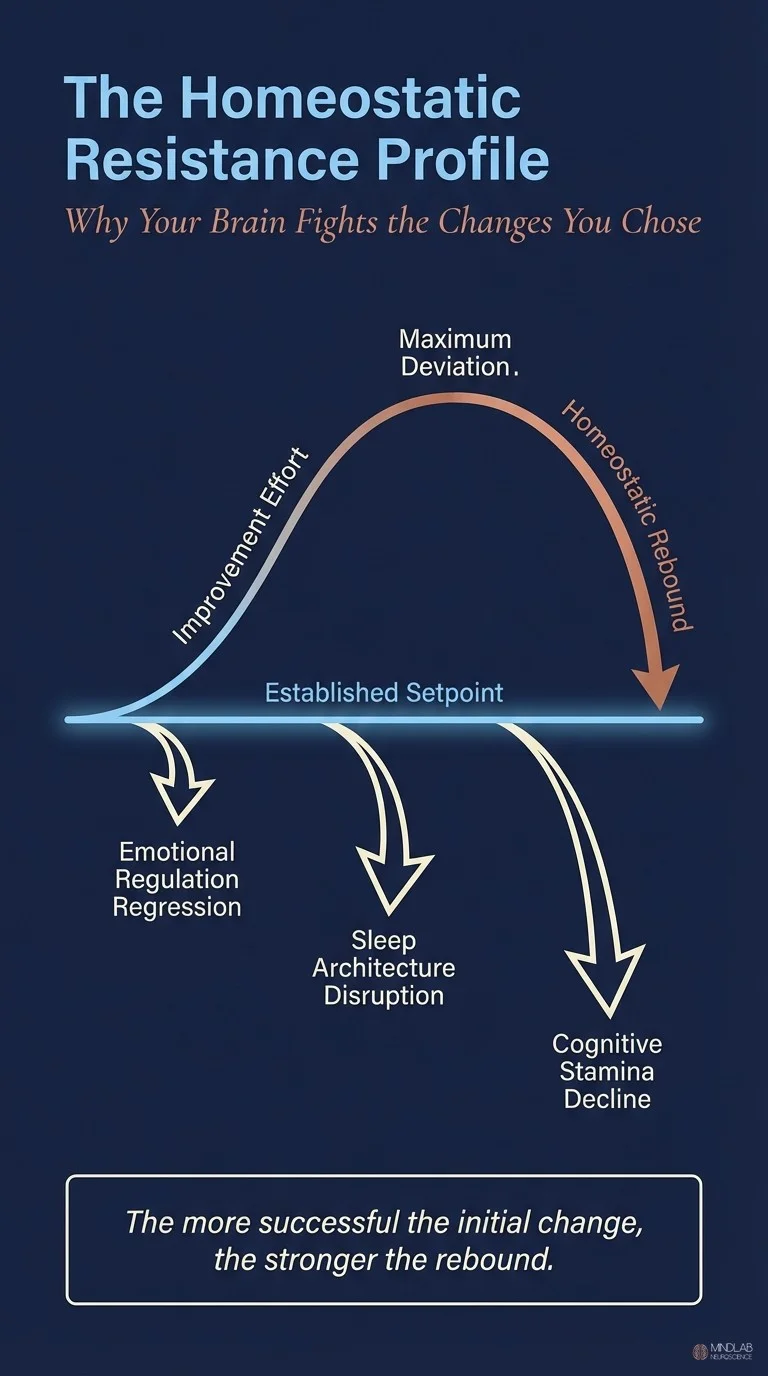
The brain actively resists chosen behavioral changes through homeostatic regulation, treating any deviation from established setpoints as a physiological threat. Neuroscientist Robert Sapolsky’s Stanford research demonstrates that the hypothalamic-pituitary-adrenal axis triggers measurable stress responses during behavioral change periods: not because change causes harm, but because unfamiliarity alone activates the same threat-detection circuitry as genuine danger.
This creates a paradox at the heart of self-improvement stagnation. The more successful your initial changes are, the harder your homeostatic systems push back. Someone who dramatically improves their sleep architecture, restructures their diet, and overhauls their professional habits simultaneously will experience a stronger homeostatic rebound than someone making a single incremental adjustment. The brain interprets rapid multi-domain change as systemic instability and mobilizes every regulatory mechanism it has to restore the previous equilibrium.
When I work with clients navigating this territory, I map what I call the homeostatic resistance profile: the specific domains where their nervous system pushes back hardest. For some, it is emotional regulation that regresses first. For others, it is sleep quality or cognitive stamina. The regression is not random. It follows the architecture of each individual’s neural hierarchy, and identifying the pattern is the first step toward working with the brain’s resistance rather than against it.
Prefrontal Fatigue and the Collapse of Conscious Effort
Every act of deliberate self-improvement draws on prefrontal cortex resources. Working memory, attentional control, inhibitory regulation, and future planning all consume glucose and oxygen at rates that the prefrontal cortex cannot sustain indefinitely. Researcher Roy Baumeister’s ego depletion framework, despite its controversies, identified a real phenomenon: sustained conscious effort produces measurable declines in subsequent self-regulatory capacity.
The practical consequence for self-improvement stagnation is this: if you are relying on conscious willpower to maintain new behaviors, you will experience periodic collapse. Not because you are undisciplined, but because the prefrontal cortex was never designed to run new behaviors permanently. Its role is to initiate and supervise new patterns until the basal ganglia automate them. The transition from prefrontal supervision to basal ganglia automation takes approximately 66 days for simple behaviors, according to Phillippa Lally’s research at University College London, and substantially longer for complex behavioral sequences.
During the gap between initiation and automation, you experience what feels like stagnation. The excitement of novelty has faded, the prefrontal cortex is fatigued from sustained oversight, and the basal ganglia have not yet fully encoded the new pattern. This is the period where I see the highest rate of abandonment in my practice, and it is precisely the period where neural consolidation is most active. For a deeper exploration of this mechanism, see how brain rewires itself through neuroplasticity.
Dopamine Habituation: The Invisible Saboteur

Dopamine rewards anticipation and prediction errors, not achievement itself. Neuroscientist Wolfram Schultz demonstrated that dopaminergic neurons fire maximally when outcomes exceed expectations, moderately when outcomes match expectations, and cease firing when outcomes fall below expectations. A new exercise routine generates strong dopamine during week one; by week six, full prediction calibration reduces dopamine response to near zero.
This habituation curve is one of the primary engines of self-improvement stagnation. The behavior has not degraded. Your performance may have objectively improved. But the subjective experience of reward has flatlined because your brain’s prediction model has caught up with reality. Without the dopaminergic signal, motivation feels hollow, effort feels unrewarded, and the temptation to seek novelty elsewhere becomes overwhelming. This is the same reward-prediction machinery The Dopamine Code maps in detail, and understanding it is what lets you ride a plateau instead of abandoning the practice driving it.
What the research does not adequately capture is what I have seen across thousands of client engagements: dopamine habituation does not affect all behavioral domains equally. Individuals habituate fastest in the domains where they already have the most established neural infrastructure. A lifelong athlete habituates to a new training protocol faster than a sedentary person does because the athletic brain has more prediction capacity in that domain. This means the people who appear most disciplined are often the most vulnerable to stagnation in their areas of greatest competence.
The Consolidation Phase: What Is Actually Happening During a Plateau
During a self-improvement plateau, the brain actively consolidates new neural pathways through long-term potentiation while weakening competing pathways via long-term depression. This synaptic pruning cycle occurs below conscious awareness and converts temporary behaviors into durable traits. Research shows consolidation periods can span 21 to 66 days depending on behavioral complexity and repetition frequency.
Sleep plays a critical role here. Research from Matthew Walker’s lab at the University of California, Berkeley, has shown that the hippocampus replays newly learned patterns during slow-wave sleep, transferring them to cortical storage for long-term retention. Disrupted sleep during a plateau period does not just impair mood; it actively undermines the consolidation process that would otherwise resolve the stagnation naturally.
In my practice, I have found that clients who maintain their behavioral commitments through the consolidation phase without attempting to accelerate or intensify their regimen emerge from plateaus with dramatically more stable results than those who escalate effort in response to perceived stagnation. The instinct to do more when results flatten is understandable, but it is neurologically counterproductive. Consolidation requires consistency, not escalation.
Breaking Through: Neural Disruption Strategies That Actually Work
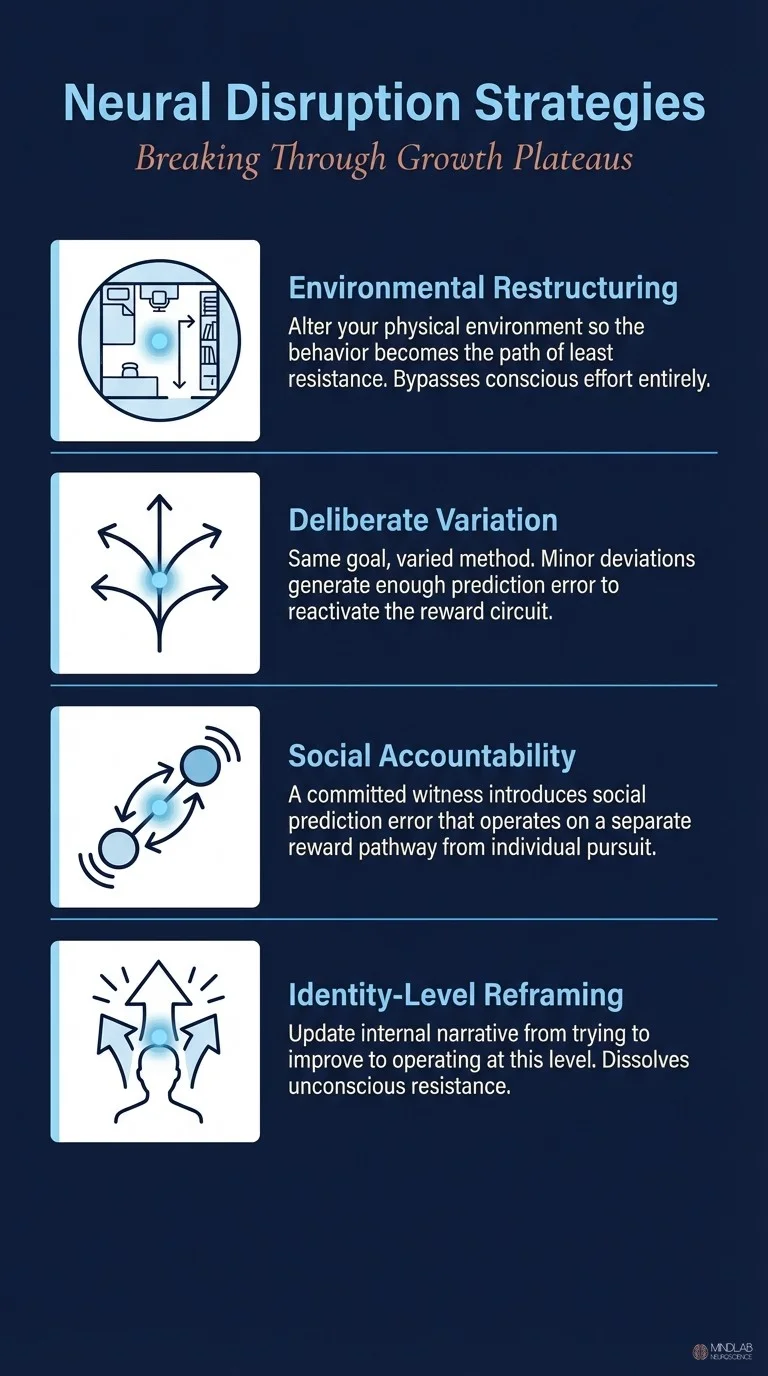
Targeted neural disruption breaks self-improvement plateaus more effectively than increasing general effort. Research on neuroplasticity shows that habitual behavioral loops become encoded in basal ganglia circuits within 66 days on average, creating self-reinforcing patterns resistant to willpower alone. Disrupting specific maintaining mechanisms, rather than amplifying effort, produces measurable behavioral change where generalized persistence fails.
Environmental restructuring bypasses prefrontal fatigue entirely. Rather than relying on willpower to sustain a behavior, you alter your physical environment so the behavior becomes the path of least resistance. Behavioral scientist B.J. Fogg’s research at Stanford shows that environmental design shapes behavior more powerfully than relying on intention or motivation alone. If your meditation practice has stalled, changing the location, the time, or the physical setup can reintroduce enough novelty to re-engage dopaminergic signaling without changing the practice itself.
Deliberate variation exploits your brain’s sensitivity to prediction errors. Maintaining the same goal while varying the method reactivates the dopamine circuitry that habituation suppressed. Run a different route. Read in a different format. Practice a skill with your non-dominant hand. The variation does not need to be dramatic. Even minor deviations from an established routine generate enough prediction error to restore dopaminergic engagement.
Social accountability reframing leverages the brain’s deep sensitivity to social evaluation. When personal motivation habituates, the presence of a committed witness or accountability partner introduces a social prediction error that the brain cannot easily ignore. The mechanism is not shame; it is the activation of the medial prefrontal cortex’s social monitoring circuits, which operate on a separate reward pathway from individual goal pursuit. For a deeper exploration of this mechanism, see how optimizing dopamine pathways for sustained motivation.
Identity-level reframing addresses stagnation at its deepest layer. When I work with clients who have plateaued despite excellent behavioral consistency, the issue is rarely tactical. It is identity-based. Their self-concept has not expanded to accommodate the person they are becoming. The brain maintains a coherent self-model, and behaviors that conflict with that model face unconscious resistance regardless of conscious intention. Updating the internal narrative from “I am someone who is trying to improve” to “I am someone who operates at this level” dissolves a category of resistance that no tactical adjustment can reach.
When Stagnation Signals Something Deeper
Not every growth plateau is a consolidation phase. Some stagnation patterns reflect a genuine misalignment between the direction of effort and the individual’s actual needs. In approximately 15-20% of the stagnation cases I encounter, the plateau is not a temporary phase but a signal that the improvement trajectory itself needs recalibration.
The distinguishing feature is emotional. Consolidation-phase stagnation feels frustrating but does not produce a sense of meaninglessness. Misalignment-based stagnation carries a qualitative flatness that extends beyond the specific behavior into a broader questioning of purpose. When a client tells me they have lost interest not just in their goal but in the category of goals they were pursuing, that is not dopamine habituation. That is their anterior cingulate cortex flagging a values-behavior mismatch that no amount of tactical adjustment will resolve.
Distinguishing between these two types of stagnation is one of the most consequential assessments in my practice. The interventions are nearly opposite: consolidation requires patience and consistency, while misalignment requires honest re-evaluation and sometimes a fundamental change in direction.
Growth plateaus are not where progress ends. They are where the brain decides whether new patterns deserve durable installation or temporary storage.
Building a Stagnation-Resilient Practice

Stagnation-resilient self-improvement practices outperform discipline-based approaches because they account for plateaus before those plateaus arrive. Practitioners who pre-load their systems with environmental supports, accountability structures, and scheduled variation every 6–12 weeks navigate stagnation more effectively than those who rely on willpower alone when progress inevitably slows.
It means accepting that the subjective experience of progress will be discontinuous even when objective progress is steady. It means recognizing that the absence of emotional reward does not equal the absence of neural change. And it means developing enough self-awareness to distinguish between a consolidation phase that requires patience and a misalignment signal that requires courage.
The brain was not built for linear improvement. It was built for punctuated equilibrium: periods of stability interrupted by rapid reorganization. Self-improvement stagnation is simply the stability phase of that cycle, and the reorganization that follows depends entirely on what you do during the quiet. For the wider set of tools that rebuild a self-model from the inside, see the Peak Performance and Flow States hub.
Recognizing a plateau as a consolidation phase rather than a failure changes how you move through it, and knowing which kind of stagnation you face changes what you do next.
Why does self-improvement stagnation happen even when I am doing everything right?
Self-improvement stagnation occurs because your brain consolidates new neural pathways in phases, not continuously. After the initial excitement of a new behavior, dopamine habituation reduces the reward signal while the basal ganglia work to automate the pattern. This consolidation phase feels like nothing is changing, but synaptic strengthening and pruning are actively occurring beneath conscious awareness. The plateau is evidence that your brain is processing the changes, not that the changes have stopped.
How long do growth plateaus typically last?
Growth plateaus vary by the complexity of the behavior being consolidated. Simple habit changes may plateau for 2-4 weeks, while complex behavioral restructuring involving multiple domains can produce stagnation periods lasting 8-12 weeks. Research from University College London suggests that full habit automation takes an average of 66 days, though individual variation ranges from 18 to 254 days depending on the behavior and the person’s existing neural infrastructure.
What is the difference between a growth plateau and genuine failure?
A growth plateau maintains the behaviors while the subjective sense of progress diminishes. Genuine failure involves the abandonment or degradation of the behaviors themselves. Neurologically, a plateau means your prefrontal cortex is still supervising the pattern while the basal ganglia automate it. Failure typically occurs when prefrontal fatigue exceeds the individual’s capacity for sustained conscious effort before automation completes. The critical distinction is behavioral consistency, not emotional experience.
Can you break through self-improvement stagnation without changing your entire approach?
Yes. Targeted variation within your existing approach is more effective than wholesale change. Environmental restructuring, introducing minor novelty into established routines, and social accountability each reactivate dopaminergic signaling without requiring you to abandon the practices that are consolidating. The goal is to generate enough prediction error to re-engage the brain’s reward system while maintaining the consistency that consolidation requires.
When should I reconsider my goals entirely versus pushing through a plateau?
The distinguishing signal is emotional quality. Consolidation-phase stagnation produces frustration but retains a sense that the direction is correct. Misalignment-based stagnation produces a qualitative flatness or meaninglessness that extends beyond the specific goal into broader questioning of purpose. If the stagnation carries a persistent feeling that the category of goals no longer resonates rather than simply the pace of progress, that signals a values-behavior mismatch that warrants genuine reconsideration rather than increased effort.
References
- Lally, P., van Jaarsveld, C. H. M., Potts, H. W. W., & Wardle, J. (2010). How are habits formed: Modelling habit formation in the real world. European Journal of Social Psychology, 40(6), 998-1009. https://doi.org/10.1002/ejsp.674
- Schultz, W. (2016). Dopamine reward prediction error signalling: A two-component response. Nature Reviews Neuroscience, 17(3), 183-195. https://doi.org/10.1038/nrn.2015.26
- Walker, M. P. (2017). Why We Sleep: Unlocking the Power of Sleep and Dreams. Scribner. Simon & Schuster
From Reading to Rewiring
Understand the neuroscience. Apply it to your life. Work directly with Dr. Sydney Ceruto to build a personalized strategy.
Schedule Your Strategy Call