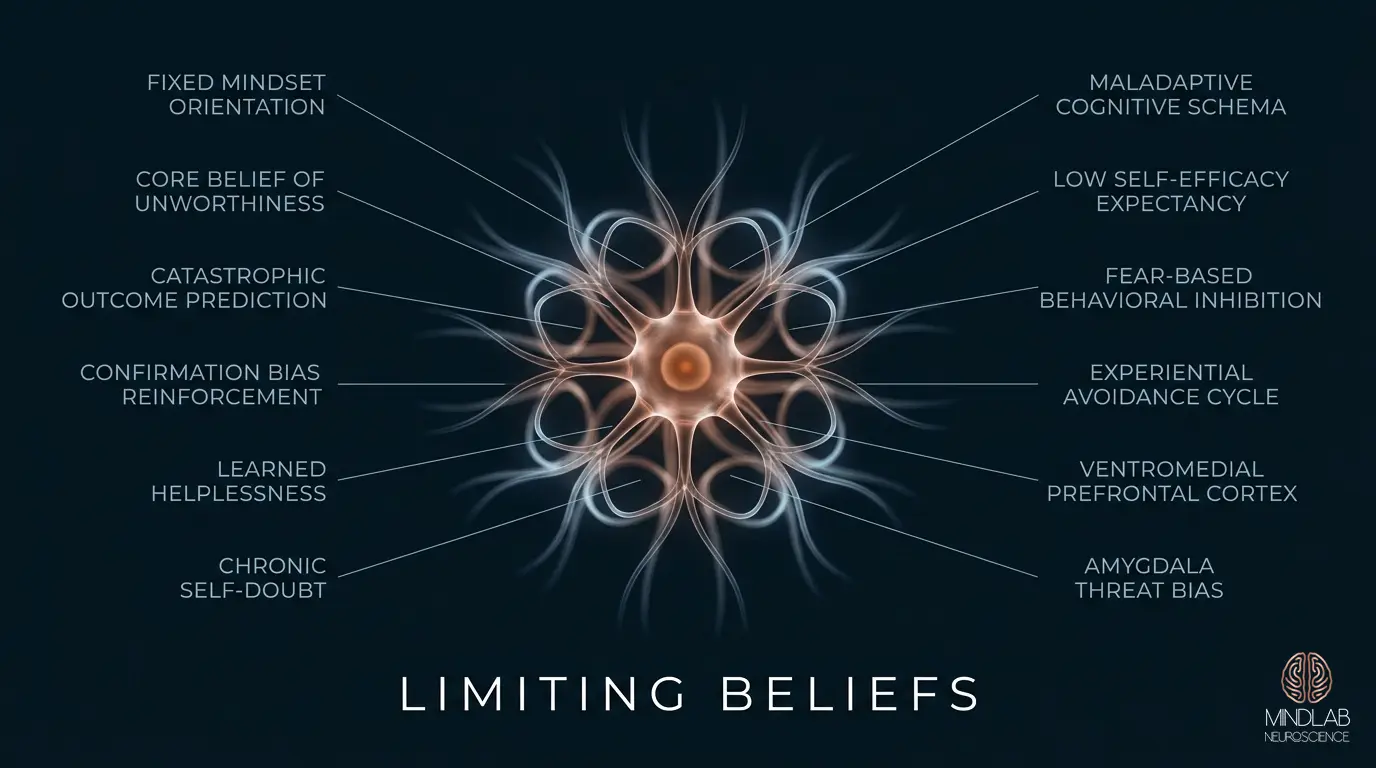
Every client who finds their way to MindLAB Neuroscience has tried something before me. Some have spent years in talk-based approaches unpacking childhood dynamics. Others have filled journals, attended weekend intensives, or worked with high-performance coaches who handed them affirmation frameworks and accountability structures. A few have read every book on mindset, manifestation, and self-sabotage available. And yet the same patterns persist: the hesitation before the high-stakes meeting, the relationship that follows the same arc as the last one, the internal voice that reassigns every opportunity to someone more qualified. Limiting beliefs are not a mindset problem. They are a structural feature of how the brain encodes self-concept. That distinction changes everything about how you address them.
In 26 years of practice, I have never encountered a client whose limiting beliefs were simply a matter of insufficient positive thinking. What I have encountered, consistently, is a nervous system that learned a particular model of self and world during a period of heightened emotional salience, and then optimized itself to maintain that model with remarkable efficiency. Understanding why that happens, and what it takes to durably alter it, is the foundation of every engagement at MindLAB Neuroscience.
Limiting Beliefs Are Neural Architecture, Not Negative Thinking
The popular framing positions limiting beliefs as thoughts: negative cognitive content that needs to be identified, challenged, and replaced with more constructive alternatives. That framing is not wrong, exactly. It is just working at the wrong level of analysis. The thought is the symptom. The architecture is the source.
When a belief becomes consolidated in the brain, it involves a distributed network: the prefrontal cortex encodes the conceptual content, the amygdala attaches emotional valence and threat relevance, the hippocampus anchors it to autobiographical memory, and the default mode network recycles it during self-referential processing. A consolidated belief does not sit in one place waiting to be corrected. It is a pattern of coordinated firing across multiple systems, each reinforcing the others.
Self-concept beliefs, including the most corrosive limiting beliefs, are particularly durable because they are encoded during periods of high emotional arousal. Research from NYU’s Phelps Lab and subsequent work on emotional memory consolidation consistently demonstrates that amygdala activation during encoding strengthens hippocampal storage and prefrontal consolidation. The belief that you are not capable, not deserving, not enough (if it was formed during a moment of genuine threat, rejection, or humiliation) gets written into memory with priority access. The brain treats it as important survival information.
This is why the experience of a limiting belief does not feel like an opinion. It feels like a fact. Because neurologically, it is being processed through the same systems that handle factual knowledge about the world.
How the Prefrontal-Limbic Loop Encodes Self-Concept
The prefrontal cortex is responsible for abstract self-knowledge: the narratives we hold about who we are, what we are capable of, and what we deserve. But it does not operate in isolation. It maintains a continuous bidirectional dialogue with the limbic system, particularly the amygdala and the anterior cingulate cortex, which tag information with emotional significance and motivational weight.
When self-concept information is being formed (during developmental experiences, but also during high-stakes adult experiences) the limbic system’s emotional tagging system determines how firmly that information gets consolidated. A belief encoded with high emotional arousal is neurologically prioritized over a belief encoded in a neutral state. This is why a single devastating public failure can override years of accumulated evidence of competence. The emotionally charged event wins the encoding competition.
The anterior cingulate cortex plays a particular role in limiting beliefs because it monitors for prediction errors: discrepancies between what the brain expects and what it encounters, a process rooted in cognitive flexibility and thought pattern regulation. Once a belief about the self is consolidated, the ACC begins filtering incoming experience through that belief. Evidence that confirms the belief is processed efficiently. Evidence that contradicts it triggers a prediction error signal that the brain, under normal circumstances, resolves by discounting the disconfirming evidence rather than updating the belief. This is the neural basis of belief perseverance. It is not stubbornness. It is the brain maintaining the integrity of its predictive model.
In my practice, I consistently observe this dynamic in high-functioning clients who accumulate objective evidence of success (promotions, accolades, financial milestones) and find that none of it touches the core belief. The external record and the neural self-model are operating on parallel tracks. The ACC is doing its job. What it needs is a specific kind of intervention that disrupts that filtering at the circuit level, not at the level of conscious argument.
Belief Perseverance and Confirmation Bias at the Circuit Level
Confirmation bias is typically presented as a cognitive flaw: a tendency to seek and remember information that supports existing beliefs. What rarely gets explained is the neural mechanism that produces it. Understanding that mechanism is essential to understanding why limiting beliefs are so resistant to conventional approaches.
The brain’s predictive processing architecture, formalized in Karl Friston’s work on free energy minimization and supported by decades of neuroimaging research, operates on the principle that the brain is continuously generating predictions about incoming sensory and social information. Incoming data is evaluated against those predictions. When data confirms an existing model, processing is efficient and the model is reinforced. When data violates a prediction, the brain has two options: update the model, or explain away the data. For deeply consolidated beliefs about the self, the brain overwhelmingly chooses the latter.
This is belief perseverance at the circuit level. It is not a choice or a character flaw. It is a predictive system protecting the coherence of its own model. The same mechanism that keeps you from being destabilized by every piece of contradictory information you encounter is the mechanism that keeps limiting beliefs in place long after the conditions that created them have changed.
The dopamine system adds another layer of complexity. Dopamine neurons fire not in response to rewards themselves, but in response to reward prediction errors: moments when outcomes are better or worse than predicted. When a person carrying a consolidated self-limiting belief encounters unexpected success, the dopamine signal that should reinforce new self-concept information is partially suppressed, because the success was unexpected and the reward prediction system does not know how to integrate it into an existing model that predicts failure or inadequacy. The circuit literally underweights disconfirming positive evidence.
Why Affirmations Fail at the Circuit Level
This brings us to one of the most common interventions people attempt before finding their way to MindLAB: affirmations. The premise is intuitive: if the problem is a negative belief, the solution is to repeat a positive counter-belief until it takes hold. The neuroscience of why this rarely produces lasting change is straightforward once you understand the encoding principles described above.
Affirmations are typically rehearsed in a neutral or mildly positive emotional state. They are not accompanied by high emotional arousal, genuine behavioral engagement, or novel environmental cues. They are, neurologically, low-priority inputs being directed at a high-priority consolidated pattern. The brain processes them as semantic content, not as updating signals for self-concept architecture. The existing belief was encoded with emotional weight. The affirmation is not.
There is also a credibility problem at the neural level. Research on the predictive processing framework suggests that the brain assigns precision weights to incoming information: essentially, a confidence rating for how much to update existing models. For an affirmation that contradicts a deeply held limiting belief, the precision weight assigned is low. The brain evaluates it against the full weight of autobiographical memory, emotional encoding, and behavioral history, and essentially flags it as an unreliable update signal. The model remains intact.
I want to be precise about this: I am not dismissing all positive reframing practices. Structured cognitive techniques can produce meaningful shifts in specific, surface-level beliefs that were never deeply emotionally consolidated. But for the core self-concept patterns that have organized a client’s behavior across years and domains, the ones that show up in professional decisions and relationship patterns and internal monologue alike, affirmation-level intervention is working at the wrong depth. It is applying a layer of paint over a structural issue.
Neural Reconsolidation: The Mechanism That Actually Changes Beliefs
Memory reconsolidation is one of the most significant findings in modern neuroscience for understanding durable belief change. The research, originating with Karim Nader’s landmark 2000 study at McGill demonstrating that activated memories become temporarily labile and must be restabilized, has profound implications for how limiting beliefs can actually be altered.
When a consolidated memory or belief is retrieved and activated in a particular way, it briefly enters an unstable state during which it is susceptible to modification. If a prediction error or genuinely disconfirming information is introduced during this lability window, the reconsolidation process can incorporate that new information, resulting in an updated memory trace rather than simple reactivation of the original. This is not suppression of the old belief. It is structural modification of the encoded representation.
The practical requirements for triggering genuine reconsolidation are specific. The target belief must be fully activated: brought into live emotional experience, not just consciously recalled. A prediction error must be introduced in a way that the nervous system registers as genuinely surprising, not just intellectually contradictory. And the integration window, the period during which the labile trace is restabilized, must be used to encode the new representation with sufficient emotional salience to compete with the original.
This is not something that happens through journaling exercises or insight conversations. It requires working in the live moment, when the belief is active and the nervous system is engaged. In my practice, some of the most important reconsolidation work happens not in a formal session but during an actual professional interaction, a real relational moment, a live high-stakes decision, because that is when the encoded pattern is fully activated and available for modification.
Dr. Ceruto’s Belief Restructuring Methodology
The work I do with limiting beliefs at MindLAB Neuroscience is built on three core principles that distinguish it from conventional approaches: principles grounded in the science of identity and neural flexibility. First, the belief must be mapped at the circuit level, not just identified as a verbal pattern, but traced back to its encoding conditions: when it was formed, what emotional context amplified it, what behavioral patterns have reinforced it, and what systems are currently maintaining it. This is investigative work in the neuroscientific sense: identifying the architecture, not just the symptom.
Second, intervention must happen in the live moment. Real-Time Neuroplasticity™ is specifically designed to work with neural patterns as they are activated, rather than reconstructing them in hindsight. When a limiting belief is firing, when a client is in the actual professional or relational moment where the pattern activates, that is the intervention window. That is when the labile state is accessible. That is when a precisely timed reframe, a genuine behavioral override, or a deliberately engineered prediction error can actually alter the neural representation rather than simply sit alongside it as competing content.
Third, the work has to be sustained across domains. These neural patterns are not localized: they organize behavior across professional performance, relational dynamics, financial decisions, and self-presentation simultaneously. An approach that addresses the belief in one domain while leaving the others untouched produces partial change at best. The embedding model that characterizes NeuroConcierge™ exists precisely because genuine restructuring of core self-concept beliefs requires access to the full context in which they operate.
What I observe consistently in clients who have completed this work is not the absence of the old thought: thoughts do not disappear. It is the loss of the thought’s authority. The pattern activates and is no longer treated by the nervous system as high-priority threat information. The emotional weight that made the belief feel like incontrovertible fact is no longer attached. What remains is a piece of personal history that can be acknowledged and moved past, rather than an organizing principle the entire behavioral system orbits around.
The Population Who Carries These Patterns Most Invisibly
There is a particular irony in the population I work with most consistently. The clients whose limiting beliefs are most structurally entrenched are frequently the ones whose external performance is most impressive. High achievement can become an elaborate behavioral compensation for a core self-concept that has never been structurally updated. The executive who prepares obsessively for every meeting because some part of her nervous system still expects to be found out: the hallmark of imposter syndrome operating at the neural architecture level. The founder who cannot delegate because the belief that he alone can prevent failure is doing structural work: keeping a threatening internal prediction at bay through behavioral hypervigilance.
Compensatory high performance is one of the most reliable indicators of a deeply consolidated limiting belief that has never been directly addressed. The compensation works well enough to prevent external failure, which means the belief is never directly disconfirmed, which means the circuit is never updated. The performance gets better and better. The internal architecture stays exactly as it was formed.
This is why the conventional markers of success (income, title, relationship status) have no reliable correlation with resolution of these encoded self-concept structures. The neural architecture that carries the belief is not impressed by external achievement. It is operating on a different timeline, maintaining a model that was built for a different set of circumstances, with a level of efficiency that external performance cannot touch.
What Changes When the Architecture Changes
The question I get asked most often, in various forms, is: what does it actually feel like when this work succeeds? When the neural architecture that has been organizing behavior for years is genuinely restructured at the circuit level rather than managed or suppressed?
What clients describe most consistently is not a sudden burst of confidence or an absence of self-doubt. It is a change in the quality of their internal experience in high-stakes moments. The thought that used to land with the weight of certainty now lands with the quality of a hypothesis: something the nervous system notices without treating as gospel. The space between activation and response, which used to be nonexistent, begins to exist. Decisions that previously felt like they were being made by the pattern now feel like they are being made by the person.
This is the neurological signature of successful reconsolidation work. The belief structure has been updated. The circuit still has the historical memory, but the emotional tag that gave it priority access to behavioral control has been altered. The pattern no longer drives. It informs.
If you have been working on the same limiting beliefs through methods that have produced insight but not structural change, the issue is not your commitment or your intelligence. It is the level at which the intervention is operating. schedule a strategy call with Dr. Ceruto to understand what circuit-level work actually requires, and whether this approach is the right fit for where you are.