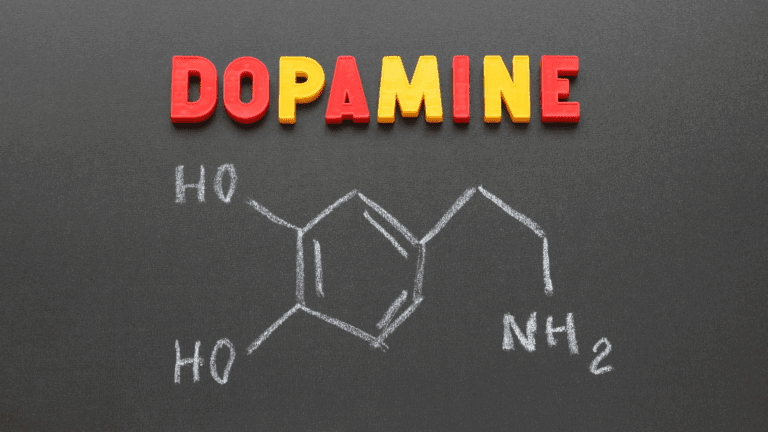
Dopamine Is Not the Pleasure Chemical — The Neuroscience Tells a Different Story
The most consequential misunderstanding in popular neuroscience is the reduction of dopamine to a pleasure signal. “Hit of dopamine,” “rush,” “reward hit” — the language implies that this neurochemical floods the brain when something feels good. That framing is not simply imprecise. It is functionally misleading, and for individuals whose lives are being organized around its depletion, the misunderstanding has real consequences.
The research tells a different story. Dopamine, at the level of its primary function, is a prediction signal — a neurochemical encoding the difference between what the brain anticipated and what actually occurred. Neuroscientist Wolfram Schultz’s foundational work in the 1990s established this with precision: the neurons that produce this signal fire not at the moment of reward, but at the moment a reward is anticipated. When a reward arrives exactly as predicted, activity is flat. When it arrives unexpectedly, the signal surges. When an anticipated reward fails to arrive, it drops below baseline. The signal is the gap — the prediction error — not the pleasure itself.
This distinction matters enormously for understanding why dopamine dysregulation is so pervasive and so difficult to address through willpower alone. The brain is not malfunctioning when it generates compulsive anticipation loops around phones, food, or substances. It is running precisely the algorithm it was designed to run — except the circuitry has been calibrated against reward schedules so reliably variable that the prediction-error signal fires continuously, with no stable floor and no clean resolution. The brain is not chasing pleasure. It is trapped in an unresolvable anticipation loop.
That reframe — from pleasure signal to prediction signal — is the foundation on which genuinely effective work with motivation, compulsion, and reward sensitivity must be built. The full scope of this architecture is explored across the dopamine and motivation hub. Everything else follows from getting that architecture right.
The Mesolimbic Pathway: What the Reward Architecture Actually Looks Like
Understanding how this neurochemical operates requires understanding the structural pathway through which it moves. The mesolimbic pathway — the primary dopaminergic circuit involved in motivation, reward anticipation, and emotional valuation — runs from the ventral tegmental area (VTA) in the midbrain to the nucleus accumbens in the ventral striatum, with extensive projections into the prefrontal cortex, amygdala, and hippocampus.
Each node of this circuit contributes something distinct to how the signal shapes behavior. The ventral tegmental area is the origin point — a cluster of neurons whose activity encodes prediction errors and broadcasts them across the system. When these neurons fire, the signal is released into connected structures and their activity is modulated accordingly. When VTA activity is suppressed — as it is in chronic stress, neuroinflammation, or reward circuit exhaustion — the downstream effects ripple through every node the pathway touches.
The nucleus accumbens is the structure that translates the incoming signal into motivational drive — the felt sense of being pulled toward something. When this structure receives strong input, approach behavior is amplified. When input is weak or blunted, the nucleus accumbens goes quiet, and with it the forward pull that makes goals feel worth pursuing. In my clinical work, this is the circuit I observe most consistently disrupted in individuals who describe their state not as distress but as a complete absence of drive — the flatness that no amount of cognitive reframing reaches, because the signal generator is offline.
The prefrontal cortex receives projections through the mesocortical branch of this system and uses them to govern executive function, working memory, and strategic inhibition. When prefrontal signaling is optimally calibrated, the capacity for deliberate choice, long-range planning, and impulse regulation is intact. When it is dysregulated — too low or saturated beyond the system’s operating range — both executive function and emotional regulation degrade simultaneously. This is not a character deficiency. It is mesolimbic pathway architecture.
Wanting vs. Liking: The Dopamine Separation That Changes the Clinical Picture
One of the most clinically important discoveries in modern neuroscience emerged from the work of Kent Berridge at the University of Michigan: the neurochemical systems underlying “wanting” and “liking” are separate. Dopamine governs wanting — the motivational drive toward a reward, the anticipatory pull, the urgency of approach. Liking — the hedonic pleasure of the reward itself — is governed primarily by opioid and endocannabinoid systems, with relatively modest involvement from this pathway.
This separation explains phenomena that the simple “dopamine = pleasure” model cannot account for. It explains why a person can want something intensely — feel a compulsive pull toward it, pursue it with urgency — and experience almost no satisfaction when they get it. The wanting system is firing. The liking system is not. The signal has been driving approach behavior that the hedonic response system is no longer able to fulfill. This is not psychological weakness or a lack of gratitude. It is a neurochemical dissociation between two systems that the popular narrative conflates into one.
I work with individuals who describe exactly this pattern — the relentless drive toward achievement, acquisition, or recognition that produces no lasting satisfaction when arrived at. They reach the goal. The anticipation resolves. The liking response fails to materialize at the intensity the wanting system had been promising. The cycle resets immediately, the want machine recalibrating toward the next target before the current one has been absorbed.
Dopamine-informed work takes this separation seriously. Addressing the wanting-liking dissociation requires different interventions than those aimed at motivation alone. It requires rebuilding hedonic capacity and recalibrating the relationship between anticipation and arrival — not as a philosophical exercise, but as a neurological one. The optimization framework I use with high-capacity clients maps both sides of this equation before designing intervention architecture.
Dopamine Receptor Sensitivity and the Desensitization Problem
The plasticity of this system is one of its most important features — and one of its greatest vulnerabilities. Dopamine receptors, particularly the D1 and D2 subtypes in the striatum and prefrontal cortex, downregulate in response to chronically elevated signaling. This is receptor desensitization: the brain reducing its own sensitivity to a signal it is receiving at consistently high amplitude, as a homeostatic correction against overstimulation.
The consequence is that the same behavior, the same substance, the same stimulation that once generated a meaningful response now generates a diminished one. The threshold rises. What was rewarding becomes ordinary. What was ordinary becomes invisible. The individual is not losing their capacity for pleasure through weakness or ingratitude — they are experiencing the predictable outcome of a receptor system running a homeostatic algorithm against chronic overactivation.
Dopamine receptor downregulation has been documented across addiction and reward architecture research, obesity research, and increasingly in studies examining chronic smartphone and social media use. The mechanism is not specific to illicit substances — it applies to any reward-delivery system that reliably exceeds the brain’s calibration baseline. The response to a novel stimulus drops after repeated exposure. The nucleus accumbens becomes less responsive. Prefrontal D1 receptor density, which governs working memory and cognitive control, shifts. And the individual finds themselves requiring progressively more stimulation to generate what was once easily available.
This is not a moral failure. It is receptor biology. Understanding it neurologically — rather than framing it as a discipline problem — is the prerequisite for doing anything genuinely effective about it. The path back to baseline sensitivity is not willpower. It is structured, intentional recalibration of the inputs the system is processing — and that requires understanding the architecture first.
The Dopamine Detox Myth and What the Neuroscience Actually Supports
The popularization of “dopamine detox” as a self-optimization strategy represents a well-intentioned but neurologically confused application of reward circuit science. The premise is that abstaining from pleasurable activities — screens, food, social interaction — allows the system to reset, restoring baseline sensitivity and motivational clarity. There is a grain of legitimate neuroscience embedded in this idea, wrapped in a framework that misunderstands how it actually works.
You cannot detox dopamine. It is not a toxin accumulating in the system — it is a continuously synthesized and recycled signaling molecule. Abstaining from stimulating activities does not flush it from the brain. What extended abstinence can do — under specific conditions, over meaningful time periods — is allow downregulated receptors to upregulate toward baseline sensitivity. That receptor recovery is the legitimate mechanism behind what detox proponents observe. But the timescales required are longer than a weekend, the conditions matter considerably, and the popular practice as typically implemented conflates the symptom with the mechanism in ways that produce frustration more often than genuine change.
More importantly, the detox framework addresses the input side of the equation without touching the architectural side. An individual who has been running high-stimulation input patterns for years has a reward system calibrated to that baseline. Temporary abstinence changes the input. It does not recalibrate the prediction architecture, the reward valuation circuitry, or the wanting-liking dissociation that developed alongside the pattern. Those require targeted neural work — not a self-imposed fast from pleasurable stimuli.
What actually works is a structured dopamine recalibration process — informed by the neuroscience of habit formation and behavioral conditioning — one that maps the individual’s specific receptor sensitivity profile, their reward-prediction circuitry, and the behavioral patterns that developed around the desensitization — then addresses the architecture from the inside rather than simply removing inputs from the outside. This is a meaningfully different undertaking, and it is the one that produces durable change.
Dopaminergic Optimization: Dr. Ceruto’s Methodology for High-Capacity Individuals
My work in this area is grounded in a straightforward premise: the brain’s reward and motivation architecture is malleable, but that malleability is not infinite, and it is not accessed through insight alone. The individuals I work with — executives, founders, high-functioning professionals — are not unmotivated. They are often exhaustively driven. What brings them to me is a specific pattern: the machinery is running, but running poorly. The anticipation loop is disconnected from genuine reward. The wanting is high; the liking is absent. The drive is enormous; the satisfaction is not.
My dopaminergic optimization methodology begins with a systems-level map. Before any intervention, I need to understand where in the mesolimbic pathway the disruption is occurring. Is this primarily a receptor sensitivity problem — a desensitization pattern built from years of high-stimulation input? Is it a wanting-liking dissociation, where the anticipatory signal is functional but the hedonic response system has been effectively bypassed? Is it mesocortical dysregulation affecting prefrontal function and executive control? The intervention architecture differs depending on which nodes of the circuit are involved.
The second principle of my methodology is real-time access. Dopaminergic patterns are not most effectively addressed in reflection. They are most available for restructuring in the live moments when the pattern is active — when the prediction error is occurring, when the anticipation loop is running, when the motivational signal is absent or misfiring. Real-Time Neuroplasticity™ is built on this insight: the highest-plasticity window for circuit modification is the moment of activation, not the retrospective analysis of it.
The third principle is calibration, not elimination. The signal is not the enemy. A well-calibrated reward system is the substrate of motivation, creativity, and goal-directed behavior. The objective is never to flatten it — it is to restore the appropriate sensitivity range, reconnect anticipation with genuine reward, and rebuild the regulatory capacity that allows the individual to operate with choice rather than compulsion. This is what separates dopaminergic optimization from the wellness industry’s reduction-and-abstinence frameworks. The goal is a sharper, better-calibrated instrument — not a quieter one.
For individuals whose reward architecture has been organized around depletion, compulsion, or the wanting-liking dissociation — and who recognize that the standard approaches have addressed symptoms without touching the underlying circuit — a strategy call is the starting point. I assess what is actually driving the pattern and map what recalibration would require for your specific neurological profile. That conversation begins with a strategy call, and it begins there deliberately: the assessment matters as much as the intervention.
What the 80 Articles in This Section Actually Cover — and Why the Depth Matters
This section of MindLAB Neuroscience encompasses 80 articles organized around the dopamine system and its implications for motivation, mental health, relationships, and performance. That breadth is deliberate. This is not a single-function neurochemical with a single-domain application — it is a system-wide signal whose dysregulation appears across the full range of conditions that bring individuals to seek change.
The articles here approach the subject from multiple directions: the basic neuroscience of the prediction error signal, the clinical manifestations of dopaminergic underactivation in depression and motivational collapse, the role of receptor sensitivity in compulsive behavior and addiction architecture, the wanting-liking dissociation and its implications for relationship dynamics and career satisfaction, and the intervention frameworks — including my own methodology — that address the system at its root rather than its surface.
This is also where the gap between popular understanding and research-level knowledge is widest. The “pleasure chemical” framing is so culturally entrenched that the individuals most affected by reward circuit disruption often come to their own experience with a fundamentally incorrect map. The prediction error model, the mesolimbic pathway architecture, the receptor desensitization mechanism — these are not academic details. They are the conceptual tools required to understand what is actually happening in one’s own brain, and without them, the behavioral changes people attempt rarely address the correct target.
Every article in this section is an attempt to close that gap — to bring the neuroscience of dopamine to the individuals for whom it matters most, with the specificity and depth the subject demands. The science is the foundation. The change is the goal.