Key Takeaways
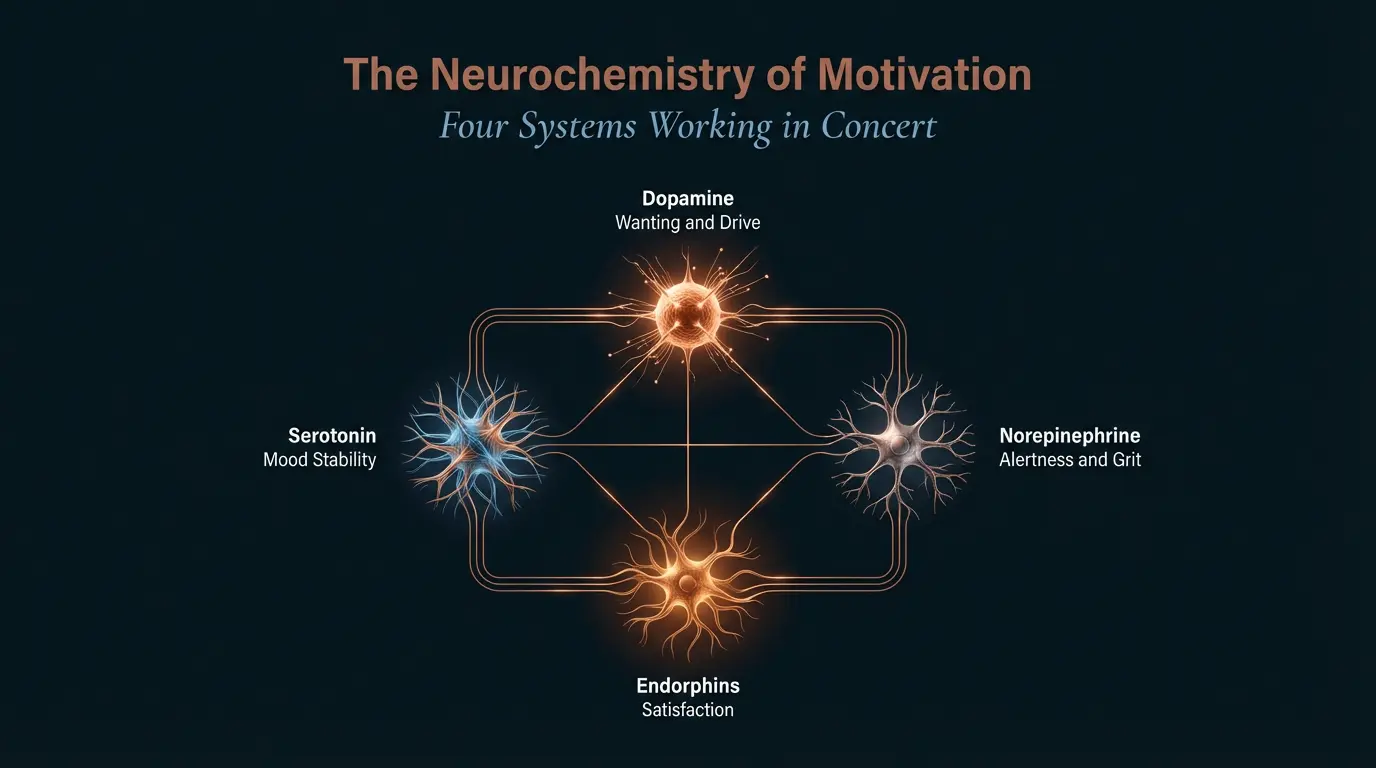
- Dopamine is closely tied to motivation. Serotonin, norepinephrine and endorphins also play roles in mood, alertness and reward.
- The dopamine system is tied more to wanting and pursuit than to enjoyment. Wanting and liking run on different brain systems.
- Intrinsic motivation (curiosity, mastery, purpose) and extrinsic motivation (outside rewards) are distinct types of drive, and expected rewards can weaken interest in a task people already enjoy.
- Stress weakens the prefrontal cortex, the front part of the brain that handles planning and attention. In one study, those effects faded once the stress eased.
- In self-determination theory, supportive relationships help sustain drive by meeting the basic need for connection.
How the Brain Drives Motivation: The Foundation of Human Achievement
How the brain drives motivation starts with specific brain circuits. A key one is the mesolimbic dopamine pathway, a main reward pathway. It runs from the ventral tegmental area (a midbrain region that makes dopamine) to the nucleus accumbens (a reward hub deep in the brain). Dopamine is a brain chemical linked to reward and drive. In studies of monkeys reviewed by Wolfram Schultz, the cells that make dopamine fired after rewards and after sights and sounds that predicted a reward. As the animals learned, the response moved from the reward itself to the cue that predicted it.
Dr. Sydney Ceruto explains why dopamine is motivation, not pleasure.
The Science of Drive: How the Brain’s Reward System Fuels Action
| Neurochemical | What the studies below link it to |
|---|---|
| Dopamine | Wanting a reward, putting in effort, and learning which cues predict a reward |
| Serotonin | Mood, emotion regulation and social behavior |
| Norepinephrine | Arousal and alertness, and whether to stay on a task or look for a better one |
| Endorphins | Part of the brain’s opioid system, which helps produce the pleasure of natural rewards |
The brain’s reward system, including the ventral tegmental area and the nucleus accumbens, is central to motivation. Berridge and Robinson separate two processes. “Wanting” is the pull toward a reward. “Liking” is the pleasure you feel when you get it. Wanting comes from large brain systems that include mesolimbic dopamine. Liking comes from smaller systems that do not depend on dopamine. That is one reason wanting something and enjoying it do not always go together.
Dopamine also shapes effort. In a brain-scan study of 25 healthy volunteers, Treadway and colleagues measured how strongly each person’s brain released dopamine. People with a stronger dopamine response in the left striatum, a reward area, and in part of the prefrontal cortex were more willing to work harder for bigger rewards. The study found a link, and it did not test cause and effect.
How the brain drives motivation goes beyond dopamine alone. Other brain chemicals, including serotonin, norepinephrine and endorphins, also play roles in mood, alertness and reward, as the sections below describe. For a step-by-step plan to keep going after the first burst of energy fades, see the four-phase approach to sustaining motivation through the predictable drop-off.
Dopamine: The Spark Plug of Motivation
Dopamine has been called the brain’s motivation chemical. Its main role is closer to pursuing a reward than to enjoying it. In their review, Salamone and Correa describe dopamine in the nucleus accumbens as part of getting going, putting in effort, approaching what you want and staying with a task. They also caution that calling the cells that make dopamine “reward” cells is an overgeneralization.

Caption: How the brain drives motivation: the chemistry behind drive and determination.
Beyond Dopamine: The Role of Other Neurochemicals
Serotonin: The Mood Stabilizer
Serotonin, a brain chemical, is involved in regulating mood, emotional balance, and social behavior. Canli and Lesch review a variation in the serotonin transporter gene. This gene controls how serotonin is recycled. The variation has been tied to anxiety-related traits and to how people manage emotions and relate to others.
Norepinephrine: Alertness and Focus
Norepinephrine, released by the locus coeruleus (a small cluster of cells in the brainstem), has long been linked to arousal and alertness. Aston-Jones and Cohen reviewed studies in monkeys. They propose that this system helps the brain decide whether to stay with the current task or drop it and look for something better.
Endorphins: Part of the Brain’s Opioid System
Endorphins are among the brain’s own opioid chemicals (endogenous opioid peptides). They act on opioid receptors, including the mu-opioid receptor. In a review of mostly rodent research, Le Merrer and colleagues describe how the brain’s opioid system responds to natural rewards and helps control the pleasure they bring.
The Psychology of Motivation: Intrinsic and Extrinsic Drives
Human motivation comes in two broad types. Intrinsic motivation means doing something because it is interesting or satisfying in itself, such as curiosity or the wish to master a skill. Extrinsic motivation means doing it for an outside result, such as pay or praise (Ryan and Deci). Deci and Ryan’s Self-Determination Theory holds that people have three basic needs: autonomy (a sense of choice), competence (feeling capable) and relatedness (feeling connected). Settings that support those needs go with better motivation, performance and well-being, and settings that block them go with poorer results.
Extrinsic motivation, on the other hand, is driven by external rewards or pressures, such as praise, money, or recognition. Rewards can also backfire. A review of 128 experiments by Deci, Koestner and Ryan found that expected, tangible rewards lowered how often people chose to keep doing an interesting task on their own. Positive feedback raised it. Murayama and colleagues saw a version of this in the brain. People who had been paid for doing well at a game played it less in a later free period. Activity in the striatum and prefrontal areas of the brain dropped along with that. Understanding how the brain drives motivation through both intrinsic and extrinsic means lets you use both with care.
Social and Cultural Influences: The Collective Power of Motivation
The people around you affect your drive. In self-determination theory, relatedness, the need to feel connected, is one of the three basic needs. Family networks, professional communities, and mastermind groups can support motivation by meeting the basic need for belonging.
Cultural values and societal expectations also play a role in how the brain drives motivation. In cultures that prize individual achievement, people may feel motivated to excel and stand out. In contrast, cultures that emphasize community and cooperation may put more weight on shared goals and group success.
Social comparison is another factor: observing the achievements of peers can inspire you to set higher goals or, if not managed well, lead to discouragement. Understanding how these social and cultural forces affect your motivation helps you seek out environments and relationships that sustain your drive intentionally.
A Client’s Journey: Mireille’s Story of Rediscovering Motivation

To illustrate how the brain drives motivation, let me share the story of Mireille, a gifted architect who came to me feeling stuck and uninspired. Despite her creative talents, Mireille struggled with procrastination and self-doubt, often losing hours to digital distractions and feeling disconnected from her goals.
Through neuroscience-based practice, we explored how constant low-level distractions were pulling her away from her goals. Each notification or social media scroll gave her a fleeting lift but left her depleted and unfulfilled. Together, we mapped out a plan to realign her daily habits.
In my practice, I consistently observe that clients like Mireille are not struggling with willpower: they are struggling with a dopamine architecture that has been calibrated to shallow, high-frequency stimulation at the expense of the sustained signal that meaningful work requires. What I find with high-drive clients is that once we identify the specific inputs, the path back to genuine engagement becomes much clearer than they expected. For a deeper look, see the Cognitive Architecture pillar.
Mireille began by identifying her most meaningful goals and breaking them into clear, manageable steps. Each small win was celebrated, reinforcing her progress. We incorporated mindful rituals (such as morning walks, deep breathing, and tech-free creative blocks) to help her regain focus and energy.
As Mireille learned to recognize her triggers and replace mindless habits with intentional actions, she experienced a profound transformation. Her focus sharpened, her energy soared, and she began leading new projects at work with confidence. By understanding how the brain drives motivation, Mireille not only revitalized her career but also reconnected with her sense of purpose and possibility.

Caption: How the brain drives motivation shows up in everyday planning and goals.
Practical Strategies: How the Brain Drives Motivation in Daily Life
Five practical strategies can help you build and sustain motivation in daily life. Each one below is tied to the research behind it.
1. Set Clear, Achievable Goals
Clear goals help. Locke and Latham summed up 35 years of research on goals. Specific, challenging goals led to better performance than being told to “do your best.” The effect was strongest when people were committed to the goal and got feedback on their progress, and it leveled off when they reached the limits of their ability. Breaking large ambitions into smaller milestones gives you nearer goals to aim for.
2. Break Tasks Into Manageable Steps
Divide large tasks into smaller steps. Checklists and progress trackers show your progress as each step is done. A review of 138 experiments by Harkin and colleagues, with almost 20,000 people, found that helping people track their progress helped them reach their goals. The effect was larger when people wrote their progress down.
3. Practice Mindfulness for Focus and Control
Mindfulness means paying attention to the present moment on purpose. Mrazek and colleagues ran a randomized trial of a two-week mindfulness course. People who took it scored better on a GRE reading test. They also did better on working memory, which means holding information in mind while you use it. Their minds also wandered less during the tests. Some earlier studies reported changes in brain structure after an eight-week mindfulness course. Two larger randomized trials, analyzed together by Kral and colleagues with 218 people, found no such changes.
4. Cultivate Social Connections
Feeling connected to others is one of the basic needs in self-determination theory. Sharing your progress with others can help you follow through. In Harkin’s review, tracking progress helped more when people reported it to others or made it public.
5. Manage Stress to Protect Focus and Planning
Stress affects the prefrontal cortex. In her review, Amy Arnsten explains that acute, uncontrollable stress raises levels of catecholamines (a chemical family that includes dopamine and norepinephrine) in the prefrontal cortex. That weakens its activity and impairs thinking. Chronic stress makes these effects stronger and can change the structure of the region. Some of this can reverse. Liston, McEwen and Casey studied 20 healthy adults after a month of heavy stress. They had weaker control over their attention. Links within a brain network that shifts attention were also weaker. After a month of lower stress, they no longer differed from a low-stress group. Regular physical activity and social support can also lower the load of chronic stress, as Bruce McEwen notes.
How the Brain Drives Motivation at Work: The Neuroscience of Leadership
Understanding how the brain drives motivation is useful for leaders who want engaged, high-performing teams. In self-determination theory, motivation at work depends on an environment that supports people’s needs for autonomy, competence and connection. Gagné and Deci describe how self-determination theory applies to work.
Caption: How the brain drives motivation: energy, insight, and the power to achieve your goals.
Four Enablers of Engagement
Leadership Narrative
Four enablers of employee engagement were named in Engaging for Success, a 2009 report by David MacLeod and Nita Clarke for the UK government. They come from a study of workplace practice. They were not drawn from brain research. The first is a clear leadership narrative: leaders communicate a clear vision and connect each person’s role to the organization’s purpose.
What I find consistently in my work with leaders is that the teams performing at the highest level are not necessarily the ones with the most talented individuals. In my practice, I observe that when leaders fail to communicate purpose clearly, motivational output drops across the entire team as a result.
Engaging Managers
Managers who foster inclusion and belonging help each person feel like a valued part of the team. Amy Edmondson studied 51 work teams in a manufacturing company. She looked at psychological safety, a shared belief that it is safe to take risks with others, such as speaking up. Teams with more of it showed more learning behavior, which in turn went with better team performance.
Employee Voice
Employee voice means giving people input into decisions that affect their work. In self-determination theory, having a say supports autonomy, one of the three basic needs.
Organizational Integrity
Organizational integrity means that what leaders do matches the values they state. In practice, that means keeping promises, explaining decisions and applying rules the same way to everyone.
The Power of Purpose and Meaning
Seeing who your work helps can raise motivation. In a field experiment by Adam Grant and colleagues, callers raising money for university scholarships briefly met a student whose scholarship the program had funded. A month later, those callers spent much more time on the phone and raised much more money than before. Callers in two comparison groups did not show those gains.
Organizations that communicate a compelling vision and help individuals see their unique impact can foster a workplace where motivation thrives. For more on dopamine and motivation in demanding jobs, see how dopamine affects motivation in high-demand professional environments.
Neuroleadership: Emotional Intelligence, Empathy, and Trust
Neuroleadership is a name for applying brain science to leadership, with a focus on motivation, managing emotions and empathy.
Empathy has been studied in the brain. Tania Singer and colleagues scanned the brains of volunteers. Two areas, the anterior insula and part of the anterior cingulate cortex, responded when the volunteers felt pain. They also responded when a signal showed that a loved one in the same room was in pain. People who scored higher on measures of empathy showed stronger responses there. Leaders who show empathy and manage their own reactions can set an example for their teams.
Enabling Productivity and Innovation
Leaders can support productivity and innovation by giving employees the right resources, training and support. In self-determination theory, competence, the sense of being capable, is a basic need, so support that builds skill also supports motivation.
Social Motivation and the SCARF Model
The SCARF model (Status, Certainty, Autonomy, Relatedness, and Fairness) is a framework David Rock proposed in 2008 for thinking about social motivation at work. It is a practical framework, and the studies cited on this page did not test it. For instance, recognition speaks to status, clear communication to certainty, room for choice to autonomy, team connection to relatedness, and even-handed decisions to fairness.
By designing workplace experiences that address these five areas, leaders can aim for places where employees feel engaged, valued and motivated to contribute their best.

Caption: From ambition to achievement: how the brain drives motivation.
Real-World Impact: What a Large Workplace Study Found
A large analysis of workplace data backs the link between engagement and results. A meta-analysis by Harter, Schmidt and Hayes combined data from 7,939 business units in 36 companies. Units with higher employee satisfaction and engagement tended to have better customer satisfaction, productivity and profit, and lower turnover and fewer accidents. Because the data show links between measures, they cannot show which one causes the other.
Building a Brain-Friendly Culture
A culture that supports motivation meets the needs described above: autonomy, competence and connection, plus the psychological safety Edmondson studied. Leaders can start with these practices:
- Communicating a compelling vision
- Encouraging open dialogue
- Recognizing achievements
- Providing resources for growth
- Modeling empathy and trust
The Future: How the Brain Drives Motivation for Transformative Growth
Neuroscience keeps tying motivation to specific brain systems, such as the dopamine pathways described above. The brain also stays changeable. In the stress study above, changes in attention and brain connections faded once the stress eased.
Integrating neuroscience insights with personal and professional development means moving beyond generic advice to approaches that fit each person. Practices such as setting clear goals, tracking progress and mindfulness training each have research behind them.
By applying these findings in your life and leadership, you give yourself a better chance of building motivation that lasts.
NeuroSync™: Personalized Dopamine Optimization offers a customized roadmap to activate lasting drive, clarity, and performance.
The clients who sustain motivation are not the ones with the most discipline.
To apply these motivation principles in daily life, Dr. Ceruto’s Dopamine Menu, the central framework in The Dopamine Code, provides a practical roadmap for sustainable drive.
Why do I know what to do but can’t make myself do it?
Getting started takes drive as well as knowledge. In their review, Salamone and Correa link dopamine in the nucleus accumbens to getting going and putting in effort. In one brain-scan study, people with a stronger dopamine response in reward areas were more willing to work hard for bigger rewards. It found a link, and it did not test cause and effect. Breaking tasks into smaller units with visible progress markers is one practical way to get started. In Harkin’s review of 138 experiments, tracking progress helped people reach their goals.
Can chronic stress permanently damage motivation circuits?
Not always. The studies cited here looked at the prefrontal cortex, which handles planning and attention. Stress weakens it, and chronic stress can change its structure. In one study, 20 healthy adults under a month of heavy stress showed weaker attention control and weaker links in an attention network. After a month of lower stress, they no longer differed from a low-stress group. That study followed one month of stress in healthy adults, so it cannot say how longer stress plays out.
Is motivation different for introverts versus extroverts?
The study cited here on this question measured how the brain responds to rewards. It did not measure motivation itself. In a brain-scan study by Cohen and colleagues, more extraverted people showed stronger responses in the brain’s reward system when they won money in a gambling task. Extraversion did not predict the brain’s response while people waited to find out whether they had won. The idea that introverts rely on a different brain chemical, such as acetylcholine, was not tested in the studies cited here.
Why does motivation fluctuate throughout the day?
Your body clock affects how well you think at different times of day. A review by Schmidt and colleagues describes how attention, planning and memory rise and fall across the day. It also shows that people perform best when tasks fall at their own peak time, which differs between morning people and evening people. Planning demanding work for your own best hours can help.
How long does it take to rebuild motivation after burnout?
The studies cited here did not set a timeline for recovery after burnout. In McEwen’s review, regular physical activity and social support lower the burden of chronic stress.
References
- Arnsten, A. F. T. (2015). Stress weakens prefrontal networks: Molecular insults to higher cognition. Nature Neuroscience, 18(10), 1376-1385. DOI
- Aston-Jones, G., and Cohen, J. D. (2005). An integrative theory of locus coeruleus-norepinephrine function: Adaptive gain and optimal performance. Annual Review of Neuroscience, 28, 403-450. DOI
- Berridge, K. C., and Robinson, T. E. (2016). Liking, wanting, and the incentive-sensitization theory of addiction. American Psychologist, 71(8), 670-679. DOI
- Canli, T., and Lesch, K.-P. (2007). Long story short: The serotonin transporter in emotion regulation and social cognition. Nature Neuroscience, 10(9), 1103-1109. DOI
- Cohen, M. X., Young, J., Baek, J.-M., Kessler, C., and Ranganath, C. (2005). Individual differences in extraversion and dopamine genetics predict neural reward responses. Cognitive Brain Research, 25(3), 851-861. DOI
- Deci, E. L., Koestner, R., and Ryan, R. M. (1999). A meta-analytic review of experiments examining the effects of extrinsic rewards on intrinsic motivation. Psychological Bulletin, 125(6), 627-668. DOI
- Deci, E. L., and Ryan, R. M. (2000). The “what” and “why” of goal pursuits: Human needs and the self-determination of behavior. Psychological Inquiry, 11(4), 227-268. DOI
- Edmondson, A. (1999). Psychological safety and learning behavior in work teams. Administrative Science Quarterly, 44(2), 350-383. DOI
- Gagné, M., and Deci, E. L. (2005). Self-determination theory and work motivation. Journal of Organizational Behavior, 26(4), 331-362. DOI
- Grant, A. M., Campbell, E. M., Chen, G., Cottone, K., Lapedis, D., and Lee, K. (2007). Impact and the art of motivation maintenance: The effects of contact with beneficiaries on persistence behavior. Organizational Behavior and Human Decision Processes, 103(1), 53-67. DOI
- Harkin, B., Webb, T. L., Chang, B. P. I., Prestwich, A., Conner, M., Kellar, I., Benn, Y., and Sheeran, P. (2016). Does monitoring goal progress promote goal attainment? A meta-analysis of the experimental evidence. Psychological Bulletin, 142(2), 198-229. DOI
- Harter, J. K., Schmidt, F. L., and Hayes, T. L. (2002). Business-unit-level relationship between employee satisfaction, employee engagement, and business outcomes: A meta-analysis. Journal of Applied Psychology, 87(2), 268-279. DOI
- Kral, T. R. A., Davis, K., Korponay, C., Hirshberg, M. J., Hoel, R., Tello, L. Y., Goldman, R. I., Rosenkranz, M. A., Lutz, A., and Davidson, R. J. (2022). Absence of structural brain changes from mindfulness-based stress reduction: Two combined randomized controlled trials. Science Advances, 8(20), eabk3316. DOI
- Le Merrer, J., Becker, J. A. J., Befort, K., and Kieffer, B. L. (2009). Reward processing by the opioid system in the brain. Physiological Reviews, 89(4), 1379-1412. DOI
- Liston, C., McEwen, B. S., and Casey, B. J. (2009). Psychosocial stress reversibly disrupts prefrontal processing and attentional control. Proceedings of the National Academy of Sciences, 106(3), 912-917. DOI
- Locke, E. A., and Latham, G. P. (2002). Building a practically useful theory of goal setting and task motivation: A 35-year odyssey. American Psychologist, 57(9), 705-717. DOI
- MacLeod, D., and Clarke, N. (2009). Engaging for success: Enhancing performance through employee engagement. A report to Government. London: Department for Business, Innovation and Skills.
- McEwen, B. S. (2007). Physiology and neurobiology of stress and adaptation: Central role of the brain. Physiological Reviews, 87(3), 873-904. DOI
- Mrazek, M. D., Franklin, M. S., Phillips, D. T., Baird, B., and Schooler, J. W. (2013). Mindfulness training improves working memory capacity and GRE performance while reducing mind wandering. Psychological Science, 24(5), 776-781. DOI
- Murayama, K., Matsumoto, M., Izuma, K., and Matsumoto, K. (2010). Neural basis of the undermining effect of monetary reward on intrinsic motivation. Proceedings of the National Academy of Sciences, 107(49), 20911-20916. DOI
- Rock, D. (2008). SCARF: A brain-based model for collaborating with and influencing others. NeuroLeadership Journal, 1.
- Ryan, R. M., and Deci, E. L. (2000). Intrinsic and extrinsic motivations: Classic definitions and new directions. Contemporary Educational Psychology, 25(1), 54-67. DOI
- Salamone, J. D., and Correa, M. (2012). The mysterious motivational functions of mesolimbic dopamine. Neuron, 76(3), 470-485. DOI
- Schmidt, C., Collette, F., Cajochen, C., and Peigneux, P. (2007). A time to think: Circadian rhythms in human cognition. Cognitive Neuropsychology, 24(7), 755-789. DOI
- Schultz, W. (1998). Predictive reward signal of dopamine neurons. Journal of Neurophysiology, 80(1), 1-27. DOI
- Singer, T., Seymour, B., O’Doherty, J., Kaube, H., Dolan, R. J., and Frith, C. D. (2004). Empathy for pain involves the affective but not sensory components of pain. Science, 303(5661), 1157-1162. DOI
- Treadway, M. T., Buckholtz, J. W., Cowan, R. L., Woodward, N. D., Li, R., Ansari, M. S., Baldwin, R. M., Schwartzman, A. N., Kessler, R. M., and Zald, D. H. (2012). Dopaminergic mechanisms of individual differences in human effort-based decision-making. Journal of Neuroscience, 32(18), 6170-6176. DOI
From Reading to Rewiring
These questions address common concerns about how the brain drives motivation.
Book Your Consultation