Key Takeaways
- Plateaus mark the handoff from prefrontal effort to basal-ganglia automation, not the end of learning.
- During the flat stretch, myelination and overnight consolidation do structural work conscious practice cannot rush.
- Massed practice stops producing gains after encoding; spaced retrieval and graded difficulty restart measurable improvement.
- Sleep is a performance input, not an afterthought: skill memory replays during specific sleep stages.
- Plateaus are usually a method problem, not a motivation problem, and method is correctable.
A learning plateau is not a sign that you have reached your ceiling. It is a predictable phase in which the brain shifts from rapid synaptic gains to slower structural consolidation, so visible progress stalls while the underlying circuit is still being rebuilt. Understanding which phase you are in tells you exactly how to move again.
Why Does Skill Progress Suddenly Stall?
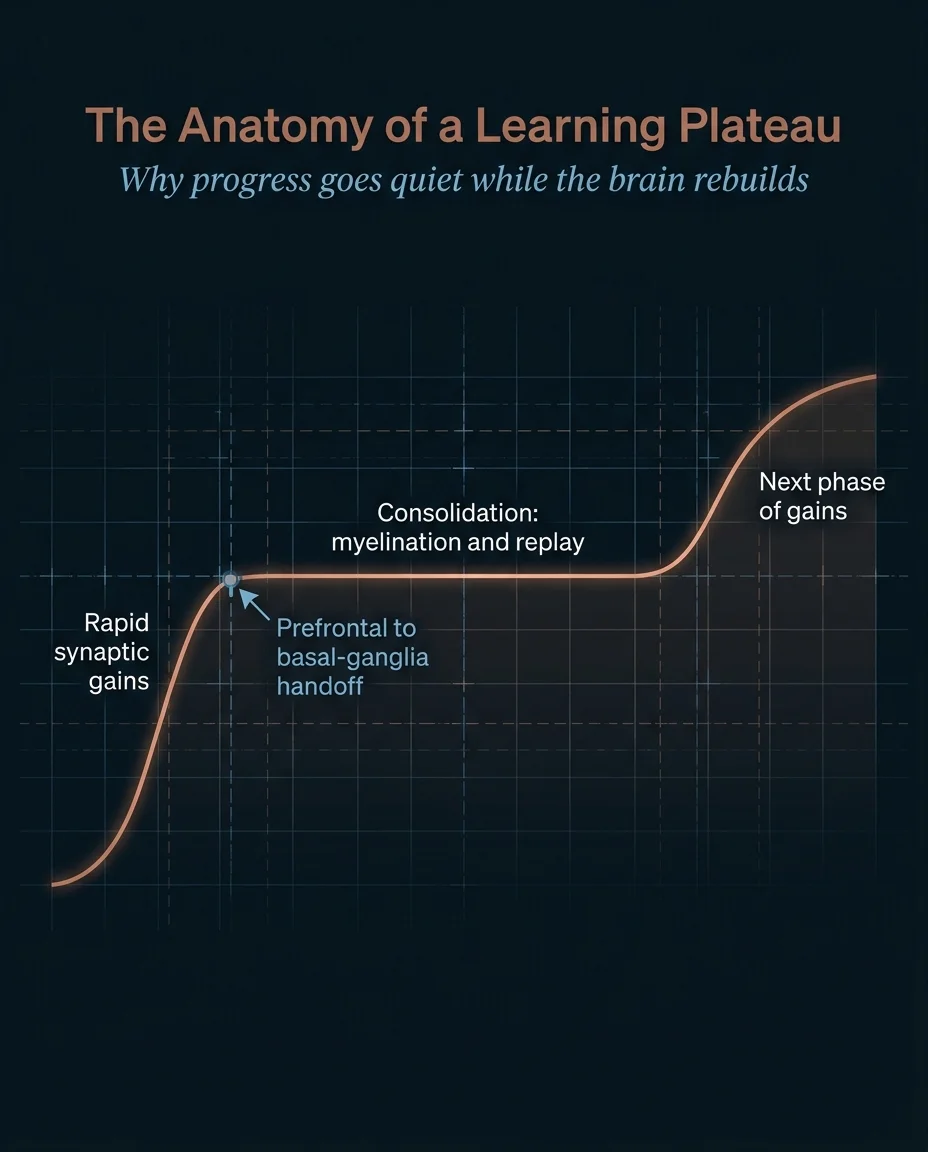
Skill progress stalls because the brain has moved from the cheap, fast phase of learning to the expensive, slow one. Early in any new skill, your prefrontal cortex holds each step in working memory and you improve quickly because synaptic connections strengthen rapidly under conscious attention. That early acceleration feels like talent. It is actually the easiest neural work your brain will do on this skill.
The plateau begins when the skill starts migrating out of effortful prefrontal control and into the basal ganglia, the structures that run learned routines automatically. During this transfer, the circuit is being physically reorganized rather than simply reinforced, and reorganization does not show up as a higher score the next day. In my practice, the high-performers who quit a skill almost always quit here, at the exact point where the brain has committed to the rebuild and the scoreboard has gone quiet.
This is the same mechanism the neuroscience guide to brain-based professional growth describes as encoding versus consolidation. The plateau is consolidation made visible, or rather made invisible, because the work has moved below the level of conscious feedback.
Is a Plateau a Sign You Have Reached Your Limit?
No. A plateau is almost never a ceiling, and treating it as one is the single most expensive misread in skill development. The flat stretch on the curve is where structural maturation happens, and structural maturation is slow by design. Research on motor skill learning shows that the brain continues to remodel the relevant circuits well after performance appears to stop improving, which means the absence of a visible gain is not the absence of change.
One of the clearest biological reasons sits in your white matter. As a skill is repeated, oligodendrocytes wrap the active pathways in myelin, the fatty insulation that lets signals travel faster and more reliably. This insulation is laid down gradually, and its timing is sensitive to experience rather than to willpower (Makinodan et al., 2012). You cannot consciously accelerate myelination by trying harder in a single session. You can only keep providing the right input so the slow process has something accurate to insulate.
What the research does not capture, and what I consistently observe, is the emotional signature of this phase. Clients describe the plateau as a loss of confidence rather than a loss of ability. The reframe that actually works is mechanical, not motivational: the friction you feel is the sensation of a circuit being rebuilt, and it is the most reliable evidence that the skill is taking hold.

The friction you feel is the sensation of a circuit being rebuilt, and it is the most reliable evidence that the skill is taking hold.
– Dr. Sydney Ceruto
What Is Actually Happening in the Brain During a Plateau?
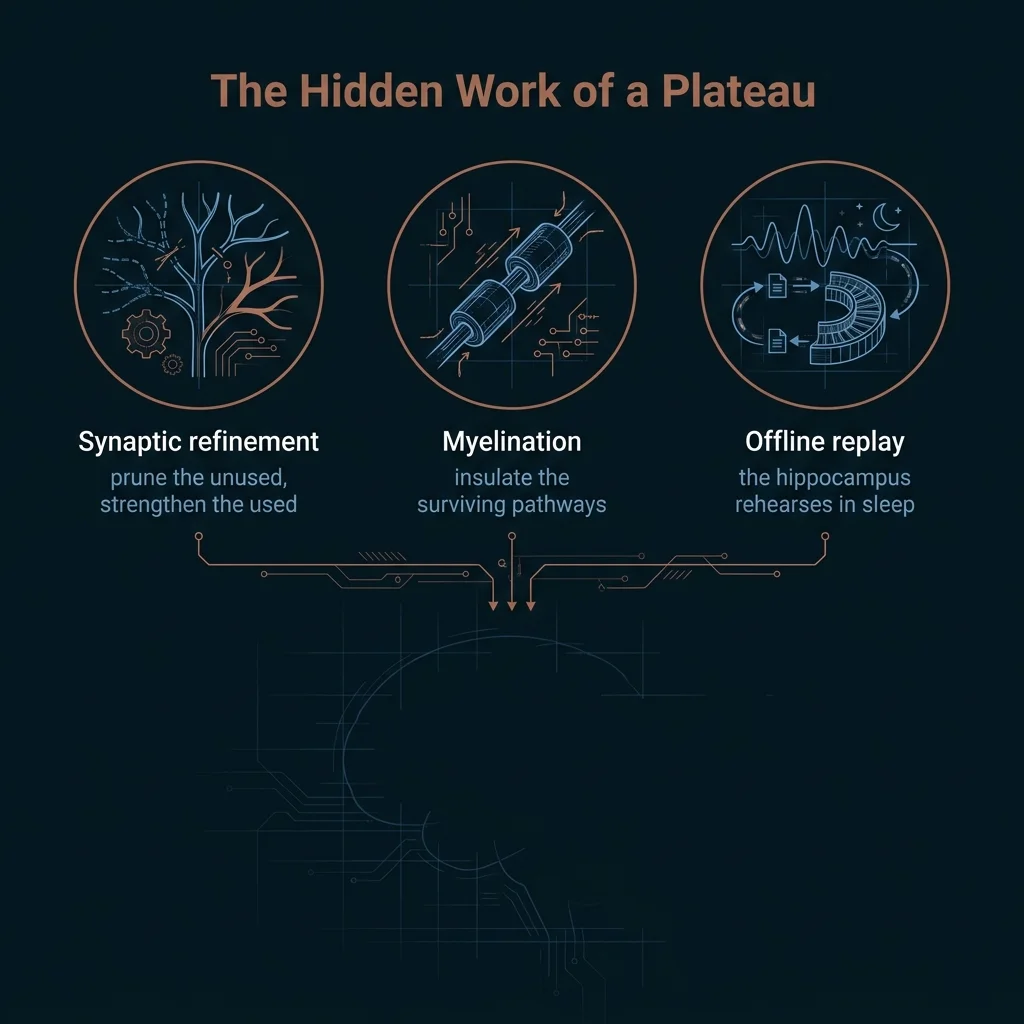
During a plateau, three processes run underneath unchanged performance: synaptic refinement, myelination, and offline consolidation. Synaptic refinement prunes the connections you do not need and strengthens the ones you do, which sharpens a skill without necessarily making it faster yet. Myelination, as above, speeds the surviving pathways. Offline consolidation is the one most people ignore entirely.
Offline consolidation means your brain keeps practicing when you are not. During sleep and even during brief waking rest, the hippocampus replays the sequences you rehearsed earlier, and this replay stabilizes the memory trace and transfers it toward long-term storage (Foster & Wilson, 2006). The practical consequence is counterintuitive. Some of your most important skill gains are scheduled for the hours after you stop working, which is why cramming through a plateau tends to deepen it rather than break it. The broader mechanics of how the adult brain rewires through this cycle are covered in the hub on optimizing your brain through targeted neuroplasticity training.
Why Does Repeating the Same Practice Stop Working?
Repeating the same practice stops working because the brain only invests in change when prediction fails. Once a movement or concept is reliably encoded, running it again produces an accurate prediction, the dopaminergic system registers no error worth learning from, and the circuit is left as is. This is the automation paradox: the very fluency you worked for removes the signal that drove your improvement.
The deliberate-practice literature formalized this decades ago. Expert performance does not come from accumulated hours of comfortable repetition; it comes from sustained work at the edge of current ability, with specific feedback, on the exact sub-skills that are still weak (Ericsson, Krampe, & Tesch-Römer, 1993). Mindless volume is not deliberate practice. It is the most common way a motivated person manufactures a plateau.
There is also a spacing dimension. When practice is distributed across intervals rather than massed into long blocks, retention rises sharply because each retrieval forces the circuit to reconstruct the skill rather than coast on a warm trace. Optimizing those intervals, rather than simply doing more, measurably enhances how much the brain learns from the same total effort (Tabibian et al., 2019). For anyone rebuilding focus while they rebuild a skill, the related work on strengthening sustained attention through neural training compounds these gains.
The very fluency you worked for removes the signal that drove your improvement.
– Dr. Sydney Ceruto

How Do You Break Through a Learning Plateau?
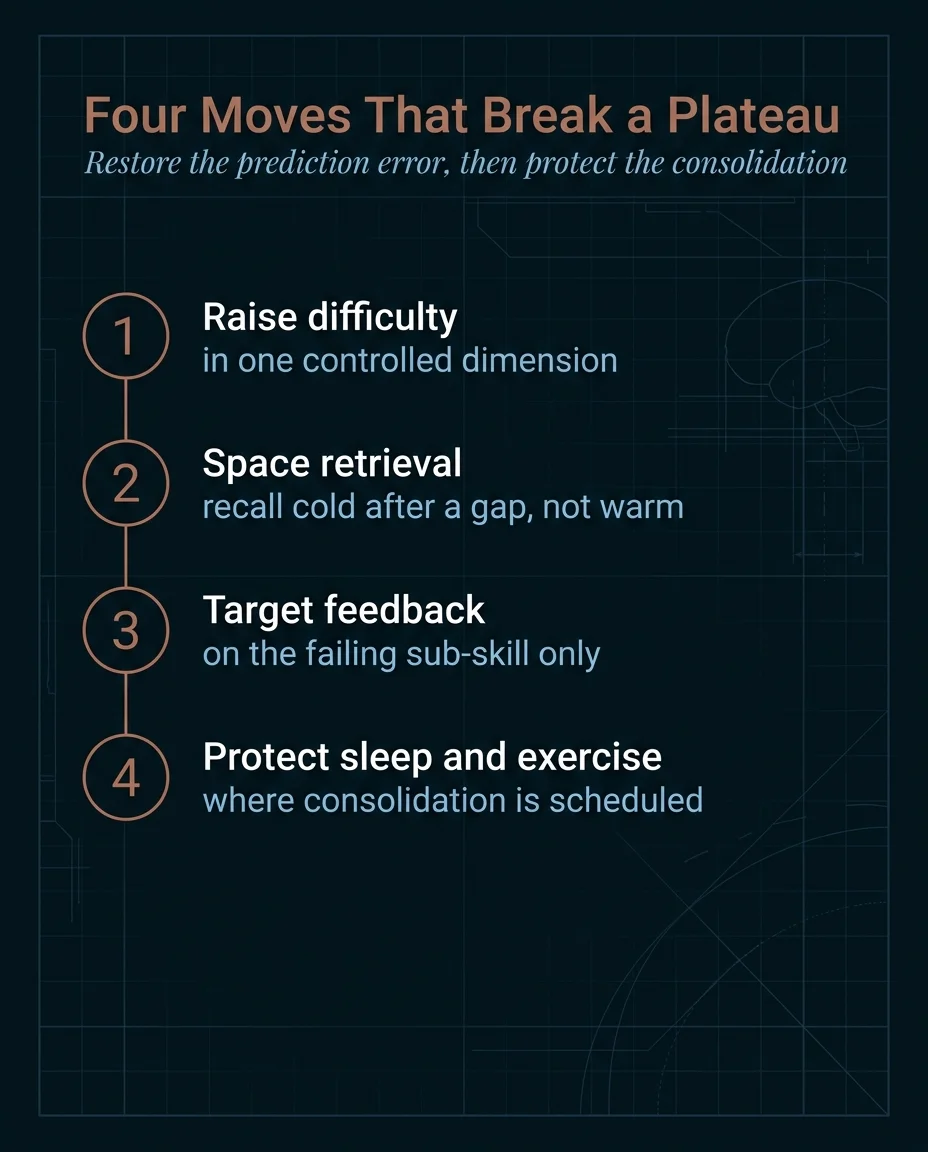
You break a plateau by restoring a prediction error the brain is willing to learn from, and then protecting the consolidation that follows. In practice that means four moves applied together rather than in isolation. First, raise the difficulty in a single, controlled dimension so the skill is hard again without becoming chaotic. Second, replace block repetition with spaced retrieval, recalling the skill cold after a gap instead of rehearsing it warm. Third, narrow your feedback to the specific sub-skill that is failing, because diffuse practice produces diffuse results.
The fourth move is the one high-achievers resist: protect sleep and add aerobic exercise. Sleep is when the replay-driven consolidation described above is scheduled, and aerobic exercise raises the neurochemical conditions for plasticity itself, with measurable downstream effects on learning and cognition (Hillman, Erickson, & Kramer, 2008). A plateau broken on four hours of sleep is usually a plateau postponed.
This is the structure of how I work with clients through a stall. We do not add hours. We change the input so the underlying motor and cognitive circuits have a reason to reorganize again, a pattern documented across studies of motor skill neuroplasticity (Dayan & Cohen, 2011). When the method is right, the plateau resolves into the next phase of gains, often abruptly, because the consolidated circuit was finished and simply waiting for a harder demand.
When Is a Plateau a Problem Worth Addressing Directly?
A plateau is worth addressing directly when it has lasted longer than the consolidation phase should reasonably take and the standard method changes have not moved it. Most genuine consolidation plateaus respond within a few weeks of corrected practice. When a stall persists for months despite spaced retrieval, graded difficulty, targeted feedback, and adequate sleep, the limiting factor is usually upstream of the skill itself: chronically elevated stress hormones that suppress plasticity, cognitive load spread across too many simultaneous goals, or a working-memory bottleneck that throttles encoding before consolidation can begin (Jaeggi et al., 2008).
This is where a generic productivity fix fails and a neurocognitive one is needed. The question is no longer how to practice the skill but which system is suppressing the brain’s capacity to consolidate it at all. Identifying that bottleneck is precise work, and it is the difference between grinding against a wall and removing it.
Recognizing a plateau as a consolidation phase is the first step. Pinpointing the specific system that is throttling your progress, whether it is method, sleep, stress load, or working-memory capacity, is where measurable change begins. A strategy call maps the bottleneck limiting your skill development and builds a targeted protocol around your own neurocognitive profile.
If your progress has stalled despite real effort, the method can almost always be corrected. Schedule a strategy call with Dr. Ceruto to identify what is keeping you on the plateau and how to move past it.
How long does a learning plateau usually last?
A typical consolidation plateau lasts from a few days to a few weeks, depending on the complexity of the skill and the quality of practice. The flat period is the time the brain needs to myelinate and stabilize the circuit it has been building. If a plateau persists for months despite spaced practice, targeted feedback, and adequate sleep, the limiting factor is usually upstream of the skill, such as chronic stress or a working-memory bottleneck, and is worth addressing directly.
Why do I feel worse during a plateau even though I am practicing?
Feeling worse during a plateau is common because the brain is reorganizing a circuit rather than simply reinforcing it, and reorganization temporarily disrupts smooth performance. The discomfort is the sensation of neural remodeling in progress, not evidence of decline. Treating that friction as confirmation the skill is taking hold, instead of as a stop signal, is the reframe that keeps people in the work long enough to reach the next phase of gains.
Does more practice break a plateau faster?
No. More repetition of an already-encoded skill does not break a plateau and often deepens it, because the brain only invests in change when prediction fails. What restarts progress is changing the input: raising difficulty in one controlled dimension, spacing retrieval across intervals, and narrowing feedback to the failing sub-skill. Quality and structure of practice move a plateau, not raw volume.
How does sleep affect breaking through a learning plateau?
Sleep is central to breaking a plateau because skill memory is replayed and stabilized during sleep, when the hippocampus consolidates what you rehearsed while awake. Cutting sleep to add practice hours removes the exact process that converts effort into durable skill. Protecting sleep, and adding aerobic exercise to raise the neurochemical conditions for plasticity, are practical levers that make corrected practice actually stick.
Is a learning plateau the same as reaching my natural limit?
A learning plateau is almost never your natural limit. It is a phase of slow structural consolidation in which performance looks flat while the underlying circuit is still maturing through myelination and offline replay. The brain continues to remodel relevant pathways after visible improvement stops, so the absence of a higher score is not the absence of change. With corrected method, most plateaus resolve into a further phase of measurable gains.
References
- Ericsson, K. A., Krampe, R. T., & Tesch-Römer, C. (1993). The role of deliberate practice in the acquisition of expert performance. Psychological Review, 100(3), 363-406. https://doi.org/10.1037/0033-295X.100.3.363
- Dayan, E., & Cohen, L. G. (2011). Neuroplasticity subserving motor skill learning. Neuron, 72(3), 443-454. https://doi.org/10.1016/j.neuron.2011.10.008
- Makinodan, M., Rosen, K. M., Ito, S., & Corfas, G. (2012). A critical period for social experience-dependent oligodendrocyte maturation and myelination. Science, 337(6100), 1357-1360. https://doi.org/10.1126/science.1220845
- Foster, D. J., & Wilson, M. A. (2006). Reverse replay of behavioural sequences in hippocampal place cells during the awake state. Nature, 440(7084), 680-683. https://doi.org/10.1038/nature04587
- Tabibian, B., Upadhyay, U., De, A., Zarezade, A., Schölkopf, B., & Gomez-Rodriguez, M. (2019). Enhancing human learning via spaced repetition optimization. Proceedings of the National Academy of Sciences, 116(10), 3988-3993. https://doi.org/10.1073/pnas.1815156116
- Hillman, C. H., Erickson, K. I., & Kramer, A. F. (2008). Be smart, exercise your heart: Exercise effects on brain and cognition. Nature Reviews Neuroscience, 9(1), 58-65. https://doi.org/10.1038/nrn2298
- Jaeggi, S. M., Buschkuehl, M., Jonides, J., & Perrig, W. J. (2008). Improving fluid intelligence with training on working memory. Proceedings of the National Academy of Sciences, 105(19), 6829-6833. https://doi.org/10.1073/pnas.0801268105