Key Takeaways
- Learning agility is unlearning, not faster acquisition: weakening old patterns lets new ones hold.
- Old knowledge does not fade; retrieving a newer pattern suppresses competitors, called adaptive forgetting.
- Proactive interference makes practiced patterns resist change: prior learning intrudes on new, worst in experts.
- Relearning runs through reconsolidation: reactivating a memory briefly opens it to rewriting by prediction error.
- Cognitive flexibility is trainable but rarely crosses domains, so deliberate variation belongs inside one domain.
Adapting to fast change depends less on how quickly you learn something new than on how readily your brain can unlearn what it already knows. Unlearning is the active weakening of an established pattern; relearning is the updating of a model the brain has already stored. Both are real neural events, and both can be trained.
What Does It Actually Mean to Unlearn Something?
Unlearning is not deletion. The brain almost never erases a pattern it has built. Instead it weakens the old pattern’s hold while strengthening a competing one, so the new response wins the moment. This matters because most people picture learning agility as a matter of absorbing the new thing faster, when the harder and more decisive work is loosening the thing already in place.
There is direct evidence that the brain does this on purpose. When you repeatedly retrieve a target memory, the brain suppresses the cortical activity pattern belonging to the older memory that competes with it. Maria Wimber and her colleagues tracked this in the human brain and showed that the act of remembering one thing measurably quiets the neural trace of its rival, an effect they describe as retrieval inducing adaptive forgetting of competing memories. Forgetting, in this account, is not a failure of memory. It is a tool the brain uses to keep the right pattern accessible and the outdated one out of the way.
At the level of synapses, the same logic holds. Plasticity strengthens some connections and weakens others, and the weakening is not waste. It is how the brain makes room. Building a skill in the first place is a matter of laying down and reinforcing a pattern, which is the side of plasticity I describe in our explainer on how the brain rewires through targeted neuroplasticity. Unlearning is the quieter counterpart: easing the grip of a pattern that is already there. Genuine agility needs both halves, and the second is the one most people neglect.

Why Is an Old Pattern So Hard to Let Go Of?
Because prior learning actively interferes with new learning. The phenomenon is called proactive interference, and the stronger and more practiced the old pattern, the more it intrudes on the new one you are trying to install. This is not a character flaw or a lack of discipline. It is a structural feature of how memory is organized.
Proactive interference has a measurable neural signature. Reviewing the brain mechanisms involved, John Jonides and Derek Nee found that resolving it depends heavily on the left inferior frontal cortex, a prefrontal region that has to do extra work to push now-irrelevant prior information aside so the current, correct information can be used. In other words, the old pattern does not simply step back politely when a better one arrives. Your prefrontal cortex has to actively hold it offline, and that effort is real and limited. Under fatigue or pressure, when prefrontal resources thin out, the brain quietly defaults back to the older, more practiced response.
This produces a paradox worth sitting with. The better you know the old way, the more your brain reaches for it automatically, which means deep expertise can make you less agile inside your own domain, not more. It is also a large part of why progress stalls. What feels like a ceiling is often the established pattern competing with the new one you are trying to build, a dynamic I unpack in our piece on why you hit a learning plateau and how to break it. The plateau is not the absence of effort. It is interference you have not yet resolved.
How Does the Brain Rewrite What It Already Knows?
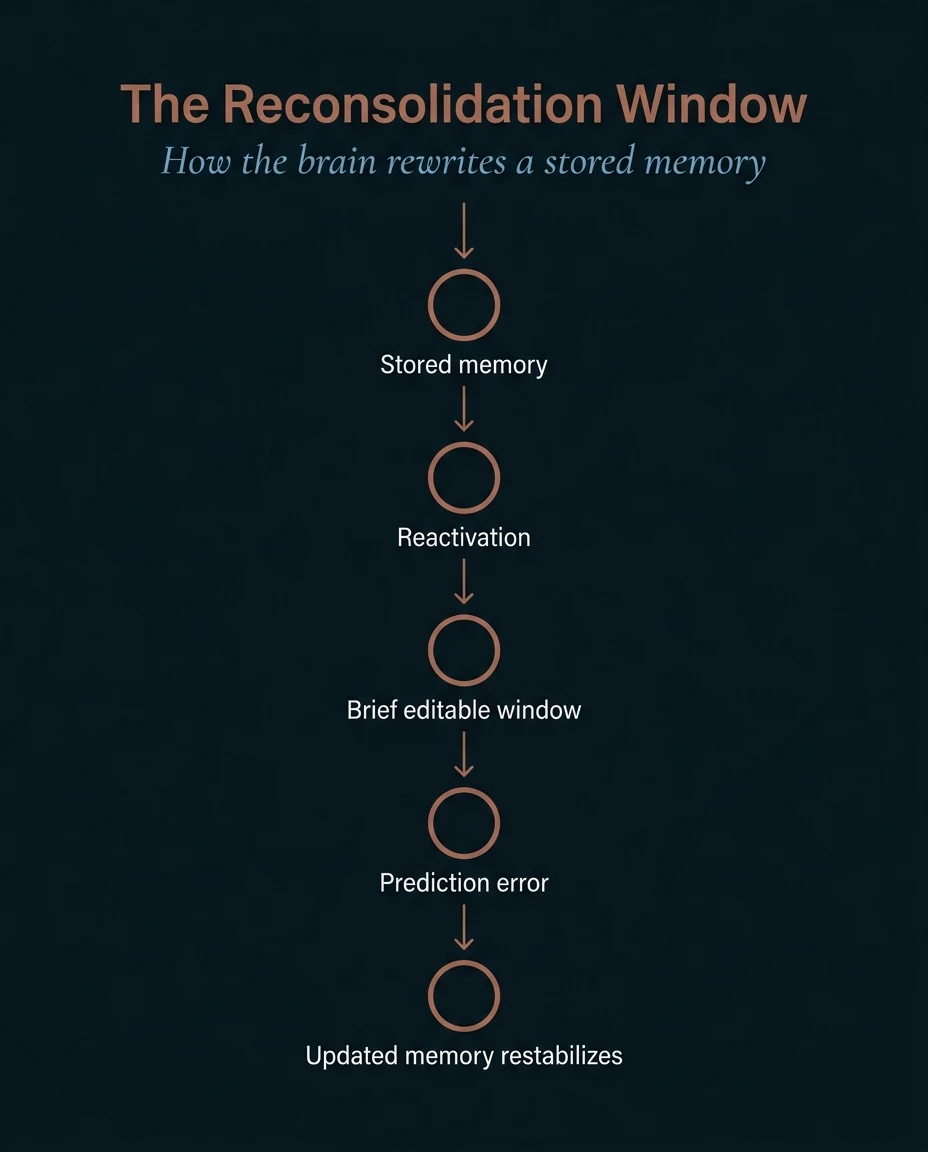
Through reconsolidation. Recalling a stored memory briefly returns it to an unstable, editable state before it settles back down, and inside that short window the memory can be changed. It means a consolidated memory is not a fixed recording. It is a draft the brain reopens every time you genuinely revisit it.
The original demonstration came from work showing that a reactivated memory requires fresh protein synthesis to restabilize after retrieval. Reactivate the memory, block the restabilization, and the memory weakens rather than persists, which means the act of remembering had returned it to a malleable state. The same principle has been pursued in people: a reactivated emotional memory, met with new information during the reconsolidation window, may be updated rather than simply suppressed. The window is the opportunity. Relearning is not a matter of grinding repetition on top of the old pattern. It is reopening the old pattern and meeting it with something that contradicts it.
What does the contradicting? A prediction error. Decades of work beginning with the discovery of a dopamine signal that encodes the gap between predicted and actual reward established that the brain learns precisely when outcomes violate expectations. The error is the teaching signal. It is the brain’s way of registering that its current model is wrong and flagging it for revision. This is why being surprised, and letting yourself fully register the surprise, is not a detour from learning but the mechanism of it. A model that is never contradicted is never updated, and a brain that protects itself from being wrong protects its outdated patterns along with its ego.
The brain does not update a settled belief through repetition. It updates through reactivation met with surprise, which is why the willingness to be wrong is the real engine of agility.
Can You Actually Train Cognitive Flexibility?
Yes, but less than the brain-training industry implies, and the gains transfer narrowly. Cognitive flexibility is the readiness to switch between mental frames, what researchers call set-shifting, and it runs on prefrontal and striatal circuits that let you drop one rule and pick up another when the first stops working. In a review defining the construct, Deanna Dajani and Lucina Uddin describe cognitive flexibility as the readiness with which a person can selectively switch between mental processes to generate appropriate responses, and the capacity is genuinely trainable in the domain you train it in.
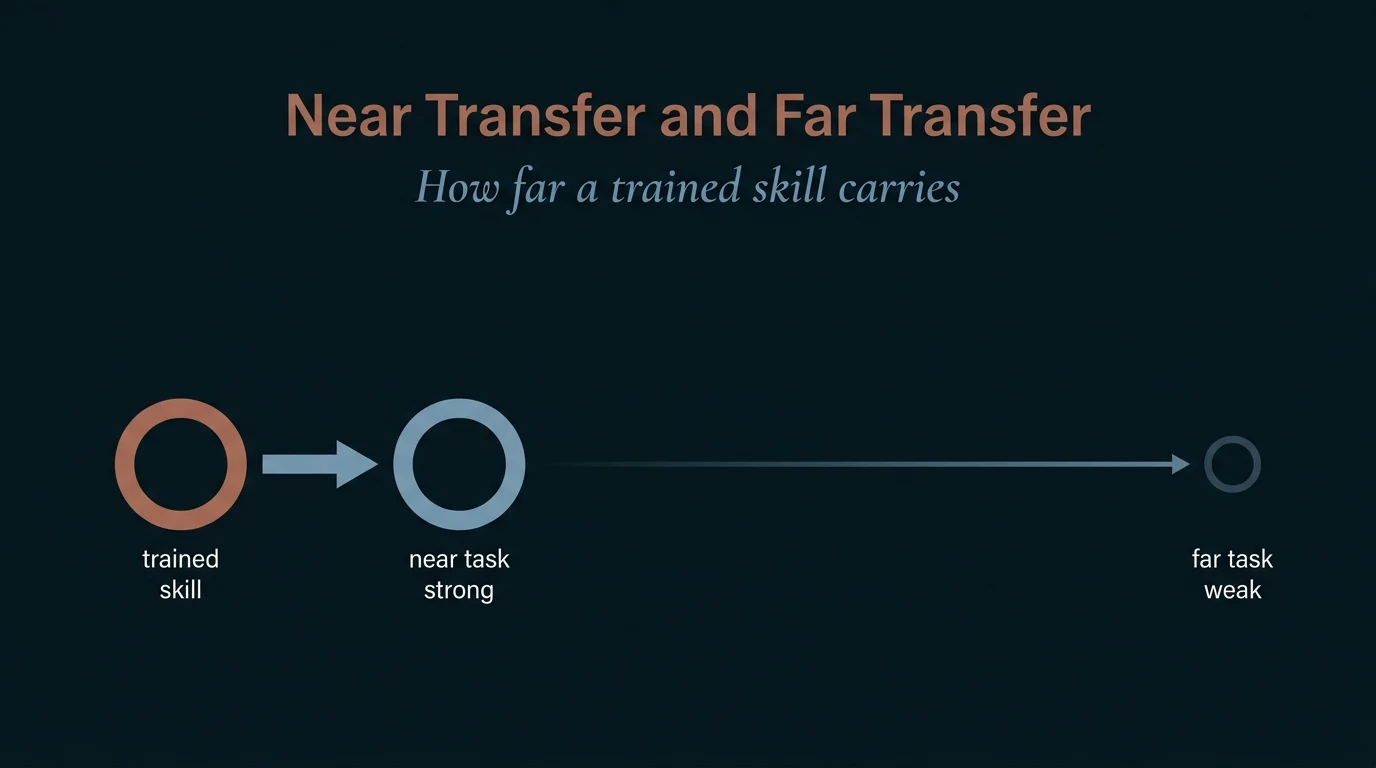
The honest complication is transfer. Whether a skill carries from where you learned it to a new situation depends on how far the two situations sit apart, a distinction the classic taxonomy of near and far transfer was built to make precise. Near transfer, to a closely related task, is reliable. Far transfer, to a context with different surface features and demands, is rare and fragile. The evidence here is sobering for anyone hoping a clever exercise will make them globally adaptable: pooled analyses of chess instruction, music training, and working-memory games find that the broad cognitive benefits shrink as study designs get more rigorous, casting real doubt on whether far transfer reliably occurs at all.
The practical implication is freeing rather than discouraging. You do not become agile in general by playing games that feel like agility. You become agile in a domain by practicing variation inside that domain: deliberately changing the conditions, the constraints, and the problems so your brain is forced to set-shift against real demands rather than abstract ones. Adaptability is built where it will be used. The broader neuroscience of training the brain for durable change is the subject of our guide to brain-based learning for professional growth.
Why Agility Is Not the Same as Being a Fast Learner
A fast learner encodes well. An agile learner unlearns well. These are different capacities, and the second is both rarer and harder to see, because it does not look like raw talent. It looks like a willingness to give up a working answer for a better one. It is the capacity the rest of our hub on learning agility and skill acquisition is built to develop.
In more than twenty-six years of working with people in high-stakes roles, the pattern I encounter most often is that the most accomplished individuals are frequently the least agile inside their own expertise. The reason is mechanical, not motivational. Mastery is a deeply grooved pattern, and a deeply grooved pattern is exactly what interferes most with a new one. The very fluency that makes someone excellent at the established way is what makes the established way hard to set down. I call this the cost of fluency: the smoother a response becomes, the more invisible it becomes, until you are no longer choosing it. You are simply running it.
This reframes what agility actually requires. The agile brain is not the one that learns fastest. It is the one most willing to register that it is wrong, because the prediction error that willingness produces is the only thing that opens the window where a settled pattern can change. A leader stepping into an unfamiliar domain, a specialist whose field has shifted under them, a high performer whose old strategy has quietly stopped working: in each case the bottleneck is rarely intelligence or effort. It is the difficulty of letting a well-practiced pattern go. That is the difficulty I work on directly, because the relationship that makes a brain feel safe enough to be wrong is part of how the rewiring happens at all. This same adaptability sits underneath the trainable circuits behind sustained, high-stakes performance.
| Dimension | The fluent brain (fast learner) | The agile brain (adaptive learner) |
|---|---|---|
| Core strength | Encodes new patterns quickly and reinforces them | Loosens established patterns so new ones can take hold |
| Relationship to expertise | Deepens the existing groove | Resists being trapped by the existing groove |
| Response to being wrong | Defends the working answer | Reads the error as the signal to update |
| Where it stalls | When the practiced pattern stops fitting the situation | Rarely, because it keeps reopening its own models |
| What it needs to grow | Repetition and reinforcement | Reactivation, contradiction, and deliberate variation |
Understanding that agility is unlearning is the first step. Building the specific conditions under which your brain will actually let a practiced pattern go, and update it for the situation in front of you, is where adaptability stops being a slogan and starts being a capability.
If you are highly capable but find yourself running an old pattern that no longer fits, the constraint is rarely effort. It is the neuroscience of interference and reconsolidation working exactly as designed. Schedule a Strategy Call with Dr. Sydney Ceruto to map where your patterns have grooved too deep and design a path to relearn them in real time.
What is the difference between learning and unlearning?
Learning is the brain building and reinforcing a pattern, strengthening the connections that carry a new skill or idea. Unlearning is the opposite motion: weakening an established pattern so it stops dominating your response. The two work together, but they are not the same capacity. You can be a fast learner, quick to encode new material, and still be slow to unlearn, because letting go of a deeply practiced pattern is harder than adding a new one. Genuine learning agility depends on both, and most people are far better at the first than the second.
Why is it so hard to unlearn an old habit or skill?
Because of proactive interference: prior learning actively intrudes on new learning, and the more practiced the old pattern, the stronger the intrusion. Resolving it draws on the prefrontal cortex, which has to hold the now-irrelevant pattern offline so the new one can run, and that effort is limited. Under fatigue or pressure, the brain quietly defaults back to the older, more automatic response. This is why the old way keeps resurfacing even when you know better. It is not weak willpower; it is the structure of memory doing what it was built to do.
Can the adult brain really relearn, or is it set after a certain age?
The adult brain remains able to relearn, and the mechanism is reconsolidation. When you genuinely reactivate a stored memory or model, it briefly returns to a changeable state before it restabilizes, and in that window new information can update it. The capacity does not vanish with age, though it does ask for the right conditions: real reactivation of the old pattern, and a genuine prediction error that contradicts it. Repetition alone does not rewrite a settled model. Reactivation met with surprise does.
Do brain-training games make you more adaptable?
Mostly not in the broad way they promise. The gains from brain-training tend to transfer narrowly, improving you at the trained task and tasks very close to it, while failing to generalize to different real-world demands. Pooled analyses of chess, music, and working-memory training find that the broad benefits shrink as the studies get more rigorous. The more useful approach is to train flexibility inside the domain that matters to you, deliberately varying the conditions and constraints so your brain practices adapting against real demands rather than abstract puzzles. Adaptability is built where it will actually be used.
Why do experts sometimes struggle to adapt more than beginners?
Because expertise is a deeply grooved pattern, and a deeply grooved pattern is exactly what interferes most with a new one. The fluency that makes an expert excellent at the established way also makes that way automatic, so the brain reaches for it without deliberation, especially under load. A beginner has no such groove to override. This is the cost of fluency: the smoother a response becomes, the harder it is to notice you are running it, let alone set it down. Adapting then requires the expert to do something genuinely uncomfortable, which is to register that a high-performing pattern has stopped fitting and allow it to be rewritten.
References
- Wimber, M., Alink, A., Charest, I., Kriegeskorte, N., & Anderson, M. C. (2015). Retrieval induces adaptive forgetting of competing memories via cortical pattern suppression. Nature Neuroscience, 18(4), 582-589. https://doi.org/10.1038/nn.3973
- Nader, K., Schafe, G. E., & LeDoux, J. E. (2000). Fear memories require protein synthesis in the amygdala for reconsolidation after retrieval. Nature, 406(6797), 722-726. https://doi.org/10.1038/35021052
- Schiller, D., Monfils, M. H., Raio, C. M., Johnson, D. C., LeDoux, J. E., & Phelps, E. A. (2010). Preventing the return of fear in humans using reconsolidation update mechanisms. Nature, 463(7277), 49-53. https://doi.org/10.1038/nature08637
- Schultz, W., Dayan, P., & Montague, P. R. (1997). A neural substrate of prediction and reward. Science, 275(5306), 1593-1599. https://doi.org/10.1126/science.275.5306.1593
- Jonides, J., & Nee, D. E. (2006). Brain mechanisms of proactive interference in working memory. Neuroscience, 139(1), 181-193. https://doi.org/10.1016/j.neuroscience.2005.06.042
- Dajani, D. R., & Uddin, L. Q. (2015). Demystifying cognitive flexibility: Implications for clinical and developmental neuroscience. Trends in Neurosciences, 38(9), 571-578. https://doi.org/10.1016/j.tins.2015.07.003
- Barnett, S. M., & Ceci, S. J. (2002). When and where do we apply what we learn? A taxonomy for far transfer. Psychological Bulletin, 128(4), 612-637. https://doi.org/10.1037/0033-2909.128.4.612
- Sala, G., & Gobet, F. (2017). Does far transfer exist? Negative evidence from chess, music, and working memory training. Current Directions in Psychological Science, 26(6), 515-520. https://doi.org/10.1177/0963721417712760